Correspondent Banking and Nested Activity Red Flags
Correspondent banking concentrates one of the financial system's hardest visibility problems: a correspondent institution processes payments for a respondent bank and, indirectly, for customers that the correspondent has not onboarded itself. The correspondent therefore relies heavily on the respondent's customer due diligence, payment data, monitoring and willingness to answer risk-based questions. Nested activity adds another layer when other financial institutions or customers gain access through the direct respondent. Criminal networks can exploit this distance, but nesting itself is not suspicious or prohibited. The control challenge is to distinguish legitimate indirect access from opaque activity that is inconsistent with the respondent's disclosed business, customer base, controls or payment profile.
The companion chapters divide adjacent territory. Corporate and trade finance red flags details the commercial-abuse patterns whose correspondent manifestations this chapter detects at the nested level. Sanctions jurisdiction and extraterritorial exposure governs the nexus analysis that corridor assessment applies to correspondent route selection. Screening versus transaction monitoring separates the list-matching and behaviour-analysis disciplines whose correspondent applications this chapter coordinates across nested opacity. Where those chapters typologise, govern nexus and separate disciplines, this chapter flags: the correspondent patterns warranting review, the nested-activity signatures distinguishing legitimate aggregation from deliberate concealment, and the transparency demands that respondent relationships must satisfy before volumes flow.
A useful way to organise correspondent red flags is to move through four layers: respondent transparency, nested-customer controls, corridor legitimacy and payment-data completeness. Each layer has a different evidence question. The objective is not to demand direct-customer visibility in every payment, but to obtain enough information, proportionate to risk and consistent with applicable law and policy, to understand the respondent, the services it provides, the nature of indirect access and unusual transactions that require deeper inquiry.
Regulatory expectations for nested oversight depth
FATF Recommendation 13 establishes the international baseline for cross-border correspondent banking. It expects a correspondent institution, in addition to normal customer due diligence, to gather sufficient information about the respondent to understand its business, assess its reputation and quality of supervision, evaluate its AML/CFT controls, obtain senior-management approval for a new relationship and clearly understand the respective responsibilities of each institution. FATF also says financial institutions should not enter into or continue correspondent relationships with shell banks and should satisfy themselves that respondents do not permit their accounts to be used by shell banks. These are FATF standards for jurisdictions to implement; the exact binding legal duties, evidence expectations and supervisory treatment depend on the law applicable to each institution.
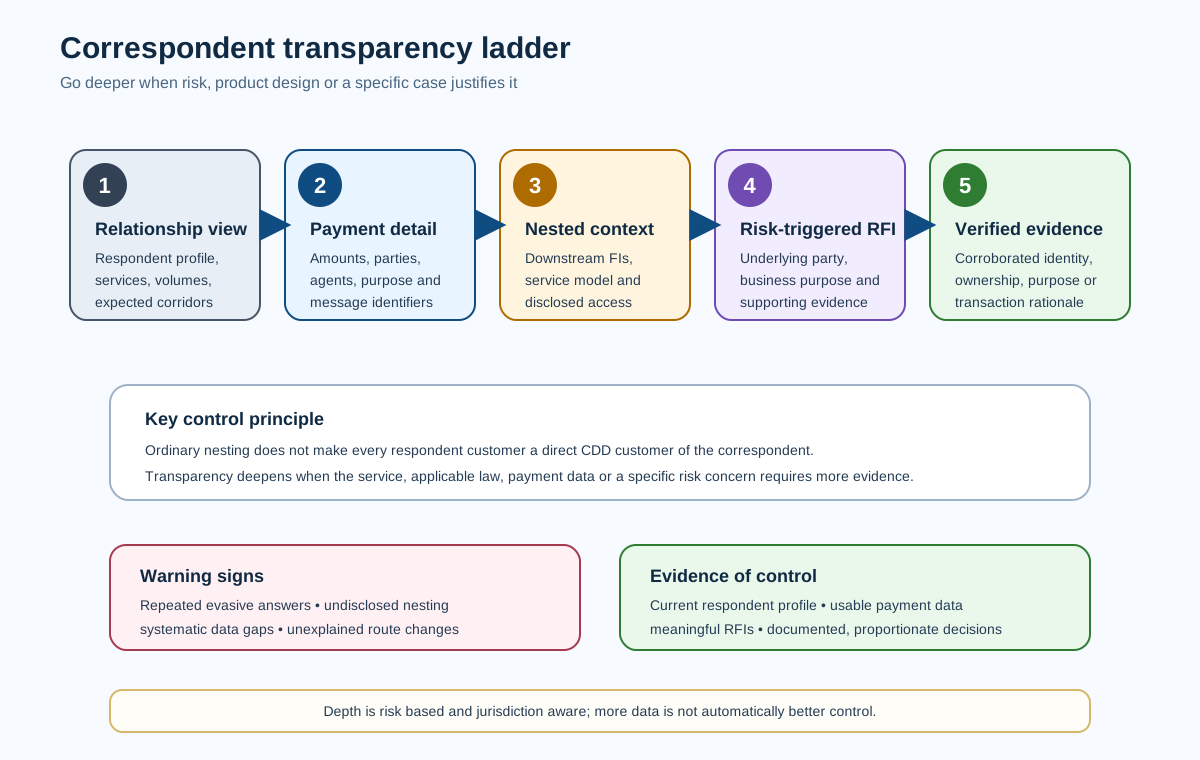
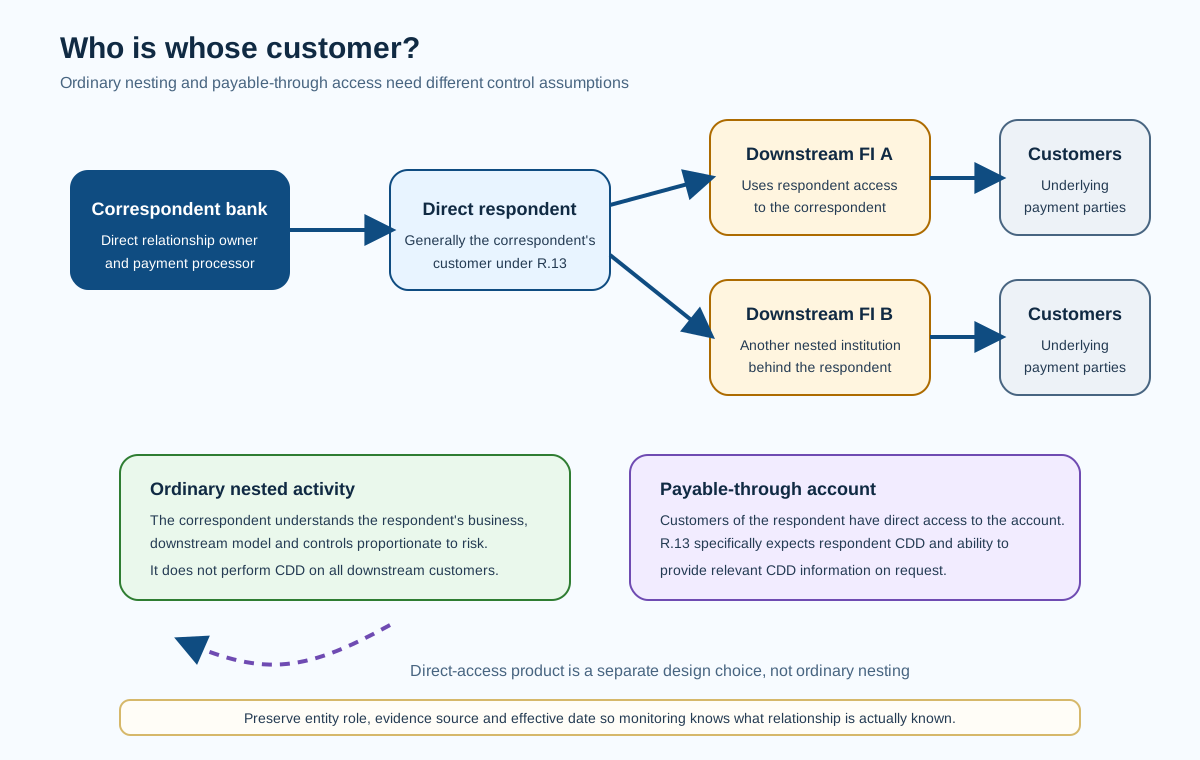
Nested activity does not convert every downstream customer into a direct customer of the correspondent. FATF's 2016 correspondent-banking guidance specifically cautions against automatically applying customer due diligence to every customer of a respondent. The correspondent instead needs a risk-based understanding of the respondent's business and customer base, including the nature and extent of downstream or nested relationships where relevant. Transaction-level or underlying-customer information may be needed when the risk profile, a specific alert, payable-through access, sanctions exposure, an information request or local law makes it necessary. Wolfsberg's Correspondent Banking Principles and CBDDQ provide practical industry mechanisms for collecting and assessing this information, while the Basel Committee embeds correspondent-banking risk within broader bank ML/TF risk management.
Supervisory testing can therefore focus on whether a bank's documented risk model is translated into evidence: whether due diligence is refreshed when risk changes, whether the institution knows when respondents offer nested or downstream services, whether payment-data defects are measured, whether requests for information are answered meaningfully, and whether escalation or restriction occurs when the correspondent cannot obtain enough information to manage the risk. The exact examination approach varies by jurisdiction. For example, the FFIEC BSA/AML Manual sets out U.S.-specific requirements for correspondent accounts maintained for foreign financial institutions and includes examination procedures for nested relationships under 31 CFR 1010.610. Those U.S. requirements should not be presented as a universal global rule.
Shell-bank and shell-branch prohibitions
FATF Recommendation 13 calls on financial institutions not to enter into or continue correspondent banking relationships with shell banks and to satisfy themselves that respondent institutions do not permit their accounts to be used by shell banks. Domestic and regional legal frameworks implement that principle in different ways. In the United States, for example, 31 CFR 1010.630 expressly prohibits covered U.S. correspondent accounts for foreign shell banks and requires reasonable steps to prevent indirect access through foreign respondents. Other jurisdictions may implement the FATF baseline through different legislation, regulation or supervisory rules, so a bank must map the obligation to the legal entity and jurisdiction actually involved.
Shell-bank analysis is about substance, not simply geography. The relevant FATF concept concerns a bank with no physical presence in the country in which it is incorporated and licensed, and which is unaffiliated with a regulated financial group subject to effective consolidated supervision. A branch in an offshore centre is not automatically a shell bank. The bank should verify licence status, physical presence, affiliation, supervision and any other facts required by applicable law or policy rather than using location as a proxy. Ongoing monitoring also matters because ownership, licensing, group affiliation or operating substance can change after onboarding.
Concentration risk in correspondent portfolios
Correspondent portfolios concentrate risk where single respondents dominate nested volumes behind diversification assumptions that respondent-count metrics support falsely while ultimate-party clustering tells different stories about actual exposure distribution. Concentration measurement examines respondent-volume shares with nested-population estimates revealing whether diversification exists at ultimate-party level or merely at respondent level behind which correlated exposures accumulate invisibly. Single-respondent dependency creates operational fragility where termination, failure or enforcement action against dominant respondents strands legitimate nested customers without alternative channels while criminal targets displace preemptively through closure-tipoff leakage that phased contingency planning contains through pre-arranged backup corridors.
Limit frameworks cap respondent concentrations with nested-adjusted thresholds tightening automatically where opacity multipliers elevate effective exposure beyond nominal volumes that unadjusted limits govern inadequately. Diversification strategies develop alternative respondents per corridor with onboarding pipelines maintained continuously rather than initiated after dominant-relationship failure forces emergency replacement under unfavourable commercial terms. Stress testing models respondent-failure scenarios with nested-customer impact quantification informing contingency adequacy that theoretical backup arrangements assert without tested activation procedures the stress exercises validate authentically through simulated transition drills.
Sanctions screening across nested flows
Nested correspondent flows create a sanctions challenge because the correspondent may not have the same customer-level information as the respondent. Screening responsibilities therefore need to be designed around the parties and data that the bank actually receives, the sanctions regimes that apply to the bank, the payment rail and the institution's role in the chain. A respondent's control environment is relevant to due diligence, but a correspondent should not assume that every nested customer must be identified and screened by the correspondent in every ordinary transaction. Where payment messages expose originators, beneficiaries, financial institutions or other parties, those data elements can be screened in accordance with applicable sanctions requirements and policy; where a specific risk concern arises, the bank may need additional underlying-party information before it can decide whether to process, reject, block, hold or escalate.
Ownership and control analysis also needs programme-specific legal interpretation. Different sanctions regimes use different ownership, aggregation and control tests, and some restrictions depend on sector, activity, goods, services, currency or jurisdictional nexus rather than list status alone. An indirect link to a designated person is therefore a reason for investigation, not an automatic legal conclusion. Screening-timing design should preserve enough information and escalation time for sanctions specialists to determine applicability while respecting payment-system cutoffs and applicable legal obligations. Performance measurement can track data completeness, true-match quality, decision timeliness and respondent cooperation without conflating those operational metrics with the legal test for whether a transaction is prohibited.
Opaque respondent flows: seeing through aggregation
Respondent payment flows arrive aggregated behind respondent totals that originator monitoring cannot decompose without transparency cooperation respondents provide variably across corridors, customer types and institutional quality. Flow-transparency assessment examines respondent reporting granularity with transaction-level detail distinguishing genuine transparency from aggregate summaries concealing ultimate-originator identities behind respondent-customer codes that originator systems cannot resolve independently. Volume-concentration analysis identifies respondent-customer clusters dominating flows with nested-pattern review distinguishing legitimate aggregation businesses from layering conduits that respondent books shelter behind commercial confidentiality claims examinations override routinely with pattern evidence.
Purpose-visibility testing probes whether respondent flows carry intelligible commercial rationale with corridor-purpose coherence, amount-distribution plausibility and timing-pattern analysis that legitimate nested activity supports through documentation while criminal transit offers only respondent assurances unsupported by underlying evidence originator banks cannot obtain without respondent cooperation that opacity serves by withholding strategically. Response calibration matches transparency-gap severity with information requests specifying ultimate-originator details, enhanced monitoring with transaction-level data mandates, volume constraints pending transparency improvement and relationship consequences where gaps persist despite remediation commitments that correspondent patience exhausts eventually behind repeated assurance cycles producing documentation without substance.
Aggregates conceal; transaction detail reveals; ultimate identities decide — escalate each cooperation grade accordingly.
Metric-governance reform for correspondent measurement
Correspondent metrics need governance preventing the measurement pathologies that volume-based reporting creates systematically across relationship management optimising respondent counts and flow values while nested visibility decays invisibly behind flattering aggregates. Metric-design standards require transparency dimensions with completeness scoring, nested-identification coverage and corridor-governance maturity weighted alongside commercial metrics that revenue reporting emphasises exclusively while control outcomes go unmeasured and therefore unmanaged. Change control for metrics demands coverage-impact analysis paralleling scenario-tuning governance, since measurement modifications alter relationship-manager behaviour as directly as detection-logic changes alter alert populations while receiving far less scrutiny from governance bodies treating metrics as reporting rather than control infrastructure.
Gaming-detection analytics monitor metric health continuously with transparency-gaming patterns — respondent-provided data accepted without verification, corridor risks understated to preserve volumes, nested populations undercounted to flatter coverage — exposing measurement exploitation that aggregate reporting conceals behind healthy totals. Audit coverage of metric design tests gaming resistance with red-team respondent-behaviour simulation probing whether rational relationship managers could inflate reported transparency while degrading actual visibility, findings driving metric redesign where exploitation proves feasible rather than assuming goodwill prevents gaming that compensation mathematics actively rewards. Leadership accountability attaches metric-health outcomes to responsible executives with performance consequences for measurement decay that governance tolerated, preventing future commercial-driven metric erosion where revenue arguments override transparency evidence without documented risk acceptance retrospective review would condemn specifically.
Benchmarking nested oversight across institutions
Internal nested-oversight metrics gain meaning through peer comparison distinguishing institution-specific failures from industry-wide challenges that shared opacity structures impose on all originator banks simultaneously behind respondent aggregation practices no single institution controls unilaterally. Benchmark participation pools anonymised transparency-completeness rates, nested-identification coverage statistics and corridor-governance maturity scores with privacy-preserving aggregation preventing competitive-exposure concerns that bilateral sharing would trigger immediately while enabling honest performance comparison that internal metrics cannot provide without external reference. Metric standardisation ensures comparable measurement across divergent counting methodologies, without which benchmarking compares definitions rather than effectiveness while participants draw false comfort or alarm from artefactual differences methodology review would expose as incomparable before strategic decisions rely upon them destructively.
Benchmark interpretation segments peers by correspondent-footprint composition with nested-heavy, corridor-concentrated and diversified cohorts compared separately rather than universal rankings punishing specialised business models for segment-appropriate performance profiles that diversified peers achieve through volume effects rather than superior controls. Persistent underperformance against relevant peers triggers deep-dive analysis with process-level comparison identifying specific transparency practices that targeted reform addresses efficiently, while outperformance validation confirms genuine excellence rather than lenient self-measurement that re-baselining exposes through methodology review. Benchmark data strengthens internal business cases for transparency-technology investment and specialist staffing with external evidence that finance committees respect more than operational assertions dismissed as self-serving budget advocacy lacking independent corroboration that benchmarking supplies authoritatively.
Industry utility models for correspondent transparency
Industry utilities promise shared transparency infrastructure where pooled respondent data, standardised assessments and collective monitoring reduce duplicated diligence costs while improving nested visibility beyond what bilateral arrangements achieve independently behind competitive confidentiality that data pooling overcomes structurally. Utility-governance design balances participant representation with independent management preventing dominant-member capture where large correspondents steer utility priorities toward their commercial interests while smaller respondents bear disproportionate compliance burdens. Data-contribution obligations mandate standardised respondent transparency inputs with quality enforcement ensuring utility databases reflect verified information rather than self-reported assurances that contributor optimism inflates systematically without validation mechanisms.
Utility-effectiveness measurement tracks transparency improvements attributable to shared infrastructure with before-after comparison on participating corridors, cost-benefit analysis quantifying diligence savings against membership fees, and coverage statistics proving nested visibility gains that bilateral due diligence never achieved despite decades of correspondent effort consuming equivalent resources without pooled infrastructure. Adoption barriers include competitive sensitivity around respondent-portfolio disclosure, liability allocation for utility-data errors that participant decisions rely upon, and governance-trust deficits where rival institutions doubt neutral administration that independent utility operators must demonstrate continuously through transparent methodology and equitable cost-sharing. Strategic assessment weighs utility participation against bilateral-investment alternatives with honestly modelled returns rather than assuming shared infrastructure outperforms dedicated capability without institution-specific analysis.
Nested relationships: customers behind customers
Nested structures can layer financial institutions and other customers behind a direct respondent, so the correspondent's visibility depends on the service model and the data made available. Ordinary nested correspondent activity, payable-through accounts and sponsored or embedded-finance arrangements should not be treated as identical. FATF Recommendation 13 contains specific expectations for payable-through accounts: the correspondent should be satisfied that the respondent has performed customer due diligence on customers having direct access to the correspondent's accounts and that the respondent can provide relevant CDD information on request. That is a more specific standard than ordinary nested activity and should not be generalised into a rule that the correspondent must perform CDD on every customer of every respondent.
Nested-correspondent chains can increase opacity with each downstream layer, so a bank may set risk-based limits, information requirements or approval conditions based on its risk appetite, the respondent's controls and local regulatory expectations. Fintech-sponsored access can introduce end-customer populations through banking-as-a-service arrangements where the correspondent should understand the respondent's business model and control framework sufficiently to assess the risk it is accepting. Sampling, contractual information rights and enhanced review can be useful tools, but they are control choices that should be tied to the specific product, risk and legal framework rather than described as globally mandatory in every case.
High-risk corridor assessment for correspondent routes
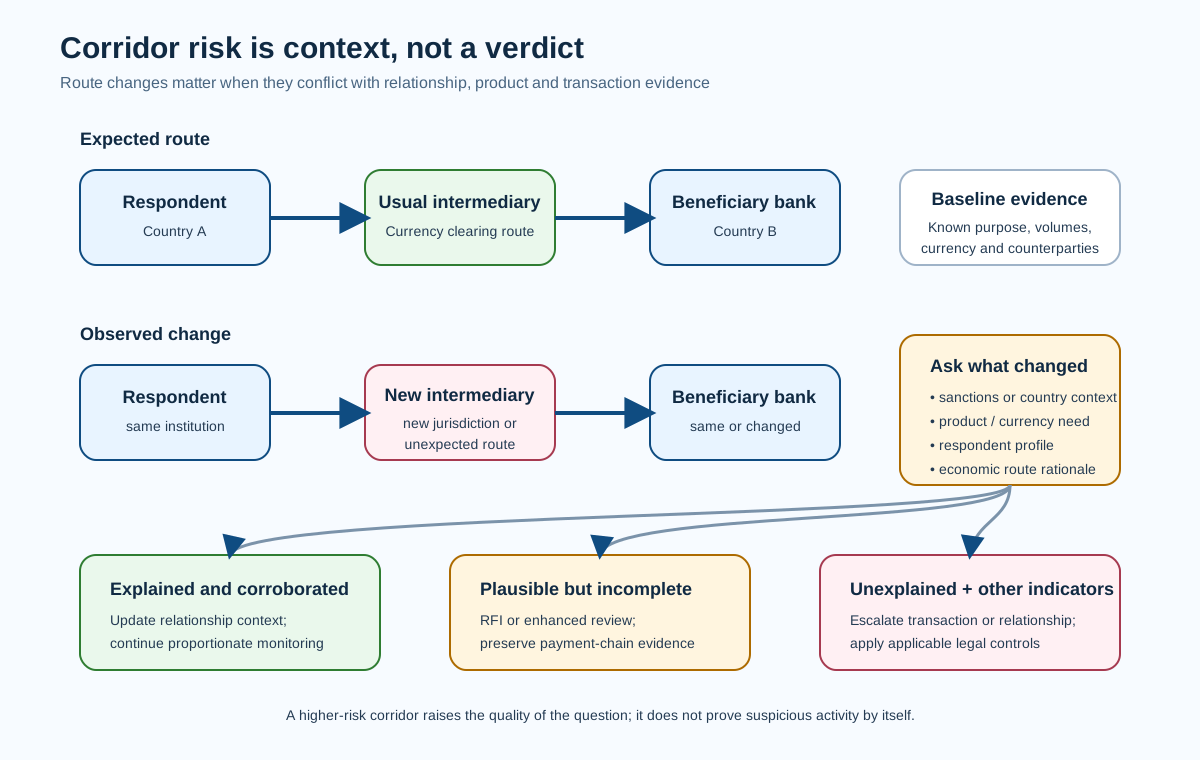
Correspondent corridors concentrate typology risks where jurisdiction combinations, product characteristics and customer mixes create abuse opportunities that route-level assessment must evaluate independently of respondent-specific review that corridor patterns transcend systematically. Corridor-risk rating combines jurisdiction typology concentrations with sanctions-programme overlays, corruption-prevalence measures and predicate-crime intelligence that monitoring consumes for risk-weighted alerting calibrated to route realities rather than global averages diluting corridor-specific dangers into portfolio means. Product-corridor interaction analysis examines how corridor risks manifest differently across payment types with cash-intensive corridors, trade-finance routes and virtual-asset on-ramps each carrying distinct abuse mechanics that uniform corridor ratings miss while product-specific assessment captures accurately.
Route-selection monitoring tracks corridor-choice rationale with commercial-justification demands where circuitous routing lacks economic logic that direct alternatives would serve more efficiently, flagging jurisdiction-shopping patterns that opacity-seeking flows exhibit characteristically behind cost or speed narratives failing basic scrutiny. Corridor-volume analytics establish route norms with deviation detection flagging sudden shifts indicating respondent-portfolio changes, criminal displacement from pressured routes or emerging typology concentrations that transparency updates should have communicated proactively rather than discovered through downstream analysis months later. Response calibration matches corridor-risk evidence with enhanced monitoring, volume constraints and exit decisions sequenced by risk severity rather than reflexive de-risking that legitimate corridor commerce would suffer unfairly while criminal flows migrate to less scrupulous correspondents.
Jurisdiction overlays, product interactions, route justification, volume vigilance — corridors assessed independently of the parties travelling them.
Missing originator details and transparency gaps
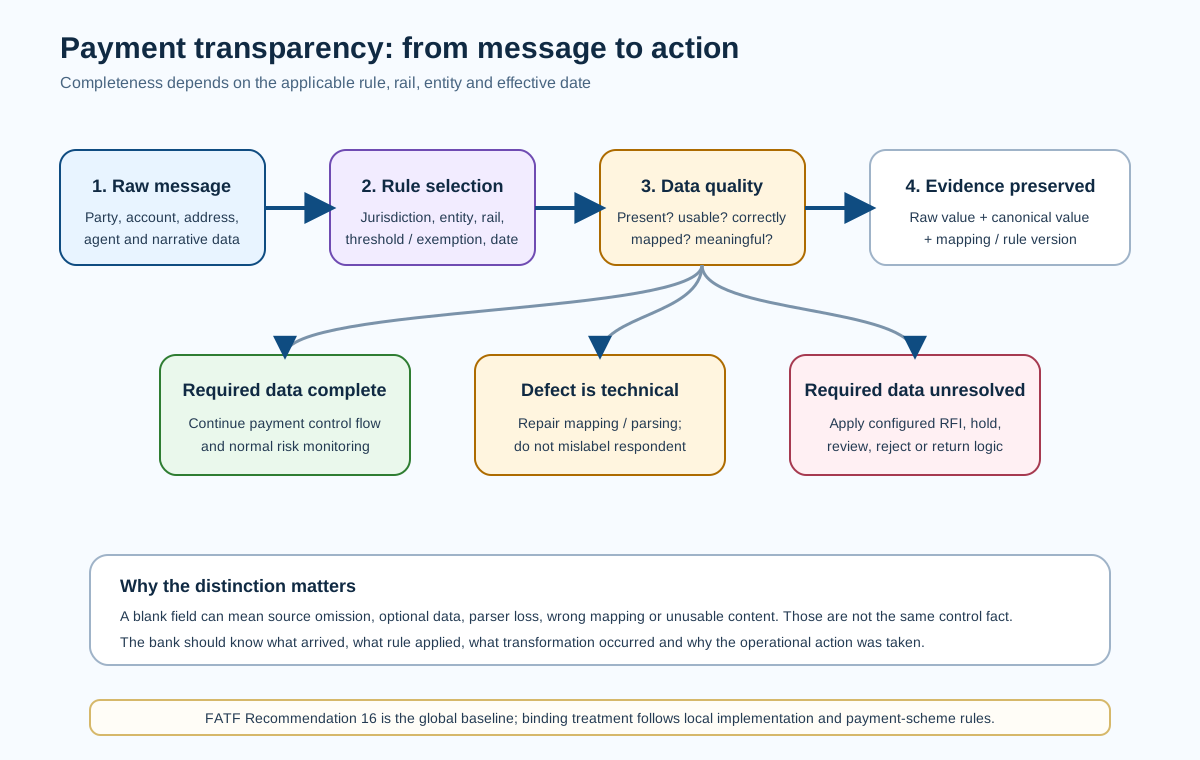
Originator-information completeness determines whether a correspondent payment carries enough information for the institutions in the chain to perform the checks required of them. FATF Recommendation 16 provides the international payment-transparency standard, but jurisdictions implement that standard through domestic or regional law and scheme rules, so the exact mandatory data fields, thresholds, exemptions, rejection or suspension expectations and record-keeping duties are not identical everywhere. FATF revised Recommendation 16 in June 2025 to reflect modern payment models and messaging standards. FATF stated in June 2026 that countries are expected to be ready to implement the strengthened changes by the end of 2030, so banks should distinguish the revised FATF standard from rules already legally effective in a particular jurisdiction today.
Completeness testing can examine whether required originator and beneficiary information is present, usable and consistently mapped. A name field containing filler text, a truncated address, an account identifier placed in the wrong element or a respondent-customer code that prevents meaningful identification can weaken screening, monitoring and investigation even where a message technically passes schema validation. Gap-pattern analysis is especially useful because systematic omissions concentrated in one respondent, corridor, product or customer segment may indicate a mapping defect, an operational practice or deliberate opacity. The correct response depends on the cause and applicable rule: repair a technical mapping problem, request missing information, apply a risk-based hold or review, reject or return where required, or escalate the respondent relationship if deficiencies persist.
Transparency-gap escalation follows graduated paths with information requests specifying missing elements and remediation timeframes, enhanced monitoring with transaction-level scrutiny compensating for opacity pending improvement, volume constraints limiting exposure where gaps persist despite engagement, and relationship exit where transparency failures indicate fundamental control incompatibility that continued processing would endorse implicitly through commercial tolerance. Regulatory-notification obligations for material transparency deficiencies vary by jurisdiction, so legal and compliance teams should map notification and reporting duties rather than assume one universal outcome. Documentation preserves gap evidence with trend analysis proving deterioration or improvement trajectories that relationship decisions reference explicitly.
Payable-through and nested-account structures
Payable-through accounts deserve separate treatment from ordinary nested correspondent banking because customers of the respondent can have direct access to the correspondent account. Under FATF Recommendation 13, the correspondent should be satisfied that the respondent has performed CDD on customers with direct access and that the respondent can provide relevant CDD information on request. Local law may impose additional or differently framed requirements. System design should therefore be able to attribute activity to the relevant downstream customer where the product requires it, preserve the information needed for monitoring and investigation, and support information requests without assuming that every ordinary nested relationship must expose identical data in real time.
Risk-concentration analysis can examine payable-through portfolios with customer clustering identifying high-risk concentrations that respondent-level review averages across benign majorities. Activity-pattern monitoring can use the downstream information actually available under the arrangement, while information gaps become an explicit risk factor. Exit mechanics should consider lawful contractual notice, sanctions or law-enforcement restrictions, tipping-off rules, operational continuity and potential impacts on legitimate customers. The decision is not simply "nested equals exit"; it is whether the bank can understand and control the risk of the service within its legal obligations and risk appetite.
Downstream distribution and layering detection
Correspondent debits distribute into beneficiary networks with layering patterns that downstream-distribution analysis detects through aggregation logic designed specifically for nested opacity that single-transaction review never penetrates regardless of analytical sophistication applied to isolated payments. Distribution-mapping traces correspondent outflows into ultimate-beneficiary clusters with concentration scoring flagging payout points serving supposedly unrelated beneficiaries behind respondent aggregation that direct-distribution analysis would expose immediately through shared-endpoint visibility. Timing-correlation analysis connects distribution bursts to upstream respondent credits with velocity assessment distinguishing legitimate settlement batches from layering operations fragmenting value across multiple ultimate recipients evading single-transaction thresholds systematically.
Beneficiary-network analysis examines downstream counterparties for shared infrastructure, coordinated timing and behavioural uniformity indicating organised collection behind nominally independent receipts that respondent books record separately without linkage analysis originator banks must perform independently. Layering-confirmation methodology assembles distribution evidence with counterparty-cycle analysis, amount-preservation measurement and timing-regularity testing into coordinated-activity assessments that balance false-positive costs against network-detection value through calibrated thresholds reviewed periodically as typologies evolve. Response coordination with respondent banks shares downstream findings with evidence packages enabling respondent-side investigation while preserving originator independence in disposition decisions that respondent commercial interests might influence inappropriately through relationship pressure applied opaquely behind cooperation rhetoric.
Respondent risk assessment and tiering
Respondent institutions warrant risk assessment with tiering that monitoring intensity, transparency requirements and volume tolerances follow proportionally rather than uniform correspondent treatment that high-risk respondents exploit through leniency calibrated to benign majorities. Assessment dimensions span respondent control-framework maturity with independent validation of monitoring effectiveness rather than contractual assurance acceptance, nested-customer standards with onboarding and ongoing-review adequacy testing, corridor-risk concentrations with route-level exposure quantification, and cooperation quality measured through information-request responsiveness, transparency-improvement trajectories and incident-handling effectiveness that past performance predicts more reliably than policy documentation promising future diligence hopefully.
Tiering mechanics assign respondents to standard, enhanced and restricted tiers with monitoring intensity, data requirements and approval authorities scaled per tier and review triggers ensuring tier currency as respondent risk evolves through portfolio changes, control developments and external intelligence that static tiering would miss while relationships transform materially behind outdated classifications. Tier-migration protocols handle upgrades with enhanced-requirement scope and timeframes preventing prolonged elevated-risk operation under standard monitoring, alongside downgrades following sustained transparency and control improvements with verification depth proving genuine enhancement rather than review-fatigue leniency. Tier-distribution monitoring tracks portfolio concentrations preventing over-reliance on high-risk respondents whose collective exposure exceeds institutional appetite regardless of individual-relationship profitability that business-line advocacy emphasises while control functions assess aggregate risk.
References and further reading
- Financial Action Task Force (FATF), The FATF Recommendations, current consolidated version: https://www.fatf-gafi.org/en/publications/Fatfrecommendations/Fatf-recommendations.html
- Financial Action Task Force (FATF), Guidance on Correspondent Banking Services: https://www.fatf-gafi.org/content/dam/fatf-gafi/guidance/Guidance-Correspondent-Banking-Services.pdf
- Financial Action Task Force (FATF), Explanatory note for revised Recommendation 16: https://www.fatf-gafi.org/content/dam/fatf-gafi/recommendations/Explanatory%20Note%20for%20Revised%20R.16.pdf.coredownload.pdf
- Financial Action Task Force (FATF), 2026 consultation on guidance for strengthened Recommendation 16: https://www.fatf-gafi.org/en/publications/Fatfrecommendations/R16-Public-Consultation-June-2026.html
- Basel Committee on Banking Supervision, Anti-money laundering and counter-terrorist financing, consolidated guidelines including correspondent banking: https://www.bis.org/committees/bcbs/basel-consolidated-guidelines/module/afs/10
- Wolfsberg Group, Correspondent Banking and Payments resources, including the 2022 Principles and 2023 CBDDQ materials: https://wolfsberg-group.org/resources/correspondent-banking
- Committee on Payments and Market Infrastructures, Correspondent banking, final report: https://www.bis.org/publications/correspondent-banking-final-report
- FFIEC, Due Diligence Programs for Correspondent Accounts for Foreign Financial Institutions (U.S.-specific): https://bsaaml.ffiec.gov/manual/AssessingComplianceWithBSARegulatoryRequirements/10
- FFIEC, Prohibition on Correspondent Accounts for Foreign Shell Banks (U.S.-specific): https://bsaaml.ffiec.gov/manual/AssessingComplianceWithBSARegulatoryRequirements/12
Operational deep dive: transparency measurement, nested quantification and originator forensics
The base chapter established correspondent red-flag disciplines. This deep dive covers the measurement machinery beneath them: transparency scoring grading respondent cooperation, nested-risk quantification pricing opacity exposure, and originator-data forensics distinguishing technical gaps from wilful concealment.
Sanctions-overlay analytics for nested flows
Nested correspondent flows need sanctions-overlay analytics distinguishing restriction-relevant patterns from benign aggregation with programme-specific logic that behaviour-only monitoring misses while list matching on immediate parties can provide an incomplete view where relevant underlying parties are not visible in the payment data. Overlay design can map sanctioned jurisdictions, listed entities, ownership or control relationships and sector or activity restrictions against the data available to the bank. An indirect connection is a risk signal requiring legal and sanctions analysis, not an automatic conclusion that a prohibition applies. Ownership, aggregation, control, facilitation and sectoral rules differ across sanctions regimes, so the applicable programme, jurisdictional nexus and facts must be established before an operational disposition is made.
Overlay-performance measurement tracks sanctions-relevant detection rates with typology attribution distinguishing genuine restriction hits from false-positive noise that broad adjacency rules generate without calibrated boundaries the bank documents explicitly. Reviewer workflows for overlay flags combine sanctions-specialist assessment with nested-investigation context ensuring restriction decisions rest on legal applicability analysis rather than pattern resemblance alone that behaviour-focused reviewers might over-interpret without sanctions expertise. Feedback integration consumes designation-event outcomes with overlay-logic updates reflecting programme evolution that static adjacency rules miss as sanctions regimes transform continuously around frozen analytical assumptions.
Reviewer-assignment optimisation for nested complexity
Case assignment determines whether capable reviewers meet consequential nested patterns with routing logic matching complexity to demonstrated correspondent expertise rather than round-robin distribution treating all reviewers as interchangeable while layered structures suffer under junior examination. Complexity scoring per alert combines nesting depth, cross-border dimensions, instrument sophistication and network-linkage presence into assignment tiers directing senior specialists toward demanding work while standard alerts flow to trained generalists with escalation paths where initial assessment underestimates difficulty. Assignment-quality measurement tracks outcome differentials across routing methods with randomised comparisons distinguishing genuine expertise effects from selection artefacts that observational analysis confounds systematically without controlled design.
Workload-balancing constraints prevent expertise concentration from overloading specialists while generalists idle on simple queues, requiring dynamic rebalancing with complexity-weighted capacity accounting rather than raw case counts that equal distribution mistreats systematically against difficulty distributions skewed heavily toward small specialist cohorts. Reviewer-development rotation exposes generalists to complex nested cases under supervision building future specialist capacity, while specialist rotation through standard work prevents expertise narrowing where prolonged complex-case focus normalises extreme patterns into accepted baselines that cross-trained reviewers would question immediately upon fresh exposure. Assignment-governance reviews routing effectiveness with missed-risk analysis by assignment path, ensuring optimisation serves detection outcomes rather than administrative convenience that static assignment rules provide while threat complexity evolves around frozen routing assumptions.
Machine-assisted nested analysis with human authority
Machine assistance accelerates nested analysis through entity-resolution automation, pattern-visualisation generation and linkage-scoring computation that reviewers verify rather than author from scratch, each carrying quality risks where automation errors propagate into dispositions faster than human detection catches them systematically under throughput pressure incentivising minimal verification. Pre-computed linkage validation samples machine-assembled networks for accuracy scoring with gap analysis identifying systematic omissions that reviewer over-reliance would miss while trusting automation outputs uncritically. Usage monitoring tracks acceptance rates distinguishing healthy productivity gains from automation dependence where reviewers stop examining linkage evidence behind machine-generated networks they approve routinely without verification the time savings originally justified adequately.
Governance for assisted nested analysis parallels human-reviewer oversight with precision, fairness and coverage evidence reviewed for automated components alongside human performance metrics integrated into unified quality pictures. Bias testing examines machine-assembled networks across demographic segments with disparity investigation where automation reproduces historical enforcement patterns embedded in training data behind mathematical objectivity claims. Reviewer training builds automation literacy with limitation awareness preventing over-trust that vendor demonstrations encourage while production limitations emerge only through operational experience the training must honestly convey rather than marketing optimism that deployment reality contradicts expensively behind failed expectations and degraded dispositions.
Reviewer-assignment optimisation for nested complexity determines whether capable reviewers meet consequential patterns with routing logic matching complexity to demonstrated correspondent expertise rather than round-robin distribution treating all reviewers as interchangeable while layered structures suffer under junior examination. Complexity scoring per alert combines nesting depth, cross-border dimensions and network-linkage presence into assignment tiers directing senior specialists toward demanding work while standard alerts flow to trained generalists with escalation paths where initial assessment underestimates difficulty. Assignment-governance reviews routing effectiveness with missed-risk analysis by assignment path ensuring optimisation serves detection outcomes rather than administrative convenience static rules provide while threats evolve.
Nested-entity resolution at portfolio scale
Entity resolution across nested populations links ultimate parties behind respondent aggregation with match-confidence scoring distinguishing strong evidentiary links from coincidental overlaps that aggressive resolution would allege routinely against legitimate communities sharing employers, corridors and cultural practices. Resolution methodology combines deterministic matching on high-quality identifiers where respondent data provides them with probabilistic linkage on behavioural attributes — transaction timing, counterparty overlap, device sharing — where identifier poverty forces inferential approaches carrying documented uncertainty that disposition decisions must respect through proportionate evidence standards. False-merge analysis measures erroneous linkage rates with sampled verification distinguishing systematic resolution defects from acceptable residual error that manual review corrects through exception handling without invalidating automated resolution at portfolio scale.
Resolution-governance reviews linkage quality with precision measurement on confirmed-network samples, fairness analysis across demographic segments where resolution errors concentrate disproportionately on populations with common-name density and shared-infrastructure patterns, and privacy-impact assessment ensuring linkage depth respects data-minimisation principles that indiscriminate graph-building violates while investigative value concentrates in high-risk segments warranting intensive resolution. Technology investments in resolution tooling balance commercial platforms against in-house development with total-cost analysis including calibration maintenance that vendor solutions require continuously behind licence fees procurement evaluates narrowly without operational-effectiveness integration.
Behavioural profiling of respondent institutions
Respondent behaviour profiling detects control deterioration and risk transformation behind stable aggregate volumes that respondent-level metrics report reassuringly while nested realities shift materially beneath unchanging totals. Profiling dimensions track transparency-responsiveness trends with request-fulfilment rates and data-quality trajectories revealing cooperation decay preceding relationship failure, volume-composition shifts indicating portfolio changes that transparency updates should have communicated proactively, and incident-pattern analysis connecting respondent operational events to downstream risk implications that originator monitoring must assess independently rather than accepting respondent characterisations uncritically. Each dimension needs baseline establishment with deviation triggers activating enhanced review where behaviour breaks from historical norms without documented explanation that legitimate transformation would provide readily.
Comparative respondent benchmarking positions individual respondents against peer cohorts with similar corridors, volumes and customer types, distinguishing institution-specific deterioration from market-wide shifts that sector developments explain collectively without respondent-specific concern. Benchmarking methodology controls for portfolio composition ensuring apples-to-apples comparison that crude volume metrics invalidate systematically across heterogeneous respondent populations. Outlier investigation follows benchmarking flags with root-cause analysis separating genuine control failures from data artefacts and business-model differences that benign explanations resolve efficiently without adversarial escalation damaging cooperative relationships unnecessarily while genuine concerns receive the intensive scrutiny deteriorating respondents warrant before incidents force retrospective reckoning.
Transparency scoring grading respondent cooperation
Transparency measurement converts qualitative cooperation impressions into governed scores with dimension-level assessment that relationship advocacy cannot inflate through narrative optimism unsupported by evidence. Dimension design spans data completeness with ultimate-originator coverage ratios measured against nested-population estimates, timeliness with information-request responsiveness tracked against agreed service levels, quality with accuracy verification sampling respondent-provided details against independent sources, and proactivity with voluntary disclosure frequency distinguishing cooperative partners from minimally compliant respondents meeting letter requirements while withholding spirit cooperation that genuine transparency demands. Each dimension needs documented scoring rubrics with evidence thresholds preventing impressionistic grading that relationship managers inflate systematically for commercially important respondents whose opacity tolerance serves revenue rather than control.
Score aggregation weights dimensions by risk relevance with completeness dominating where nested opacity concentrates exposure while timeliness matters most where interdiction clocks constrain review windows that delayed transparency renders moot regardless of eventual data quality. Trend analysis tracks transparency trajectories distinguishing improving respondents deserving continued engagement from deteriorating ones where cooperation decay signals control abandonment preceding relationship failure that proactive exit would manage better than reactive termination after incidents force retrospective reckoning. Score governance reviews methodology with respondent-appeal mechanisms where grading disputes arise, ensuring measurement fairness that unilateral scoring would undermine through perceived arbitrariness damaging the cooperative relationships transparency programmes need most from borderline respondents weighing improvement investment against relationship value.
Nested-risk quantification pricing opacity exposure
Nested opacity carries quantifiable exposure that risk pricing should reflect through premium structures, capital allocation and limit frameworks treating transparency as a risk factor alongside credit and market dimensions that traditional pricing models already incorporate routinely. Quantification methodology estimates nested-population sizes with confidence intervals acknowledging respondent-data limitations, applies opacity multipliers reflecting verification impossibility where ultimate parties remain unknown, and aggregates across correspondent portfolios with concentration adjustments where single respondents dominate nested exposure behind diversification assumptions that respondent-count metrics falsely support while ultimate-party clustering tells different stories. Each quantification element needs documented assumptions with sensitivity analysis showing how opacity-premium conclusions vary under alternative transparency scenarios that governance stress-tests periodically.
Pricing integration translates opacity quantification into respondent fees with transparency-differentiated schedules rewarding cooperative respondents through preferential terms while opaque relationships carry premiums funding enhanced monitoring, or into volume constraints where pricing cannot compensate for verification impossibility that no premium renders acceptable regardless of commercial attractiveness. Limit frameworks cap nested exposure by respondent tier with opacity-adjusted thresholds tightening automatically where transparency scores deteriorate, preventing limit adequacy assessed under cooperative assumptions from governing deteriorated relationships whose actual opacity exceeds approved parameters silently. Governance reporting presents opacity-pricing outcomes with revenue-impact transparency ensuring commercial functions understand transparency economics rather than perceiving compliance-driven pricing as arbitrary burden that business development circumvents through exception requests governance must evaluate sceptically.
Originator-data forensics distinguishing gaps from concealment
Missing originator information stems from technical failures, process gaps and deliberate concealment in proportions that forensic analysis must separate before prescribing remediation that mismatched causes render ineffective while true problems persist uncorrected behind wrong-category treatment. Technical-gap forensics examines message-format truncations with field-length analysis identifying systematic cutoffs, character-encoding failures corrupting non-Latin scripts into filler entries, and system-migration artefacts where platform changes dropped historical data elements that reconciliation testing should have caught before production cutover. Process-gap forensics traces manual-handling breaks where operations staff omit fields under time pressure, training deficiencies where requirements never reached front-line awareness, and oversight failures where quality sampling excluded originator completeness from review scope that design assumed covered without verification.
Concealment-pattern forensics identifies deliberate opacity through selective omission correlating with risk indicators — high-risk corridors missing originators disproportionately, sanctioned-adjacent parties appearing as coded references, nested customers systematically anonymised behind respondent abbreviations that legitimate privacy never requires. Statistical testing distinguishes concealment from random technical failure through omission-rate analysis by risk segment with significant correlations triggering enhanced investigation rather than technical remediation that wilful opacity would absorb cosmetically while continuing unchanged behind fixed systems. Response calibration matches forensic conclusions with technical fixes for system gaps, training and oversight reform for process failures, and enforcement escalation for concealment patterns that respondent explanations cannot justify credibly under evidence-weighted scrutiny.
Advanced practice: turning correspondent risk into an operating control
A correspondent-banking control becomes useful only when relationship knowledge, payment data, investigation workflow and governance decisions meet in the same operating model. It is easy to write a policy saying that nested activity, high-risk corridors or incomplete payment data require enhanced attention. The harder question is how a bank represents those facts in systems, how it knows when something has changed, how an alert reaches the right analyst with enough context, and how the institution records a defensible decision without pretending that it knows more about the respondent's customers than it actually does.
This section translates the chapter into delivery practice for business analysts, architects, data teams, product owners, operations and control functions. It deliberately separates international standards from implementation choices. FATF Recommendation 13 sets a baseline for cross-border correspondent banking, while local law and supervisory expectations determine the binding obligations for a particular legal entity. Wolfsberg tools such as the CBDDQ can support due diligence, but they do not replace the bank's own assessment. A well-designed solution therefore needs configurable policy and jurisdiction layers rather than one global rule hard-coded into every payment flow.
Model the relationship before modelling the alert
The first architectural mistake is to treat correspondent risk as a transaction-only problem. A payment cannot be interpreted properly unless the system knows which institution is the direct respondent, what services the bank has agreed to provide, which legal entity owns the relationship, which currencies and corridors are expected, whether the respondent offers downstream correspondent services, whether a payable-through arrangement exists, and what the bank learned during onboarding and subsequent reviews.
A practical relationship model should preserve at least the respondent institution, legal-entity identifier or other stable identifier where available, booking entity, account or service relationship, permitted products, currencies, expected geographies, expected customer types, material downstream or nested services disclosed by the respondent, payable-through status where relevant, risk classification, approval authority, review dates, information-rights terms and effective dates. The exact fields depend on the bank's products and legal requirements, but the design principle is consistent: monitoring needs time-valid relationship context, not a static profile overwritten whenever a review changes an answer.
Effective dating matters because investigators often look backwards. Suppose a respondent disclosed no nested relationships in January, introduced a downstream institution in April, notified the correspondent in June and an unusual payment occurred in May. If the system stores only the latest answer, a reviewer examining the May payment may incorrectly assume the June disclosure was already known. The relationship store should therefore retain the previous state, the new state, the source of the change, when the respondent said it became effective and when the correspondent learned of it. That distinction between event time, effective time and knowledge time is particularly important when reconstructing whether controls operated on the information actually available at the time.
The same principle applies to risk ratings. A respondent moving from standard to enhanced oversight should not erase the earlier rating. Monitoring, case management and audit teams need to know which rating drove the decision on the transaction date, which facts later caused the change, and whether retrospective review is warranted. This is not merely an audit convenience. It prevents current knowledge from being projected backwards into past decisions and makes model validation more credible.
Represent nested activity without pretending every downstream party is a customer
The data model should distinguish the correspondent's direct customer from downstream institutions and underlying parties. FATF guidance is clear that the respondent institution is generally the correspondent's customer. Ordinary nested activity does not automatically make every customer of the respondent a direct customer of the correspondent. The model should therefore preserve relationship type and evidentiary status instead of flattening every name into a generic customer table that implies a legal relationship which does not exist.
A useful structure can represent a direct respondent relationship, a disclosed downstream institution, a payable-through customer where the product provides direct access, and an underlying payment party as different entity roles. Each link should carry a source: respondent questionnaire, contractual disclosure, transaction message, request-for-information response, public registry, screening result or investigation finding. Confidence and verification status are also useful because an analyst should be able to distinguish a respondent-provided assertion from independently corroborated evidence.
This matters operationally. A downstream institution named in a respondent questionnaire may be known as part of the respondent's business model but may never appear explicitly in a payment message. Conversely, an intermediary institution can appear in a payment message without being a nested customer of the respondent. Treating those situations as equivalent produces bad analytics and weak legal reasoning. The system should preserve what relationship is actually known, how it is known and at what point in time.
Payable-through accounts need an explicit service flag rather than being inferred from transaction volume. FATF Recommendation 13 places specific expectations on arrangements where customers of the respondent have direct access to the correspondent account. If a bank offers such a product, the control architecture should make the service type visible to due diligence, monitoring, case management and periodic review. That visibility allows the bank to test whether the respondent has performed the required customer due diligence and can provide relevant CDD information on request, without turning those product-specific expectations into a universal rule for every nested correspondent relationship.
Build a payment view that preserves the chain
The payment layer should preserve the parties and institutions available in the message rather than collapsing them into a payer-payee pair. Depending on the rail and message format, the bank may receive debtor, creditor, ultimate debtor, ultimate creditor, debtor agent, creditor agent, intermediary agents, instructing and instructed agents, account identifiers, addresses, remittance information, purpose codes and payment identifiers. Legacy messages may expose less structure or use narrative fields. ISO 20022 can provide richer structured data, but richer schemas do not guarantee good data quality.
For correspondent monitoring, the useful question is: what did this bank actually receive and what should it reasonably have expected to receive under the applicable payment-transparency framework and scheme rules? The answer varies by payment type, jurisdiction and implementation date. The platform should therefore store both the raw inbound message and a canonical representation used for analytics. The raw message supports legal reconstruction and mapping diagnosis. The canonical layer supports cross-format monitoring. Losing either one weakens investigation.
Mapping lineage should be testable from source field to canonical field to screening or monitoring decision. If an originator address is truncated, the analyst should be able to determine whether it arrived truncated from the respondent, was shortened by an intermediary, or was lost during internal transformation. Without that lineage, a relationship team can wrongly blame a respondent for an internal mapping defect, while a technology team can wrongly dismiss a deliberate upstream omission as a parser problem.
A good canonical model also preserves null reason and quality status where possible. originatorAddress = null tells little. Was the field absent in the source message? Was it not required for that payment? Did validation fail? Was the value present only in unstructured narrative? Was it suppressed by a transformation rule? These distinctions make data-quality analytics more useful and prevent monitoring teams from treating every missing field as the same risk condition.
Separate relationship controls, transaction controls and legal decisions
Correspondent risk spans several control layers that should exchange evidence without collapsing into one decision engine. Relationship due diligence asks whether the bank understands the respondent and can manage the relationship. Payment screening asks whether parties or data elements create a sanctions or other list-based concern under applicable rules. Transaction monitoring asks whether behaviour is inconsistent, unusual or potentially suspicious. Payment-transparency controls assess required data completeness. Fraud controls may identify scam or account-takeover indicators. Legal or sanctions specialists determine whether a prohibition or licence condition applies. AML investigators determine whether facts support escalation or suspicious-activity reporting under the relevant legal framework.
These decisions can influence one another, but the system should preserve their boundaries. For example, a high-risk corridor can increase monitoring sensitivity without proving that a payment is suspicious. A sanctions-adjacent ownership link can require specialist analysis without automatically establishing that funds must be blocked. An incomplete originator field can trigger repair or investigation without necessarily requiring rejection in every jurisdiction. A respondent's poor cooperation can affect relationship risk even where an individual payment is otherwise explainable.
From an architecture perspective, that means each control should produce a typed outcome with reason codes, evidence references, timestamps and responsible function. Downstream workflows can then use those outcomes without overwriting their meaning. A sanctions potential_match should not become an AML suspicious = true flag merely because both are financial-crime controls. Likewise, a transaction-monitoring alert closure should not release a sanctions hold unless the sanctions workflow has independently reached an authorised disposition.
Make corridor risk contextual rather than deterministic
Corridor risk is valuable when it changes the questions a bank asks, not when it becomes a substitute for evidence. A corridor model can combine country risk, sanctions exposure, known typologies, respondent concentration, product type, expected trade or remittance patterns and the bank's own historical experience. The output can influence review frequency, monitoring thresholds, information requirements or approval level. It should not automatically classify every payment through a higher-risk route as suspicious.
The model also needs versioning. Country and sanctions contexts change. A corridor considered ordinary today may become more sensitive after a designation, conflict, regulatory notice or typology update. Conversely, a country may improve its AML/CFT framework or leave a FATF increased-monitoring list. If corridor risk is stored only as the latest score, investigators cannot explain why a transaction was treated differently six months earlier.
Route analysis should distinguish unusual routing from legitimate payment-chain complexity. Correspondent payments can take indirect paths because of currency access, clearing arrangements, liquidity, cut-off times, commercial relationships or technical reachability. A circuitous route becomes interesting when it lacks a credible economic or operational explanation, changes unexpectedly, avoids an institution or jurisdiction that would normally be used, or appears together with other indicators such as opaque parties or inconsistent payment purpose. Analysts need the expected-route context before any deviation score has meaning.
For a BA, an important acceptance criterion is therefore not simply system flags high-risk corridors. It is that the system records the factors contributing to the corridor assessment, uses the correct version for the transaction date, distinguishes corridor risk from transaction suspicion, and exposes enough explanation for a reviewer to understand why the alert was generated.
Design the RFI workflow as part of the control, not an email side process
Requests for information are central to correspondent investigations because the respondent often holds customer-level evidence that the correspondent does not. If RFIs are managed through individual mailboxes, the bank loses structured evidence about what was asked, what was answered, how long it took and whether the answer resolved the concern. That weakens both individual cases and relationship-level assessment.
A controlled RFI workflow should link the request to the payment, alert or case; identify the respondent and relationship owner; capture the specific information requested; record legal or confidentiality constraints where relevant; store response due dates; preserve all responses and attachments; and record whether the answer was complete, partial, contradictory or non-responsive. It should also show who assessed the response and how it affected the decision.
The quality of the question matters. Please explain the transaction invites a generic answer. A stronger risk-based question might ask for the business purpose, relationship between originator and beneficiary, source of funds, underlying invoice, downstream institution involved or explanation for a change in routing. The system can provide structured question categories while allowing investigators to tailor requests to the facts. Templates should accelerate good analysis, not replace it.
Relationship analytics can then use RFI history as evidence. Repeated late responses, incomplete answers, unexplained inconsistencies or improvement after remediation can inform the respondent's cooperation assessment. The measurement must remain fair: a complex request may reasonably take longer than a simple data clarification, and legal restrictions can constrain what a respondent is permitted to share. Timeliness should therefore be interpreted with request type and applicable law, not scored mechanically.
Define escalation states that reflect what the bank can actually do
A correspondent case can result in several different outcomes: no concern after review, request for more information, enhanced monitoring, relationship review, payment repair, payment hold under an applicable control, sanctions specialist referral, AML investigation, restriction of a product or corridor, senior risk acceptance, external reporting where legally required, or relationship exit. The available actions depend on legal authority, payment status and operating model.
The workflow should not force every alert through the same linear ladder. A confirmed sanctions prohibition may require immediate action under applicable law. A persistent respondent-transparency problem may need relationship governance rather than transaction-level investigation. An unusual but explainable payment may close without changing the relationship. A cluster of individually small alerts may justify a respondent-level thematic review even when no single transaction is decisive.
Decision states should therefore be typed and reversible where appropriate. A temporary awaiting respondent information state differs from a legal blocked outcome. A relationship restriction proposed state differs from relationship terminated. Clear state semantics are essential for operations, customer communication and regulatory reporting. Vague labels such as high risk or failed invite different interpretations across teams.
Evidence retention should link each material decision to the information available at the time. That includes relationship profile, relevant message data, screening or monitoring output, investigator notes, RFI responses, external-source checks and approvals. The purpose is not to create an enormous case file for every alert. It is to make the reasoning reconstructable when the decision materially affects a payment, customer or relationship.
BA requirements for correspondent transparency
A strong requirement starts with the decision the bank needs to make and the evidence required to make it. Consider the weak statement: The system shall monitor nested activity. It does not define what counts as nested, which data source identifies it, how the bank handles undisclosed nesting, what behaviour matters, who reviews an alert or what outcome is possible.
A better requirement would identify the direct respondent, disclosed downstream institutions and payable-through service status as distinct relationship attributes; retain effective dates and evidence source; correlate those attributes with payment-chain data; and generate a review when behaviour materially exceeds the approved downstream model or when the system detects a downstream institution not represented in the current relationship profile. Acceptance criteria would include known legitimate nesting, undisclosed-nesting scenarios, false matches, relationship changes, incomplete message data and historical replay using the correct relationship version.
Another weak requirement is Reject payments with missing originator data. That may be wrong because the applicable obligation depends on payment type, jurisdiction, threshold, exemption, scheme rule and implementation status. A better requirement is to determine the applicable payment-transparency rule for the processing entity and rail, validate the required elements, preserve the deficiency reason, apply the configured repair, hold, reject, return or review action, and record which rule version drove the outcome. Legal and scheme specialists should own the rule interpretation; technology should implement versioned configuration and evidence.
Requirements for sanctions-related nested exposure should also avoid universal percentage or control rules. The system should identify relevant direct and indirect relationships, retain ownership and control data with source and effective date, and route potential exposure to the legal or sanctions policy applicable to the processing entity. The disposition engine should not assume that the same ownership threshold, aggregation test or control concept applies to every sanctions regime.
Architecture pattern for a correspondent-risk service
A scalable architecture can separate the relationship master, payment event store, reference data, risk analytics and case management while using stable identifiers to connect them. The relationship master owns respondent and service context. The payment event store preserves raw and canonical message data. Reference services provide sanctions lists, country risk, legal-entity data and other governed data sets. Analytics detect behavioural, transparency and corridor anomalies. Case management brings the evidence together for human decision and records outcomes.
Event-driven integration is useful when relationship changes need to affect monitoring quickly. A respondent-risk upgrade, new downstream disclosure, sanctions-list change or material RFI failure can publish an event that causes relevant controls to refresh. However, event-driven design does not remove the need for replay. If a new risk fact is learned today, the bank may need to identify historical transactions affected by that information. Stores should therefore support time-bounded retrospective queries rather than only forward processing.
Data lineage and observability deserve first-class treatment. A monitoring service should expose which source fields fed a feature, which rule or model version generated the alert, which reference-data version was used and whether upstream feeds were complete. If a payment parser drops an intermediary-agent field for six hours, operations should not discover the gap weeks later through an investigation. Control-health monitoring should detect failed feeds, stale reference data, unusual drops in populated fields and sudden changes in alert volumes.
Resilience design also needs business-defined fallback. If a respondent-risk enrichment service is unavailable, should payments continue without the enrichment, queue temporarily, receive a reduced control, or stop? There is no universal answer. The decision depends on the legal requirement, rail, settlement deadline, risk appetite and availability of alternative controls. The fallback must be agreed in advance, tested, observable and recorded rather than invented during an outage.
Test the data and decision path, not just the alert rule
Testing correspondent controls should start before scenario logic. First verify the relationship data: direct respondent, legal entity, service type, downstream disclosure, payable-through flag, risk tier, expected corridors and effective dates. Then verify payment ingestion: parties, agents, identifiers, addresses, remittance and purpose fields. Then test enrichment and analytics. Finally test case workflow and disposition.
Positive tests should use synthetic or governed historical examples where the expected result is known. Examples include a newly observed downstream institution inconsistent with the respondent profile, a sudden route shift into a materially different corridor, a systematic payment-data gap from one respondent, and a cluster of transfers that aggregate into a downstream beneficiary network inconsistent with stated business. The expected result should specify not merely alert created but which evidence appears in the case and which team receives it.
Negative tests are equally important. A disclosed nested institution with stable expected activity should not be treated as suspicious merely because it is nested. A legitimate route change caused by a new clearing arrangement should be explainable without permanent adverse treatment once the relationship profile is updated. A technically optional payment field should not trigger the same deficiency handling as a legally required field. A common company name should not merge unrelated downstream parties without sufficient entity-resolution evidence.
Temporal tests catch problems ordinary functional testing misses. Change a respondent's risk tier on day 10 and replay a day-5 payment: the system should use the day-5 state unless the review is explicitly retrospective. Add a downstream relationship effective on day 7 but notified on day 12: the case should be able to distinguish effective date from knowledge date. Update a sanctions list and confirm that the screening service uses the new version prospectively while preserving the list version used for historical decisions.
Failure-mode tests should simulate missing feeds, duplicated payment events, delayed RFI responses, stale country-risk data, unavailable case-management integration and partial message parsing. The expected behaviour should be explicit. A control that works only when every upstream service is healthy is not a production-ready control.
Measure effectiveness without turning metrics into substitutes for judgement
Correspondent dashboards often over-emphasise counts: number of respondents reviewed, number of alerts, number of RFIs and number of exits. Those figures describe workload, not necessarily control effectiveness. Useful measures ask whether the bank is gaining or losing visibility and whether important risks are acted on.
Examples include the proportion of payments with required data complete under the relevant rule, repeat deficiencies by respondent, material downstream relationships recorded before they appear in unusual activity, RFI responses that actually resolve the question, ageing of unresolved higher-risk cases, alert outcomes by respondent and corridor, and control failures caused by data or integration defects. False-positive and missed-risk analysis should feed tuning and training rather than being used simply to reward lower alert volumes.
Metrics also need context. A rise in RFIs could mean deteriorating respondent transparency, a newly introduced control, or better investigator practice. A fall in alerts could mean risk reduction or a broken feed. Governance packs should therefore connect the number to the cause and to an action. Senior management needs to know not only that data completeness is 96 per cent, for example, but what the remaining four per cent represents, whether it is concentrated in a risky respondent or product, and what the bank is doing about it. The percentage itself should not become a universal target detached from legal requirements and risk.
Restriction and exit: control decisions with real customer consequences
Restriction or exit can be necessary when the bank cannot understand or manage a relationship, when legal prohibitions apply, when required remediation fails or when the exposure lies outside approved risk appetite. But the decision should not be treated as a routine final step in every enhanced review. FATF's risk-based approach and the FCA's current de-risking guidance both reinforce the importance of distinguishing individual relationship risk from broad-category assumptions.
Operational planning matters because correspondent changes affect more than the respondent bank. Lawful remittances, trade payments, payrolls and other services can depend on the corridor. Where law and risk allow a managed transition, the bank should understand outstanding payments, settlement positions, contractual notice, customer communication, data retention, pending investigations and any confidentiality or tipping-off constraints. Where law requires immediate action, those transition considerations cannot override the legal duty, but the institution should still manage the operational consequences within what the law permits.
Post-exit monitoring should be targeted and lawful. A bank may use historical evidence to identify attempts to recreate the same risky structure through a connected institution or changed route, subject to retention, privacy and information-sharing rules. It should not assume that every institution serving former downstream customers is suspicious by association. Network evidence remains evidence to investigate, not guilt transferred through proximity.
Delivery principle: preserve uncertainty honestly
Correspondent banking is an information-asymmetry business. The correspondent will often know less about an underlying customer than the respondent does. Good control design does not pretend to eliminate that asymmetry. It makes the uncertainty visible, asks for more information where risk justifies it, records the quality of the answer and escalates when the remaining uncertainty is no longer acceptable.
That principle should be visible in the data model, case interface and governance language. Unknown, respondent-provided, independently verified, not applicable and not required under this rule are different states. Collapsing them into blank fields creates false certainty. Likewise, an alert should show which fact is observed and which conclusion is inferred. A reviewer who can see that distinction is better equipped to challenge weak assumptions, protect legitimate activity and escalate genuine risk.
For a BA or architect, this is the strongest test of the solution: can the bank reconstruct what it knew about the respondent and payment at the time, identify which rule and control version applied, see why the system raised or did not raise concern, obtain additional evidence through a governed workflow, and demonstrate who made the final decision? If the answer is yes, the technology is supporting a defensible correspondent-banking control. If the answer depends on undocumented emails, overwritten profiles or analyst memory, the control remains fragile regardless of how sophisticated the detection model appears.
Practice close: requirements, testing and operational assurance
The chapter becomes useful in delivery when its concepts can be translated into requirements that are testable without turning risk indicators into rigid universal rules. Correspondent banking is especially vulnerable to vague requirements because phrases such as “monitor nested activity” or “check high-risk corridors” can appear complete while leaving every important implementation decision unresolved. A good BA, product owner or architect should be able to trace each requirement back to a decision the bank must make, the data needed for that decision, the legal or policy owner of the rule and the evidence that proves the control worked.
Start with the service boundary
Before writing a monitoring requirement, establish which correspondent service is in scope. Ordinary cross-border correspondent payments, payable-through accounts, clearing, liquidity services, trade-related services and respondent relationships supporting downstream institutions can create different information and control needs. The first acceptance condition should therefore confirm that the system knows the direct respondent, the bank legal entity providing the service, the account or service type, relevant currencies and the relationship state in effect on the transaction date.
A test should then confirm that those attributes reach monitoring and case management without manual re-entry. If the relationship team changes the respondent's service profile, risk classification or disclosed nested model, the change should carry an effective date and source. Historical transactions should remain linked to the relationship context that existed when they were processed. This protects later investigations from the common error of interpreting an old payment using today's customer profile.
For ordinary nested correspondent activity, the requirement should not assume that every downstream party is a direct customer of the correspondent. Instead, it should specify what the bank needs to know about material downstream services, what information it expects from the respondent, and what conditions trigger deeper transaction or underlying-party review. For payable-through accounts, the product configuration should expose that direct-access model clearly because FATF Recommendation 13 contains specific expectations for the respondent's CDD and ability to provide relevant customer information on request.
Write transparency requirements around the applicable rule
Payment-data requirements need a rule source and version. Originator name mandatory is incomplete unless the BA can identify the payment type, processing entity, jurisdiction, threshold or exemption where relevant, scheme or regulatory rule and effective date. FATF Recommendation 16 provides an international baseline, but local implementation and scheme rules determine the binding treatment of a specific payment.
A better requirement states that the platform identifies the applicable payment-transparency rule, validates the elements required under that rule, records the deficiency type and invokes the configured operational response. That response might be repair, request for information, review, reject, return or another action depending on the rail and legal framework. The rule owner should be legal, compliance or payment-scheme policy; technology implements the decision table and keeps the version history.
Testing should cover genuine missing data, blank or filler values, values present in the wrong field, truncation, structured versus unstructured addresses, transliteration and character-set issues, and a message that is fully compliant but unusual. The last case is important: data completeness and suspicion are different questions. A complete payment can still be suspicious, while an incomplete payment can result from a technical mapping problem rather than financial crime.
The test evidence should show both the raw inbound field and the canonical field consumed by screening or monitoring. If the canonical value is wrong, the tester needs to know whether the defect entered at source, translation, enrichment or downstream presentation. Merely checking that an alert was produced is not enough.
Test nested activity as a relationship-to-payment comparison
A useful nested-activity scenario compares what the relationship says should happen with what payment flows show. Suppose the respondent has disclosed that it provides services to two downstream banks in specified currencies and corridors. Synthetic test data can introduce a third financial institution whose transactions begin appearing consistently through the respondent. The expected outcome might be a review of the relationship and underlying activity, not an automatic criminal classification.
The case presented to the analyst should include the direct respondent, the apparent downstream institution, transaction dates and values, corridor, relevant message parties, relationship disclosures and reason the activity is inconsistent with the current profile. The reviewer should be able to request additional information and record whether the explanation changes the relationship profile, resolves the alert or creates grounds for further investigation.
A negative test should show a disclosed downstream institution transacting within its expected service model. The system should not generate adverse treatment merely because nesting exists. Another negative test can use a new institution whose apparent presence is caused by an internal entity-resolution false match. The control should support identity resolution and correction rather than allowing one weak match to propagate into the respondent's risk record.
Undisclosed nesting also needs temporal testing. If the respondent notifies the correspondent after the underlying arrangement began, the system should preserve both the effective date of the downstream relationship and the date the correspondent learned of it. This distinction lets investigators identify transactions occurring before notification without falsely claiming the bank knew the fact earlier.
Test corridor logic with legitimate explanations as well as risk
Corridor tests should challenge the assumption that indirect routing is inherently suspicious. Build one scenario where a respondent shifts payments through a new intermediary because a clearing relationship changed, and another where routing changes repeatedly without a plausible operational or economic reason while other risk indicators increase. Both may look unusual at first, but only the second should remain unexplained after relationship evidence is considered.
Acceptance criteria should require the alert to display the corridor factors actually used: jurisdictions, product, respondent profile, route history and relevant risk attributes. A generic high-risk country label is not enough. The reviewer needs to know whether risk came from sanctions exposure, known typologies, unusual route selection, respondent concentration or another governed factor.
Version testing is again essential. Change a country-risk assessment or sanctions context and confirm that new transactions use the new version while historical decisions retain the old one. A retrospective review, if policy requires one, should be a deliberate workflow rather than a side effect of silently overwriting reference data.
Test the RFI workflow as evidence management
The request-for-information process should be tested like a control application, not like an email template. Create a case where the analyst asks the respondent for the business purpose, relationship between parties and underlying documentation. The test should confirm that the request is linked to the payment and case, has an owner and due date, preserves the exact question, stores the response and attachments, and records whether the answer was complete.
Then test partial and contradictory responses. A respondent may answer the commercial-purpose question but omit the underlying-party information that created the concern. The case should remain open for the unresolved issue rather than appearing complete because an email was received. Conversely, a clear and corroborated answer should allow proportionate closure without forcing additional escalation simply because the relationship is rated higher risk.
Testing should also cover lawful information constraints. A respondent may be unable to share a particular category of information because of local law or confidentiality restrictions. The workflow should allow that fact to be recorded and escalated for legal or relationship assessment rather than labelling the respondent automatically uncooperative. The central question becomes whether the correspondent can still manage the relationship with the information lawfully available.
Preserve decision boundaries in end-to-end tests
One end-to-end scenario should deliberately generate several different control outcomes on the same payment. For example, transaction monitoring may identify unusual nested activity, sanctions screening may create a potential name match, and payment-data controls may detect an address-quality issue. The case architecture should preserve all three outcomes separately.
The sanctions potential match should route to sanctions review under the applicable regime. The transaction-monitoring alert should retain its behavioural rationale. The data-quality issue should identify the field and rule involved. Clearing one outcome should not overwrite the others. If sanctions specialists determine that the name is a false match, the AML alert can still remain open because unusual behaviour may require investigation independently of sanctions.
This is an important testing principle for architects and developers. Financial-crime controls share data, but they do not share identical legal decision logic. A single financialCrimeStatus field is rarely sufficient for a mature bank because it obscures why a transaction is held, released, reported or investigated.
Use synthetic and governed historical data for assurance
Testing should not create unexplained suspicious-looking activity in live customer accounts simply to prove that monitoring works. Synthetic transactions, controlled test accounts and governed replay of historical data provide safer ways to validate detection. Where historical cases are used, access, privacy, retention and masking requirements should be agreed with the appropriate data and compliance owners.
A good synthetic test pack includes clear true-positive patterns, legitimate lookalikes and ambiguous cases. For nested correspondent monitoring, that can include rapid downstream dispersal, repeated use of a small beneficiary network across apparently unrelated underlying parties, systematic originator-data degradation, sudden route changes and a respondent whose RFI answers do not match observed flows. Legitimate comparators can include payroll aggregation, remittance batching, disclosed downstream clearing and seasonal trade flows.
The purpose is not to teach the system that every recurring pattern is criminal. It is to prove that the alert contains enough context for a competent reviewer to distinguish the two. Testing should therefore assess evidence quality as well as trigger accuracy.
Failure-mode testing matters as much as positive detection
A correspondent control can fail quietly when an upstream service is stale rather than unavailable. Simulate a reference-data feed that stops refreshing but continues returning old data. Simulate a payment parser that suddenly stops populating one intermediary field. Simulate duplicate event delivery and delayed relationship updates. Simulate the case system being unavailable while payment processing continues.
For each failure, the bank should have a defined response. That may be automatic retry, queueing, reduced functionality, operational alert, manual review or stopping a specific process where legal or risk requirements make degraded operation unacceptable. The fallback decision belongs to the business and control owners; technology should make the degradation visible and auditable.
Observability tests should confirm that control-health dashboards identify unexpected drops in field population, stale list versions, failed enrichment calls and unusual changes in alert volume. A monitoring engine that produces no alerts because its input feed failed can look deceptively healthy unless the bank measures the inputs as well as the outputs.
Reviewer testing should assess reasoning, not memorised outcomes
Analyst calibration can use anonymised historical cases and synthetic scenarios with known evidence. Reviewers should be scored not only on whether they selected the expected outcome but on whether they distinguished observed facts from assumptions, considered plausible alternative explanations, identified missing information and escalated to the correct specialist where necessary.
A reviewer who closes a legitimate case for the wrong reason has not demonstrated reliable judgement. Likewise, a reviewer who escalates every nested relationship may appear cautious but is not applying a risk-based approach. Calibration should therefore include benign nesting, difficult but legitimate cross-border activity and cases where the correct answer is that more information is needed.
The bank can use those results to target coaching and case assignment. Complex cases may be routed to experienced correspondent specialists, but the routing logic should remain transparent and reviewable. Tenure alone is not proof of judgement quality, and automated complexity scores should not become an unchallengeable gate.
Acceptance criteria for a production-ready correspondent control
By the time a feature is ready for release, a test team should be able to demonstrate several things together. The correct respondent and relationship version are attached to the transaction. Material downstream or payable-through information is represented with the right relationship type. Payment parties and institutions can be traced from the raw message into the canonical model. The applicable payment-transparency rule and version are identifiable. Corridor and respondent risk factors are explainable. Alerts show the evidence that generated them. RFIs are linked to cases and responses are assessed rather than merely received. Sanctions, AML, data-quality and relationship decisions remain distinct. Audit logs show who changed configuration and when. Failure modes generate visible operational responses.
The release should also demonstrate negative behaviour: legitimate disclosed nesting does not trigger automatic suspicion, an optional field is not treated as a mandatory deficiency, a false entity match can be corrected, and a route change with a corroborated business explanation can be resolved proportionately. These negative tests are often where weak designs fail because teams spend more time proving that the system can stop activity than proving it can avoid unnecessary customer harm.
Operational readiness after deployment
Production readiness continues after the code is released. Operations need clear ownership for alert queues, RFIs, sanctions referrals, relationship escalations and technical defects. Service-level measures should distinguish time-sensitive legal or payment decisions from longer relationship reviews. Backlogs should be visible by risk, not just count.
The relationship team needs a feedback mechanism when investigations reveal that the respondent profile is outdated. Monitoring needs feedback when an alert pattern repeatedly produces explainable activity. Technology needs defect feedback when missing data originates in mapping or integration rather than the respondent. Governance needs to see where those loops are failing.
A practical post-implementation review can compare the first months of production against design assumptions: which respondents generated the most alerts, which data fields caused the most defects, how often RFIs resolved cases, whether higher-risk corridors behaved as expected, and whether analysts received enough context. The aim is controlled learning, not immediate threshold reduction simply because alert volumes are higher than forecast.
The final test is simple: when a reviewer opens a correspondent alert, can they understand the relationship, the payment chain, the risk reason, the data quality, the applicable control context and the evidence still missing without calling several teams to reconstruct the story manually? If they can, the design is helping the bank manage correspondent risk. If they cannot, the control may be technically implemented but operationally incomplete.
Masterclass: layering behind nested totals
This masterclass traces a composite case where nested correspondent flows concealed systematic layering for three years behind clean respondent aggregates, assembled from recurrent industry patterns. Figures are illustrative and the scenario is not presented as a specific enforcement case. The mechanics — aggregate trust, transparency-request deflection, downstream discovery and structural remediation — recur wherever correspondent monitoring accepts respondent totals without sufficient risk-based visibility into underlying activity.
Clean totals concealing criminal contents
The respondent, a mid-sized bank in a high-risk corridor, processed monthly volumes growing steadily with aggregate patterns matching legitimate regional trade finance that correspondent monitoring reviewed at totals level without transaction-detail penetration the relationship agreement permitted theoretically but operational practice never exercised. Underlying flows layered criminal proceeds through nested customer accounts with round-amount distributions to shared beneficiaries, timing regularity indicating scripted operations and originator details systematically coded behind respondent-customer references that transparency requests would later reveal as deliberate anonymisation rather than technical limitation. Reviewers cleared aggregate patterns quarterly with commentary noting growth consistency while nested reality diverged completely from respondent-level appearances that monitoring scope never penetrated by design limitation nobody questioned while volumes performed reassuringly.
Transparency requests arrived sporadically from correspondent compliance with generic ultimate-beneficiary inquiries that respondent operations answered with aggregate reassurances lacking transaction-level substance, each exchange documented as cooperation while delivering no verifiable detail that analytical review could test independently. Request-quality governance never examined whether responses actually answered questions posed, allowing procedural compliance — timely replies in professional tone — to substitute for substantive transparency that content analysis would have exposed as inadequate. The relationship continued for three years behind this dialogue of the deaf where both sides performed oversight rituals without exchanging the information oversight fundamentally requires, each institution's files demonstrating diligent engagement while criminal layering proceeded undisturbed through the channels oversight claimed to govern.
Downstream discovery and structural remediation
Discovery arrived through a law-enforcement inquiry about beneficiary accounts whose respondent-aggregated origins the correspondent had never examined individually, forcing downstream-distribution analysis that reconstructed three years of layering behind clean monthly totals within weeks using techniques available throughout the blind period but never applied because aggregate monitoring satisfied governance reporting without transaction-detail investment that cost discipline had rejected as disproportionate to respondent-risk ratings calibrated optimistically at onboarding and never revised despite volume growth transforming the relationship's risk profile fundamentally.
Remediation imposed transaction-level transparency for defined higher-risk activity, stronger nested-customer understanding, payment-data quality controls and corridor-risk reassessment reflecting typology concentrations the case exposed beyond original ratings. The respondent relationship moved to enhanced-requirements probation rather than immediate termination because the institution could obtain enough information and cooperation to manage the risk under a documented remediation plan. That outcome is deliberately risk based: another bank, legal framework or fact pattern might require restriction, reporting, suspension or exit sooner. FATF and Basel standards do not prescribe one universal remediation sequence for every nested relationship, and local law, sanctions obligations, supervisory expectations and the seriousness of the facts remain decisive.
Victim-impact accounting beyond bank exposure
Nested-layering harm extends beyond correspondent risk into legitimate nested customers whose accounts featured as transit conduits without owner knowledge, with small businesses and individuals potentially affected when restrictions introduced after discovery interrupt lawful commerce alongside criminal activity. Impact assessment should document livelihood disruption, payment delays, reputational effects and the cost of moving to alternative banking channels, while avoiding the assumption that every downstream customer is culpable merely because it sits inside a problematic respondent relationship.
Responsibility analysis distinguishes correspondent due-diligence or monitoring weaknesses from respondent deception and from downstream-customer misconduct. Where legal frameworks provide redress, reimbursement or complaint routes, those processes should be applied according to the relevant jurisdiction and product rather than assumed to exist globally. Criminal proceeds may also become subject to restraint, freezing, confiscation or law-enforcement action, but those outcomes depend on competent-authority powers, court processes and applicable law. The operational lesson is to preserve enough payment, relationship and investigation evidence to support whichever route becomes legally relevant.
Cost anatomy of aggregate trust
Financial accounting for three-year undetected layering extends beyond investigation and remediation expenditure into foregone interdiction opportunities where timely transparency demands might have reduced exposure earlier. Prevention-value analysis can compare transparency-technology investment — nested-analytics tooling, ultimate-party resolution systems, completeness-monitoring automation — against incident and remediation costs. The model should use the bank's own evidence and assumptions rather than inventing universal return multiples, because the economics vary materially by correspondent footprint, data quality, corridor mix and existing control maturity.
Reform-investment accounting tracks remediation expenditure with benefit realisation through transparency-completeness improvement, nested-identification coverage expansion and corridor-governance maturation. Cultural-change costs include retrospective review of analyst concerns, onboarding-curriculum redevelopment embedding healthy scepticism and leadership credibility rebuilding where commercial priorities previously outweighed control evidence. Those softer changes matter because technology cannot compensate for a governance culture that repeatedly accepts weak explanations from profitable respondents.
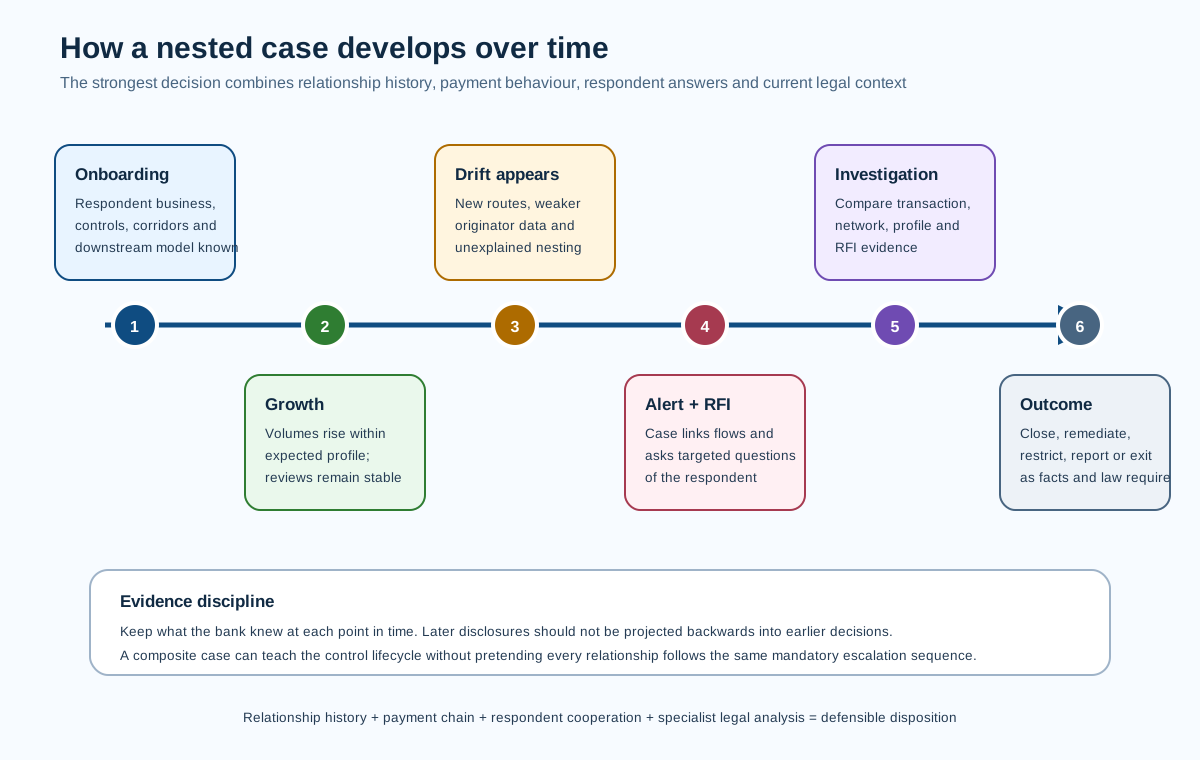
Staff accountability without scapegoating
Post-incident accountability should distinguish process-design responsibility from individual execution failures with review outcomes reflecting genuine culpability gradients rather than uniform blame across differently situated staff. Aggregate-trust procedures that management designed and approved cannot fairly ground individual reviewer discipline where staff executed flawed processes faithfully while design accountability sat with leadership that approved insufficient visibility or repeatedly rejected proportionate enhancements despite documented concerns.
Whistleblower and speak-up protections should operate according to the institution's policy and applicable law for analysts who raise good-faith concerns about correspondent transparency. Cultural remediation can recognise transparency-driven challenge alongside commercial metrics, rebalancing professional incentives from relationship preservation toward evidence quality. The point is not to make every respondent interaction adversarial; it is to ensure that revenue, seniority or relationship sensitivity cannot override unresolved financial-crime risk without explicit, reviewable risk acceptance.
Supervisory examination of nested oversight
In a realistic supervisory examination, reviewers may test whether the institution understood the respondent's business, knew about material nested or downstream services, obtained appropriate due-diligence information, monitored activity in line with the assessed risk and escalated when information was insufficient. The precise legal basis and examination procedures vary by jurisdiction. In the United States, for example, the FFIEC BSA/AML Manual contains specific examination procedures for due diligence on correspondent accounts for foreign financial institutions and asks examiners, where relevant, to determine whether foreign respondent banks provide correspondent services to other foreign banks and whether the U.S. bank takes reasonable steps to obtain information needed to assess and mitigate the associated ML risk.
A finding could therefore distinguish inadequate relationship design from weak execution. Remediation might strengthen information rights, respondent due-diligence standards, payment-data quality controls, monitoring scenarios, review frequency or governance. It should not be described as a universal supervisory mandate for transaction-level visibility into every downstream customer. FATF's correspondent-banking guidance expressly supports a risk-based approach and does not require the correspondent to perform CDD on every customer of the respondent merely because a nested relationship exists.
Transparency rights as control infrastructure
The case's structural lesson concerns information rights and expectations negotiated at onboarding rather than only after suspicion arises. Depending on the service and risk, contracts can define the respondent's obligation to provide accurate due-diligence information, respond to transaction RFIs, disclose material changes in its business or downstream model, support audit or assurance activity where agreed, and comply with restrictions that form part of the correspondent's risk appetite. The scope should be legally reviewed and proportionate to the product rather than copied mechanically across all relationships.
Ongoing transparency verification can use targeted sampling, data-quality metrics and risk-triggered requests. Technology investments in nested-flow analytics and entity resolution can reduce manual review burden, but automation must preserve source data, confidence levels and human review for material decisions. A correspondent relationship becomes defensible not because it has the largest possible data set, but because the bank can explain what it knows, what it does not know, why that level of information is sufficient for the assessed risk, and what happens when the evidence no longer supports that conclusion.
Knowledge check and glossary
Test understanding of correspondent red flags before applying it. Each answer follows its question with the reasoning that makes the answer stick.
Why is aggregation a challenge for correspondent monitoring? Because respondent totals can conceal underlying parties, purposes and patterns that transaction-level data would make easier to assess. The answer is not universal full look-through into every respondent customer. It is risk-based transparency: enough information about the respondent, its business, its downstream model and specific higher-risk transactions to manage the exposure and ask for deeper detail when the facts justify it.
What distinguishes legitimate nesting from concealment? Legitimate nesting is generally consistent with the respondent's disclosed business model, customer base and controls and is supported by meaningful cooperation when risk-based questions arise. Concern increases where downstream access is hidden, payment purpose is incoherent, information requests are evaded, required payment data is missing or the observed flow is inconsistent with the respondent's profile. Nesting by itself is neither prohibited nor proof of suspicion.
How should corridors be assessed independently? Through jurisdiction typology overlays, applicable sanctions exposure, product-interaction analysis and route-justification review where circuitous paths lack economic logic. Corridor risk supplements party-level review; it does not turn every payment through a higher-risk route into suspicious activity.
What makes originator data complete? Completeness means the payment carries the originator and beneficiary information required by the applicable legal framework, payment scheme and message standard in a form that is usable for screening, monitoring and investigation. The exact fields, thresholds, exemptions and handling of incomplete messages vary by jurisdiction and rail. FATF Recommendation 16 provides the international baseline, with strengthened revisions agreed in June 2025 and implementation expected globally by the end of 2030 rather than being instantly binding everywhere.
When should opaque relationships exit? Exit becomes a serious option where the bank cannot obtain enough information to understand or mitigate material risk, where required remediation fails, or where law or risk appetite prevents continuation. The path before exit depends on the facts and legal framework and may include information requests, enhanced review, restrictions, reporting or other measures. There is no universal rule that every opaque or nested relationship must be terminated after a fixed escalation sequence.
How do payable-through structures differ from ordinary nesting? Payable-through accounts give customers of the respondent direct access to the correspondent account. FATF Recommendation 13 specifically expects the correspondent to be satisfied that the respondent has performed CDD on customers with direct access and can provide relevant CDD information on request. That specific standard should not be generalised into a rule that the correspondent must perform CDD on every customer of every respondent in ordinary nested activity.
What reveals layering behind nested totals? Downstream-distribution mapping, concentration scoring on shared beneficiaries, timing correlation connecting bursts to upstream credits, circular or pass-through patterns and respondent information that does not explain the activity. No single pattern proves laundering; the investigator combines transaction behaviour, customer context, respondent explanations and external intelligence before deciding whether suspicion exists.
How are respondents tiered fairly? Through documented risk factors such as business model, geography, customer base, downstream services, control maturity, regulatory history and cooperation quality. Tier migration should follow sustained evidence in both directions and not be distorted by relationship profitability or senior commercial sponsorship.
Why coordinate downstream findings with respondents? Because the respondent may hold the customer-level information needed to investigate activity that the correspondent only sees indirectly. Information sharing must stay within applicable legal, confidentiality, data-protection and tipping-off constraints, and the correspondent remains responsible for its own decisions under the rules that apply to it.
What proves correspondent monitoring works? Evidence that the bank's risk assessment leads to proportionate controls: due diligence is current, material nested services are understood, required payment data is usable, unusual activity is investigated, information requests are meaningful, and restrictions or escalation occur when the bank cannot obtain enough information to manage the risk. Volume alone is not an effectiveness metric.
How should shell banks be handled? FATF Recommendation 13 calls on financial institutions not to enter into or continue correspondent relationships with shell banks and to satisfy themselves that respondents do not permit their accounts to be used by shell banks. Domestic implementation varies. In the United States, 31 CFR 1010.630 creates an express prohibition for covered U.S. correspondent accounts for foreign shell banks. A bank should map the relevant legal rule rather than assume one jurisdiction's wording applies globally.
What justifies enhanced correspondent review intensity? Higher or less transparent risk can arise from downstream services, high-risk jurisdictions or products, adverse regulatory history, unusual flows, material data gaps, weak respondent controls or poor cooperation. Enhanced review should respond to evidence and risk rather than to complexity alone.
When do nested structures warrant restriction or exit? Where the bank cannot understand the structure or manage material risk, where required information is repeatedly unavailable, where the activity breaches law or sanctions, or where the respondent falls outside risk appetite. A transparent and well-controlled nested model can remain legitimate; the decision must follow the facts.
How are payable-through risks controlled? Through the specific FATF Recommendation 13 expectations for customers with direct access, supplemented by applicable local law, contractual information rights, transaction attribution and monitoring appropriate to the service. Controls should distinguish payable-through access from ordinary downstream correspondent relationships.
What validates respondent cooperation genuinely? Timely and complete due-diligence responses, meaningful answers to transaction RFIs, evidence that disclosed controls operate in practice, transparent notification of material changes and a record of remediation when problems arise. A polished questionnaire alone is not proof of control effectiveness.
Why price opacity into correspondent economics? A bank may choose to reflect the operational and risk-management cost of higher-opacity relationships in pricing, limits or resource allocation. That is a commercial risk-management choice, not a FATF requirement. Pricing cannot make an otherwise prohibited or unmanageable relationship acceptable.
How do utilities improve correspondent transparency? Shared KYC utilities and standardised questionnaires such as the Wolfsberg CBDDQ can reduce duplicated data collection and improve consistency. They are inputs to due diligence, not substitutes for the correspondent's own risk assessment or legal responsibilities.
What makes calibration continuous in correspondent review? Dedicated ownership of model and data quality, periodic validation, review of false positives and missed-risk cases, controlled threshold changes and testing against current respondent behaviour. What-if environments can simulate changes before deployment while version discipline supports retrospective analysis.
How do seeded cases test nested detection? With known layered flows spanning respondent accounts, difficulty grading from obvious aggregation anomalies to sophisticated layering with legitimate commercial camouflage, and proportionality checks alongside detection. Results can identify training, data or scenario-design gaps without exposing real customers unnecessarily.
When does outsourcing preserve nested-review quality? Where scope, data access, competence, escalation, quality sampling and legal responsibilities are clearly defined, and the bank retains sufficient oversight to know whether the outsourced activity works. High-risk or legally sensitive cases may require tighter in-house control depending on the operating model and jurisdiction.
Glossary for delivery teams
Nested customer or downstream institution: a party obtaining services indirectly through the correspondent's direct respondent. The correspondent should understand the nature and extent of material nested activity proportionate to risk, but ordinary nesting does not automatically make every downstream party a direct CDD customer of the correspondent.
Transparency ladder: a practical model for increasing information depth from relationship-level understanding through transaction detail to underlying-party information when risk requires it. It is a control design concept, not a universal legal sequence.
Corridor risk: route-level financial-crime exposure associated with jurisdiction combinations, products, payment purposes and known typologies. It supplements, rather than replaces, customer and transaction assessment.
Originator completeness: the presence and usability of originator information required by the applicable payment-transparency framework. Completeness must be assessed against the relevant legal rule, rail and message standard, not against one universal field list.
Payable-through account: a correspondent account that permits customers of the respondent to transact directly through the account. FATF Recommendation 13 places specific due-diligence expectations on this arrangement that differ from ordinary nested correspondent activity.
Downstream distribution: tracing value from respondent-level debits into beneficiary networks to identify concentration, rapid dispersal, circularity or coordinated behaviour that may be hidden by aggregation.
Respondent tiering: internal risk classification used to differentiate due diligence, monitoring, approval and review intensity according to documented respondent risk.
Opacity premium: an internal pricing or resource-allocation concept that reflects additional effort or risk created by limited transparency. It is not a regulatory safe harbour and cannot override legal prohibitions.
Transparency score: an internal measure of respondent information quality, timeliness, accuracy and cooperation. The score should support judgement rather than replace it.
Re-entry watch: post-exit monitoring for attempts to restore similar activity through renamed institutions, changed ownership, alternative corridors or connected infrastructure, subject to the bank's lawful data use and retention rules.
References and further reading
Global standards and industry guidance
- Financial Action Task Force (FATF), The FATF Recommendations, including Recommendation 13 on correspondent banking and the revised Recommendation 16 on payment transparency: https://www.fatf-gafi.org/en/publications/Fatfrecommendations/Fatf-recommendations.html
- Financial Action Task Force (FATF), Guidance on Correspondent Banking Services: https://www.fatf-gafi.org/content/dam/fatf-gafi/guidance/Guidance-Correspondent-Banking-Services.pdf
- Financial Action Task Force (FATF), Explanatory note for revised Recommendation 16: https://www.fatf-gafi.org/content/dam/fatf-gafi/recommendations/Explanatory%20Note%20for%20Revised%20R.16.pdf.coredownload.pdf
- Financial Action Task Force (FATF), 2026 consultation on guidance for strengthened Recommendation 16, including the expected end-2030 implementation horizon: https://www.fatf-gafi.org/en/publications/Fatfrecommendations/R16-Public-Consultation-June-2026.html
- Basel Committee on Banking Supervision, Anti-money laundering and counter-terrorist financing, consolidated guidelines including correspondent banking: https://www.bis.org/committees/bcbs/basel-consolidated-guidelines/module/afs/10
- Wolfsberg Group, Correspondent Banking and Payments resources, including the 2022 Financial Crime Principles for Correspondent Banking and 2023 CBDDQ materials: https://wolfsberg-group.org/resources/correspondent-banking
- Committee on Payments and Market Infrastructures, Correspondent banking, final report: https://www.bis.org/publications/correspondent-banking-final-report
Jurisdiction-specific supervisory material
- US Federal Financial Institutions Examination Council, Due Diligence Programs for Correspondent Accounts for Foreign Financial Institutions: https://bsaaml.ffiec.gov/manual/AssessingComplianceWithBSARegulatoryRequirements/10
- US Federal Financial Institutions Examination Council, Prohibition on Correspondent Accounts for Foreign Shell Banks; Records of Owners and Agents: https://bsaaml.ffiec.gov/manual/AssessingComplianceWithBSARegulatoryRequirements/12
- UK Financial Conduct Authority, De-risking: managing money-laundering risk, updated 11 February 2026: https://www.fca.org.uk/firms/financial-crime/money-laundering-terrorist-financing/derisking-managing-risk
These sources should be read together. FATF and Basel provide international standards and risk-management guidance; Wolfsberg provides industry practice; FFIEC material is specific to U.S. BSA/AML requirements; and FCA material reflects UK supervisory expectations. None should be treated as automatically binding in a jurisdiction outside its legal scope.