Customer Risk Rating and High-Risk Relationship Factors
A customer risk rating is best understood as a structured view of the money-laundering and terrorist-financing risk presented by a relationship, not as a verdict about whether the customer is good, bad, criminal or safe. Banks use different names: customer risk profile, customer risk classification, AML risk rating, relationship risk tier or simply risk level. Some use numerical scores. Others use categories such as standard, elevated and high. Some use rule-based decisions, some combine rules with scoring, and some rely heavily on documented expert judgement. There is no single global formula that every institution must use.
That distinction matters. The international standard is the risk-based approach: understand the relevant risks, apply controls proportionate to those risks, keep customer information sufficiently current and respond when the relationship changes. The exact mechanics are shaped by local law, supervisory expectations, the bank's products, customers, countries, delivery channels, risk appetite and operating model. In the United States, for example, the FFIEC examination manual explicitly says customer risk assessment is bank-specific and that there are no required risk-profile categories. In the EU, the EBA risk-factor guidelines describe factors firms should consider and how due diligence should be adjusted to the risks identified. FATF provides the global framework and, since its February 2025 changes to Recommendation 1, places even clearer emphasis on proportionality rather than mechanically treating broad classes of customers as inherently high risk.
A useful customer risk profile therefore answers four practical questions. What do we know about this customer and the people who own or control it? What products, services, channels, counterparties and geographies will the relationship expose the bank to? What does the customer's expected and actual activity tell us? What level of due diligence, monitoring, review and approval is proportionate to the identified risk? The profile should make those questions easier to answer consistently. It should not replace them with a number.
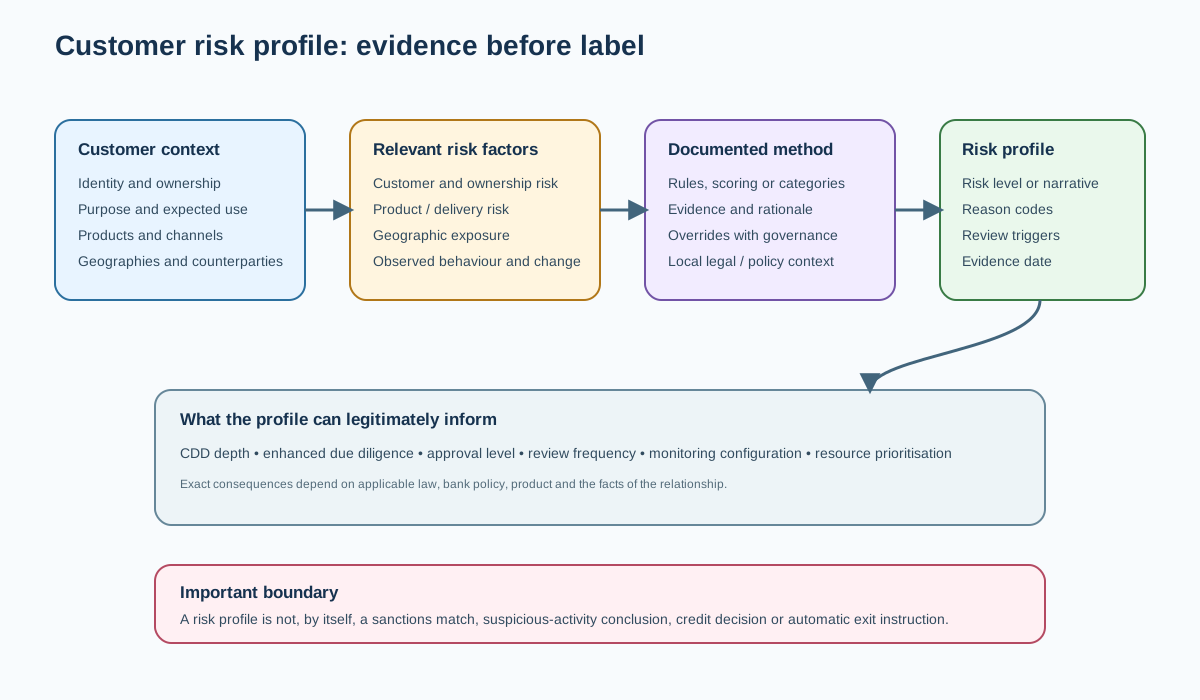
The mental model: profile first, label second
A weak implementation starts with a label. A customer is called "high risk" because it is a money-service business, a charity, a private-banking customer, a foreign company, a PEP-related relationship or a digital-asset business. The label then drives heavier controls whether or not the underlying facts justify them. That is not a mature risk-based approach.
A stronger implementation starts with the relationship. Consider a regulated remittance company. Its business model may create specific risks because it handles cross-border transfers for many underlying customers, but the level of risk will depend on more than its industry name. Ownership transparency, licensing status, countries served, agent network, transaction corridors, monitoring capability, nested relationships, cash exposure, customer base, control history and actual activity can materially change the bank's assessment. Two companies in the same sector can present different risks.
The same principle applies to individuals. A politically exposed person is not automatically a criminal. A customer connected to a higher-risk country is not automatically suspicious. A customer who uses cash is not automatically laundering money. A customer with adverse media is not automatically guilty. These facts can be relevant risk factors, sometimes strongly relevant, but they must be considered together with identity, purpose, source of funds or wealth where appropriate, products, expected activity, behaviour and other available information.
The risk profile is therefore a structured summary of the bank's current understanding. It should preserve the reasons behind the result. A label without reasons is operationally weak because the next analyst cannot tell whether the customer is high risk because of ownership opacity, product exposure, geography, PEP status, unusual activity, a specific legal requirement or a combination of factors. Reason codes, narrative rationale and evidence dates make the profile usable.
Global standards: what is actually required
FATF Recommendation 1 establishes the risk-based approach. Countries and financial institutions are expected to identify and assess relevant ML/TF risks and apply measures proportionate to those risks. In February 2025, FATF amended Recommendation 1 and related text to strengthen the use of proportionality and to encourage simplified measures in lower-risk situations where permitted. This is important for customer risk rating because it pushes against a one-directional model in which every new factor only increases controls and nothing can ever justify simplification.
FATF Recommendation 10 provides the core customer due-diligence framework. Banks need to identify and verify customers, identify beneficial owners and take reasonable measures to verify them, understand the purpose and intended nature of the relationship, and conduct ongoing due diligence. Higher-risk situations can require enhanced measures under the applicable framework. But FATF does not prescribe a universal 1-to-100 customer score, a mandatory set of three tiers or a fixed weighting for geography, occupation or product risk.
FATF's banking-sector risk-based guidance is older than the 2025 amendments and should be read with the current Recommendations, but it remains useful in explaining how banks can consider customer, country or geographic, product, service, transaction and delivery-channel factors together. The point is not to create a globally identical mathematical model. The point is to make the institution's assessment sufficiently reasoned and proportionate to support effective controls.
The US position illustrates this clearly. FFIEC guidance describes the concept of a customer risk profile, commonly called a customer risk rating, and says the assessment is bank-specific. It states that there are no required risk-profile categories and that a single indicator is not necessarily determinative of lower or higher risk. That is a jurisdiction-specific supervisory statement, not a rule for every country, but it is a useful warning against presenting scoring architecture as though international standards prescribe one method.
In the EU, the EBA's revised ML/TF Risk Factors Guidelines set out customer, country or geographic, product or service, transaction and delivery-channel factors that firms should consider. They also explain how CDD measures can be adjusted so they are appropriate and proportionate. The EBA has also repeatedly warned against indiscriminate de-risking of entire categories of customers. EU requirements are now evolving within the wider AML package and AMLA supervisory architecture, so firms operating in the EU need to map the currently applicable legislation, regulatory technical standards, guidelines and transition dates rather than assuming an older policy document remains sufficient indefinitely.
Australia provides another practical example. AUSTRAC's current guidance expects firms to understand customer risk based on factors such as the nature of the relationship, product or service, delivery method and relevant foreign-jurisdiction exposure, and to use ongoing monitoring to keep that understanding current. Again, the obligation is risk assessment and proportionate control, not a single prescribed weighting formula.
What belongs in a customer risk assessment
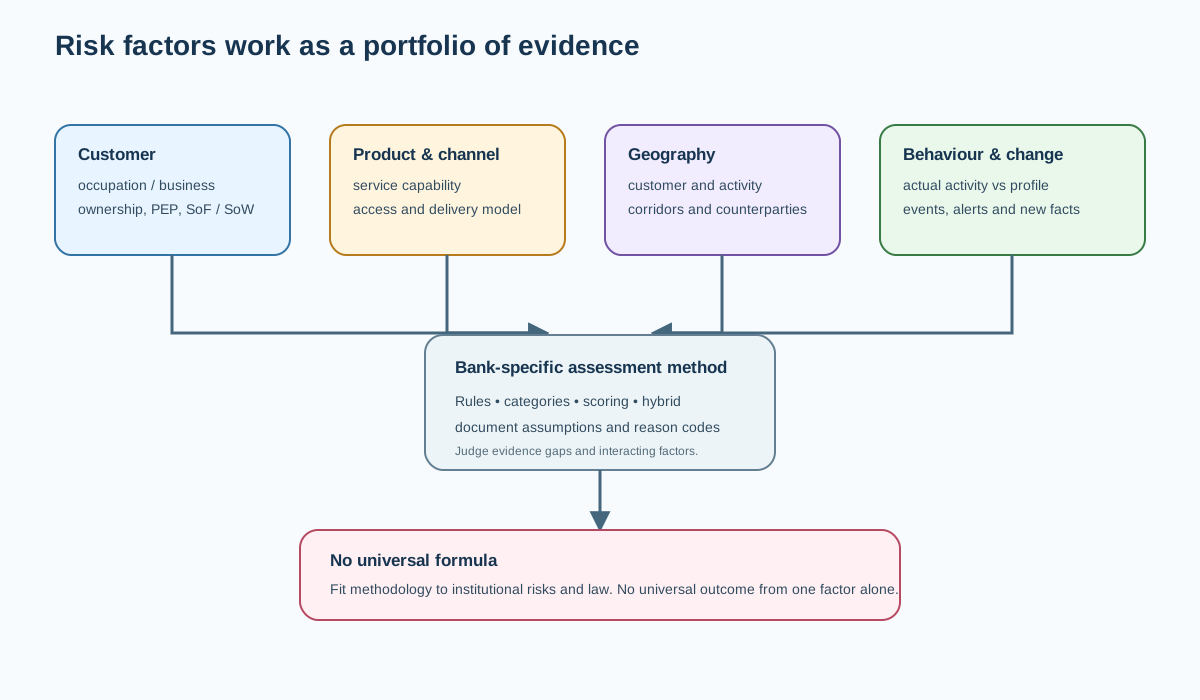
A well-designed assessment usually draws from several families of information. The exact factors vary by business model, but five families recur in mature banking programmes.
Customer and ownership factors include the customer's legal form, occupation or industry, ownership and control structure, beneficial owners, authorised representatives, PEP exposure, source of funds or wealth where relevant, and the degree to which the bank can understand the customer from reliable evidence. Complexity by itself is not wrongdoing; unexplained or unnecessary complexity can raise questions.
Product and service factors reflect what the customer can actually do through the bank. A simple salary account has a different capability from correspondent banking, trade finance, private banking, merchant acquiring, cross-border remittance services or products that permit rapid movement across jurisdictions. The assessment should focus on capability and expected use, not merely the product name.
Delivery-channel factors consider how the relationship is opened and operated. Non-face-to-face banking can create particular risks when identity controls are weak, but FATF's 2025 changes explicitly recognise that non-face-to-face relationships should not be treated as inherently higher risk where appropriate risk-mitigation measures are in place. Strong digital identity, device controls and verification processes can materially change the risk.
Geographic factors can include customer residence or establishment, location of business operations, source or destination of funds, counterparties and other relevant exposure. Geography needs precision. A customer incorporated in one country may operate almost entirely elsewhere. A multinational may make legitimate payments to many jurisdictions. FATF's lists also require careful interpretation: increased monitoring does not itself mean FATF calls for enhanced due diligence against every transaction involving that country, while a FATF call for action can carry stronger expectations. Local sanctions, high-risk-third-country rules and national risk assessments can create additional obligations.
Behavioural and relationship factors emerge after onboarding. Actual volumes, counterparties, corridors, cash patterns, product use, changes in ownership, sudden activity shifts and unexplained deviations from the expected profile can alter the bank's understanding. This is why customer risk rating cannot be treated as a once-and-done onboarding exercise.
Scoring, rules, categories and judgement
Banks often ask whether a customer risk model should be quantitative or qualitative. The better question is whether the method produces a sufficiently accurate, explainable, repeatable and governable view of risk for the institution's business.
A simple retail bank may use a rules-based approach in which a small number of clearly defined factors assign a risk category. A global bank with millions of customers may use scoring to achieve consistency at scale, with mandatory rules for particular scenarios and analyst judgement for exceptional cases. A private bank may rely more heavily on documented qualitative assessment because ownership structures, source-of-wealth narratives and relationship context are complex. A correspondent-bank portfolio may use a specialist assessment covering respondent controls, nested relationships, jurisdictions, products and ownership.
Numerical scoring can help but creates false confidence if the underlying assumptions are poor. Giving geography 20 points, PEP status 30 and product risk 15 does not make the result scientific simply because arithmetic is involved. Teams need to understand why each factor is included, what the values mean, whether factors overlap, how missing data is handled, whether mandatory rules override the score and how changes are approved.
Weighting can be informed by regulatory requirements, typology knowledge, enterprise risk assessment, control experience, internal cases and available data. Where there is enough reliable historical information, quantitative analysis can help test whether the model behaves sensibly. But it is dangerous to state that every AML customer risk model must statistically predict SAR filings, criminal outcomes or enforcement events. SAR filing is itself a decision produced by the control environment and can create circular validation if used carelessly as ground truth. Confirmed criminal outcomes are sparse, delayed and subject to law-enforcement visibility. The model's purpose is usually risk classification for proportionate AML controls, not criminal prediction.
Validation should therefore be proportionate to the method. It can include checking factor definitions, data lineage, rule implementation, score calculations, boundary behaviour, missing-data treatment, override patterns, population distribution, changes over time, known cases, false concentrations, segment behaviour and whether the resulting controls remain aligned with policy. More sophisticated statistical testing can be useful where the model and data justify it, but it should not be described as a universal legal requirement.
High risk does not mean prohibited
This is one of the most important operational lessons in AML. A high-risk customer can be entirely legitimate. Higher risk normally means the bank needs stronger understanding and controls, not that it has concluded the customer is laundering money.
FATF's risk-based framework is designed precisely so that higher-risk situations receive enhanced measures. The EBA has stated that firms are not required to discontinue services to entire categories of customers merely because they associate them with higher ML/TF risk. FFIEC similarly reminds US examiners that no specific customer type automatically presents higher risk and that banks are not discouraged from serving lawful customer classes when risk is reasonably managed.
A bank may of course decide that a particular relationship falls outside its risk appetite or cannot be controlled adequately. Local law may prohibit some relationships. A sanctions rule may forbid making funds or services available to a designated person. A regulator may impose restrictions. A customer may refuse information that the bank is legally required to obtain. Those are distinct decision grounds. They should not be collapsed into the statement "high risk = exit."
This distinction also protects financial inclusion. Indiscriminate exclusion can push lawful customers into less transparent channels without necessarily reducing systemic financial-crime risk. A defensible programme asks whether risk can be understood and mitigated within law and risk appetite before deciding that the relationship cannot be supported.
What a high-risk classification should change
When a relationship is genuinely higher risk, the control response should be visible. The exact response depends on the applicable framework and customer type, but common examples include obtaining more information about ownership, purpose, source of funds or wealth; obtaining senior or specialist approval where required; increasing review frequency; improving understanding of counterparties or expected activity; tailoring transaction monitoring; and conducting more frequent event-driven or periodic reassessment.
The response should be linked to the reason for the risk. If a corporate customer is high risk because of opaque ownership, the response should improve ownership understanding rather than simply increase transaction-monitoring sensitivity. If geography is the primary concern, the bank may need better corridor and counterparty understanding. If the customer operates an agent network, the bank may need information on agent controls and nested activity. If a PEP relationship creates corruption exposure, source-of-wealth and source-of-funds measures and senior management involvement may be relevant under the applicable framework.
Generic "EDD completed" checkboxes weaken the risk-based approach because they do not show how controls address identified risk. A better design links each material risk reason to one or more mitigating controls and records whether residual concerns remain.
Risk profile versus other decision engines
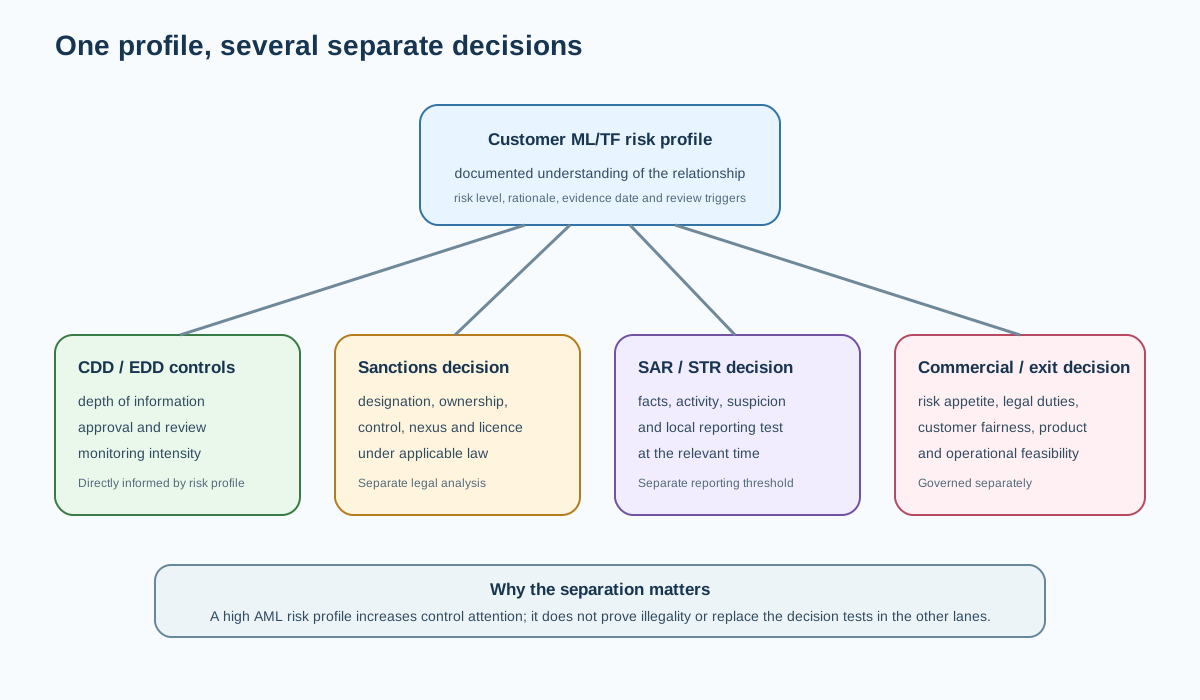
Banks often create confusion by using one risk score for too many purposes. An AML customer risk profile is not the same as credit risk, fraud risk, sanctions exposure, operational risk, conduct risk or cyber risk. Those disciplines can share information, but their decision tests are different.
A high AML risk profile does not mean a customer is a poor credit. A profitable, well-capitalised business can still have complex AML risks, and a financially weak customer can present low ML/TF risk. Conversely, credit underwriting should not use AML risk categories as a shortcut for affordability or default probability.
Sanctions analysis is also separate. If a customer or beneficial owner is a true match to a designated person, the required action depends on the applicable sanctions regime, ownership or control rules, nexus, asset position and any licence or exemption. The AML customer risk score does not determine whether assets must be frozen or a transaction rejected.
Suspicious activity reporting is separate again. A customer can be high risk without creating suspicion. A standard-risk customer can generate a transaction that provides grounds for suspicion under local law. Reporting teams need to assess facts and the relevant statutory threshold, not merely check the customer's tier.
Relationship exit decisions can consider AML risk, but they also involve legal duties, risk appetite, customer-treatment considerations, product obligations, contractual terms, operational feasibility and sometimes regulator expectations. A rating should inform the governance process rather than silently become an automatic exit instruction unless a clearly defined legal or policy rule requires that result.
Overrides: when judgement disagrees with the method
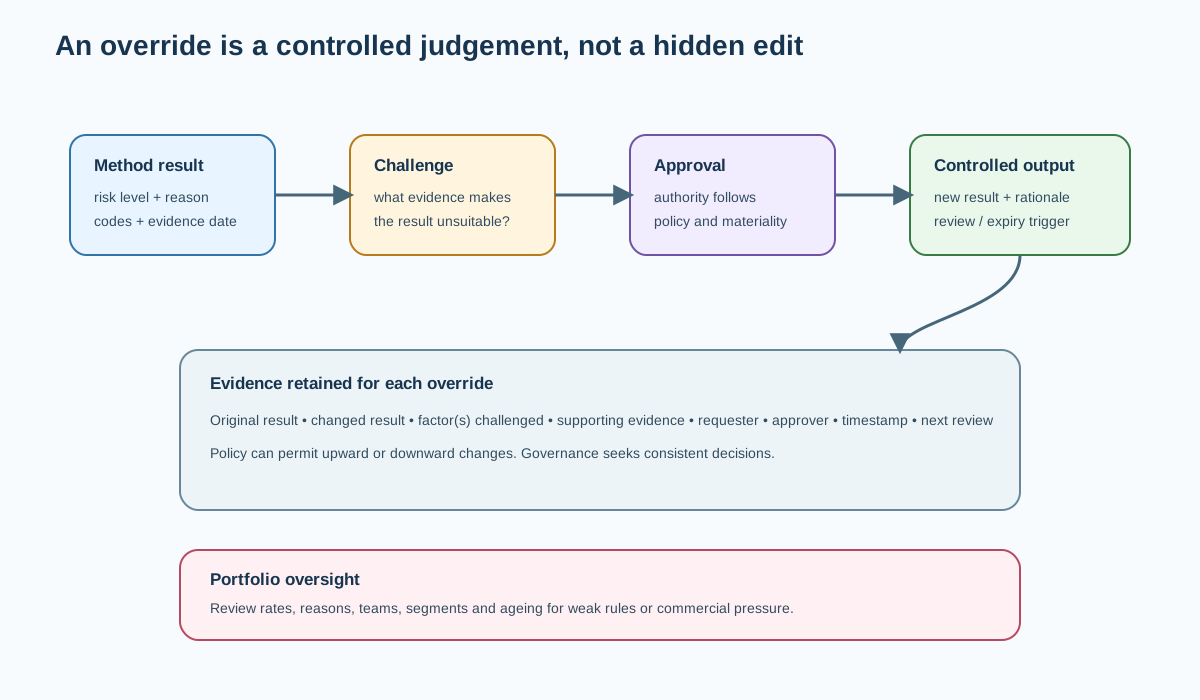
No rating method handles every relationship perfectly. A customer can sit near a scoring threshold. Data can be incomplete. A mandatory rule can create a result that makes little sense in a particular context. Two risk factors can interact in a way the model does not capture. Banks therefore often permit overrides.
An override is not a defect if it is controlled. It becomes a problem when analysts can silently change ratings without retaining the original result, reason, evidence, approver and timing. The bank should be able to reconstruct what the method produced, why a person disagreed, who approved the change and when the decision must be reviewed.
There is no universal rule that every upward override can be freely applied while every downward override must receive a particular level of independent approval. A bank can reasonably apply stronger controls to downward overrides because they reduce control intensity, but the appropriate governance depends on policy, materiality, model design and jurisdiction. What matters is that both directions are visible, justified and monitored.
Portfolio-level override analysis is valuable. If one business unit has unusually high downgrade rates, that can indicate commercial pressure or misunderstanding. If specialists repeatedly upgrade customers for the same reason, the base methodology may be missing an important factor. If overrides remain open indefinitely, temporary judgement can become an ungoverned permanent state.
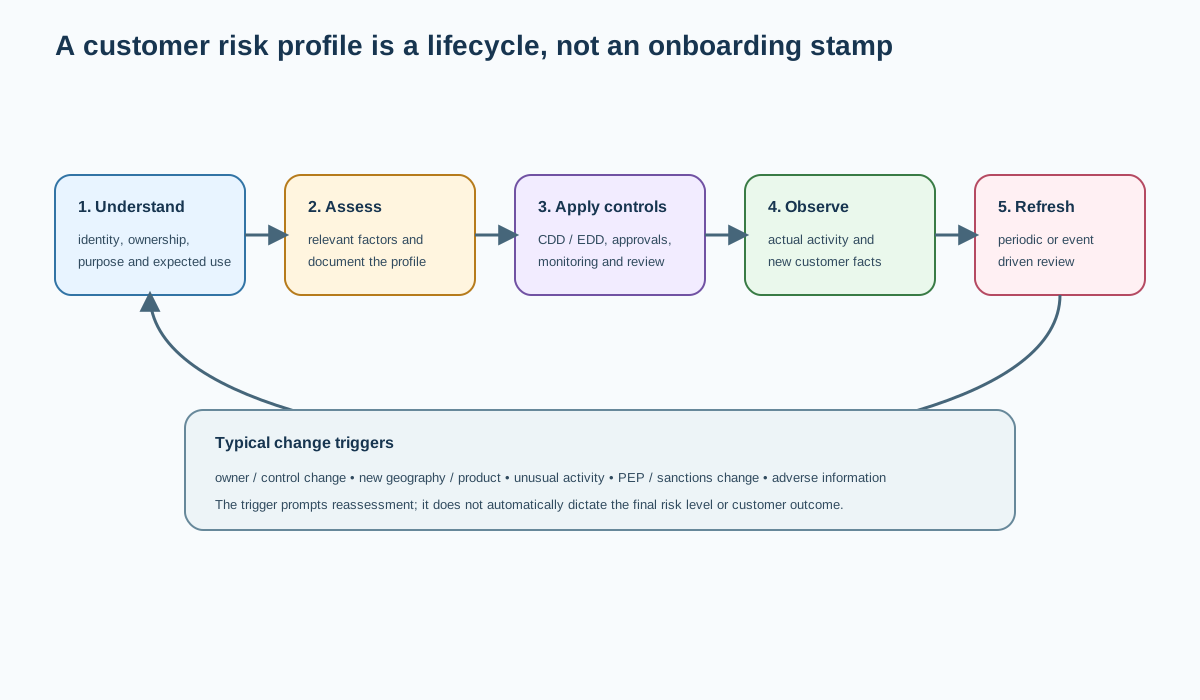
Keeping the profile current
Customer risk can change after onboarding. Ownership may change. A business can expand to new countries. A customer can adopt a new product. A previously domestic company may begin receiving international payments. A beneficial owner may become a PEP. New adverse information may emerge. Actual transaction patterns may diverge materially from the expected profile. Regulatory changes can alter the relevance of particular geographic or product factors.
Banks usually combine periodic review with event-driven review. Higher-risk customers may be reviewed more frequently under policy, while event triggers can require reassessment at any time. The exact timetable is institution- and jurisdiction-specific. A mature design does not depend only on a calendar because material change can occur one day after the last scheduled review.
An event should not automatically force a predetermined final rating unless policy or law clearly requires that result. For example, a change of address may be routine. A new country exposure may be legitimate and well explained. A PEP event can create mandatory enhanced measures in some frameworks without proving suspicious activity. The event should trigger the right assessment and control steps.
Ongoing transaction monitoring is also not the same as customer risk rating, but the two should exchange information. The risk profile can influence scenario selection or thresholds where appropriate. Monitoring outcomes can provide new facts that prompt profile review. The feedback loop is useful only if it is designed carefully: repeatedly filing alerts should not mechanically increase a customer's score forever without considering alert quality and case outcomes.
Data architecture behind a reliable risk profile
A customer risk rating can look simple on a screen while depending on a large data chain. Identity may come from onboarding platforms. Ownership may come from KYB tools, registries and manually verified evidence. Product use may come from core banking and channel systems. Geography may be derived from addresses, legal registration, transaction corridors and counterparties. PEP and sanctions-related attributes may come from screening platforms. Behavioural triggers may come from monitoring or case systems.
For a business analyst or architect, the first question is therefore data lineage: where does each factor originate, how is it transformed, when is it refreshed and what happens when it is missing? A factor called country_risk is too vague unless the system distinguishes customer residence, incorporation, operating country, beneficial-owner residence, payment destination and other relevant concepts. A factor called PEP should distinguish whether it concerns the customer, beneficial owner, controller or close associate where policy needs that distinction.
Effective dating is essential. A bank may need to explain why a customer was classified as high risk six months ago, even if today's data is different. Systems should retain the factor values, methodology version, result, override, evidence references and approval state that applied at the relevant time.
Method versioning matters because risk models evolve. If factor weights or rules change, teams need to know whether existing customers will be recalculated immediately, at next review or through a controlled migration. They also need to test that the change does not unintentionally move large populations because of a mapping error.
Missing data deserves explicit treatment. Setting missing values to zero can falsely lower risk. Setting every missing value to maximum can create false high-risk populations and operational overload. The correct handling depends on the field, whether it is required, whether absence itself is meaningful and what remediation process exists.
BA requirements that make the control testable
A good requirement does not say, "System shall calculate customer risk." It explains the factor, source, business meaning, evaluation logic, output, reason code, review trigger, override path, audit trail and downstream use.
For each factor, the BA should be able to answer: What business fact are we measuring? What source is authoritative? What values are permitted? Is the factor mandatory? How is unknown represented? Does it apply to individuals, entities or both? Is it assessed at customer level, relationship level or legal-entity level? Does it create a mandatory rule, contribute to a score or only prompt review? What happens when it changes?
Acceptance criteria should cover boundary conditions. If a numerical score of 70 means high risk, test 69, 70 and 71. If a mandatory PEP rule applies only to specified connected parties, test each relationship type. If a country factor uses a list, test additions, removals, effective dates and list-version rollback. If an override expires after a review period, test that the expiry creates the intended workflow rather than silently reverting the customer in production.
The BA should also challenge downstream coupling. If a risk tier is sent to transaction monitoring, what happens when the tier changes? Does the monitoring platform update immediately or in batch? If the KYC system is unavailable, can customer risk still be retrieved? If a customer has multiple legal relationships with the bank, does one rating propagate globally or remain entity-specific? There is no universal answer, but the design must be deliberate.
Testing the rating process without pretending crime has perfect ground truth
Testing begins with implementation correctness. Does the code reproduce the approved rules? Are factor mappings correct? Are thresholds implemented as documented? Are mandatory conditions evaluated in the right order? Are reasons visible? Can the audit trail be reconstructed?
Then test business behaviour. Use synthetic and anonymised cases representing lower, standard and higher-risk relationships. Test combinations of factors rather than isolated fields. Include legitimate high-risk customers, because a model that treats all high-risk sectors as suspicious has failed the risk-based principle. Include unusual but explainable behaviour and common but genuinely concerning behaviour.
Historical case information can be useful, but it needs careful interpretation. An alert, investigation or SAR is not definitive proof of criminality. Law-enforcement outcomes are incomplete and delayed. A model can be assessed for stability, explainability, population concentrations, sensitivity to known risk factors, unexpected segment effects, override behaviour and whether control outcomes make operational sense without claiming it predicts crime with scientific certainty.
Regression testing is particularly important after methodology changes. A small rule change can move thousands of customers into enhanced review, creating operational backlogs that themselves become control risk. Change impact should therefore estimate population movements and workload before deployment.
Practical examples
Consider a locally incorporated import company with clear ownership, five years of stable banking history and standard domestic products. It begins making payments to new suppliers in several higher-risk corridors after acquiring a new distribution business. The correct response is not automatically to label the customer suspicious. The bank should verify the business change, understand the suppliers and expected volumes, assess relevant geographic and trade exposure, decide whether the customer risk profile changes and adjust monitoring or diligence proportionately. If the explanation and evidence are strong, the relationship may remain manageable even if the risk profile increases.
Now consider a private company owned through multiple layers where the bank cannot confidently identify the natural persons exercising control. The customer's stated business is generic consulting, expected turnover is modest, but incoming payments originate from unrelated overseas entities and funds leave rapidly to third parties. Here several factors reinforce each other: ownership opacity, weak business purpose, counterparty inconsistency and behavioural mismatch. The bank may need enhanced due diligence and specialist review. Whether it files a suspicious report, restricts services or exits depends on the evidence and applicable framework; those decisions should not be mechanically inferred from the risk tier alone.
A third example is a PEP-related customer with long-standing transparent wealth and consistent activity. The applicable framework may require enhanced measures because of the PEP connection, but that does not mean the customer is presumed corrupt. The bank should apply required controls, understand the source of wealth and funds where relevant, obtain approvals where required and monitor the relationship. If evidence remains coherent, the relationship can be legitimately managed even though it remains higher risk.
Mini case study: the fast-growing payments company
Northbridge Pay is a fictional payment institution seeking operating accounts and settlement services from a commercial bank. It is licensed in its home jurisdiction, has reputable institutional investors and provides card-to-bank payouts for online marketplaces. During onboarding, the bank initially sees strong governance documents and audited financial statements.
The deeper assessment reveals important complexity. Northbridge uses several overseas programme partners. Some marketplaces aggregate sub-merchants, so the bank will not always see the ultimate seller in the payment message. Transaction volumes are expected to triple in a year. A meaningful share of flows will involve jurisdictions the bank assesses as elevated risk. Northbridge has its own transaction-monitoring system, but its bank has not yet tested how quickly underlying merchant information can be produced when requested.
A simplistic rating process might either give Northbridge a low score because it is licensed and audited, or classify every payment institution as automatically high risk. Neither approach is satisfactory. The relationship assessment should capture the business model, regulatory status, ownership, transparency into underlying parties, corridors, expected volumes, partner structure, monitoring controls and the bank's ability to obtain information when needed.
Suppose the bank's documented methodology produces an elevated-risk result that requires enhanced onboarding. The bank obtains more detail on partner due diligence, merchant categories, prohibited business rules, corridor controls and information-sharing arrangements. It sets contractual requirements for timely retrieval of underlying merchant information and builds monitoring around expected corridors and volume growth. Senior approval is obtained under policy.
Six months later, volumes grow faster than forecast and a new marketplace significantly increases flows to a corridor that was not material at onboarding. This is a legitimate event-driven trigger. The bank refreshes the profile, confirms the new business rationale, reviews sample underlying merchants and checks whether monitoring remains suitable. The reassessment may or may not move the customer into the highest risk tier. What matters is that the change is understood and controls are adapted to the actual exposure.
If a later transaction creates suspicion, investigators assess that transaction and related activity against the local reporting threshold. If a sanctions match occurs, sanctions specialists apply the relevant legal analysis. If the business repeatedly fails to provide required underlying-party information, relationship governance considers restriction or exit. Each decision uses the customer risk profile as context without confusing the profile with the separate legal or commercial decision.
Failure modes to watch
The first failure mode is category substitution: assuming a sector or nationality is the risk assessment. The second is false precision: presenting a score with decimals while factor quality is poor. The third is stale profiles: accurate onboarding followed by years without meaningful updates. The fourth is hidden overrides: human judgement changes the result without an audit trail. The fifth is downstream ambiguity: systems consume a risk tier without knowing what it means or when it was produced. The sixth is de-risking by automation: a model converts higher risk directly into exit without considering whether risk can be mitigated or whether applicable law and policy support that outcome.
A further failure is using reporting outcomes as unquestioned model truth. If investigators file more reports on high-risk customers partly because those customers receive more intense monitoring, then a higher SAR rate may simply show different surveillance intensity. Model governance needs to recognise that feedback loop rather than declaring the rating validated because it produces the outcomes it helped create.
Finally, programmes fail when they optimise for one regulator's terminology and then call it global. A multinational bank needs a global methodology with local rule packs where necessary. The common framework can define factor families, evidence standards, audit fields and governance. Local implementations can then add statutory high-risk cases, approval requirements, review periods, reporting obligations and data-protection constraints.
What good looks like
A good customer risk-rating framework is understandable to the analyst who uses it, explainable to the customer-risk owner, implementable by technology teams, testable by QA, reviewable by compliance and auditable after the fact. It makes risk differences visible without pretending that a score proves misconduct. It helps the bank devote stronger controls to higher-risk relationships while avoiding unnecessary friction where risk is lower and manageable.
Most importantly, it remains connected to evidence. The bank knows which facts produced the profile, when those facts were obtained, which methodology version was used, what changed, who overrode anything and why. When the relationship changes, the profile changes with it. When a legal decision is required, the relevant legal test is applied separately.
That is the practical purpose of customer risk rating: not to rank customers morally, and not to predict crime with certainty, but to turn a bank's understanding of a relationship into proportionate, governable and reviewable financial-crime controls.
Operational deep dive: method design, data lineage and validation
The base chapter establishes the core principle: a customer risk profile is a structured AML/CFT assessment that informs proportionate controls. This deep dive focuses on the machinery needed to make that assessment reliable at scale without pretending there is one mandatory global scoring formula.
Start with the decision the profile must support
Risk-rating projects often begin by asking how many points should be given to a PEP, a country or a product. That is too early. First define what the resulting profile will actually do. Will it select standard or enhanced due diligence? Determine the level of approval? Change periodic-review frequency? Pass a risk attribute to transaction monitoring? Prioritise remediation? Each use needs a clearly defined business meaning.
If the same field drives multiple downstream processes, those processes must understand the same semantics. A HIGH value cannot mean "requires EDD" in one application, "likely suspicious" in another and "exit customer" in a third. The label should have one documented AML meaning, while downstream decisions apply their own policy and legal tests.
Factor catalogue and lineage
A mature factor catalogue records more than the factor name. It identifies the business definition, customer types to which it applies, source system, authoritative field, transformation logic, refresh frequency, valid values, missing-data behaviour, effective date, owner and downstream use.
Geography shows why this matters. Country = X is not enough. A system may hold nationality, residence, incorporation, principal place of business, operating markets, beneficial-owner residence, source-of-funds geography and transaction corridors. Those facts can have different relevance. Collapsing them into one country field makes both risk assessment and audit difficult.
Ownership also needs structure. The rating service may need verified beneficial owners, controllers and ownership percentages with effective dates. If the KYB platform only sends a Boolean ownership_verified, the scoring engine cannot explain what changed when the underlying structure changes.
Data provenance should survive the calculation. An investigator or reviewer needs to know whether a factor came from customer declaration, an official registry, a screening service, internal transaction data or analyst judgement. Source quality can affect how confidently the bank uses the factor.
Method choices
A rules-based method is appropriate where outcomes are clearly defined and the population is manageable. For example, policy may require enhanced handling for a specified regulatory case. Rules are transparent but can become brittle if hundreds of exceptions accumulate.
A weighted score can combine several factors consistently. It is useful for large populations, but the numbers do not create truth by themselves. Factor weights need a documented rationale and change governance. Teams should avoid double counting: a country can influence customer geography, payment corridor and product availability, so poorly designed models may amplify the same underlying exposure three times.
A hybrid method is common. Mandatory policy rules handle certain conditions; scoring differentiates the remainder; human review addresses incomplete information and unusual combinations. The hybrid structure should be explicit so operations can explain whether the final result came from a score, a mandatory rule or an approved override.
Missing and conflicting data
Missing data should never be handled accidentally. The correct treatment depends on the field. If beneficial-owner information is legally required and unavailable, that may create a CDD completion problem rather than simply add ten risk points. If an optional behavioural field is not yet available because the relationship is new, the system may need a neutral value plus a future refresh trigger.
Conflicting data also needs a workflow. If the customer says it operates only domestically but transaction history shows material foreign activity, the risk engine should not silently choose one source. The conflict is itself information that may require review. Data-quality exceptions should reach the owner able to resolve the underlying fact rather than remain permanently embedded as scoring noise.
Effective dating and reproducibility
A defensible system can reproduce a historical rating. That means storing the methodology version, input values or sufficient references to them, calculated result, mandatory-rule outcomes, override details, approvals and timestamps. If a country-risk list changes today, the bank should still be able to explain why the customer was rated differently at the time of a transaction six months ago.
Versioning also supports safe change. A new methodology can be run in parallel against existing customers before release. Teams can analyse how many customers move between categories, why they move and what workload the new control state will generate. A technically correct rule can still be operationally unsafe if it suddenly sends tens of thousands of customers into enhanced review without capacity or prioritisation.
What validation should mean
Validation should test whether the method is designed and implemented for its intended purpose. It is not automatically a criminal-prediction exercise.
At minimum, testing should confirm that factor definitions match policy, data mappings are correct, calculations reproduce the approved logic, mandatory rules fire when intended, boundary values behave correctly, missing data is handled deliberately, reason codes are accurate, overrides are traceable and downstream systems receive the correct result.
Portfolio analysis can then ask whether results make sense. Are nearly all customers landing in one category? Is one branch creating unusual concentrations? Did a model change produce unexpected shifts? Are high-risk reasons dominated by one duplicate factor? Are override rates clustering around one threshold? Are older ratings systematically stale?
Historical investigations, suspicious reports and confirmed cases can provide useful evidence, but none is perfect ground truth. Reporting rates are influenced by monitoring intensity and human decisions. A customer assigned high risk may receive more scrutiny and therefore generate more alerts, which can create circular evidence if the bank then claims the high alert rate proves the rating was correct. Confirmed criminal outcomes are too sparse and delayed to serve as the only validation target. Statistical methods can help where data supports them, but the governance objective is a credible risk-classification control, not a universal requirement to predict law-enforcement outcomes.
Segment testing
Test realistic segments independently. Retail, private banking, SMEs, correspondent banks, charities, payment firms and digital-asset businesses can have very different risk structures. A model that appears stable in aggregate may be poor for a small but important segment.
Segment testing should also guard against proxy effects. A factor may unintentionally operate as a proxy for nationality, ethnicity, age or another characteristic with legal or fairness implications depending on jurisdiction. AML law can require risk-based differentiation, but that does not remove the need for accurate factor design, appropriate data use and governance.
Change controls
Every methodology change should have an owner, rationale, impact assessment, test evidence, approval, effective date and rollback plan. Changes to external lists need similar discipline. If the institution uses FATF public statements, national high-risk-country lists or local regulatory classifications, the source, version and interpretation must be clear. FATF increased monitoring, for example, should not be converted automatically into a claim that FATF requires enhanced due diligence against every customer connected to that jurisdiction.
Where local law creates mandatory EDD, the rule pack should identify the specific legal basis and effective date rather than hiding it inside a global "country risk" score. This separation makes the global methodology reusable while allowing local obligations to remain legally precise.
Operational controls around the engine
The risk engine needs service monitoring like any other critical control. Teams should know what happens if a source feed fails, a screening attribute is delayed or the calculation service is unavailable. A silent failure that leaves old ratings displayed as current is particularly dangerous.
Good operational design includes freshness indicators, failed-calculation queues, reconciliation between source populations and rated populations, alerts for missing mandatory inputs, retry controls, audit logs and management information on unresolved exceptions. If a calculation cannot be completed, the status should make that visible rather than defaulting to a benign category.
Testing examples for delivery teams
A QA pack should include ordinary lower-risk relationships, high-risk-but-legitimate relationships, contradictory information, threshold boundaries, missing fields, ownership changes, country-list changes, new product adoption, PEP changes, override approval and override expiry. It should also test historical reproducibility after a methodology upgrade.
Integration tests should verify that a rating change reaches all intended downstream systems. If transaction monitoring receives the new tier but the periodic-review scheduler does not, the institution has created inconsistent control states. If the case system displays only the final tier without the reason, investigators can overinterpret the label.
Finally, test the boundaries shown in the chapter diagrams: the AML customer risk profile can inform CDD and monitoring, but sanctions, suspicious-reporting, credit and relationship-exit decisions must continue to use their own evidence and decision rules. That separation is as important as the score calculation itself.
Advanced practice: interpreting high-risk relationship factors
The difficult part of customer risk assessment is rarely identifying a list of possible factors. It is deciding what those factors mean when they conflict, reinforce each other or change over time. The following practice patterns show how experienced teams can reason without turning risk factors into guilt indicators.
A regulated payment firm with opaque downstream activity
A payment firm can be licensed, profitable and professionally audited while still presenting elevated AML risk to its bank. Regulation and audit are relevant controls, but they do not answer every question about underlying customers, sub-merchants, agent networks or cross-border flows.
The bank should understand which activities it can see directly and which are aggregated. If payment messages identify only the payment firm while the economic activity sits with thousands of underlying merchants, information-access arrangements become important. The bank may need contractual rights and operational procedures for obtaining underlying-party data when alerts or investigations require it.
The risk profile should therefore reflect both positive and challenging facts. Licensing, transparent ownership and a mature control framework can mitigate risk. High transaction velocity, cross-border reach, nested parties and limited underlying transparency can increase it. The final classification should follow the bank's approved methodology and evidence, not prestige on one side or sector stigma on the other.
A cash-intensive business
A restaurant, convenience chain or other cash-intensive business is not suspicious merely because it handles cash. The bank first needs a plausible business model: locations, turnover, seasonality, expected cash share, tax or accounting evidence where appropriate and normal deposit behaviour for the sector and customer.
Risk becomes more concerning when facts do not fit the business. Examples include repeated deposits by unrelated third parties, rapid movement of cash deposits to apparently unrelated beneficiaries, volumes inconsistent with physical capacity, unexplained geographic dispersion or sudden activity changes without a commercial explanation.
The risk assessment should distinguish the factor "cash intensive" from the evidence "customer activity materially inconsistent with its known business." The first may justify a higher baseline control level. The second may trigger review, monitoring or investigation. Suspicious-reporting decisions remain separate and depend on the applicable threshold and totality of information.
A PEP-related relationship
PEP status is a good example of why customer risk rating must not be a moral ranking. FATF and many national frameworks require additional measures for relevant PEP relationships because public position can increase exposure to bribery or corruption risk. Those measures do not mean the PEP is presumed corrupt.
The bank should determine the relationship to the PEP, relevant jurisdiction, position, source of wealth and funds where required, expected activity and other context. Strong transparent wealth evidence and stable behaviour can make a relationship more understandable even where mandatory enhanced controls continue to apply. A model that allows "good history" to cancel a legal EDD requirement would be wrong; a model that treats every PEP as suspicious would also be wrong.
Geography without nationality shortcuts
Geographic risk needs to follow the actual exposure. A customer born in one country but resident and economically active in another should not be rated solely on birthplace. A domestic company may have high-risk cross-border suppliers. A multinational customer may operate legitimate businesses across many countries. A customer in a FATF increased-monitoring jurisdiction is not automatically subject to a FATF demand for enhanced due diligence merely because of that public statement.
Banks need clear source hierarchies for geography. FATF public statements, national high-risk lists, sanctions regimes, enterprise risk assessments, corruption indicators and internal experience can all be relevant but serve different purposes. The methodology should define which source creates a factor, which creates a mandatory rule and which merely prompts additional assessment.
Charities and non-profit organisations
A non-profit organisation should not be categorised as high risk simply because it is a charity. FATF's standards are risk based and have evolved specifically to avoid disproportionate treatment of the entire NPO sector. Risk can vary materially based on activities, geography, funding, beneficiaries, delivery model and controls.
For a humanitarian organisation operating in conflict areas, the bank may face real TF, sanctions and diversion risks. The correct response is not necessarily blanket refusal. The institution should understand programme delivery, counterparties, cash usage, implementing partners, controls and applicable sanctions or humanitarian exceptions. Local law and sanctions licences can be critical. Customer risk rating can organise the assessment, but legal sanctions analysis must remain separate.
Private banking and complex wealth
Private-banking relationships can involve trusts, investment companies, family offices, multiple jurisdictions and sophisticated assets. Complexity is not automatically suspicious. The key questions are whether ownership and control can be understood, whether wealth generation is credible, whether expected activity fits the customer's profile and whether the bank can monitor the relationship adequately.
Source-of-wealth evidence should be evaluated according to the nature of wealth. An entrepreneur may rely on company sale documents and business history. An heir may provide probate or estate evidence. An investor may have long-term portfolio records. A broad statement such as "wealth from investments" is weaker than evidence that explains how the wealth accumulated and why the current financial activity makes sense.
Correspondent banking
A respondent bank cannot be assessed like a retail customer. Relevant factors can include ownership, licensing and supervision, jurisdiction, products, customer base, nested relationships, AML controls, sanctions controls, payment transparency, prior regulatory findings and the bank's ability to obtain information.
One important distinction is between a respondent's financial soundness and its financial-crime control environment. Strong financial statements do not prove strong AML controls. Likewise, a regulatory finding does not automatically mean every transaction is suspicious. The relationship assessment should translate these facts into due diligence, approval, monitoring and review requirements appropriate to correspondent risk.
Digital assets
A regulated virtual-asset business may present different risks depending on the services it offers, jurisdictions, customer base, exposure to unhosted wallets, transparency, travel-rule implementation, blockchain analytics and controls. A percentage of activity linked to a particular on-chain category should be interpreted carefully: blockchain labels have methodology and attribution limitations and should not be treated as infallible legal conclusions.
The bank should understand the source of blockchain risk information, confidence level, asset and network coverage, counterparty context and how the customer handles identified exposure. The customer risk profile can reflect residual risk after controls; it should not simply convert one vendor score into the bank's own decision.
When factors conflict
Consider a long-standing corporate customer with transparent ownership, strong audited accounts and stable domestic activity. It acquires a business that introduces customers in higher-risk jurisdictions and a new product with faster cross-border settlement. Positive history is relevant, but it does not eliminate new exposure. The correct response is a refresh based on the post-acquisition business model.
Now reverse the pattern. A new customer operates in a sector often classified as elevated risk but provides unusually strong ownership, licensing, transaction transparency and control evidence. The bank should still apply any legally required measures, but it should avoid inventing additional risk merely to preserve a sector stereotype. Risk classification should reflect the actual relationship within the institution's methodology.
Interaction effects without mathematical theatre
Factors can reinforce each other. Foreign ownership plus cross-border payments is not necessarily concerning. Opaque ownership plus unexplained cross-border payments to unrelated third parties may be far more material. A model can address interactions using rules, additional scoring, analyst review or specialist referral.
The design should be explainable. If interaction logic is so complicated that analysts cannot tell why a customer moved categories, challenge and remediation become difficult. Sophisticated modelling is justified only when the institution can govern the data, logic, performance and operational consequences.
Risk appetite versus legal obligation
Risk appetite describes the level and type of risk the institution is prepared to accept within law and strategy. It cannot override a legal prohibition. If sanctions law prohibits a relationship or transaction, a high commercial appetite does not make it permissible. If law requires EDD for a scenario, a low internal score cannot remove that requirement.
Conversely, a bank may lawfully choose not to support a customer or product that is outside its risk appetite even if the relationship is not prohibited. That decision should be governed transparently and should not be described as a universal regulatory requirement.
Practical review questions
When an analyst sees a high-risk result, the first question should be "why?" The answer should identify the material drivers and supporting evidence. Next ask whether those drivers are current and whether the method treated them correctly. Then ask what controls correspond to the risks. Finally, ask whether any separate decision process is required: sanctions, suspicious reporting, customer restriction, legal advice or relationship governance.
A well-designed risk profile allows all four questions to be answered from evidence. A weak one offers only the word HIGH and leaves every downstream team to guess what that means.
Practice close: controls, acceptance criteria and review evidence
This section turns the chapter into delivery and assurance artefacts. The aim is not to prescribe one scoring model. It is to make whichever risk-profile method the bank adopts understandable, testable and traceable.
Minimum control evidence
For each customer risk profile, the bank should be able to reconstruct the customer or relationship assessed, assessment date, relevant factor values, source or provenance of important data, methodology version, calculated or rules-based result, reason codes, any override, approver where applicable, review trigger and current status.
The evidence needs to be proportionate. A simple retail relationship does not need the same narrative as a complex correspondent bank. But the control should not depend on undocumented personal knowledge held by one relationship manager.
Suggested BA acceptance criteria
Factor definition. Every implemented factor has an approved business definition, valid values, applicable customer types, authoritative source, treatment of unknown values and owner. A tester can trace the displayed factor back to source data or a controlled analyst entry.
No silent default. If a required risk input is missing, the system follows documented handling. It does not silently treat the value as zero risk merely because the source feed is blank.
Explainable result. The user can see why the customer received the current risk profile. Reason codes identify the material drivers and distinguish mandatory rules, scoring outcomes and analyst overrides.
Version reproducibility. Historical assessments retain enough information to reproduce or explain the result using the methodology and data effective at that time.
Boundary correctness. Thresholds are tested immediately below, at and immediately above each boundary. If a rule uses dates, percentages or ownership thresholds, exact boundary behaviour is defined and tested.
Event-driven refresh. Material events configured by policy create a reassessment workflow. The event does not automatically produce a new final risk level unless the approved method explicitly requires that outcome.
Override control. An override records original result, new result, rationale, evidence, requester, approver as required, timestamp and next review or expiry trigger. Users without appropriate authority cannot bypass the control through direct data editing.
Downstream consistency. When a customer profile changes, intended downstream systems receive the new value and effective date within the defined service level. Reconciliation identifies failed updates.
Decision separation. A high customer AML risk profile does not automatically create a sanctions disposition, suspicious-report decision, credit rejection or customer exit unless a separate documented rule with an appropriate legal or policy basis explicitly requires that consequence.
Audit trail. Reviewers can distinguish customer-declared data, externally sourced data, system-derived data and analyst judgement.
Positive testing
Positive tests prove that known risk factors and mandatory rules are recognised. Use synthetic examples such as a relevant PEP relationship, a complex ownership chain, a regulated payment firm with nested activity, a customer adding material higher-risk-country exposure, or a relationship adopting a product with substantially different financial-crime capability.
The expected result should follow the institution's documented method, not a generic assumption that every example must be high risk. If a local rule requires enhanced measures regardless of the numerical result, test that the mandatory control path remains effective.
Negative testing
Negative tests prove that the model does not overreact to harmless facts. Examples include a legitimate digital-only onboarding completed through strong identity controls, a common-name screening false positive, a customer with a foreign nationality but no material exposure to that country, or a charity operating domestically with transparent beneficiaries and controls.
These tests are especially important because category-based false positives can produce systematic de-risking and large operational backlogs.
Interaction testing
Test combinations that are more informative together than alone. Transparent foreign ownership may be manageable; opaque ownership plus unexplained third-party payments and inconsistent business purpose requires stronger review. A high transaction volume may be expected for a payment company; high volume combined with new corridors, limited underlying-party visibility and weak information retrieval can change the risk picture.
The objective is to confirm that interaction logic behaves as approved and remains explainable. If the system uses machine-learning or advanced analytics in the future, governance still needs an intelligible way to connect outputs to customer-risk decisions and legal obligations.
Change and migration testing
Before a methodology release, run the old and new versions over a representative portfolio where possible. Analyse category movement, reason changes and workload impact. Investigate unexpected concentrations before production deployment.
When external reference data changes, test effective dates and removals as well as additions. A country moving off a public monitoring list should not remain permanently elevated because a stale cache persists. At the same time, removing one external factor may not automatically lower a customer's overall profile if other current risks remain.
Override testing
Test both upward and downward overrides under the institution's actual policy. Confirm approval thresholds, evidence requirements, role segregation, expiry behaviour and audit history. Attempt unauthorised edits. Test whether an expired override creates a review rather than silently changing the customer without human awareness.
Portfolio reporting should identify override volumes and reasons. It should support review of unusual concentrations without treating every override as a control failure.
Ongoing-review testing
Create events such as ownership change, new product adoption, large behavioural deviation, PEP-status change and material adverse information. Confirm that the intended review workflow opens and that the customer remains in the correct operational state while review is pending.
Test delayed source feeds and duplicate events. A repeated source message should not open endless duplicate reviews. A delayed event should retain its true effective date so historical analysis remains accurate.
Management information
Useful management information can include customer population by risk category and segment, ageing of assessments, overdue reviews, major risk reasons, factor-data completeness, failed calculations, unresolved data-quality exceptions, override rates and movements after methodology changes.
Metrics should not encourage bad behaviour. A target to reduce the percentage of high-risk customers can pressure teams to reclassify rather than manage risk. A target to eliminate overrides can discourage legitimate challenge. Governance should focus on control quality, timeliness and explainability rather than cosmetic distributions.
Review questions for quality assurance
When sampling a customer file, QA can ask: Does the risk profile reflect current facts? Are the main reasons supported by evidence? Were relevant legal requirements applied separately from the score? Did high-risk classification lead to appropriate risk-specific controls? Were changes processed promptly? Can the reviewer reconstruct any override? Are downstream settings consistent with the current profile? If the customer was exited or reported, is that decision supported by the applicable process rather than merely the rating label?
A strong file answers these questions without requiring the reviewer to infer what the system or analyst meant. That is the practical test of whether customer risk rating is functioning as a control rather than as an administrative label.
Masterclass: when the score is technically correct but the risk profile is wrong
This fictional case shows why customer risk rating needs evidence, governance and human challenge rather than blind confidence in arithmetic.
The onboarding result
Meridian Industrial Trading Ltd applies for operating accounts, foreign exchange and cross-border payments. It is incorporated domestically, has three named shareholders, no PEP matches, no sanctions matches and three years of audited accounts. Its declared business is importing industrial equipment for local manufacturers.
The bank's rating engine uses customer type, ownership, geography, products and expected turnover. Meridian receives a standard-risk result. The result is technically correct under the approved rules: the incorporation country is standard risk, ownership appears straightforward, requested products are common for corporate customers and expected turnover fits the segment.
The relationship manager accepts the result and onboarding completes.
What the score did not know
During the first four months, Meridian's activity differs from the onboarding story. Incoming funds arrive from unrelated companies in several countries. Payments leave within one or two days to freight businesses and electronics wholesalers outside the customer's stated supplier network. Transaction narratives are vague. Total turnover reaches almost twice the expected annual amount within one quarter.
None of those facts proves money laundering. Fast-growing import companies can legitimately change suppliers and receive third-party payments. But the behaviour materially weakens the assumptions used in the original customer profile.
The transaction-monitoring system creates alerts. The first two are closed because each transaction can be explained individually. The third investigator notices the pattern across counterparties and time and refers the relationship for KYC refresh.
Event-driven reassessment
The refresh discovers that one original shareholder transferred shares to a holding company shortly after onboarding. The legal register is updated, but the bank's KYB source feed did not deliver the ownership event because of a mapping defect. The holding company is owned through two further entities. The bank can eventually identify the ultimate beneficial owner, but the structure is more complex than the original assessment.
Meridian explains that it acquired a regional distribution contract and now receives payments from affiliated distributors before buying equipment centrally. It supplies contracts and invoices supporting part of the explanation. However, several payment counterparties remain outside that model.
At this point the bank has three separate questions. First, should the customer risk profile change? Second, do particular transactions create grounds for suspicion under local law? Third, can the relationship remain within the bank's risk appetite if information gaps persist? Those questions are connected but should not be collapsed into one score.
The rating challenge
The recalculation still produces standard risk because the scoring model does not use actual transaction behaviour and the new beneficial owner is not independently high risk. A KYC analyst challenges the result. The analyst does not write "customer looks suspicious" as an override reason. Instead, the rationale is evidence based: ownership changed after onboarding, transaction volumes materially exceed the expected profile, several counterparties remain unexplained and the customer's operating model has expanded into additional corridors.
Policy permits a documented upward override to elevated risk pending completion of enhanced review. The system records the calculated result, overridden result, factors challenged, analyst, approver, supporting case references and review date.
The override is not treated as proof that the model is defective. It is a controlled response to facts the current methodology does not fully capture.
Investigation and reporting stay separate
The investigation team reviews transaction clusters, counterparties, invoices and account flows. Some activity is explained by the distribution contract. Other transactions remain inconsistent and lack satisfactory commercial rationale. Investigators assess the unexplained activity against the jurisdiction's suspicious-reporting threshold and decide whether a report is required under the applicable law.
That reporting decision does not occur because Meridian is now elevated risk. It occurs because investigators evaluate facts that may provide the legally relevant grounds for suspicion. Had the transactions been fully explained, the bank could still retain an elevated risk profile because the relationship is more complex and requires stronger controls.
Sanctions screening is likewise separate. If one supplier later becomes a true match to a designated party, sanctions specialists apply the relevant regime, ownership or control rules, nexus and licensing analysis. The AML rating does not decide whether funds must be frozen or a payment rejected.
Root-cause analysis
The case reveals several control issues.
The first is data lineage. The ownership change existed in the legal register but did not reach the KYC platform. The bank fixes the interface and creates reconciliation between source updates and successfully processed ownership events.
The second is profile maintenance. The customer's actual turnover exceeded its expected annual amount quickly, but no event trigger sent that deviation to KYC. The bank adds a proportionate behavioural trigger designed to prompt reassessment rather than automatically change the rating.
The third is methodology scope. The existing model was designed primarily for onboarding attributes. Governance decides not to add every transaction alert directly into the score. Instead, it adds a controlled pathway in which specified material behavioural changes trigger review, preserving separation between monitoring alerts and customer classification.
The fourth is override analytics. Other cases show similar upward overrides caused by post-onboarding business-model changes. That evidence supports a methodology enhancement: acquisition, major product expansion and significant corridor change become explicit event-driven reassessment triggers.
What senior governance should learn
It would be easy to conclude that the scoring model failed because it did not predict the case. That is too simplistic. The model correctly processed the inputs it received. The real weaknesses were incomplete source data, insufficient event triggers and overreliance on an onboarding result after the relationship had changed.
A mature control framework therefore evaluates the whole system: customer understanding, data quality, methodology, ongoing monitoring, event handling, analyst judgement, override governance and downstream decisions. A risk score is one component.
It would also be wrong to "validate" the model merely because the case ultimately generated a suspicious report. That would create circular logic. High-risk customers often receive more scrutiny, and reporting itself is a judgement under local law rather than confirmed criminal ground truth. The useful validation evidence is broader: did the framework identify material changes, did controls respond, were decisions explainable, and can the bank fix weaknesses revealed by the case?
Delivery lesson
For BAs and architects, the case translates into concrete requirements. Ownership changes need reliable event ingestion and reconciliation. Behavioural deviations need configurable review triggers. Risk-profile history must be effective-dated. Overrides need controlled evidence fields. Case systems should link to the current and historical customer profile without turning the profile into the suspicious-reporting decision. Downstream systems need reason codes, not just a risk label.
For testers, the case becomes an end-to-end scenario: onboard the customer as standard risk; change ownership; fail and then restore an upstream event; create material activity deviation; trigger KYC review; apply an approved override; verify downstream control changes; and confirm that sanctions and suspicious-reporting workflows remain logically separate.
The central lesson is simple: a customer risk method can calculate exactly what it was designed to calculate and still be operationally wrong if the bank's understanding of the customer is stale. The answer is not more mathematical confidence. It is a living, evidence-led risk profile connected to reliable data and governed judgement.
Knowledge checks with explained answers
1. Does FATF require every bank to use the same numerical customer-risk score?
No. FATF requires a risk-based approach and proportionate AML/CFT measures. It does not prescribe a universal numerical customer-rating formula, common set of weights or fixed number of customer risk categories. Banks need a method appropriate to their risks and legal framework that can support effective, explainable controls.
2. A licensed payment firm is profitable and well audited, but the bank has limited visibility into its underlying sub-merchants. Is licensing enough for standard risk?
No single fact should answer the question. Licensing, governance and audit quality are relevant mitigating information. Nested activity, cross-border corridors, information-access limitations, transaction capability and the customer's own controls are also relevant. The bank should assess the relationship as a whole under its approved method and apply proportionate controls.
3. A customer is connected to a jurisdiction on a FATF increased-monitoring list. Does FATF automatically require enhanced due diligence solely because of that listing?
No. FATF's public statements on jurisdictions under increased monitoring explicitly say FATF does not call for enhanced due diligence merely because a jurisdiction is on that list and does not support indiscriminate de-risking. Firms still need to consider the information in their risk analysis and comply with any separate local high-risk-country requirements that may apply.
4. Can a high-risk customer be legitimate?
Yes. High AML/CFT risk means stronger understanding and mitigation may be needed. It does not mean the customer is guilty of financial crime. PEPs, correspondents, payment firms, charities, private-banking customers and cross-border businesses can be legitimate while presenting higher or more complex risks.
5. A customer's rating is high. Must the bank file a suspicious report?
Not merely because of the rating. Suspicious-activity reporting uses the applicable jurisdiction's legal threshold and the facts known at the time. High-risk classification can provide context and may increase scrutiny, but it is not itself suspicion.
6. A customer's score is low but a beneficial owner is a true sanctions match. Can the low score permit the relationship?
No. Sanctions decisions are separate legal analyses. The bank must apply the relevant sanctions regime, ownership or control tests, nexus, licensing or exemption rules and required disposition. An AML customer-risk score does not override a legal prohibition.
7. What makes an override well governed?
The bank retains the original result, the changed result, reason for challenge, supporting evidence, requester, required approval, timestamp and next review or expiry. Both upward and downward overrides should be visible. The exact approval model is bank- and jurisdiction-specific; there is no universal rule that one direction is always freely permitted.
8. Must an AML risk model statistically predict SARs or criminal outcomes to be valid?
Not as a universal requirement. Quantitative testing can be valuable where data and model design support it, but SARs are control decisions rather than perfect ground truth and can be influenced by monitoring intensity. Validation should test purpose, factor design, data quality, implementation, boundaries, population behaviour, overrides, change control and operational effectiveness. More sophisticated statistical testing should be proportionate to the model and evidence available.
9. What should happen when actual customer behaviour materially diverges from the onboarding profile?
The divergence should trigger the institution's defined reassessment process where material. The reviewer should understand the change, collect evidence where needed, update the risk profile and adjust controls proportionately. The event does not automatically prove suspicious activity or dictate a particular final rating unless an approved rule requires that result.
10. Why is historical reproducibility important?
Because regulators, audit, investigators and control owners may need to understand what the bank knew and how it assessed the customer at a past point in time. Reproducibility requires methodology version, relevant inputs, effective dates, result, reason codes, override history and approvals to remain reconstructable.
Glossary of working terms
Customer risk profile: The bank's documented understanding of the ML/TF risk associated with a customer or relationship. It may be expressed as a category, score, narrative or combination.
Customer risk rating: A common operational term for a customer risk profile, especially where a bank assigns risk tiers or scores. The term does not imply that numerical scoring is mandatory.
Risk factor: A characteristic or circumstance relevant to ML/TF risk, such as customer type, ownership, product capability, delivery channel, geography or observed behaviour. A factor is information for assessment, not proof of wrongdoing.
Mandatory rule: A documented condition that produces a specified control outcome because of law or policy rather than ordinary score aggregation. Its legal or policy basis should be traceable.
Reason code: A structured explanation of why a risk result was produced, allowing users and reviewers to see the material drivers rather than only the final tier.
Override: An authorised change to the result produced by the standard method because available evidence supports a different risk judgement. Overrides require traceability and governance.
Event-driven review: Reassessment triggered by a material change such as ownership, product, geography, PEP status, business activity or observed behaviour rather than waiting for the next periodic review date.
Enhanced due diligence (EDD): Additional or more intensive due-diligence measures applied where required by law or proportionate to higher risk. Exact requirements depend on the applicable framework and situation.
Residual risk: The risk remaining after relevant mitigating controls are considered. Institutions use the concept differently; methodology should define whether the displayed customer profile represents inherent risk, residual risk or a hybrid assessment.
Methodology version: The identifiable set of factors, rules, thresholds and logic used to produce a risk assessment at a point in time.
Data lineage: The traceable path from source data through transformations to the factor and final risk result.
De-risking: Broadly withdrawing or refusing services to categories of customers because of perceived risk rather than assessing and managing individual relationships proportionately. FATF and EBA materials caution against indiscriminate approaches of this kind.
References and further reading
The chapter uses the following public primary or supervisory sources. Jurisdiction-specific material is identified as such in the chapter and should not be treated as a universal rule.
Global standards
Financial Action Task Force (FATF), Updates to the FATF Standards to better promote financial inclusion, 25 February 2025. This explains the 2025 amendments to Recommendation 1 and related text, including stronger emphasis on proportionality and differentiated measures according to risk. https://www.fatf-gafi.org/en/publications/Fatfrecommendations/update-standards-promote-financial-conclusion-feb-2025.html
Financial Action Task Force (FATF), Guidance for a Risk-Based Approach: The Banking Sector. This remains useful for customer, country/geographic, product/service/transaction and delivery-channel risk concepts, but it predates the 2025 Recommendation 1 changes and should be read with the current Standards. https://www.fatf-gafi.org/content/dam/fatf-gafi/guidance/Risk-Based-Approach-Banking-Sector.pdf.coredownload.pdf
Financial Action Task Force (FATF), Guidance on Financial Inclusion and Anti-Money Laundering and Terrorist Financing Measures. Current FATF guidance reinforces proportionate risk-based controls and cautions against unnecessary exclusion. https://www.fatf-gafi.org/en/publications/Financialinclusionandnpoissues/guidance-financial-inclusion-aml-tf-measures.html
United States
Federal Financial Institutions Examination Council (FFIEC), BSA/AML Examination Manual: Customer Due Diligence. The manual explains the US customer risk profile concept, states that customer risk assessment is bank-specific, that there are no required risk-profile categories, and that no single indicator is necessarily determinative of higher or lower customer risk. https://bsaaml.ffiec.gov/manual/AssessingComplianceWithBSARegulatoryRequirements/02
FFIEC, BSA/AML Risk Assessment. This states that various methods and formats can be used and there is no expectation for a particular method or format for the bank's BSA/AML risk assessment. https://bsaaml.ffiec.gov/manual/BSAAMLRiskAssessment/01
FFIEC, Risks Associated with Money Laundering and Terrorist Financing: Introduction — Customers. This reminds examiners that no specific customer type automatically presents higher ML/TF risk and that banks can provide services to lawful customer classes when risks are reasonably managed. https://bsaaml.ffiec.gov/manual/RisksAssociatedWithMoneyLaunderingAndTerroristFinancing/00
European Union
European Banking Authority (EBA), Final revised Guidelines on money laundering and terrorist financing risk factors, 1 March 2021, with the linked EBA/GL/2021/02 document and subsequent amendments. The guidance addresses factors to consider when assessing ML/TF risk in individual business relationships and how CDD measures should be adjusted proportionately. https://www.eba.europa.eu/publications-and-media/press-releases/eba-publishes-final-revised-guidelines-money-laundering-and
The EU framework is evolving under the 2024 AML package and AMLA. Institutions should confirm which legislation, regulatory technical standards and guidance are currently applicable to the relevant entity and date before translating EU examples into production rules.
Australia
AUSTRAC, Financial services for customers that financial institutions assess to be higher risk. Current guidance describes individual customer risk assessment using the nature of the relationship, product or service, delivery methods, foreign-jurisdiction exposure and ongoing monitoring. https://www.austrac.gov.au/industry-and-business/obligations-and-guidance/additional-guidance/financial-services-customers-financial-institutions-assess-be-higher-risk
AUSTRAC, How to monitor your customers. Current guidance explains ongoing customer monitoring and its role in identifying, assessing, managing and mitigating ML/TF risks and identifying unusual activity. https://www.austrac.gov.au/industry-and-business/obligations-and-guidance/your-amlctf-program/customer-due-diligence/ongoing-customer-due-diligence/how-monitor-your-customers
Practical reading note
The international and national materials use related but not identical terminology. Customer risk profile, customer risk rating, individual customer risk assessment, higher risk, enhanced due diligence and risk appetite should therefore be mapped to the exact legal and policy meaning used by the institution rather than assumed to be interchangeable across jurisdictions.