AML Program Governance and Control Ownership
An AML/CFT programme can contain excellent policies, modern screening technology and experienced investigators and still fail if nobody can answer a simple question: who is accountable for making this control work? Governance is the mechanism that gives that answer before a problem occurs, not after an audit finding or regulatory request forces the bank to reconstruct it.
In practical banking terms, governance connects six things that are often managed separately: the risk the bank is exposed to, the legal or policy obligation that applies, the control designed to address it, the person or function responsible for operating and overseeing that control, the evidence showing that it worked, and the route for escalation when it did not. Control ownership is the discipline that keeps those six things joined through organisational change, new products, technology releases, outsourcing, acquisitions and changes in regulation.
This is therefore not a chapter about drawing an organisation chart. It is about building an operating system for accountability. A learner should be able to look at a control such as sanctions screening, customer risk rating, transaction monitoring, high-risk customer approval or SAR/STR governance and identify the business owner, control owner, operator, second-line challenger where the bank uses that model, independent assurance provider, evidence source, escalation route and decision authority. If any of those elements are unclear, the control may be present on paper while remaining fragile in practice.
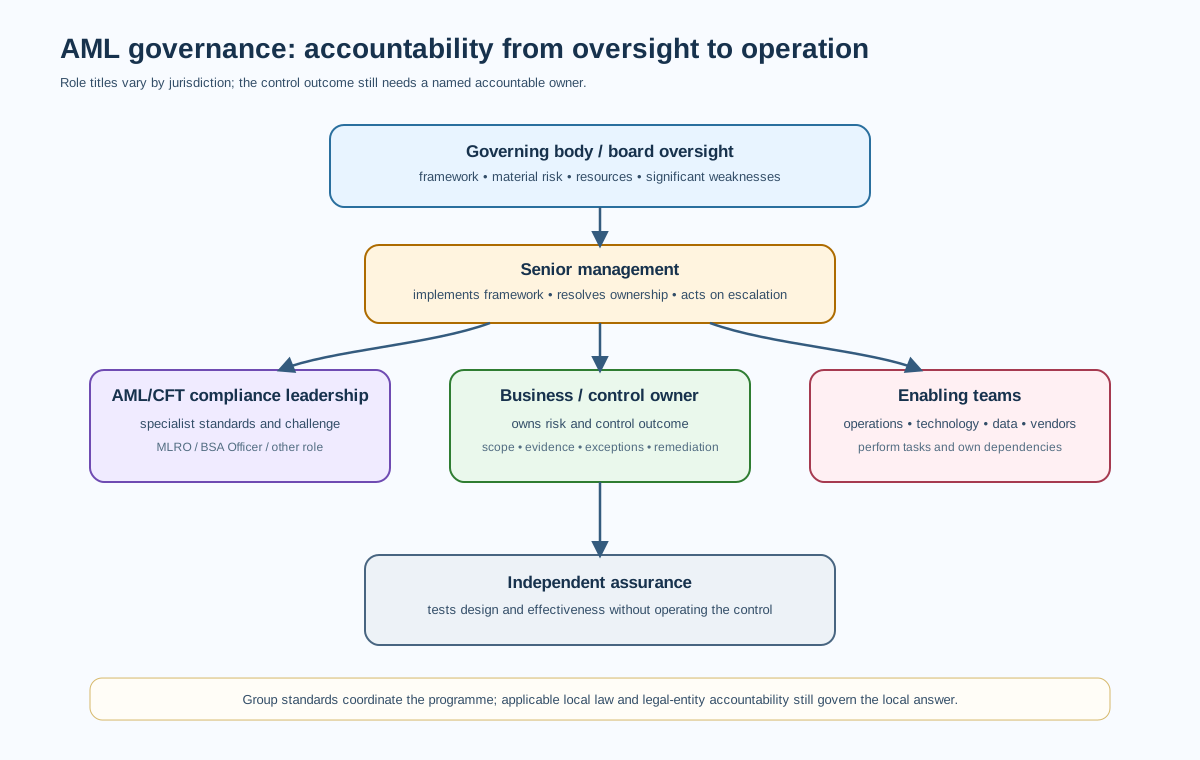
The simplest mental model: risk, obligation, control, owner, evidence
A useful way to think about AML governance is as a five-part chain.
Risk is the exposure the institution is trying to manage. That might be money laundering through cash-intensive customers, terrorist financing through cross-border flows, sanctions evasion through trade activity, misuse of instant payments, or weaknesses in customer identity data. Risk is not the same as an obligation. A bank can face material risk even where a rule does not prescribe a specific control design.
Obligation is what applicable law, regulation, supervisory expectation, licence condition, group standard or approved internal policy requires. Global standards such as the FATF Recommendations influence national frameworks, but they do not replace local law. The exact duties of a bank in London, New York, Singapore or Stockholm are not identical simply because all operate under broadly similar AML/CFT principles.
Control is the mechanism used to prevent, detect, contain or evidence the risk. Examples include onboarding verification, beneficial-ownership checks, transaction-monitoring scenarios, sanctions screening, high-risk relationship approval, quality assurance, suspicious activity escalation, data-quality reconciliation and independent testing.
Owner is the role with defined accountability for the control. Ownership is different from performing a task. A central operations team may execute customer refreshes while a business line owns the customer relationship, a compliance function defines minimum standards, a technology team operates the platform, and internal audit independently assesses the programme. The design must make those distinctions explicit.
Evidence is what allows an independent person to determine what happened. Evidence includes approved policy, control specifications, system configuration, case records, reconciliations, test results, committee minutes, issue logs, change approvals, training records and management information. Governance without evidence becomes assertion. Evidence without clear ownership becomes a collection of artefacts that no one is responsible for keeping reliable.
The practical test is straightforward: if a supervisor asks, “Who is responsible for this control, what evidence demonstrates its operation, and what happens when it fails?”, the bank should not need several weeks of organisational archaeology to answer.
Global baseline: what the standards actually require
FATF Recommendation 18 provides the core global reference point for internal AML/CFT controls. It expects financial institutions to implement programmes that take account of ML/TF risk and the size of the business. The programme includes internal policies, procedures and controls; appropriate compliance-management arrangements, including appointment of a compliance officer at management level; employee screening; ongoing employee training; and an independent audit function to test the system. FATF also expects financial groups to implement group-wide programmes, including information-sharing arrangements and application to branches and majority-owned subsidiaries, subject to the detailed conditions in the Recommendation and its Interpretive Note.
That global baseline is deliberately principles-based. FATF does not prescribe one universal committee structure, one universal “three lines” allocation or one universal RACI. National law and supervisory regimes turn the standard into enforceable requirements. A multinational bank therefore needs both a common group framework and a legal-entity view that records what each local entity must do.
The Basel Committee’s current consolidated AML/CFT guidance, published in the Basel framework in 2026 and based on its earlier sound-management guidance, treats ML/FT risk as part of the bank’s overall risk-management framework. This matters because AML should not be isolated inside a specialist compliance team. Customer strategy, product design, operations, technology, data, correspondent relationships and senior-management decisions can all change the bank’s exposure. A strong programme therefore connects financial-crime governance to enterprise governance while preserving specialist expertise and independence where required.
The Wolfsberg Group adds an industry effectiveness lens. Its work on effectiveness and auditing encourages financial institutions to focus not only on technical compliance but on whether controls are risk-based and produce useful outcomes. That does not reduce legal obligations. It changes the governance question from “did we operate the process exactly as written?” to the stronger question “did the process meet the legal requirement and materially reduce or identify the risk it was designed to address?”
Jurisdiction-specific examples must remain jurisdiction-specific
The European Union provides a useful example of why governance cannot be taught as a single global rule. The EBA’s 2022 Guidelines on the role and responsibilities of the AML/CFT compliance officer set detailed expectations for the management body, the member responsible for AML/CFT, the compliance officer and group arrangements. On 1 January 2026, EU-level AML/CFT mandates moved from the EBA to AMLA. Existing EBA AML/CFT guidelines remain in force until AMLA replaces them, so a bank operating in the EU in 2026 must understand both the existing guideline set and the developing AMLA framework rather than assuming the institutional change made earlier guidance disappear.
In the United Kingdom, FCA rules require applicable firms to allocate overall responsibility for establishing and maintaining effective AML systems and controls to a director or senior manager, and to appoint an MLRO with sufficient authority, independence, resources and information. The FCA Financial Crime Guide further emphasises senior-management engagement and practical evidence that financial-crime risks are understood and managed. Those are UK requirements and expectations, not global titles that every bank must replicate word for word.
In the United States, the BSA/AML framework uses different terminology and legal architecture. The FFIEC BSA/AML Examination Manual explains that a bank’s board must designate a qualified BSA compliance officer and that the officer needs appropriate authority, independence, resources and competence. The U.S. programme also includes internal controls, training and independent testing. Again, the operating principle is recognisable globally, but the exact regulatory source, role title and board duty are jurisdiction-specific.
This distinction is important for architects and business analysts. A global workflow should not hard-code the assumption that every country uses the title “MLRO”, every compliance officer has identical approval powers, or every high-risk customer requires the same committee. The data model should support jurisdiction, legal entity, role type, delegated authority, effective date and source of authority.
Governance is more than the “three lines” model
Many banks use a three-lines model in which the business owns and manages risk, an independent risk or compliance function provides oversight and challenge, and internal audit provides independent assurance. It is a useful organising model, but it should not be mistaken for the legal text of FATF Recommendation 18 or for a universally mandated organisational design.
The important idea is separation of responsibilities and credible challenge. The team generating revenue should not be able to redefine the control standard silently when the standard becomes inconvenient. The function monitoring compliance should have enough independence, seniority and access to challenge weaknesses. The party providing independent assurance should not be testing work for which it is operationally responsible. How a particular institution implements those principles depends on size, business model, jurisdiction and governance structure.
A common large-bank operating model may therefore contain the following roles without implying that every bank must use these labels:
| Role | Practical accountability | What should not be confused with it |
|---|---|---|
| Governing body or board | Oversight of material AML/CFT risk, framework, resources and significant weaknesses | Day-to-day case handling |
| Senior management | Implements strategy, resolves material ownership conflicts, allocates resources and acts on escalation | Independent audit |
| AML/CFT compliance officer or MLRO | Specialist oversight, advice, monitoring, escalation and reporting within the applicable legal framework | Automatic ownership of every first-line control |
| Business or product owner | Owns risks arising from the business activity and ensures required controls operate in the process | Setting aside mandatory standards for commercial reasons |
| Control owner | Accountable for design, documentation, operation, evidence, performance and remediation of a defined control | Merely executing a task in the workflow |
| Control operator | Performs a control activity, manually or through an operating team | Ultimate accountability for design and effectiveness unless explicitly assigned |
| Technology/data owner | Provides reliable systems, rules, data, access, lineage and change controls | Deciding the legal meaning of an AML obligation |
| Internal audit or equivalent independent assurance | Independently assesses programme design and effectiveness | Routine operational QA performed by the control owner |
This table is a design aid, not a legal allocation. Local rules may assign specific responsibilities differently.
Control ownership: one control, one accountable owner
A control can involve many teams, but it should have one clearly identified accountable owner at a point in time. Shared contribution is normal; shared accountability is often where ambiguity begins.
Consider customer sanctions screening. The customer platform captures names and identifiers. A screening engine performs matching. An operations team reviews alerts. Compliance defines the minimum screening standard and escalation policy. Technology maintains the engine. Data teams manage feeds. Legal may advise on difficult ownership questions. Internal audit may later assess the control. If an alert is missed because the customer feed was not delivered, the bank needs to know which owner is accountable for the end-to-end control and which component owner is accountable for the failed data interface.
The same principle applies to transaction monitoring. The monitoring platform may belong to technology, the scenarios may be designed by financial-crime analytics, alerts may be reviewed by operations, and the programme may be overseen by compliance. The control record should make clear who owns coverage, who owns each technical component and who has authority to accept limitations. “Technology owns the system” is not an adequate answer to “who owns the transaction-monitoring control?”
A mature control inventory normally records more than a control name. Useful attributes include the risk or obligation addressed, control purpose, control type, legal entities and products in scope, process location, owner, operator, frequency or trigger, systems and data used, evidence produced, key dependencies, performance measures, testing approach, known limitations, issue links, policy source, last review date and effective-date history.
The metadata matters because controls change. A control owned by the Retail KYC Head in January may move to a shared operations function in July. A supervisor reviewing a historical event needs to know the owner and design that applied at the time, not merely the current-state record.
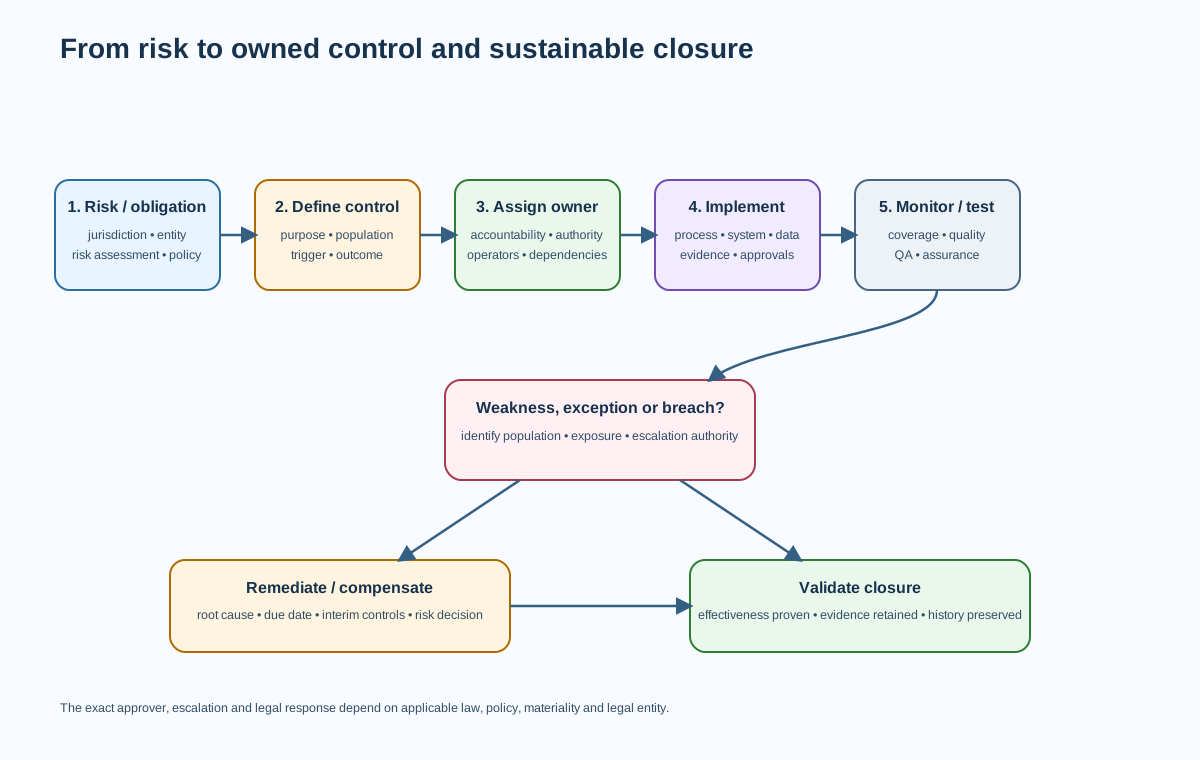
From enterprise risk assessment to control framework
Governance should begin with the bank’s risk assessment, not with an inherited list of controls. The enterprise-wide or business-level ML/TF risk assessment identifies exposure across customers, products, services, channels, geographies and delivery models. The control framework then maps those exposures to preventive, detective and corrective measures.
Suppose an institution enters merchant acquiring for online marketplaces. The risk assessment may identify layered merchants, payment facilitators, rapid settlement, cross-border sellers and opaque beneficial ownership as new exposures. Governance should not simply add a line saying “merchant acquiring covered by AML programme.” It should identify which controls must change: KYB requirements, merchant risk classification, sanctions screening, transaction monitoring, payout monitoring, prohibited-business controls, adverse-media intelligence, escalation rules and reporting. Each change needs an owner and delivery date.
This is where risk appetite becomes operational. Risk appetite should not be a slogan such as “zero tolerance for money laundering.” No bank can credibly claim zero exposure to attempted financial crime while participating in the financial system. Useful appetite statements distinguish conduct the bank will not knowingly support from the residual risk it is prepared to manage, the customer or product exposures it permits under enhanced controls, and the control-performance indicators that trigger escalation.
Governance forums then use measurable information to decide whether exposure remains within approved appetite. An increasing backlog of sanctions alerts, a transaction-monitoring data gap or a fall in high-risk periodic-review completion is not merely an operational metric. It may represent a period during which the institution’s residual risk exceeds its approved tolerance. The issue should therefore route to a decision-maker with authority to accept temporary exposure, require compensating controls, restrict activity or accelerate remediation.
Policy, standard, procedure and control must not be collapsed together
Banks frequently create confusion by calling everything a “policy”. A strong hierarchy distinguishes what the institution intends, what minimum rules apply, how a process is performed and which specific activity demonstrates control.
A policy usually sets principles, scope, governance and high-level requirements approved at the appropriate level. A standard translates policy into mandatory minimum requirements, often across legal entities or businesses. A procedure explains operational steps for a particular team or workflow. A control is a defined mechanism that prevents, detects or responds to a risk and produces evidence of its operation.
For example, an AML policy may require ongoing monitoring. A monitoring standard may require coverage of defined customer and transaction risks. A procedure may describe how analysts investigate alerts. Individual controls may include daily ingestion reconciliation, scenario execution, alert ageing thresholds, investigator QA and monthly coverage review.
Control ownership becomes much easier when these levels are separated. The policy owner does not automatically own every underlying control. A business can be accountable for operating a control while compliance owns the minimum standard. Internal audit remains independent of both.
RACI helps only when decision rights are explicit
RACI matrices are common in transformation programmes because they force teams to name who is Responsible, Accountable, Consulted and Informed. They are useful, but they can create false comfort if the underlying decision is vague.
A row saying “high-risk customer approval — business A, compliance C” is incomplete if nobody has defined whether the business may approve against a compliance objection, whether the compliance role has veto authority under policy, which senior manager can accept an exception, and whether certain customers are prohibited by law rather than by risk appetite.
For material AML controls, the better question is not simply “who is A?” but “what decision can this role make, within what authority, based on what evidence, and how is that decision recorded?” Delegations should be explicit and time-bounded. Temporary acting arrangements should not silently create permanent risk acceptance. Committee terms of reference should distinguish recommendation, approval, escalation and information roles.
RACI should also be versioned. When a reorganisation changes ownership, the effective date matters. Historical investigations, audit work and regulatory responses may need to reconstruct the governance model that existed before the change.
Group governance versus legal-entity accountability
Large banks often seek consistency through group policy, common platforms and centralised operations. This is efficient, but it can create a dangerous assumption that a group function has absorbed the legal accountability of local entities.
FATF Recommendation 18 supports group-wide programmes and information sharing, but local implementation can still differ because of secrecy law, data-protection requirements, suspicious-reporting rules, sanctions regimes, customer rights, local supervisory expectations and restrictions on cross-border data access. A group standard therefore needs a jurisdictional applicability model rather than a lowest-common-denominator rule.
A useful design separates three layers. The group layer establishes common principles, taxonomy, minimum standards, technology patterns and escalation expectations. The legal-entity layer identifies local obligations, accountable management, regulatory contacts and permitted deviations. The service layer describes what a shared service or centre of excellence performs on behalf of entities and what evidence it returns to them.
When a group operations centre performs KYC reviews for several countries, the local entity should be able to demonstrate that the service meets its requirements. An intercompany service agreement or outsourcing contract does not by itself prove control effectiveness. The entity needs service measures, quality results, issue visibility, change notification and rights of escalation.
Outsourcing does not outsource accountability
Banks increasingly rely on vendors for identity verification, sanctions data, adverse media, transaction-monitoring platforms, case management, managed operations and cloud services. Governance must distinguish service delivery from regulatory accountability.
A vendor can operate part of a process, but the regulated institution remains responsible for determining whether the service is appropriate for its obligations. That means vendor governance should include due diligence, clear control requirements, service-level measures, data and security requirements, change notification, audit or assurance rights, incident escalation, business continuity, concentration risk and exit planning.
For AML controls, a particularly important question is who owns configuration. A screening vendor may provide a matching engine, but the bank may choose thresholds, lists, fields and alert logic. If a change reduces false positives but also reduces coverage, the decision requires financial-crime governance rather than being treated as routine technical tuning.
The same is true for managed investigations. Productivity targets should not pressure an outsourced team to close cases without sufficient evidence. Quality measures, training, competency and escalation must be part of the control design.
Technology and data are part of governance
AML governance often fails through technical dependencies that are absent from committee papers. A control may be described as “all outgoing cross-border payments are sanctions screened”, while the actual architecture contains six channels, two message formats, three enrichment services, a screening engine and several exception routes. If one channel bypasses the screening interface after a release, the governance statement is no longer true.
A bank therefore needs traceability from the business control to technical implementation. Useful links include:
- the source systems and events that trigger the control;
- mandatory data fields and quality rules;
- transformation and enrichment logic;
- control configuration and version;
- downstream workflow and decision status;
- override and exception permissions;
- evidence store and retention period;
- reconciliations proving completeness;
- monitoring showing failed or delayed execution.
This traceability allows a control owner to ask whether the control actually covers the promised population. It also helps architects understand why a “small” interface change may require AML approval and regression testing.
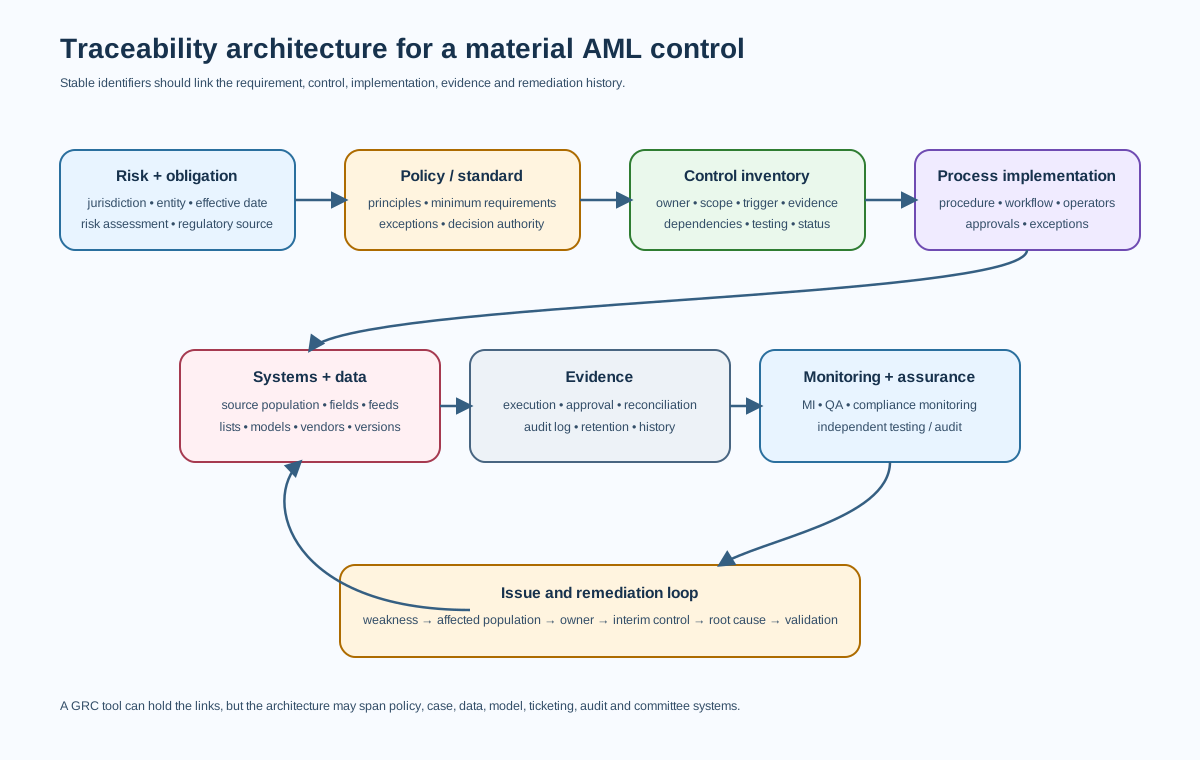
Evidence: what good control ownership looks like after the event
A control is not effective merely because a policy says it exists. A reviewer should be able to inspect evidence from a defined period and determine that the control operated as designed.
For a daily payment-screening completeness control, evidence might include the expected payment population, actual population submitted for screening, reconciliation result, exception details, remediation action and reviewer sign-off. For high-risk customer approval, evidence might include the risk assessment, enhanced due diligence, compliance recommendation, approval authority, conditions, decision date and scheduled review. For a governance committee, evidence includes the information considered, challenge raised, decisions made, actions assigned and follow-up to closure.
Evidence should be reproducible rather than dependent on screenshots assembled manually for an audit. Where possible, systems should retain immutable or controlled logs showing who performed the action, what version of rules applied, what data was available and what outcome was recorded.
The evidence model should also preserve failures. If a control missed its deadline, the record should not be overwritten to make the dashboard green. A mature programme captures the breach, the period of exposure, compensating actions, root cause and closure evidence. That history is valuable because repeated “temporary” exceptions often reveal a systemic weakness.
Management information should enable decisions, not decorate committees
AML committees commonly receive large packs containing alert volumes, case closures, KYC completion rates and training percentages. Those metrics may be necessary, but volume alone does not tell leadership whether the programme is effective.
A useful management-information set connects risk, control performance, quality, capacity, issues and outcomes. For example, a rise in alert volume matters differently if it reflects a deliberate new detection capability, a data defect, criminal activity growth or poor tuning. A high case-closure rate is positive only if quality and suspicion-escalation measures remain credible. A KYC review backlog is more serious when concentrated in high-risk customers than when limited to low-risk administrative refreshes.
Senior management needs trends, thresholds and narrative. Every red indicator should answer: what happened, what risk does it create, how long has it existed, who owns it, what is being done, what is the expected residual exposure, and what decision is required from this forum?
Boards and governing bodies need a different level of information from operational committees. They do not need every scenario threshold. They need a clear view of material ML/TF exposure, significant control weaknesses, regulatory matters, resource constraints, risk-appetite breaches and whether remediation is progressing. Governance fails when reporting is either so detailed that material signals are buried or so aggregated that serious weaknesses disappear into a green status.
Issue management and the meaning of closure
A control issue is not closed because a project delivered code or because an owner changed the status to “complete”. Closure means that the root cause has been addressed, the remediation has been implemented, the new or repaired control has been validated, required evidence exists and any residual risk has been accepted by the correct authority.
A useful issue record includes the control failure, affected population and period, root cause, regulatory or customer implications, interim controls, accountable owner, milestones, dependencies, validation approach and closure authority. Significant issues should be traceable to the governing forum that accepted the plan and, where appropriate, to the risk appetite or regulatory commitment they affect.
Extensions need governance too. A due-date extension should state why the original plan failed, what exposure exists during the extension, what compensating measures apply and who has authority to approve the delay. Repeated extensions should trigger stronger challenge rather than becoming a normal project-management practice.
Independent validation is especially important where management has incentives to declare completion. A control owner can provide evidence, but assurance should be sufficiently independent to challenge whether the remediation is sustainable.
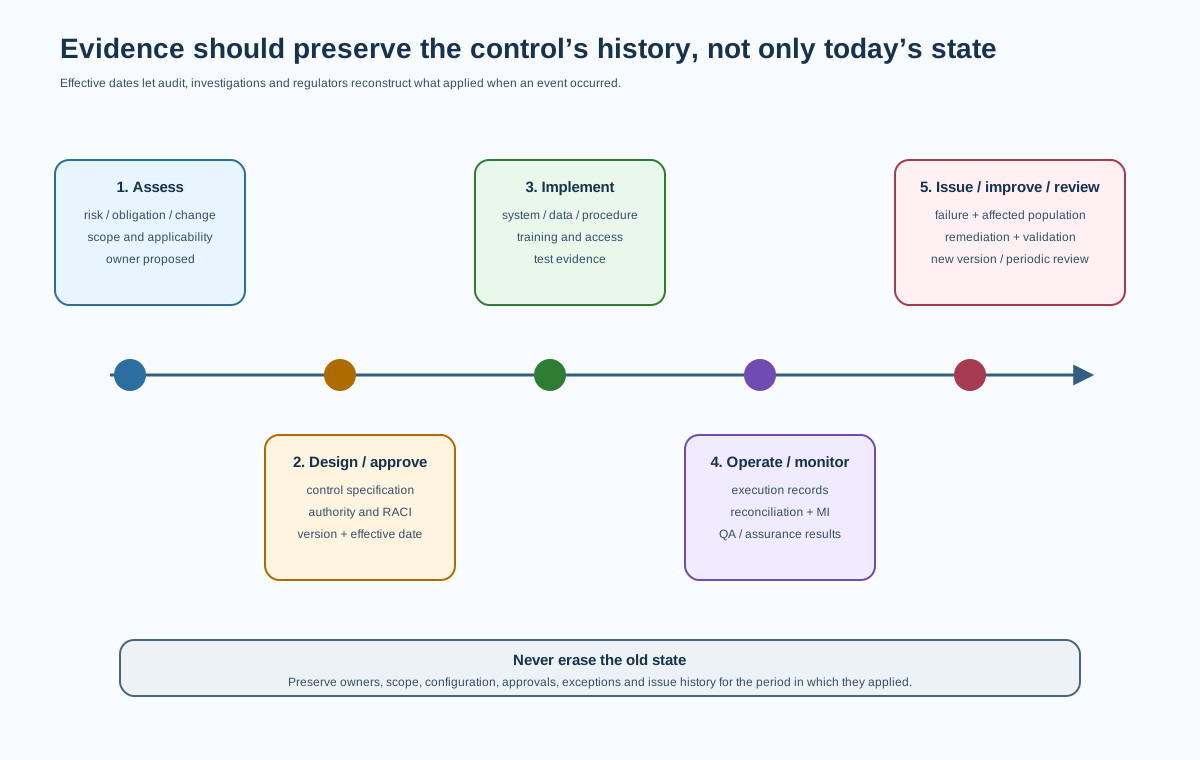
Change governance: every material change can alter the AML control environment
AML programme governance must be connected to product and technology change. New products, new geographies, acquisitions, cloud migrations, payment-rail changes, message-format changes, vendor replacements and organisational restructures can all modify risk or control coverage.
A good change process asks financial-crime questions early. What new customer behaviour becomes possible? What new data is created or lost? Which sanctions, CDD or monitoring controls are affected? Does the change create a new legal entity, delivery partner or geography? Do existing scenarios still receive the correct fields? Are roles and approval authorities changing? What regression testing is required?
The goal is not for compliance to approve every software release. The goal is to define risk-based triggers that route material changes to appropriate review. A front-end colour change should not require AML governance. A change to beneficiary data mapping, screening fields, transaction codes or customer-risk logic probably should.
Change records should connect to control records. When a deployment changes a control, the bank should update configuration evidence, test results, owner sign-off and effective date. Otherwise the control inventory becomes a description of yesterday’s system.
A practical case: the control that everybody owned and nobody owned
Consider a fictional international bank, Northstar Bank, launching instant payments for small-business customers in three countries. The programme reuses the existing sanctions engine and transaction-monitoring platform. Product management owns the launch, payments operations handles exceptions, a central financial-crime team sets policy, a regional compliance team oversees local requirements, technology owns the screening interface, and a vendor operates part of the alert queue.
During design, everyone agrees that outbound payments will be screened and high-risk patterns monitored. The project plan contains dozens of technical owners but no end-to-end control owner. The sanctions team assumes Payments owns screening completeness because Payments owns the journey. Payments assumes Financial Crime owns it because Financial Crime owns the policy. Technology assumes it owns only platform availability. The vendor believes its obligation begins when an alert reaches its queue.
Three months after launch, an internal review finds that one API channel used a new structured-address field that was not passed correctly into screening. Payments were screened, but with incomplete address data. There is no automatic reconciliation comparing source payment fields with the payload sent to the sanctions engine. The issue existed from launch.
The immediate technical fix is easy. The governance problem is harder. Northstar needs to determine the affected population, assess whether rescreening or other retrospective review is required under applicable policy and law, document the exposure period, notify appropriate management, evaluate whether the defect created a reportable breach, and strengthen design governance so similar omissions do not recur.
The bank appoints an end-to-end payment-screening control owner in the Payments business, with Compliance owning the minimum screening standard and independent challenge. Technology owns defined technical components, including field mapping and interface reconciliation. The control record links all in-scope channels and mandatory fields. A daily completeness control compares source and screened populations, while a data-quality control tests critical party fields. Material mapping changes now trigger financial-crime impact assessment and regression testing.
This case shows why “the system was working” is not enough. Governance asks whether the control objective was met across the promised population and whether someone was accountable for proving that outcome.
Business-analysis requirements for governance controls
Business analysts can make governance concrete by turning principles into testable requirements. “The bank shall have clear control ownership” is not testable. Better requirements define the control object and the behaviour around it.
For example, a control inventory requirement might state that every material AML control must have a unique identifier, named accountable owner, effective date, linked risk and policy requirement, in-scope legal entities and products, control description, frequency or trigger, evidence source, system dependencies, testing approach and current status. The system should prevent a material control from becoming active without an owner and should preserve prior ownership history.
An issue-management requirement might state that a high-severity financial-crime issue cannot be closed until remediation evidence and validation results are attached and the closure authority is recorded. If the due date changes, the system must record the original date, revised date, rationale, approver and interim risk treatment.
A governance-workflow requirement might distinguish recommend, approve, challenge, escalate and inform actions rather than using a generic “complete” status. Those verbs matter because they reflect decision rights.
For data and architecture, the BA should trace each critical control to systems and data dependencies. If a customer-screening control depends on name, date of birth, nationality and beneficial-owner data, the requirement should specify which sources are authoritative, how missing values are handled, how completeness is monitored, and what happens when an upstream feed fails.
Architecture considerations
Architecture for governance is usually distributed rather than contained in one “GRC system”. Relevant information may sit in policy management, control libraries, case platforms, workflow engines, data catalogues, model inventories, ticketing systems, audit tools, HR systems and committee portals.
The design challenge is traceability. The control owner should not need five manual spreadsheets to understand whether a critical control has an open issue, upcoming test, failed dependency or pending regulatory change.
A practical logical model can use stable identifiers linking obligation → risk → policy/standard → control → process → system/data dependency → evidence → test → issue → remediation. Not every bank needs one physical database, but the relationships should be queryable.
Effective dating is essential. Regulators, audit teams and investigators often ask historical questions. A current-state graph cannot answer who owned a control when a failure occurred six months earlier unless changes are preserved.
Access controls also matter. Governance information can contain confidential suspicious-activity details, regulatory findings and legal advice. The platform should support least privilege, segregation of duties and appropriate retention without making oversight impossible.
Testing the governance model
Governance testing should prove more than whether mandatory fields are populated.
A positive test can create a new control and confirm that it cannot become effective until ownership, scope, evidence and approval requirements are satisfied. A change test can replace an owner and verify that history remains visible. An issue test can attempt closure without validation evidence and confirm that the workflow rejects it. A role test can confirm that a control operator cannot approve their own independent assurance result. A resilience test can simulate an unavailable evidence source and verify escalation rather than silent completion.
End-to-end tests should start from a real business event. For a new payment product, trace the financial-crime risk assessment through policy requirements, control changes, system configuration, evidence, MI and governance sign-off. This reveals gaps that component testing misses.
Negative testing is equally important. Try a legal entity missing from group control scope, a vendor service without an assigned internal owner, a control with an expired exception, a committee decision without action ownership, or a data feed that drops transactions while the screening engine remains technically available.
Good testing asks: could the bank confidently reconstruct what it knew, who decided, what control was expected to operate and what evidence existed at that time?
Common governance failures
Some failures appear repeatedly across institutions.
The first is ownership by committee. A committee can provide oversight and collective decision-making, but it is rarely a substitute for a named executive or control owner responsible for action between meetings.
The second is compliance owns everything. Compliance may own the framework and specialist oversight, but if business teams treat AML as someone else’s problem, financial-crime risk is separated from the products and customers that create it.
The third is technology owns every automated control. Technology can own reliability and configuration components while the business or financial-crime function remains accountable for the control outcome.
The fourth is outsourcing ownership with the task. A vendor can perform work; the bank still needs an internal accountable owner who understands whether the outsourced control meets applicable requirements.
The fifth is green dashboards without exposure analysis. A project can be on schedule while a control gap remains open. Governance should report the risk created during remediation, not only delivery progress.
The sixth is current-state-only documentation. If role, control and configuration history are overwritten, the bank cannot reconstruct past accountability.
The seventh is confusing challenge with approval. A compliance review may be advisory, mandatory concurrence, veto-capable or final approval depending on policy and law. The workflow must represent the actual authority.
The eighth is closing issues on implementation rather than effectiveness. Installing a new system is not the same as proving that the new control works across the required population.
Governance map: who needs to see what
Different governance levels need different decisions. Operational owners need failed-control details and immediate actions. Specialist financial-crime forums need trends, typologies, coverage, quality and material exceptions. Senior management needs material residual risk, resource decisions, major remediation and appetite breaches. The board or governing body needs a clear view of programme effectiveness, significant deficiencies, regulatory exposure and whether management is responding credibly.
The group function needs to see cross-entity patterns without erasing local accountability. Local legal entities need enough visibility into shared services to meet their own obligations. Internal audit needs access to records without becoming part of control operation.
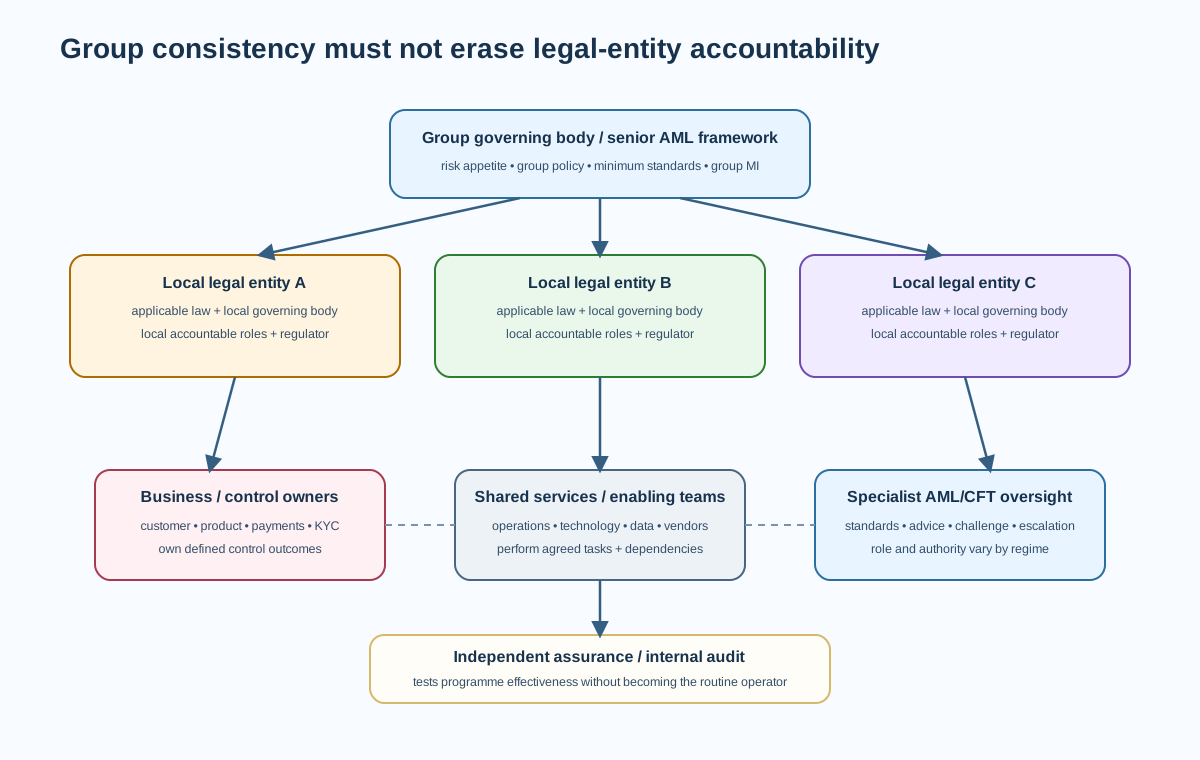
What good looks like
A strong AML governance framework is visible in everyday decisions. People know which risks they own. Control records are current. Specialist compliance can challenge the business without becoming the owner of every operational task. Senior management receives information that explains risk rather than just volume. Material weaknesses have named owners, realistic due dates and compensating measures. Internal audit can independently assess the programme. Group standards and local obligations are reconciled rather than assumed to be identical. Technology and data dependencies are part of control documentation rather than hidden below the governance layer.
Most importantly, accountability survives pressure. Commercial urgency, alert backlogs, transformation deadlines and regulatory change do not cause decision rights to disappear. When a control cannot operate as designed, the organisation knows who must decide what happens next and how that decision will be evidenced.
That is the practical purpose of AML programme governance: not to create more meetings, but to make sure important financial-crime risks have a clear owner, an effective control, reliable evidence and an escalation path before the bank needs to explain a failure to customers, auditors or supervisors.
Operational deep dive: making AML governance work in a real bank
The base chapter explains the governance model. This deep dive focuses on the hard part: turning that model into daily decisions that remain clear when several businesses, legal entities, systems and specialist teams contribute to the same control.
Start with the control objective, not the organisation chart
A weak governance exercise begins by listing departments and then attaching AML responsibilities to them. A stronger exercise begins with the risk and the required control outcome. If the objective is to ensure that all in-scope cross-border payments are screened against the applicable sanctions requirements before release, the bank should first define the population, timing, data fields, decision states, exceptions and evidence. Only then should it allocate ownership.
This order matters because organisation charts change faster than control objectives. A bank can move sanctions operations from one country to another, replace a vendor, centralise technology or reorganise compliance without changing the underlying obligation. When the control definition is stable and the owner is explicitly effective-dated, governance survives those changes.
A useful control record therefore answers five questions in plain language. What risk or obligation does the control address? What exactly must happen? Who is accountable for making sure it happens? What evidence proves operation? What happens when the control cannot operate as designed?
The record should also distinguish the end-to-end control from its components. For payment sanctions screening, component controls can include list ingestion, customer or payment data extraction, data transformation, screening-engine availability, matching configuration, alert workflow, analyst quality review and population reconciliation. A technology team can own a component without owning the full sanctions-control outcome.
Control owner, process owner and task performer are different roles
Banks often use these labels inconsistently. That is acceptable if the local framework defines them clearly, but the underlying responsibilities should not blur.
A process owner is usually accountable for the broader business process. A control owner is accountable for a specific control within that process. A control operator performs the control. A system owner is accountable for the technology service. A data owner is accountable for defined data assets and quality. A policy owner maintains the governing standard. A second-line or specialist compliance function, where the bank uses that model, sets or interprets financial-crime requirements and challenges the first line. Internal audit provides independent assurance and should not become part of routine control operation.
For a high-risk customer review, for example, the relationship business may own the customer relationship and the periodic-review control, a KYC operations team may perform evidence collection, financial-crime compliance may set minimum EDD requirements and provide challenge, a workflow team may own the platform, and a senior approval forum may decide whether residual risk is acceptable. Naming each role prevents the common failure where every team can say it contributed but no one is accountable for the final control outcome.
A RACI can help, but only if the decision is specific. “Compliance consulted” is too vague where the real question is whether a business can proceed against a compliance objection. Governance documentation should state whether compliance gives advice, mandatory concurrence, veto, final approval or escalation, according to the bank’s applicable policy and law.
Governance forums should have decisions, not just meetings
Committees are useful when they aggregate information and exercise authority. They become ceremonial when the agenda contains volumes and status updates but no clearly defined decisions.
An operational AML forum may review alert backlog, case ageing, data failures, KYC exceptions and service incidents. A specialist financial-crime risk committee may review control effectiveness, typology changes, material high-risk customers, sanctions exposure, major investigations and policy exceptions. Senior management may review significant deficiencies, resource constraints, remediation, risk-appetite breaches and regulatory commitments. A board or governing-body forum may receive the programme-level view of material ML/TF risk, significant control weakness and management response.
The exact structure varies by institution and jurisdiction. The design principle is that each forum should have a documented purpose, membership, quorum, decision rights, escalation criteria, information requirements and action tracking. Minutes should show what was challenged and decided, not merely reproduce presentation slides.
If a committee approves a temporary control exception, the record should show the affected population, exposure period, interim measures, accountable owner, expiry date and who can renew it. Otherwise “temporary” exceptions can remain open indefinitely without an explicit risk decision.
Group standards and local legal-entity duties
A multinational bank usually wants one common AML framework. That can improve consistency, technology reuse and oversight. It does not mean every local entity has identical legal obligations.
The group policy should define minimum principles and common controls. The legal-entity layer should document local legislation, regulator expectations, suspicious-reporting arrangements, sanctions regimes, customer rights, secrecy or data-protection constraints, record-retention rules and required accountable roles. Where local law is stricter than group policy, the local requirement must be implemented. Where group policy is stricter, the bank should understand whether the stronger group requirement is legally permissible and operationally appropriate.
This becomes particularly important for information sharing. FATF Recommendation 18 supports group-wide AML/CFT programmes and information sharing, but national laws can affect what customer, investigation or suspicious-reporting information may be transferred across borders. Governance should therefore distinguish the group need for risk visibility from the legal permission to share a specific data set.
A shared-service centre performing KYC or monitoring for several entities should maintain an explicit service catalogue. Each entity needs to know which controls the service performs, which data it receives, what quality and timeliness measures apply, what happens during outages and how incidents are escalated. The local entity should not discover during an examination that its critical AML process depended on an informal service arrangement with no measurable control evidence.
The control inventory is the backbone of traceability
A mature control inventory should allow the bank to move from a regulatory or policy requirement to the implemented control and then to evidence. A useful logical chain is:
obligation or risk → policy/standard → control → process → system/data dependency → evidence → monitoring/testing → issue → remediation.
This chain matters during change. If a payment hub changes the field used for debtor address, the bank should be able to identify which screening, monitoring or reporting controls consume that field. If a vendor discontinues a sanctions-data product, the control inventory should reveal which controls depend on it. If a regulator changes a rule, obligation mapping should identify the policies and controls requiring impact assessment.
Effective dating is essential. A control record should not overwrite the past. The bank may need to reconstruct which owner, scenario version, policy and system configuration applied when a historical transaction was processed. This is particularly important for lookbacks, regulatory investigations and internal audit.
Evidence design should be part of the control, not an afterthought
Control evidence is strongest when generated naturally by the workflow. Manually assembling screenshots after an audit request is expensive and often unreliable.
For an automated control, evidence can include input population counts, configuration version, execution timestamp, processing result, exception population and reconciliation. For a manual approval, evidence can include the information presented, recommendation, authority, decision, conditions and timestamp. For a committee, evidence includes the pack version, minutes, decisions and tracked actions.
Evidence quality also depends on immutability and access. A person should not be able to change a historical approval silently. Audit logs should capture changes to material configuration and ownership. Retention should follow the applicable legal and policy requirements, which can vary by record type and jurisdiction.
Management information: connect volume to risk
A dashboard that shows 25,000 alerts and a 98% closure rate tells leaders very little by itself. Governance information should connect operating performance to risk.
For transaction monitoring, useful questions include: which scenarios drive volume, how has alert-to-case conversion changed, which high-risk segments have backlog, how old are the oldest cases, what proportion of alerts are waiting because data is missing, and what quality findings recur? For KYC, leaders need more than completion percentage: they need risk segmentation, overdue high-risk populations, exception causes, ageing, data-quality defects and remediation status.
Thresholds should have a decision attached. If a backlog exceeds tolerance, the governance framework should specify who decides whether to add capacity, apply a compensating control, restrict new business, change prioritisation or accept temporary residual risk. Metrics without decision rights become reporting theatre.
Issue ownership and sustainable closure
A financial-crime issue should describe the actual control weakness, not only the project task created to fix it. “Implement new monitoring rules” is a remediation action. The issue is the underlying detection gap and the exposure it creates.
A good issue record identifies the affected control and population, start date, severity, root cause, customer or regulatory impact, interim controls, accountable owner, milestones, dependencies and validation method. If the bank cannot determine the exact affected population, that uncertainty should be recorded rather than hidden.
Closure should require evidence that the remediation works. A new system can be installed and still fail because source data is incomplete, operators are not trained or exceptions bypass the workflow. Independent validation should test the corrected control across the intended population and verify that the root cause has been addressed.
Extensions deserve the same discipline. A due-date change should record why the original plan failed, what risk persists during the extension, which compensating controls apply and who has authority to accept the revised date.
When governance should escalate immediately
Some situations should move quickly beyond routine operating management. Examples include an AML control that has stopped operating for a material population, a sanctions-screening feed failure, evidence that a high-risk customer was onboarded outside approved authority, a significant transaction-monitoring data gap, an unapproved change to critical configuration, repeated quality failures in outsourced operations, or a missed statutory reporting deadline.
The escalation route depends on applicable law, materiality and the bank’s governance. It may involve financial-crime leadership, senior management, legal, risk, internal audit or the regulator. The important design feature is that operational teams know the trigger and do not have to invent the route during an incident.
Practical review questions
A reviewer assessing AML governance should be able to trace one material control from policy to operation. Who owns it? Which legal entities and products are in scope? Which systems and data does it depend on? How is completeness proven? What exceptions are open? How is the control tested? What happened the last time it failed? Which forum saw the issue? Who accepted interim risk? What evidence supported closure?
If those questions require several disconnected spreadsheets, oral explanations and undocumented assumptions, the programme may have many governance artefacts without a reliable governance system.
The strongest programmes make accountability reconstructable. They do not assume that experienced people will remember who owned what. They preserve the relationship between risk, decision, owner and evidence so that the control remains understandable even after the people who designed it have moved on.
Advanced practice: governance under change, outsourcing and assurance
AML governance is easiest to describe when the operating model is stable. The harder test is whether accountability remains clear during acquisitions, platform migrations, regulatory change, outsourcing, model tuning, staff turnover and control failure. This supplement focuses on those conditions.
Outsourcing a task does not outsource the bank’s accountability
Financial institutions increasingly use third parties for screening technology, sanctions data, identity verification, adverse media, managed KYC, alert investigation, cloud infrastructure and specialist analytics. A supplier can perform work and still leave the regulated institution accountable for deciding whether the service satisfies its obligations.
Governance should therefore identify an internal owner for every material outsourced AML capability. The owner needs enough information to challenge the supplier rather than simply monitor contractual uptime. Service governance should include population coverage, quality, error rates, data completeness, configuration, material changes, staff competence where managed operations are involved, incidents, backlog, business continuity and remediation.
A service-level agreement saying that a platform is “99.9% available” is not evidence that the sanctions control is effective. The service could be technically available while a source feed is incomplete, a list update failed, a critical field is truncated or a threshold has been configured incorrectly. Control measures must therefore connect technology performance to the financial-crime outcome.
Exit planning is part of control ownership too. If a vendor contract ends or a service becomes unavailable, the bank should know how lists, cases, audit records, customer data, configuration and open alerts will be transferred. An AML control should not become unreconstructable because its evidence remained inside a supplier platform after termination.
Change governance and the AML impact assessment
Product and technology changes can alter financial-crime risk without changing the name of a control. A payment product may move from batch to instant settlement. A channel may introduce a new message format. A KYC platform may replace a document-verification provider. A sanctions engine may change its matching algorithm. An acquisition may introduce customers from new jurisdictions.
A practical AML change assessment should ask four questions.
First, does the change alter inherent risk? New customers, geographies, channels, transaction speeds, counterparties or products can change exposure.
Second, does the change alter control coverage? A new API, payment type or data field may not be included in existing controls automatically.
Third, does the change alter evidence or decision rights? Moving a workflow to a new platform can lose historical audit data or change who can approve an exception.
Fourth, does the change create a new dependency? A new vendor, cloud service, data source or model becomes part of the control architecture and needs ownership.
Not every change requires senior financial-crime approval. The bank should define materiality triggers so low-risk technical changes proceed efficiently while changes affecting customer identification, screening fields, monitoring logic, transaction classification, reporting, sanctions lists, risk ratings or control populations receive appropriate review.
Regulatory change needs obligation ownership before control ownership
When law or supervisory guidance changes, governance should first identify the affected obligation and legal entities. Only then can the bank determine which policies, controls, systems and procedures must change.
A mature regulatory-change record includes the source, publication date, effective date, jurisdiction, affected entities, interpretation owner, impact assessment, implementation owner, control changes, testing, evidence and closure decision. The bank should distinguish a publication date from a legal effective date and should not treat a consultation as if it were already binding.
The 2026 transfer of EU-level AML/CFT mandates from the EBA to AMLA is a useful example. The institutional owner changed, but existing EBA AML/CFT guidelines did not simply cease to apply on 1 January 2026. EBA and AMLA stated that the guidelines remain in force until AMLA replaces them. Governance teams therefore need version and authority tracking, not a simplistic “old regulator/new regulator” replacement in a policy library.
Automation and models do not remove accountable judgement
Banks increasingly use machine learning, network analytics, entity resolution and automated decisioning in financial-crime controls. Governance should separate model or algorithm ownership from the business control outcome.
A model owner may be responsible for methodology, validation, performance monitoring and limitations. A technology owner may be responsible for deployment and availability. A control owner remains accountable for how the output is used in the process. If a model ranks alerts but investigators can override the ranking, the control design must cover both the model and human decision path.
Material model changes should be versioned and tested. The bank should understand whether a change affects sensitivity, false-positive rates, customer segments, geographic coverage or explainability. Where a model is supplied by a vendor, the bank still needs enough transparency to govern its use safely, even if proprietary details are limited.
The same principle applies to generative AI used for case summarisation or investigator support. A generated narrative is not independent evidence. Governance should define permitted use, source traceability, confidentiality controls, human review and prohibited decisions. The control owner should be able to explain what the tool does and what it is not authorised to decide.
Segregation of duties and conflict management
Effective governance does not require every activity to sit in a different department, especially in smaller institutions. It does require conflicts to be identified and controlled.
A person who designs a monitoring scenario may participate in testing, but independent validation should not depend solely on the designer’s own assessment. A business may approve a customer within delegated risk appetite, but should not be able to waive mandatory sanctions restrictions. An operations manager may oversee investigators, but quality assurance should have enough independence to challenge closure behaviour driven by productivity pressure.
Access rights should reinforce these distinctions. A user who operates a control should not necessarily be able to change its configuration. A person who raises an issue should not be able to erase the issue history. A model developer should not be able to place an unvalidated version into production without the required approvals.
These are not merely IT controls. They protect the credibility of AML decisions.
Quality assurance, compliance monitoring and internal audit are not the same thing
Banks sometimes use “testing”, “QA”, “monitoring” and “audit” interchangeably. They serve different purposes.
Quality assurance often reviews operational work for accuracy and consistency. It may sample KYC reviews or investigations and provide feedback to teams.
Compliance monitoring, depending on the bank’s operating model, assesses whether regulatory requirements and internal standards are being met. It can identify systemic weaknesses across a control population.
Independent testing or internal audit provides a more independent assessment of programme design and effectiveness. FATF Recommendation 18 includes an independent audit function in the internal-control programme. In the U.S. BSA/AML framework, independent testing is a core programme element and the FFIEC manual states that testing should be risk-based and reported to the board or designated committee; it does not prescribe one universal interval for every bank.
The programme should record who performs each form of assurance, what independence is required, how findings are rated, who owns remediation and how closure is validated. One team’s QA should not be presented to a supervisor as if it were independent audit.
Assurance should test the control promise
A useful assurance test begins with the statement the bank believes to be true. If policy says “all high-risk customers receive enhanced due diligence before onboarding”, the reviewer should define “all”, identify the source population, inspect whether the risk classification is complete, confirm EDD occurred before activation, test approvals, review exceptions and determine whether evidence is retained.
Testing only cases already present in the EDD queue can miss customers that should have entered the queue but never did. Population completeness is therefore one of the most important assurance questions for automated controls.
For sanctions screening, the equivalent test does not begin with alerts. It begins with the in-scope customer or payment population and asks whether all records reached the screening process with the necessary data. For transaction monitoring, it begins with source transactions and coverage logic rather than with the cases investigators happened to receive.
This approach connects assurance to control design rather than to convenient samples.
Material control failure: a governance playbook
When a significant control fails, governance should move through a repeatable sequence.
Contain the exposure. Determine whether activity should be paused, restricted, rerouted or subject to compensating review. The correct response depends on the control and applicable law.
Identify the population and period. Work out when the failure started, which customers or transactions were affected and whether the population can be reconstructed reliably.
Escalate to the correct authority. Operational teams should not carry material residual risk silently while a technical fix is developed.
Assess legal and regulatory implications. The bank may need legal analysis, regulatory notification, suspicious-reporting assessment, sanctions review or customer remediation. These decisions are jurisdiction-specific.
Repair the control and root cause. A patch that fixes today’s symptom is insufficient if governance, data lineage or change controls allowed the failure to arise.
Validate independently. Test that the repaired control works across the intended population and that compensating measures can be retired safely.
Preserve the evidence. The timeline, decisions, affected population, interim controls and validation results should remain reconstructable.
Remediation programmes need control-level outcomes
Large remediation programmes can become project-management exercises dominated by milestones, headcount and status colours. Financial-crime governance should keep the target control outcome visible.
A remediation workstream might deliver a new customer-risk-rating engine. The real closure question is whether the bank can now identify and risk-rate all in-scope customers accurately, route high-risk customers into required due diligence, preserve explanations, monitor model performance and handle exceptions. Delivering the software is only one part of that outcome.
Milestones should therefore map to control effectiveness. Data remediation, rule configuration, process redesign, training, migration, regression testing, production validation and post-implementation monitoring may all be required before closure.
Where a regulator has imposed a formal remediation commitment, governance should distinguish internal target dates from regulatory deadlines and ensure that evidence is capable of supporting formal attestation where required.
Management information for senior leaders
Senior leaders need enough detail to understand risk without receiving operational noise. A strong programme pack typically combines current exposure, control health, material incidents, overdue remediation, emerging typologies, regulatory developments, resource constraints and forward-looking change.
Metrics should be contextualised. A 20% increase in alerts can be positive if caused by a deliberately expanded typology and manageable capacity. The same increase can be negative if caused by corrupt source data. A falling SAR/STR filing rate can reflect better customer selection, weaker detection or investigator inconsistency. Governance should require explanation rather than allowing metrics to speak for themselves.
Trend and concentration matter. A small number of overdue cases can be material if they involve the highest-risk customers. A modest defect rate can be serious if all defects affect sanctions-relevant fields. Aggregate percentages can hide those concentrations.
What advanced governance looks like
Mature AML governance has three characteristics.
First, accountability is explicit. People know which decision they own and where their authority ends.
Second, traceability is engineered. The bank can follow an obligation or risk through policy, control, system, evidence, testing and issue management.
Third, challenge survives pressure. A launch deadline, backlog, vendor problem or commercial objective does not cause mandatory controls or escalation rules to disappear.
Those characteristics are more important than the number of committees or governance documents. They show that the programme can continue to operate safely when the institution changes, because ownership and evidence change with it rather than being left behind.
Practice close: translate governance into requirements and tests
AML governance becomes useful when a delivery team can build it, an operations team can follow it, management can make decisions from it and an independent reviewer can reconstruct it. This close converts the chapter into practical artefacts and test questions.
A control-owner checklist
Before a material AML control is treated as live, the accountable owner should be able to answer the following without relying on undocumented tribal knowledge.
Purpose and scope. Which risk or obligation does the control address? Which legal entities, products, channels, customer types and transactions are in scope? What is explicitly out of scope and why?
Authority. Which policy, standard, regulatory requirement or risk assessment requires the control? Is the source global, group-wide or jurisdiction-specific? What is the effective date?
Operation. What event or frequency triggers the control? Is it preventive, detective or corrective? Which team or automated service performs it? What are the possible outcomes?
Data and technology. Which source systems, fields, interfaces, lists, models and configuration are required? How is completeness proven? What happens when a dependency is unavailable?
Decision rights. Who can approve, reject, override, escalate or accept an exception? Which decisions require specialist compliance, legal or senior-management involvement under the bank’s framework?
Evidence. What record proves the control operated for a given case, day or population? Where is that evidence stored and how is historical change preserved?
Monitoring and testing. Which indicators show control health? Who reviews them? How is design and operating effectiveness tested? What independent assurance applies?
Failure and remediation. Which failures require immediate escalation? Who owns the issue? What interim controls can be used? Who validates sustainable closure?
If a control owner cannot answer these questions, the bank should treat the governance design as incomplete even if the technology is already in production.
Example BA requirements
The following examples show the level of precision useful for a business analyst. They are illustrative and should be adapted to the institution’s framework.
Control identity and ownership
The control repository shall assign a unique identifier to each material AML control and record a named accountable owner, ownership effective date and the organisational role rather than relying only on a person’s free-text name.
The repository shall preserve prior owners and effective dates so historical accountability can be reconstructed.
A material control shall not be approved as active if no accountable owner is assigned.
Scope and traceability
Each material control shall link to at least one risk or obligation and identify in-scope legal entities, products or processes at the level required by the control framework.
Where a group control is used by several legal entities, the record shall distinguish the group-standard owner from each entity’s local accountable role where applicable.
Dependencies
The control record shall identify critical source systems, data feeds, screening lists, models, vendors and workflow platforms that can prevent or materially weaken execution.
A critical dependency failure shall generate an exception or incident record rather than allowing the control to remain reported as fully effective solely because the downstream application is available.
Evidence and auditability
The system shall record control execution or review evidence with timestamp, outcome, operator or system identity and relevant configuration/version where material.
Changes to ownership, scope, material configuration and closure evidence shall be auditable and shall not overwrite historical values silently.
Issue management
A material financial-crime issue shall link to the affected control or controls and identify affected population or state why the population cannot yet be determined.
Issue closure shall require remediation evidence and the validation result required by the institution’s issue-management framework.
If an issue due date is extended, the record shall retain the original date, revised date, reason, approver and interim risk treatment.
Governance decisions
The workflow shall distinguish recommendation, challenge, approval, rejection, escalation and information states where those distinctions affect decision authority.
An approver shall not be able to approve outside the authority assigned to their role. Where an exception is permitted, the system shall record the exception authority, rationale, expiry and conditions.
These requirements turn “clear ownership” into behaviour that can be tested.
End-to-end testing scenarios
Test 1: a new AML control is created
Create a control for a new instant-payment monitoring rule. Leave the owner blank and attempt activation. The workflow should prevent activation or route the record according to the institution’s approved exception process. Add an owner, risk link, scope, evidence source and approval. Confirm the control can become effective and that the effective date is recorded.
Test 2: ownership changes after reorganisation
Transfer ownership from one business role to another. Confirm the current record shows the new owner while historical queries still show the prior owner for the earlier period. Audit logs should identify who approved the change.
Test 3: a critical data feed fails
Simulate a customer-data feed failure while the screening application remains available. The control-health view should not report the screening control as fully effective merely because the application is running. The failure should trigger the appropriate exception, incident or escalation path and preserve the affected period.
Test 4: an outsourced queue breaches quality tolerance
Create a scenario in which a managed-service provider meets turnaround time but fails quality sampling. Confirm governance escalates control effectiveness rather than treating contractual SLA performance as sufficient. Verify that an internal accountable owner receives the issue.
Test 5: a product change creates a new transaction code
Introduce a new payment code. Confirm the change process identifies downstream monitoring or screening dependencies, requires mapping and regression testing where applicable, and records control-owner sign-off before production.
Test 6: an issue is closed too early
Attempt to close a significant AML issue after the technical fix but before validation evidence is available. The workflow should reject closure or require the appropriate exception authority. Once validation is complete, the closure record should link the evidence and final decision.
Test 7: group standard conflicts with a local requirement
Create a local entity requirement that is stricter than the group minimum. Confirm the applicability model can preserve the local rule and does not overwrite it with the group default. The workflow should make clear which version applies to that entity.
Test 8: an unauthorised override is attempted
Give a control operator permission to perform a review but not to approve a policy exception. Attempt the override. The system should enforce the decision-right boundary and log the failed or denied action as appropriate.
Negative testing matters
Governance platforms often pass happy-path tests because all required data is present and every owner acts within the expected sequence. Real weaknesses appear in negative conditions.
Test a control whose owner leaves the organisation. Test a vendor whose service contract expires. Test a rule change with an effective date earlier than implementation. Test a committee action with no named owner. Test a system that reports successful processing while the input population is incomplete. Test an exception that passes its expiry date. Test a legal entity added to a group platform but not to the control scope. Test an internal audit finding linked to the wrong control.
These scenarios reveal whether governance is resilient or merely well documented.
Reviewer prompts for a governance walkthrough
When conducting a walkthrough, avoid starting with “show me your AML policy”. Start with a real material control.
Ask the control owner to explain the risk the control addresses and the exact population. Then inspect the source population and evidence. Follow one exception to see who decided what happened next. Follow one recent change to see whether the control record and testing were updated. Follow one issue from discovery to closure. Finally, compare the explanation with the committee reporting and control inventory.
If the story changes at each layer, governance is not aligned. For example, the policy may say all relevant parties are screened, the system team may say all records received by the engine are screened, and operations may say it reviews all alerts. None of those statements proves all required parties reached the engine. The reviewer should continue tracing until the control promise can be evidenced end to end.
Common misconceptions
“The MLRO owns every AML control.” Not necessarily. The exact role and legal responsibilities vary by jurisdiction. Specialist compliance may own standards and oversight while business or operational owners remain accountable for controls embedded in their processes.
“The board is the control owner.” A board or governing body provides oversight and may hold defined legal responsibilities, but day-to-day controls still require accountable management and operating ownership.
“Three lines is a FATF-mandated organisation chart.” It is a widely used governance model, not a universal organisational prescription in FATF Recommendation 18. Institutions should apply an operating model consistent with applicable law, size and risk.
“If technology is available, the automated control is working.” Availability is one dependency. Population completeness, data quality, configuration and decision workflow can fail while the application remains online.
“A vendor owns the control because the vendor performs it.” The supplier can own service delivery obligations; the regulated bank still needs internal accountability for whether the outsourced arrangement meets its requirements.
“A green project status means the risk is controlled.” Project delivery and residual risk are different. A remediation can be on schedule while a material control gap remains open.
“Closing a ticket closes the issue.” Sustainable closure requires evidence that the underlying control weakness and root cause have been addressed, with the required validation.
“One global policy means one global legal answer.” Group policy can provide common minimums, but jurisdiction, legal-entity scope, effective dates and local reporting or secrecy rules still matter.
Knowledge check
1. Why should the control objective be defined before the owner is assigned?
Because ownership should attach to a stable, testable control outcome. If the organisation changes, the bank can reassign accountability without losing the definition of what must happen.
2. What is the difference between a control owner and a control operator?
The owner is accountable for the control’s design, operation, evidence and remediation under the bank’s framework. The operator performs a defined activity. They can be the same role in some designs, but the distinction should be explicit.
3. Why is population reconciliation important for automated AML controls?
Testing only records that reached the control can miss records that should have entered the control but were omitted upstream. Reconciliation helps prove completeness.
4. What should an issue extension record contain?
At minimum, the revised date, reason, continuing exposure, interim treatment and authorised approval, while preserving the original commitment and history.
5. Does a group AML framework remove local legal-entity accountability?
No. Group standards can harmonise controls, but local entities remain subject to applicable law and supervisory requirements. The exact allocation depends on the jurisdiction and group structure.
6. Why should independent assurance remain distinct from operational QA?
Because operational quality review and independent assessment serve different purposes. A bank should not present routine first- or second-line checking as if it were independent audit when the governance framework requires greater independence.
7. What should happen when a critical control dependency fails?
The failure should be identified, its affected population and exposure assessed, the appropriate owner and governance route notified, interim measures considered, and the event preserved for remediation and validation. The specific response depends on the control and applicable law.
Chapter close
The best AML governance frameworks do not depend on perfect people remembering informal arrangements. They make decision rights, ownership, evidence and escalation visible in the way the bank operates.
When a customer is onboarded, a payment is screened, an alert is investigated, a scenario is tuned or an issue is remediated, the institution should be able to trace the decision back to an accountable control model. That traceability is what turns governance from a committee exercise into a working financial-crime control.
Masterclass: when governance fails across a group
This case is fictional but built from recurring banking control patterns. It shows why an AML programme can have policies, committees, experienced teams and modern technology yet still fail if ownership is fragmented.
The starting position
Meridian Commercial Bank operates through six regulated banking entities. The group has a common AML policy, central sanctions and transaction-monitoring platforms, a shared KYC operations centre and local compliance teams. The group financial-crime function owns policy and specialist standards. Business lines own customer relationships. Technology owns shared platforms. Internal audit provides independent assurance.
Meridian acquires a smaller corporate bank in Country F. The acquired bank uses a different customer master, a local payment engine and a separate beneficial-ownership database. Management decides to migrate the acquired entity onto the group platforms over eighteen months. Until migration, the local systems remain in production.
The acquisition programme records dozens of delivery owners. The group AML policy states that all entities must apply group minimum standards, but nobody creates a control-by-control transitional ownership map. The acquired entity’s management assumes central Financial Crime will own monitoring because the group platform is the strategic destination. Central Financial Crime assumes the local entity owns its legacy controls until migration. Technology owns the migration but does not own the AML outcome.
Month 2: the first warning
A local compliance analyst notices that customers in the acquired bank have beneficial-owner data stored differently from group customers. The group customer-screening service receives the legal-entity name and directors but not all beneficial owners from the legacy database.
The analyst raises a project ticket. The migration team classifies it as a data-mapping improvement because customer names are already screened. The ticket receives a medium priority and no formal financial-crime issue is opened.
This is the first governance failure. A potentially incomplete screening population has been treated as a project defect rather than as a control-coverage question. No one asks who owns the end-to-end customer-screening control for the acquired entity, whether the gap breaches local or group requirements, how long it has existed or whether compensating action is necessary.
Month 4: a dashboard looks green
The group sanctions dashboard reports 99.8% screening-platform availability and no overdue high-severity alerts. Senior management sees no red indicator for the acquired entity.
The dashboard is technically correct and operationally misleading. It measures the central platform but not the completeness of data supplied by the local legacy systems. The control promise is “in-scope customers and connected parties are screened”, while the metric measures “the screening engine was available”.
This is the second governance failure: the measure is detached from the control objective.
A mature control framework would include population and critical-field reconciliations. It would show whether all customers and required connected parties reached screening with the data expected by policy. Platform availability would remain important, but it would be one dependency measure rather than proof of control effectiveness.
Month 6: a transaction-monitoring change creates a second gap
The acquired bank launches a faster corporate-payment service using its local payment engine. Product management obtains commercial and operational approvals. Because the service uses an existing payment type, the change process does not trigger formal AML review.
The local payment engine assigns the new transactions a code not recognised by one of the group transaction-monitoring feeds. The transactions are posted correctly to customer accounts but excluded from two scenarios designed for rapid cross-border movement.
Again, no one owns the end-to-end monitoring coverage for the transitional architecture. Technology confirms that the interface is operating according to its specification. The local business confirms that the product launch was approved. Financial Crime confirms that the monitoring scenarios are active. All three statements are true while the overall control is incomplete.
This is the third governance failure: component ownership exists, but outcome ownership does not.
Month 8: an investigation exposes the pattern
An unrelated customer investigation reveals payments that do not appear in the expected monitoring history. The investigator escalates the discrepancy. A joint review then discovers both the transaction-monitoring omission and the beneficial-owner screening gap.
The bank now has to answer questions that would have been easier on day one:
- Which customers and transactions were affected?
- When did each gap begin?
- Which applicable local rules, group standards and sanctions requirements are relevant?
- Were prohibited or suspicious relationships missed?
- Is retrospective screening or transaction review required?
- Is regulatory notification required in any entity?
- Which senior manager can accept interim residual risk while remediation is underway?
- What controls are needed before new customers or payments continue?
Because ownership was unclear, the first days of the incident are spent determining who has authority to answer rather than managing the risk.
Containment
Meridian establishes an incident governance cell with representatives from the acquired entity, Group Financial Crime, sanctions, transaction monitoring, technology, data, legal, operations and the relevant business.
The bank does not assume the same legal response across all jurisdictions. The acquired entity’s legal and compliance teams assess local obligations, while the group team coordinates common evidence and remediation.
For beneficial-owner screening, the bank creates an interim extract from the legacy ownership database and routes the identified population through the central screening process. For transaction monitoring, it identifies the missing transaction code, repairs the feed and performs a retrospective analysis for the affected period. Whether particular matches or activity require reporting is determined through the applicable sanctions and suspicious-reporting processes, not by the project team.
New-product growth is temporarily constrained until monitoring completeness is demonstrated. That is a risk decision taken by authorised management, not a technical decision by the interface team.
Root-cause analysis
The initial temptation is to record two root causes: “incorrect data mapping” and “transaction code not mapped”. Those are immediate technical causes, but the bank’s analysis goes further.
The governance root causes are:
- No transitional AML control inventory was created for the acquired legal entity.
- No single accountable owner was assigned for customer-screening completeness or transaction-monitoring coverage during migration.
- Group dashboards measured central platform performance without local source-population completeness.
- Product-change triggers did not capture AML impact where an existing payment type used a new local transaction code.
- Project tickets could contain material financial-crime defects without being linked to formal risk issues.
- Shared-service assumptions were not documented in service-control agreements with the acquired entity.
These causes explain why two different technical defects produced the same governance weakness.
Redesigning the ownership model
Meridian builds a transitional control register for every material AML control in the acquired entity. Each record identifies the local legal-entity owner, group standard owner, operator, technology dependencies, data sources, evidence, open gaps, migration target and effective date.
For customer sanctions screening, the acquired entity’s designated business/control owner is accountable for complete in-scope population coverage. Group Sanctions owns the minimum screening standard and specialist interpretation. Technology owns the central engine and interfaces. Local data owners are accountable for source fields. The shared KYC service operates defined tasks. Internal audit remains independent.
For transaction monitoring, the business owns the product risk and source-transaction completeness, the specialist monitoring function owns scenario standards and coverage methodology under the bank’s model, technology owns platform execution and feeds, operations owns alert handling, and a named end-to-end control owner is accountable for proving that the required transaction population is monitored.
The exact allocation is Meridian’s chosen model. Another bank may allocate roles differently. What matters is that the responsibilities, decision rights and evidence are explicit and consistent with applicable law.
Rebuilding the evidence model
Meridian introduces three evidence controls that materially strengthen governance.
First, customer screening receives a daily population reconciliation covering customers and required connected parties, with separate critical-field quality checks. A “screening completed” metric is no longer accepted without population evidence.
Second, transaction monitoring receives source-to-monitoring reconciliation by product and transaction code. New codes cannot enter production without a mapping decision and test result.
Third, material AML changes are linked to the control inventory. When a product, system, field, vendor or legal entity changes, the relevant control owners receive an impact-assessment task.
These measures reduce dependence on individual memory. The programme becomes easier to reconstruct because evidence is generated by design.
Governance forum redesign
The group acquisition committee had previously received one AML status: green, amber or red. Meridian replaces this with a focused control view showing open gaps, affected populations, interim controls, risk owner, due date, effective-date milestones and local-entity sign-off.
The local entity’s governing body receives material issues and residual-risk decisions affecting its obligations. The group financial-crime committee sees cross-entity themes and consistency. Senior management resolves resource and risk-appetite questions. Internal audit later validates whether the new governance is operating, rather than participating in its design approvals.
This prevents group oversight from erasing local accountability while still giving the group a coherent risk view.
Closure
Six months later, the migration of screening and monitoring is complete. The bank does not close the issue on deployment day.
Closure requires confirmation that all in-scope customers and transactions migrated, reconciliations operate successfully, historical exceptions were addressed, configuration is approved, user access is correct, staff are trained, operating evidence exists for a defined period and independent validation finds no material residual gap.
The issue record retains the original discovery, affected period, decisions, interim controls, remediation evidence and validation results. The bank can therefore explain not only what was fixed but how management governed the exposure while it was being fixed.
Lessons from the case
The central lesson is that complex banks rarely fail because literally nobody has a job title. They fail because responsibility is divided by function while the risk crosses the same boundaries.
A screening engine can have an owner, a customer database can have an owner and a KYC team can have an owner while the completeness of customer screening has no accountable owner. A monitoring scenario can be active while transactions never reach it. A committee can meet monthly while nobody has authority to accept the residual risk created by an overdue remediation.
Good AML governance therefore follows the control outcome across organisational boundaries. It asks who owns the promise the bank makes to itself and its supervisors, how that promise is evidenced, and how the institution reacts when a dependency makes the promise temporarily untrue.
For a business analyst, architect or product owner, the practical takeaway is to treat ownership as part of the requirement. For compliance, it is to distinguish standard setting and challenge from operational ownership. For senior management, it is to ensure material residual risk has an authorised decision-maker. For audit, it is to test whether those arrangements work in practice.
When those responsibilities are clear, governance becomes an operational control rather than a diagram in a policy pack.
References and further reading
These are public authoritative sources used to ground the chapter. FATF and Basel sources provide the international baseline; EU, UK and U.S. sources are clearly jurisdiction-specific examples and should not be treated as globally interchangeable legal requirements.
Global standards and supervisory guidance
- Financial Action Task Force, The FATF Recommendations, including Recommendation 18 on internal controls and foreign branches/subsidiaries: https://www.fatf-gafi.org/en/publications/Fatfrecommendations/Fatf-recommendations.html
- Financial Action Task Force, Guidance for a Risk-Based Approach: Banking Sector: https://www.fatf-gafi.org/en/publications/Fatfrecommendations/Guidance-rba-banking-sector.html
- Basel Committee on Banking Supervision, Consolidated guidance on sound management of risks related to money laundering and financing of terrorism, current Basel Framework module: https://www.bis.org/committees/bcbs/basel-consolidated-guidelines/module/afs/10
- Basel Committee on Banking Supervision, Sound management of risks related to money laundering and financing of terrorism: revisions on supervisory cooperation: https://www.bis.org/bcbs/publ/d505.htm
- Wolfsberg Group, Effectiveness resources: https://wolfsberg-group.org/resources/effectiveness
- Wolfsberg Group, Principles for Auditing a Financial Crime Risk Management Programme: https://wolfsberg-group.org/resources/157/157
- Wolfsberg Group, Guidance on a Risk-Based Approach for Managing Financial Crime Risks: https://wolfsberg-group.org/resources/rba/203
European Union
- European Banking Authority, Guidelines on policies and procedures in relation to compliance management and the role and responsibilities of the AML/CFT Compliance Officer: https://www.eba.europa.eu/activities/single-rulebook/regulatory-activities/anti-money-laundering-and-countering-financing-1
- European Banking Authority, EBA and AMLA complete handover of AML/CFT mandates, 19 January 2026: https://www.eba.europa.eu/publications-and-media/press-releases/eba-and-amla-complete-handover-amlcft-mandates
- Authority for Anti-Money Laundering and Countering the Financing of Terrorism, EBA and AMLA complete handover of AML/CFT mandates: https://www.amla.europa.eu/eba-and-amla-complete-handover-amlcft-mandates_en
United Kingdom
- Financial Conduct Authority Handbook, SYSC 6.3: Financial crime, including allocation of overall responsibility and MLRO requirements for applicable firms: https://handbook.fca.org.uk/handbook/SYSC/6/3.html
- Financial Conduct Authority, Financial Crime Guide, governance and senior-management material: https://handbook.fca.org.uk/handbook/fcg
United States
- Federal Financial Institutions Examination Council, BSA Compliance Officer: https://bsaaml.ffiec.gov/manual/AssessingTheBSAAMLComplianceProgram/04
- Federal Financial Institutions Examination Council, Independent Testing: https://bsaaml.ffiec.gov/manual/AssessingTheBSAAMLComplianceProgram/03
The chapter deliberately avoids presenting titles such as MLRO, BSA Officer or a particular three-lines structure as universal. Institutions should map these sources to the law, supervisory framework, legal entity and effective date that apply to them.