Chapter 046: Why Banks Hedge
Section 10: Hedge Accounting and Balance Sheet Management · Chapter 046 of 100
1. Chapter opening
Banks economically hedge rates, currencies and other risks using instruments with offsetting sensitivities. Hedge accounting is an optional reporting treatment for qualifying, documented relationships; economic risk management can continue without it.
A fixed-rate loan at AC and its pay-fixed/receive-floating swap can have a measurement mismatch: the swap changes in P&L while pure rate changes in the loan are unrecognised. A fair-value hedge recognises designated-risk item changes; a cash-flow hedge uses effective OCI with event-appropriate release; a net-investment hedge follows foreign-operation translation/disposal mechanics. Neither accounting nor economic hedging guarantees zero residual risk or constant margin.
2. Learning objectives
By the end of this chapter you will be able to:
- Explain the accounting mismatch hedge accounting solves, with a worked pair of journals.
- Distinguish fair-value, cash-flow and net-investment hedges with correct P&L homes.
- List designation requirements: eligible items/instruments, risk components, documentation.
- Apply effectiveness requirements (economic relationship, credit dominance, hedge ratio).
- Post basic fair-value and cash-flow hedge journals including ineffectiveness.
- Handle rebalancing vs discontinuation with frozen-balance amortisation.
3. Business context
Choose instruments for actual risk management, then assess eligible accounting treatment and documentation cost. Under IFRS 9 qualification, an economic relationship, credit risk not dominating and a ratio consistent with risk management matter; a monitoring metric alone is insufficient. A selected IAS 39 policy has different requirements.
| Exposure | Typical economic hedge | Eligible accounting possibility |
|---|---|---|
| Fixed-rate asset | Pay-fixed/receive-floating swap | Fair-value hedge of designated risk |
| Floating-rate funding | Pay-fixed/receive-floating swap | Cash-flow hedge of variability |
| Foreign operation | Eligible FX instrument/borrowing | Net-investment hedge |
| Forecast pipeline | Suitable forward-starting instrument | Cash-flow hedge only if forecast/risk criteria met |
Documentation identifies item, instrument, risk, objective, ratio, method and ineffectiveness sources at valid relationship inception. An existing instrument can be designated prospectively; prior undesignated results are not backdated.
4. Finance and accounting view
4.1 Fair-value hedge mismatch
Fictional fixed-rate loan 100 at amortised cost is hedged for benchmark rate risk with a pay-fixed/receive-floating swap. Rates rise; loan's hedged-risk value falls 5 and swap gains 5. Without hedge accounting, Dr Derivative asset 5 / Cr P&L 5 while the loan has no pure rate-value entry. With designation, also Dr Hedge P&L loss 5 / Cr Loan basis adjustment 5, offsetting to zero on these idealised inputs. Credit/basis/prepayment differences can create ineffectiveness.
4.2 Cash-flow and net-investment hedges
Floating-rate funding hedged by a pay-fixed/receive-floating swap can be a cash-flow hedge. Effective amounts accumulate in OCI under the lower-of mechanics and reclassify when the hedged cash flows affect P&L; ineffectiveness is P&L. For a forecast transaction no longer highly probable, discontinue hedge accounting prospectively. Keep the reserve if the transaction is still expected; reclassify immediately when it is no longer expected. A probability downgrade alone is not always immediate recycling.
A net-investment hedge addresses foreign-operation translation risk. Effective FX results on the hedging instrument go to OCI; ineffectiveness is P&L. Recycling or reattribution follows IAS 21 disposal/partial-disposal rules, not simply any sale of a subsidiary interest.
4.3 Designation and rebalancing
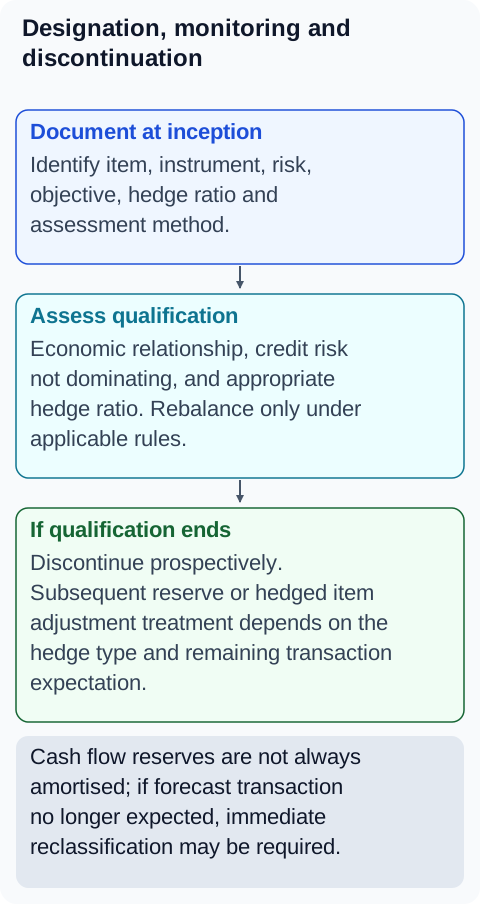
IFRS 9 documentation at inception of the hedging relationship identifies item, instrument, risk, objective, ratio and assessment method. A pre-existing derivative can be designated prospectively from a later valid inception; what is prohibited is backdating hedge accounting. IFRS 9 requires an economic relationship, credit risk not dominating, and a ratio consistent with actual risk management, without deliberate accounting imbalance.
Rebalancing adjusts the ratio of a continuing relationship when appropriate and the risk objective remains unchanged; it is not automatically a brand-new designation. Measure ineffectiveness before rebalancing. Discontinue when qualification ceases after applicable rebalancing, with remaining basis/reserve treatment appropriate to the hedge type.
4.4 Portfolio framework
IFRS 9 allows an accounting-policy choice to continue IAS 39 hedge accounting. Its additional option for fair-value hedging of interest-rate exposure of a portfolio uses IAS 39's specific requirements. EU-endorsed IAS 39 carve-outs are a separate local difference; globally available IAS 39 retention is not limited to EU banks. Future risk-mitigation proposals must not be represented as current accounting.
5. Product and customer impact
Economic hedges manage risk regardless of accounting designation. Hedge accounting can improve timing alignment but does not guarantee constant margin, remove basis/prepayment risk or change customer contractual terms. Pipeline hedges need a specific eligible risk and highly probable forecast population; OCI does not always recycle immediately at loan drawdown. Financial versus non-financial recognition and timing of P&L determine the reserve treatment.
6. Regulatory and supervisory view
IFRS 9 and permitted IAS 39 hedge policies must be clearly identified and consistently applied. IFRS 7 disclosures explain risk strategy, instruments, reserves, basis adjustments and ineffectiveness. Undesignated economic hedges are not automatically a control finding: they are an allowed reporting outcome when deliberately governed.
US ASC 815 differs and requires its own designation/testing. Local supervisory capital and IRRBB frameworks do not override hedge-accounting eligibility.
7. Systems and data view
Maintain a designation register, source populations, valuation inputs, qualification evidence, ineffectiveness, basis adjustments and reserves. Link derivatives to actual cash settlements and item events. Risk-approved undesignated hedges remain visible in management reporting.
Reserve release follows when hedged cash flows affect P&L or the appropriate basis/disposal rule, not merely derivative maturity or loan drawdown. Forecast cancellation and delay need distinct decisions. Basis amortisation and reserve movements reconcile independently to their underlying populations and GL.
8. End to end process
Identify risk; execute an appropriate economic hedge; decide valid prospective designation; document at relationship inception; measure instrument and designated item risk; assess continued qualification and actual ineffectiveness; process applicable rebalancing/discontinuation; reconcile basis/reserve/cash; and disclose. Discontinuation depends on qualification and objective under the selected framework, not solely a treasury preference for a different profit pattern.
9. Controls and risks
| Risk | Control | Evidence |
|---|---|---|
| Backdating | Valid timestamped inception | Original designation |
| Ineligible item/risk | Framework-specific scope assessment | Eligibility analysis |
| Ratio imbalance | Compare accounting ratio to actual strategy | Sensitivities and quantities |
| Credit dominance | Credit effect assessment | Qualification conclusion |
| Incorrect reserve release | Event/P&L/basis mapping | Reserve bridge |
| Portfolio drift | Population/cohort reconciliation | Change and exit records |
10. Practical examples
Fictional undesignated hedge: a mortgage portfolio at AC and its swap offset economically, but the bank has not designated accounting treatment. Swap changes go to P&L; the portfolio's rate-value change is unrecognised. Management can explain that volatility or designate an eligible relationship prospectively, never backdate it.
Fictional amortisation: the fixed-rate hedged book amortises faster than expected. Review actual hedge quantities and the risk objective. Under IFRS 9, an applicable rebalance can continue the relationship; a 75% quantity ratio is not an 80-125% effectiveness conclusion and does not itself require discontinuation.
11. Diagrams
Figure 1. Economics and accounting timing.
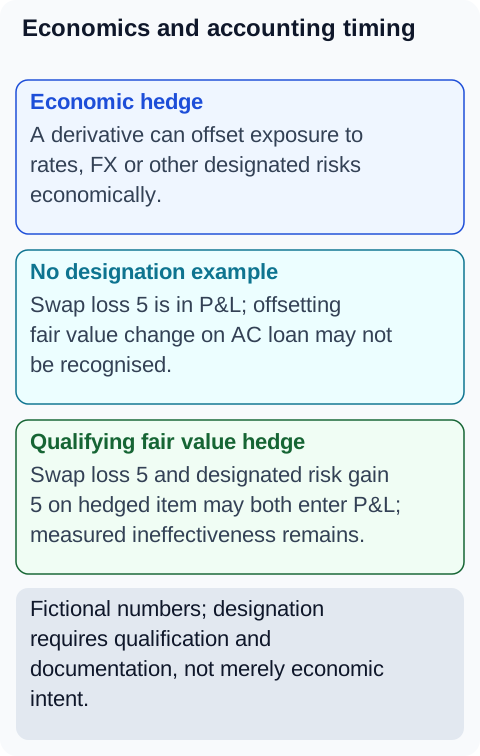
Figure 2. Three hedge accounting models.
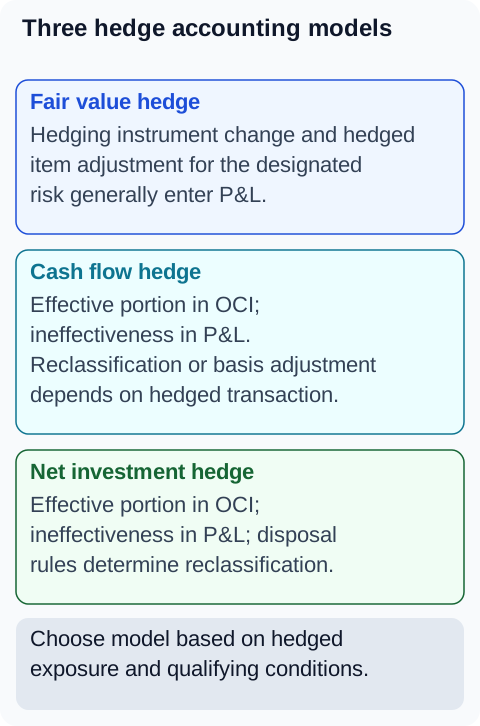
Figure 3. Designation, monitoring and discontinuation.
12. Tables
| Illustrative event | Debit | Credit |
|---|---|---|
| FV hedge derivative gain 5 | Derivative asset 5 | P&L 5 |
| FV hedge designated loan loss 5 | P&L 5 | Loan basis 5 |
| CF hedge derivative gain 5, fully effective under lower-of | Derivative asset 5 | Hedge reserve 5 |
| CF reserve gain released with hedged interest expense | Hedge reserve 5 | Interest expense 5 |
These idealised inputs exclude tax, credit/basis differences and cash settlement. Eligibility and ineffectiveness must be assessed independently. Written options, non-derivative instruments, risk components and groups require specific standard conditions rather than a blanket product-label pass/fail table.
13. Illustrative bank case study
Fictional bank scenario. An economic mortgage hedge remains after the accounting population changes. Finance explains undesignated derivative volatility and reassesses eligible prospective designation. Management reviews actual residual risk and liquidity rather than infer an unhedged position solely from P&L volatility. This training case does not assert an event at an unnamed real institution.
14. BA, developer, tester and operations guidance
- BA: Specify framework, risk, quantity, valid inception, qualification and basis/reserve rules.
- Developer: Preserve timestamps and versions; block backdating while allowing valid prospective designation of existing instruments.
- Tester: Test late designation, ratio changes, credit dominance, cancellation versus delay, basis amortisation and framework differences.
- Operations: Reconcile designated and undesignated populations and maintain evidence for qualification and reserve decisions.
15. Common mistakes
- Failing to explain or govern undesignated economic-hedge volatility when accounting designation is optional.
- Backdating accounting designation, even though the economic hedge may have existed earlier.
- Discontinuing instead of rebalancing on ratio drift.
- Forgetting OCI recycling triggers (stranded reserves misstate equity composition).
- Designating ineligible items/instruments (cosmetic hedging).
- Performing effectiveness tests late (breaching the designated schedule).
- Failing to update designations when the hedged portfolio changes.
16. Key takeaways
- Economic hedging and optional hedge accounting have different purposes.
- Fair-value, cash-flow and net-investment hedges have different journal and ending mechanics.
- Document at valid inception; existing instruments can be designated prospectively.
- Apply qualification, rebalancing and discontinuation under the actual chosen framework.
- Explain residual ineffectiveness and reconcile basis, reserves and settlement cash.
17. References and verification notes
- IFRS 9 hedge accounting and IAS 39 policy option
- IAS 39 retained requirements
- IFRS 7 hedging disclosures
- IAS 21 foreign operations
- Rules are applied under the reporting entity's adopted accounting framework and jurisdiction. Basel standards require local implementation; they are not themselves national law. All unnamed cases, amounts and operational thresholds are fictional training examples.