Chapter 045: Impairment Accounting in Practice
Section 9: Credit Impairment and Expected Credit Losses · Chapter 045 of 100
1. Chapter opening
For AC assets, an allowance reduces net carrying amount; increases/reversals affect impairment P&L. For FVOCI debt, ECL affects P&L with an OCI offset without reducing the fair-value carrying amount. Commitments/guarantees can create provision liabilities, subject to applicable scope and measurement.
Subsequently credit-impaired assets use net-basis interest in subsequent reporting periods; POCI has its separate credit-adjusted basis. Write-off reduces gross carrying amount when there is no reasonable expectation of recovery, using the relevant allowance and any required expense/top-up. No policy-defined small-balance exception is needed to justify recognising a real loss. Recovery after write-off and legal forgiveness are distinct events.
2. Learning objectives
- Post allowance recognition, top-ups, releases, write-offs and recoveries.
- Apply gross-vs-net interest by stage with transfer-month mechanics.
- Enforce write-off criteria (partial vs full) with approval levels.
- Reconcile the allowance from opening through actual charges, releases, transfers, write-offs and FX to closing; separately reconcile post-write-off recoveries recognised directly in P&L.
- Explain FVOCI-debt impairment (P&L with OCI offset) and OBS provisions.
3. Business context
Coverage, cost of risk, NPE ratios and write-off vintage help interpret asset quality but require consistent definitions. Accounting Stage 3 and regulatory NPE are not interchangeable in every report. A lower NPE ratio caused by write-offs is not the same as borrower cure.
Coverage can fall because collateral, product mix, valuation or recoveries change. Neither a rising ratio nor a low expense automatically proves adequate allowance. Read the cash-flow estimate, population changes and opening-to-closing bridge before comparing banks or periods.
4. Finance and accounting view
4.1 Balanced provision and write-off
Fictional gross loan 1,000, existing allowance 300: net 700. Required allowance rises to 350: Dr Impairment expense 50 / Cr Allowance 50. If it later falls to 330: Dr Allowance 20 / Cr Impairment gain 20. Stage migration changes status; the journal is the change in measured ECL, not an automatic fixed top-up.
For a full write-off when gross remains 1,000 and allowance is 300, first Dr Impairment expense 700 / Cr Allowance 700, then Dr Allowance 1,000 / Cr Gross loan 1,000. A compound Dr Allowance 300 / Dr Impairment expense 700 / Cr Gross loan 1,000 is economically equivalent under the posting policy. Debiting allowance 700 and crediting loan 1,000 alone is unbalanced. For a 400 partial write-off with only 300 allowance, top up 100 before clearing 400, then reassess the surviving 600.
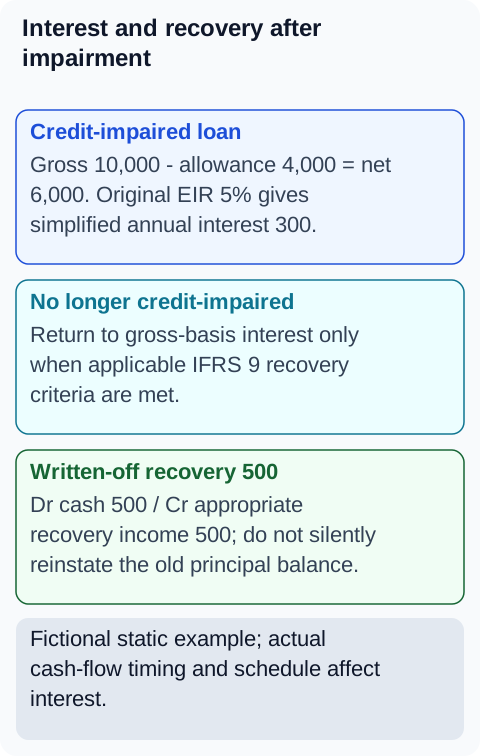
Recovery 60 after full write-off: Dr Cash 60 / Cr Impairment recovery income 60, linked to the written-off exposure. Debt FVOCI ECL uses an OCI offset without reducing fair-value carrying amount. Eligible undrawn commitments use a provision liability, with the appropriate combined-facility treatment where drawn/undrawn ECL cannot be separately identified.
4.2 Interest basis and POCI
For subsequent credit impairment, interest is calculated on net amortised cost in subsequent reporting periods under IFRS 9. Gross 1,000, allowance 300 and EIR 6% gives annualised net interest 42 rather than 60, on constant balances. The recognised interest calculation is separate from contractual interest due and customer statements. Use the reporting-period policy consistently rather than inventing universal same-day Stage 3 switching rules.
POCI assets use a credit-adjusted EIR on expected cash flows at initial recognition; no separate initial allowance is recognised for credit losses already included in that measurement. Subsequently recognise cumulative changes in lifetime ECL, including favourable impairment gains. Keep POCI populations separate from ordinary Stage 1/2/3 interest mechanics.
4.3 Write-off and modification governance
Write off all or part when there is no reasonable expectation of recovery. Legal action need not be exhausted; collection can continue if rights remain. A write-off is not itself forgiveness and not a clean-slate restructure. Assess modification or derecognition separately; a new contract does not erase continuing financial difficulty.
Document recovery evidence, authority, date, amount, continuing rights and allowance effect. Bankruptcy, collateral sales, limitation periods, costs and tax treatment are inputs, not an automatic identical checklist for every jurisdiction. Reassess remaining exposures after partial write-off.
4.4 Allowance bridge
Opening allowance 100 + new/net remeasurement charges 40 - releases 10 - write-offs 25 + FX change 5 = closing 110 on this fictional book. Cash recoveries after a full write-off, recognised directly in P&L, do not automatically increase the allowance. Stage transfers can move allowance between stage columns without changing the total unless remeasurement changes required ECL. Reconcile every movement to exposure and journal evidence.
5. Product and customer impact
Accounting write-off does not itself forgive a legal debt, but legal rights can separately expire, be waived or be settled. Explain the borrower's actual residual obligation and lawful collection options. Partial restructuring/write-off requires clear terms; it does not automatically erase prior financial difficulty.
Debt-sale governance should consider applicable purchaser, customer-treatment and notification requirements. Distinguish reputational monitoring from an asserted universal legal duty to guarantee every purchaser's subsequent conduct.
6. Regulatory and supervisory view
Accounting Stage 3, regulatory non-performing exposures, prudential provision shortfalls and tax deductions are distinct. EU statutory NPE backstops concern capital deductions under applicable law and scope; EBA management guidelines do not impose one universal accounting haircut or reduction deadline on every bank. India uses applicable RBI asset-classification, income-recognition and provisioning directions with specific current and future effective dates, independently of IFRS 9; no universal three-month NPA upgrade rule should be inferred.
US ASC 326 and amended borrower-modification disclosures need their own policy. Apply local report definitions and maintain a bridge to the accounting impairment ledger rather than rewriting legal classifications to match IFRS stages.
7. Systems and data view
Link allowance by facility/category/stage to gross exposure, interest basis, write-off approvals, recovery events and GL. The disclosure bridge separately identifies remeasurement, origination, derecognition, transfers, FX and write-offs. Stage transfers can reallocate columns without changing total allowance.
Test credit-impaired interest treatment for the required reporting periods, including POCI and supported subsequent improvement. Do not switch every asset to net interest at an arbitrary daily migration timestamp. Retain manual exception approval and reconcile all inputs and outputs; an input defect requires error/materiality assessment, not an automatic assertion that every defect mandates restatement.
8. End to end process
Reconcile exposures and allowance population; measure required ECL; post changes with source evidence; apply the correct reporting-period interest basis; update recovery expectations; approve and post supported full/partial write-offs; record recoveries with original-exposure linkage; and reconcile disclosures to GL. A journal policy cannot replace the cash-flow recovery assessment.
9. Controls and risks
| Risk | Control | Evidence |
|---|---|---|
| Evergreening (no write-off) | Timeliness rules, vintage analysis | Days-in-default distributions |
| Basis-switch failure | Automated stage-driven switch | Transfer-month samples |
| Unlinked recoveries | Write-off ID linkage | Recovery linkage reports |
| Disclosure gaps | Stage-flow reconciliation | Tied disclosure packs |
10. Practical examples
A — Partial clarity: 1,000 exposure, 400 hopeless (unsecured shortfall), 600 viable under restructure — partial write-off 400 plus modification accounting on 600, each evidenced separately. B — Recovery surprise: 60 recovered on a 2019 file written off fully — gain posted with linkage, forecasts updated, buyer-pricing models recalibrated.
11. Diagrams
Figure 1. Allowance, write-off and recovery.
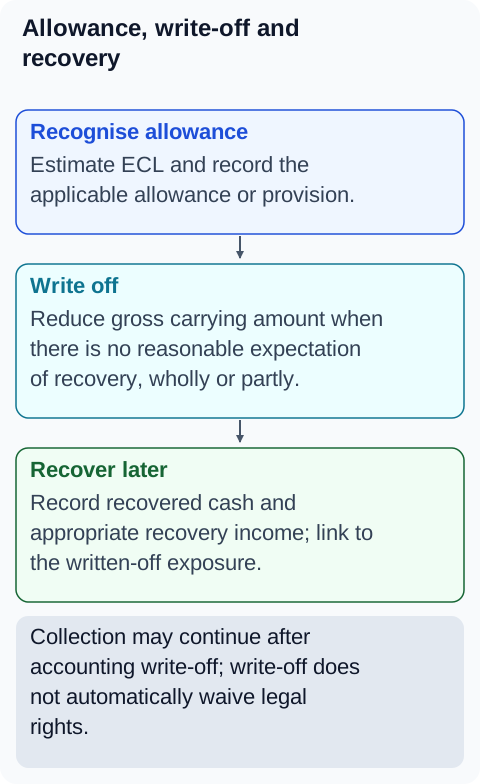 Figure 2. Write-off: a balanced journal.
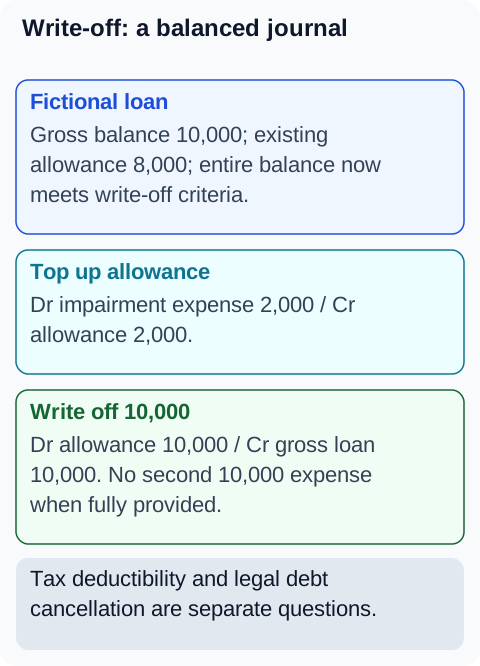 Figure 3. Interest and recovery after impairment.
12. Tables
Table 1 — Impairment journal map
| Event | Debit | Credit |
|---|---|---|
| Provision/top-up | Impairment charge | Loss allowance |
| Release | Loss allowance | Impairment gain |
| Write-off (full/partial) | Loss allowance (+ top-up if short) | Gross loan (slice) |
| Recovery | Cash | Impairment gain |
| FVOCI ECL | Impairment charge | OCI (not carrying amount) |
| OBS provision | Impairment charge | Provision liability |
Table 2 — Coverage reading guide
| Metric | Healthy signal | Warning |
|---|---|---|
| Stage 3 coverage | Stable/rising into stress | Falling while NPEs rise |
| Cost of risk | Through-cycle range | Near-zero in late cycle |
| Write-off vintage | When no reasonable expectation of recovery | Multi-year zombie balances |
13. Illustrative bank case study
Fictional bank scenario. Repeated distressed modifications conceal overdue amounts in the staging feed. Finance reconstructs the actual risk history, assesses regulatory classification separately, updates ECL and considers write-off only where recovery expectations support it. Correcting the data and estimating losses are distinct from any legal change to borrower obligations. This training case does not assert an event at an unnamed real institution.
14. BA, developer, tester and operations guidance
- BA: Specify write-off criteria, approval tiers, basis-switch rules and disclosure flows per portfolio.
- Developer: Automate basis switches; enforce write-off approvals; link recoveries to write-off IDs.
- Tester: Transfer-month interest paths, partial/full write-offs, FVOCI offset postings, disclosure tie-outs.
- Operations: Age workout files visibly; propose write-offs on time; track recovery cost-benefit.
15. Common mistakes
- Removing a gross asset without clearing its related allowance and assessing any required loss/top-up.
- Keeping Stage 3 assets on gross-basis interest.
- Confusing write-off (accounting) with forgiveness (legal).
- Unlinked recoveries inflating unexplained gains.
- Evergreening via rolling forbearance instead of timely write-off.
16. Key takeaways
- Allowance is staged contra-asset; charges move profit; disclosures reconcile everything.
- Subsequently credit-impaired assets use net interest in subsequent periods; POCI and supported improvement have specific rules.
- Write-off requires no reasonable expectation of recovery and governed approval; partial recovery can support a partial write-off.
- Recoveries are gains with lineage, not windfalls.
- Vintage analysis exposes evergreening that ratios hide.
17. References and verification notes
- IFRS 9 allowance/interest/write-off
- IFRS 7 allowance disclosures
- BCBS ECL guidance
- Rules are applied under the reporting entity's adopted accounting framework and jurisdiction. Basel standards require local implementation; they are not themselves national law. All unnamed cases, amounts and operational thresholds are fictional training examples.