Chapter 047: Fair Value Hedges
Section 10: Hedge Accounting and Balance Sheet Management · Chapter 047 of 100
1. Chapter opening
A bank with fixed-rate loans loses economic value when benchmark interest rates rise. A pay-fixed/receive-floating swap gains value in the same scenario. Without hedge accounting, the swap's fair-value gain is in P&L while amortised-cost loans do not recognise a pure benchmark-rate fair-value loss. An eligible, documented fair-value hedge recognises that designated loss and adjusts the loans' carrying amount.
Specify whether the relationship follows IFRS 9 or an allowed IAS 39 policy. IFRS 9's qualification tests and rebalancing differ from IAS 39's prospective/retrospective effectiveness requirements. A bank's regression tolerance is a monitoring parameter, not a substitute for the applicable standard.
2. Learning objectives
- Identify the item, hedging instrument and separately identifiable, reliably measurable risk component.
- Post the derivative movement and hedged-risk basis adjustment with consistent signs.
- Calculate and explain ineffectiveness without forcing equality.
- Continue effective-interest amortisation and impairment after the adjustment.
- Govern discontinuation, disposal and disclosure under the selected framework.
3. Business context
Treasury may hedge one bond, a loan tranche or an eligible group. Credit spreads, customer margins, prepayment behaviour and derivative counterparty credit can make the economic hedge imperfect. Designating benchmark interest-rate risk can avoid treating every credit spread movement as hedged, provided the component meets the standard's criteria.
Customer contracts do not change when finance designates a hedge. The customer still owes the contractual principal and coupon. The hedge adjustment is a financial-reporting basis component with its own audit trail; it must not increase the customer's statement balance or collection demand.
4. Finance and accounting view
4.1 Fixed-rate loan: bank-perspective journals
Fictional loan has carrying amount 100 and a swap initially valued at zero. Ignore accrued interest, ECL, tax and transaction costs for this period. Rates rise. The derivative gains 5; the loan's value attributable to the designated benchmark risk falls 4.8.
- Dr Derivative asset 5 / Cr Hedge P&L gain 5.
- Dr Hedge P&L loss 4.8 / Cr Loan hedge-basis adjustment 4.8.
Loan carrying amount is 95.2 and net hedge P&L is a 0.2 gain. Debits and credits each total 9.8. There is no 5 cash receipt until the derivative actually settles. A valuation balance is distinct from variation-margin cash or settlement-to-market treatment.
4.2 Fixed-rate liability
A bank issues fixed-rate debt 100 and hedges with a receive-fixed/pay-floating swap. Rates rise: the liability's designated-risk value falls 4.8 and the swap loses 5. Dr Debt hedge-basis adjustment 4.8 / Cr Hedge P&L gain 4.8; Dr Hedge P&L loss 5 / Cr Derivative liability 5. The debt is 95.2 before other movements; net loss is 0.2. Reusing the loan example's swap direction would increase the bank's risk.
4.3 Measurement boundaries
Measure the derivative using the applicable fair-value policy, including relevant credit and collateral effects. Measure the hedged item only for the designated risk. Do not put the entire loan fair-value movement into its basis if only benchmark-rate risk is designated. Keep the assessment period and currency consistent and explain any accrued-interest presentation.
For a debt instrument measured at FVOCI, the designated-risk gain or loss is recognised in P&L under fair-value hedge mechanics; the remainder follows FVOCI requirements. A qualifying hedge of an equity investment elected to FVOCI has a specific OCI exception, rather than the ordinary debt-instrument recycling pattern.
4.4 Amortisation, impairment and ending the hedge
For an amortised-cost item, the hedge basis is amortised to P&L using a recalculated effective interest rate. Amortisation may begin while the adjustment exists and must begin no later than when the item ceases to be adjusted. Avoid an arbitrary straight-line schedule presented as the universal IFRS requirement.
ECL continues to apply to the underlying loan; designation does not remove credit impairment. A subsequent write-off or disposal must clear the relevant gross balance, allowance and hedge basis. If the hedge ends but the item remains recognised, the basis is not immediately reversed merely to restore the original principal amount.
5. Product and customer impact
Hedging can change the bank's reported interest pattern, but it does not change contractual fixed-rate payments or justify a new customer fee. Early repayment changes the hedged quantity and timing. Finance needs the repayment event promptly so that closed amounts are removed and the relationship is assessed under its selected framework.
Reporting should separate customer yield, hedge funding economics, basis amortisation, derivative results and ineffectiveness. A near-zero net hedge result can still conceal large gross movements requiring valuation and liquidity controls.
6. Regulatory and supervisory view
IFRS 9, retained IAS 39 and US ASC 815 are separate frameworks. IFRS 9 has no universal 80-125% retrospective qualification band; IAS 39's effectiveness requirements must be applied when that policy is retained. Local endorsement may differ, including specific EU IAS 39 portfolio provisions.
IFRS 7 requires information about risk-management strategy, effects on future cash flows and effects of hedge accounting on financial statements. Prudential valuation adjustments, capital filters and IRRBB measures are separate calculations; accounting hedge effectiveness does not establish compliance with them.
7. Systems and data view
Store item and instrument identifiers, quantities, risk component, designation timestamp, valuation curves, models, basis adjustment, amortisation schedule and status. A hedge subledger must reconcile to both the investment/loan/debt ledger and derivative ledger. Preserve versioned valuation inputs and approvals so another reviewer can reproduce the close.
Reconcile the population first: a technically correct valuation of an omitted loan is still an incorrect report. Link prepayments, maturities, restructurings and disposals to designation records. Separate model changes from actual exposure changes in the P&L explanation.
8. End to end process
- Confirm eligible exposure and instrument under the selected policy.
- Document the relationship at its inception, with risk and measurement method.
- Value the derivative and designated item risk using consistent data.
- Assess qualification, quantify ineffectiveness and approve exceptions.
- Post linked journals, update the basis and amortisation schedule.
- Reconcile instrument, item, cash settlement and hedge reserves/basis separately.
- Review changes, discontinuations, disclosures and independent valuation evidence.
9. Controls and risks
| Risk | Control | Evidence |
|---|---|---|
| Wrong swap direction | Sensitivity sign test at designation | Rate-up/rate-down results |
| Full fair value mistaken for designated risk | Component valuation review | Risk decomposition |
| Forced perfect offset | Independently calculated item and derivative | Ineffectiveness bridge |
| Basis charged to customer | Separate accounting-only ledger component | Customer/GL reconciliation |
| Stale prepayment quantity | Event-driven population reconciliation | Removed-item register |
| Historic error treated as current hedge result | IAS 8 error assessment | Materiality and correction memo |
10. Practical examples
Fictional sign test: a fixed-rate asset's designated-risk value moves-4.8 and the swap moves+5. Net P&L+0.2 reconciles to the two valuations. If both values fall, inspect direction and risk mapping before posting; do not flip a sign just to eliminate ineffectiveness.
Fictional discontinuation: the hedge ends with a-4.8 basis on a surviving AC loan. Finance calculates a new EIR that amortises the basis over the remaining term. If the loan is sold instead, remove the basis with the asset and calculate the disposal result from its adjusted carrying amount. The two events require different entries.
Fictional model error: a missed prepayment understated prior-period hedge loss by 3. Evaluate correction under IAS 8, including whether a material prior-period error needs retrospective restatement. An unexplained prospective journal is not an acceptable substitute for the error assessment.
11. Diagrams
Figure 1. IFRS fair value hedge.
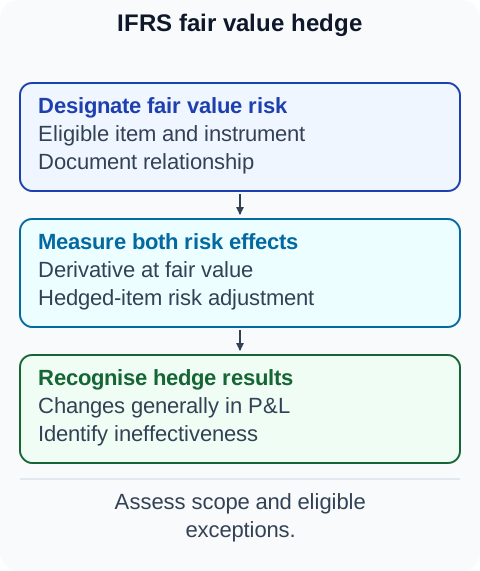 Figure 2. Linked hedge measures.
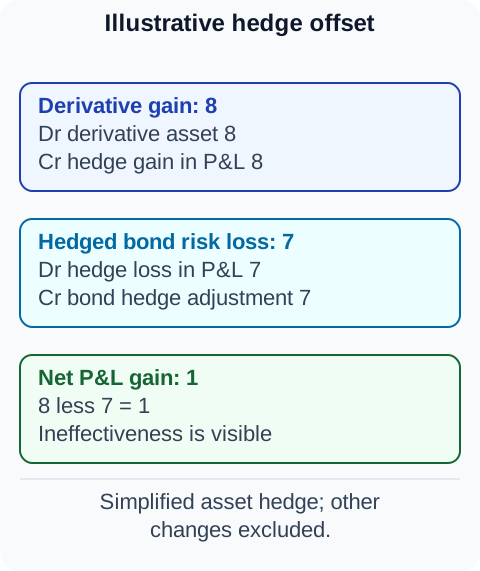
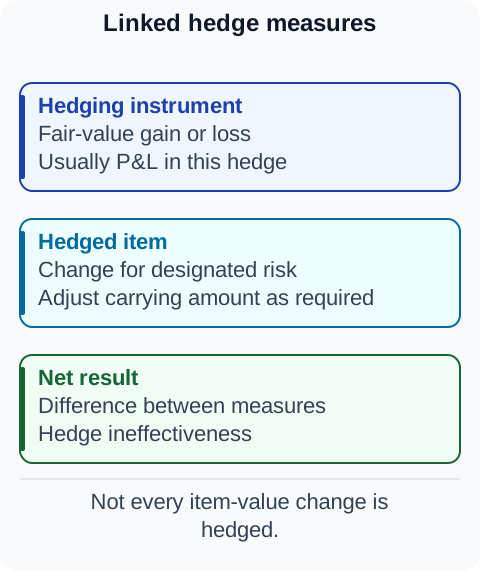 Figure 3. Illustrative hedge offset.
12. Tables
| Item | Rates rise: designated-risk movement | Typical offsetting swap |
|---|---|---|
| Fixed-rate loan or bond asset | Fair value falls | Pay fixed / receive floating |
| Fixed-rate issued debt | Liability fair value falls | Receive fixed / pay floating |
| Balance | What it represents |
|---|---|
| Derivative asset/liability | Instrument fair value |
| Hedge basis | Cumulative designated-risk adjustment to item |
| ECL allowance | Expected credit losses on relevant exposure |
| Settlement cash | Actual cash paid/received, separately reconciled |
13. Illustrative bank case study
Fictional bank case: mortgage prepayments rise and the hedge population no longer matches the swap quantity. The bank rebuilds the eligible population, measures the genuine ineffectiveness and assesses rebalancing or discontinuation under its policy. It retains the surviving basis and amortises it properly. This scenario is illustrative, not a claim about an unidentified institution.
14. BA, developer, tester and operations guidance
- BA: Define the designated-risk component, population events, journal signs and basis ownership.
- Developer: Keep contract principal separate from hedge basis and link both valuation legs.
- Tester: Test asset/liability sign reversal, zero inception, prepayments, disposal and discontinuation.
- Operations: Reconcile settlements independently from unrealised marks and obtain close approvals.
15. Common mistakes
- Treating model validation as the hedge-accounting qualification itself.
- Applying IAS 39's numeric band to every IFRS 9 hedge.
- Recording the entire asset valuation change when only one risk is designated.
- Reversing surviving basis immediately on discontinuation.
- Omitting credit impairment or recording a mark as cash.
- Correcting material historic errors only through current-period journals.
16. Key takeaways
- Fair-value hedge accounting recognises the designated item risk alongside the instrument.
- Asset and liability hedges need different swap directions and journal signs.
- Ineffectiveness is measured, not engineered away.
- Basis adjustments, ECL and settlement cash represent different balances.
- Discontinuation, disposal and prior-period correction require separate accounting decisions.
17. References and verification notes
- IFRS 9 fair-value hedges
- IAS 39 hedge policy
- IFRS 7 hedge disclosures
- IFRS 13 valuation
- IAS 8 errors
- Rules are applied under the reporting entity's adopted accounting framework and jurisdiction. Basel standards require local implementation; they are not themselves national law. All unnamed cases, amounts and operational thresholds are fictional training examples.