Chapter 019: Wholesale Funding and Issued Debt
Section 4: Deposit and Funding Accounting · Chapter 019 of 100
Friday afternoon: 1.5 billion of bonds mature next month, deposit outflows are running above forecast, and the CFO asks treasury for a funding plan that doesn't spike costs or breach limits. Treasury is the bank's funding engine and balance-sheet guardian — raising money across deposits, interbank, repo and bond markets, then managing the resulting liquidity, rate and currency risks. This chapter maps treasury's mandate and the wholesale funding instruments with their journals.
1. Chapter opening
Treasury manages the bank's money position: how the balance sheet is funded (funding strategy across retail, corporate, interbank, repo, bonds), what it costs, and what risks the funding mix creates. It operates through front office (dealing), middle office (risk and valuation), and back office (confirmation, settlement, GL posting), directed by ALCO within Board risk appetite. This chapter covers the mandate, the funding stack from sticky deposits to subordinated debt, issuance journals, and the controls that keep funding honest.
The treasury function is the bank's financial nerve centre. It is responsible for ensuring that the bank always has sufficient cash to meet its obligations — from routine daily payments to unexpected stress events. This responsibility extends across multiple dimensions: funding (raising cash from various sources), liquidity management (ensuring cash is available when and where it is needed), interest-rate risk management (hedging the mismatch between assets and liabilities), and currency risk management (hedging cross-border exposures). The treasury function is also responsible for managing the bank's investment portfolio, its capital instruments, and its relationships with central banks, correspondent banks, and other financial institutions.
The front office, middle office, and back office structure is designed to create segregation of duties that prevent fraud and error. The front office executes transactions (buys and sells securities, enters into derivatives, raises funding). The middle office independently values positions, monitors risk limits, and challenges the front office's marks. The back office confirms transactions, settles them, and posts them to the general ledger. The segregation ensures that no single individual can execute, value, settle, and account for a transaction — a control that is essential for preventing both fraud and error. The ALCO (Asset-Liability Committee) provides strategic direction, setting the funding plan, risk limits, and hedging strategy within Board-approved risk appetite.
2. Learning objectives
By the end of this chapter you will be able to:
- State treasury's mandate and the front/middle/back split with segregation logic.
- Compare funding sources by cost, stability, tenor and confidence sensitivity.
- Post bond issuance (par/discount/premium), coupon accruals, buybacks and maturities.
- Account for interbank borrowing, repos and commercial paper.
- Explain funding concentration and refinancing (rollover) risk with ladder evidence.
- List treasury's deliverables to ALCO, finance, risk and regulators.
3. Business context
Funding strategy is survival strategy: insured retail and wholesale funding have different confidence, concentration and maturity risks; either mix can become stressed. Mix shifts have P&L consequences (wholesale reprices fast when rates rise), liquidity consequences (confidence-sensitive funding flees first), and strategic consequences (issuance windows close in volatility — fund before you need to). Investor relations, rating agencies and supervisors all read the funding plan; treasury owns the story with numbers from the maturity ladder.
The funding mix decision is one of the most consequential strategic choices a bank makes. A bank that funds itself primarily with retail deposits (insured and operational) has a stable, low-cost funding base that is still exposed to deposit runs, concentration and repricing. The trade-off is that retail deposits are limited in volume (constrained by the bank's branch network, customer base, and market share) and may need competitive rates and operating/distribution expenditure; funding cost is measured from the bank’s perspective. A bank that funds itself primarily with wholesale instruments (bonds, repo, interbank) has access to deep, liquid markets that can fund rapid growth — but the funding is confidence-sensitive, reprices quickly in rate cycles, and can evaporate in stress.
The maturity ladder is the treasury's primary tool for managing refinancing risk. It maps every liability by its residual maturity — showing when each instrument matures and how much must be refinanced. The ladder reveals concentrations (maturity walls where large amounts mature in a single month), gaps (periods where no maturities fall due), and imbalances (maturities concentrated in one currency or instrument type). ALCO uses the ladder to set limits — single-month maturity caps, short-term wholesale funding ratios, currency concentration limits — and to approve pre-funding actions (issuing ahead of maturities to avoid cliff effects).
| Source | Cost | Stability | Stress behaviour |
|---|---|---|---|
| Insured retail deposits | Often lower; rate and servicing costs vary | Often more stable, subject to concentration and access | Insurance and relationships can support retention; outflows remain possible |
| Corporate/operational deposits | Contract and service-dependent | Counterparty, operational qualification and tenor-dependent | Operational relationships can support retention; concentration and uninsured balances can increase outflow risk |
| Interbank unsecured | Market | Often confidence-sensitive | Access and rollover can contract sharply in stress |
| Repo (secured) | Market rate affected by collateral and counterparty | Depends on tenor and market | Eligibility alone does not guarantee refinancing; haircuts, margin and counterparty capacity can tighten |
| Senior bonds / CP | Market + spread | Contractual tenor | Cannot flee before maturity; refinancing cliff after |
| Subordinated/AT1 | Instrument-dependent | Eligibility and tenor vary | AT1 distributions may be discretionary; ordinary Tier 2 interest is not automatically cancellable |
4. Finance and accounting view
4.1 Issuance journals (500m 5-year bond at 4%, issued at 99.6, fictional)
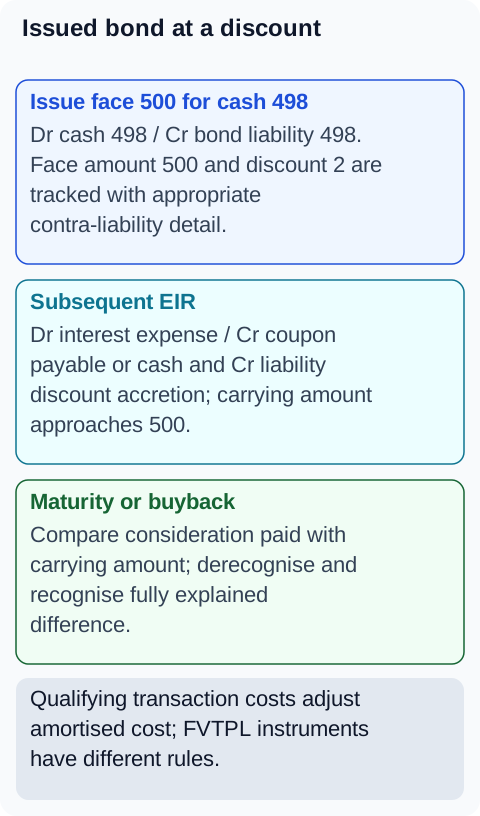
Assume face value 500 million, five annual coupons of 20 million, redemption at 500, issue proceeds 498 and directly attributable issuance costs 2. All amounts are millions and debt is measured at amortised cost.
Issue: Dr Cash 498 + Dr Issue discount (contra-liability) 2 / Cr Bonds face 500. Costs: Dr Issuance-cost adjustment (contra-liability) 2 / Cr Cash 2. Net initial liability is 496. EIR solves 496 = Σ[20/(1+r)^t] for t=1..5 + 500/(1+r)^5, approximately 4.180614%. Year-one expense is 20.735848, not the cash coupon of 20; the difference increases carrying amount.
Accrue Dr Interest expense 20.735848 / Cr Coupon payable 20 / Cr Discount/cost adjustments 0.735848; pay Dr Coupon payable 20 / Cr Cash 20. At maturity the amortised-cost liability reaches 500 and is repaid. Retain full precision in the engine; shown amounts are rounded. FVTPL debt expenses transaction costs immediately, and own-credit OCI is restricted to designated FVTPL liabilities under the applicable IFRS 9 conditions.
For a buyback, compare consideration and relevant costs with the net carrying amount, not just face value. Extinguish the liability and all unamortised adjustments; recognise the gain/loss under the applicable policy.
4.2 Interbank, repo, commercial paper
Overnight interbank borrowing: Dr Cash / Cr Due to banks; interest accrues daily at market rates. For a typical repo where the applicable transfer assessment concludes that substantially all risks and rewards are retained, record financing: Dr Cash / Cr Repo liability; retain the securities on the balance sheet and track encumbrance. Accrue repo interest and settle the liability at maturity. Assess actual contractual rights, risks/rewards and control under the applicable derecognition framework; the repo label alone does not determine every transfer’s accounting. Reverse repo mirrors (Dr Reverse-repo asset / Cr Cash). Commercial paper: short-dated issuance at discount; Dr Cash / Cr CP with discount amortised over weeks/months. Encumbrance tracking matters: pledged assets aren't available for other liquidity — disclosure and LCR consequences (Section 16).
Repo accounting illustrates the substance-over-form principle. A repo is legally structured as a sale and repurchase — the bank sells securities to a counterparty and agrees to repurchase them at a specified price on a specified date. In the typical retained-risk transaction illustrated here, its economic substance is a collateralised loan: the bank receives cash (the loan principal), pledges securities as collateral, and repays the cash with interest (the repo rate) at maturity. For a typical repo that fails the applicable derecognition/sale criteria, financing treatment applies under IFRS and US GAAP — the securities remain on the bank's balance sheet (because the bank retains the risks and rewards of ownership), and the cash received is recognized as a liability (repo liability). IFRS assesses contractual rights, risks and rewards, and control; US GAAP applies its transfer and effective-control criteria. Do not substitute the IFRS risks-and-rewards test for the US GAAP assessment. The distinction between sale and financing treatment is critical: if the repo were treated as a sale, the securities would be derecognized, the cash would be recognized as proceeds, and the bank's asset composition and reported exposures would differ — an inappropriate result for this retained-risk example. Other contracts require their own transfer assessment.
The encumbrance dimension is increasingly important for liquidity management. When securities are pledged as collateral (in repo, as margin at a CCP, or as collateral for central-bank lending), they are encumbered — they cannot be used for other purposes (selling, pledging again, or counting as HQLA under certain conditions). The bank must track encumbrance levels carefully, because over-encumbrance can create liquidity shortfalls — the bank may have sufficient securities on its balance sheet, but if most of them are encumbered, the available unencumbered amount may be insufficient to meet new obligations. Encumbrance limits are set by ALCO and monitored daily, with breaches escalating to treasury management.
4.3 Refinancing risk and the ladder
Maturity profile (fictional): next 3 months 2bn of 12bn wholesale matures — a refinancing wall. Treasury pre-funds (issue before maturity, carrying negative carry briefly), staggers tenors, diversifies instruments/currencies/investors, and maintains benchmarks (regular issuance keeps curves alive and investors engaged). ALCO limits: single-month maturity caps, short-term wholesale ratios, encumbrance ceilings. Breach the ladder and the bank funds at whatever price panic sets — or not at all.
The refinancing wall scenario illustrates the core refinancing risk. When a large amount of debt matures in a single month, the bank must either refinance (issue new debt to repay the maturing debt) or use cash reserves to repay. If market conditions are unfavorable (wide credit spreads, low investor demand, volatile rates), the bank may be forced to issue at a higher cost — increasing its funding expenses and reducing its net interest margin. In extreme cases, the bank may be unable to refinance at any price — a funding crisis that can threaten the bank's viability. The 2008 financial crisis demonstrated this risk vividly: banks that relied on short-term wholesale funding (commercial paper, interbank deposits) were unable to refinance when markets froze, leading to forced asset sales, fire-sale losses, and in some cases, failure.
The pre-funding strategy is the primary defense against refinancing walls. Treasury issues new debt 3–6 months before existing debt matures, carrying the cost of the new issuance (the "negative carry" — the interest earned on the new proceeds minus the interest paid on the new debt) as insurance against market disruption. Carry equals the proceeds’ investment return less the new funding expense and can be positive or negative. Calculate amount, currency, holding period and stressed investment/refinancing capacity; neither a fixed monthly basis-point cost nor an open issuance market is guaranteed. The pre-funding decision requires forecasting market conditions — a task that is inherently uncertain — and balancing the cost of insurance against the probability and severity of market disruption.
5. Product and customer impact
Customers meet funding strategy indirectly: savings rates rise when treasury needs deposits (campaigns funded by FTP value), mortgage pricing includes wholesale spreads when deposit growth lags lending, and corporate depositors get operational-service bundles because their balances are NSFR-valuable. Issuance calendars affect markets, not customers — but funding stress can transmit to customer pricing and credit availability over a timeframe dependent on liquidity and contingency capacity as rationed credit and repriced loans.
The connection between funding strategy and customer pricing is mediated by funds transfer pricing (FTP, Funds Transfer Pricing). FTP is the internal transfer price that treasury charges business units for funding and pays for deposits. The approved FTP methodology assigns matched funding and liquidity components using contractual and behavioural tenors. It should avoid counting premiums already included in the funding spread twice. Deposit FTP credit reflects the funding value transferred under that policy; it is not mechanically the customer rate plus a universal premium. The FTP mechanism ensures that each business unit's profitability reflects its true contribution to the bank's overall funding cost and risk.
The customer impact of failed funding is severe and delayed. When a bank is unable to refinance its wholesale debt, it must reduce its lending — either by raising loan pricing (to reduce demand), by tightening credit standards (to reduce new origination), or by selling existing loans (which may require price concessions). Each of these actions affects customers: higher prices, reduced availability, or in the case of loan sales, potential disruption to servicing relationships. the timing of customer impact depends on cash, collateral and contingency capacity — the time it takes for the funding shortfall to propagate through the bank's balance sheet and into its lending capacity.
6. Regulatory and supervisory view
Funding structures face supervisory review: funding plans assessed in SREP, concentration limits, encumbrance monitoring, applicable MREL/TLAC eligibility and subordination requirements informing issuance (resolution block), and disclosure of funding sources and maturity (Pillar 3). Rating agencies grade funding diversity; downgrades raise spreads, raising costs, pressuring ratings — the downgrade spiral treasury plans to avoid. Central-bank facilities (collateral frameworks, emergency lending) are backstops with stigma and conditions, never the plan.
For institutions within their scope, MREL (Minimum Requirement for Own Funds and Eligible Liabilities) and TLAC (Total Loss-Absorbing Capacity) require eligible loss-absorbing resources, including qualifying own funds and liabilities. Not every bank has the same debt-issuance obligation. MREL and TLAC have different scopes, calibrations, exposure bases and eligibility rules. Apply the resolution authority's entity-specific requirement and current implementation; do not substitute one universal RWA range. Treasury must issue MREL-eligible instruments as part of its funding strategy, which adds complexity and cost to the funding plan. The interaction between MREL requirements and the funding plan is a critical planning input — MREL-eligible instruments typically have longer tenors and higher costs than senior unsecured instruments, which affects the funding mix, the maturity ladder, and the overall cost of funding.
The rating-agency dimension is important for funding cost. A bank's credit rating directly affects its funding cost — a downgrade may increase issuance spreads by an amount that depends on rating, instrument and market conditions, depending on the bank's rating level and the market environment. Treasury must therefore consider the rating implications of its funding decisions — for example, increasing the proportion of wholesale funding may increase the bank's funding diversification (a positive rating factor) but also increase the bank's dependence on market confidence (a negative rating factor). The rating agencies publish their criteria for assessing funding profiles, and treasury should maintain an ongoing dialogue with the agencies to understand how funding decisions will affect the rating.
7. Systems and data view
Treasury platform chain: dealing capture → position keeping (real-time per currency/instrument) → risk/limits engine (middle office) → confirmations/matching → settlement → GL postings (issuance, accruals, maturities) → ladder feeds (treasury, liquidity, FTP, disclosure). Controls: dealer-limit enforcement pre-trade, straight-through confirmation matching, settlement-failure escalation, position-to-GL daily tie-out, and ladder completeness (every funding contract in the maturity profile — none off-system).
The treasury platform must support the full lifecycle of funding instruments: from issuance (capturing the terms, calculating the EIR, generating the amortisation schedule) through the life of the instrument (accruing interest, tracking calls and puts, monitoring triggers) to maturity or early redemption (calculating the final payment, derecognizing the instrument, updating the maturity ladder). The platform must also support the real-time monitoring of positions and limits — the front office needs to know its current position in each instrument and currency, the middle office needs to know whether limits are being breached, and the back office needs to know which transactions have been confirmed and settled.
The ladder feed is a critical integration point. The maturity ladder is built from the contract details of every funding instrument — its maturity date, its coupon, its call date, its put date, and any other features that affect the bank's cash-flow obligations. The feed must be complete (every instrument is included), accurate (the details match the contract terms), and timely (updated daily at minimum). A gap in the feed — an instrument that is missing from the ladder — creates a blind spot that can lead to refinancing surprises. The ladder completeness check is therefore a critical control: every funding instrument must be reconciled to the ladder at least monthly, with any gaps investigated and resolved immediately.
8. End to end process
One bond issue's life: (1) ALCO approves tenor/volume within plan; (2) mandate banks, pricing, bookbuild; (3) pricing and allocation; (4) settlement: proceeds in, discount/cost deferrals set, EIR schedule built; (5) years of coupon accruals, investor reporting, rating maintenance; (6) liability management (buybacks, exchanges) if strategy shifts; (7) maturity: payout, derecognition, ladder updated; (8) archive for audit, tax and disclosure history. Steps 4–5 are finance-owned; the rest is treasury front office with finance evidencing.
The ALCO approval (step 1) is the governance gateway. ALCO must approve the instrument's tenor (how long the bank borrows), volume (how much the bank borrows), timing (when the bank borrows), and pricing parameters (maximum spread, maximum coupon). The approval must be consistent with the funding plan (which sets the overall funding strategy for the year) and with the bank's risk appetite (which sets limits on funding concentration, maturity, and cost). ALCO should also consider the rating implications of the issuance, the MREL implications, and the competitive landscape (what are peer banks issuing, and at what spreads?).
The liability management step (step 6) is increasingly important as banks seek to optimize their funding profiles. Liability management exercises (LMEs) include buybacks (purchasing the bank's own debt in the secondary market), exchanges (offering to exchange existing debt for new debt with different terms), and tenders (offering to purchase debt at a specified price). LMEs can be used to reduce refinancing risk (buying back debt that matures at an inconvenient time), optimize the funding mix (exchanging short-term debt for long-term debt), or manage regulatory capital (buying back AT1 or T2 instruments). LMEs require careful planning and execution — they must be consistent with the funding plan, approved by ALCO, and executed in compliance with market rules and disclosure requirements.
9. Controls and risks
| Risk | Control | Evidence |
|---|---|---|
| Unauthorised dealing / limit breach | Pre-trade limits, segregation, post-trade review | Limit reports, breach logs |
| Mispriced issuance (bad timing/tenor) | ALCO-approved plan, market monitoring | Plan vs execution packs |
| Encumbrance creep | Encumbrance limits and reporting | Encumbrance dashboards |
| Maturity cliff | Bucket limits, pre-funding rules | Ladder packs, limit compliance |
| Confirmation/settlement fails | Same-day matching, fail escalation | Match rates, fail logs |
| Ladder gaps | Monthly instrument-to-ladder reconciliation | Completeness checks |
10. Practical examples
A: refinancing delay. In a fictional case, an additional 80 basis points on 2 billion costs 16 million per year, assuming the same principal and full-year duration. Pre-funding may incur negative carry, but compare it with actual stressed refinancing capacity rather than assuming markets will reopen.
B: EIR versus straight line. A fixed-coupon discount liability increases toward face value under EIR. As its carrying amount rises, EIR interest and discount accretion generally rise; straight-line discount allocation has the same lifetime total but different period timing. Quantify that difference from the actual schedule; do not assert an unexplained 1.2 million drift or change contractual payments to erase it.
11. Diagrams
Figure 1. Treasury duties and segregation.
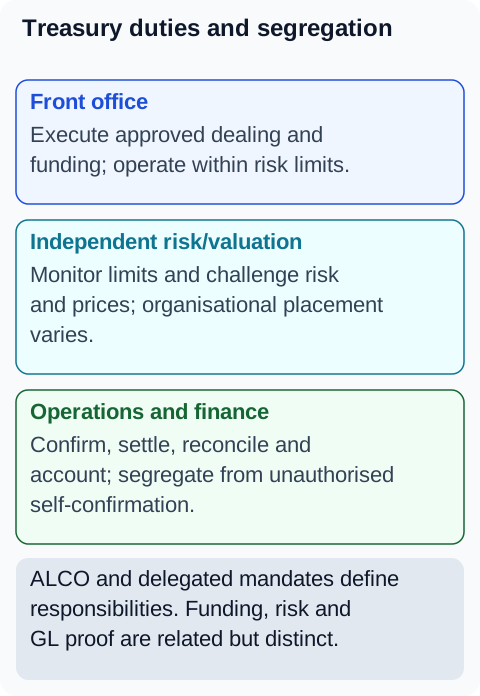
Figure 2. Funding sources and eligibility.
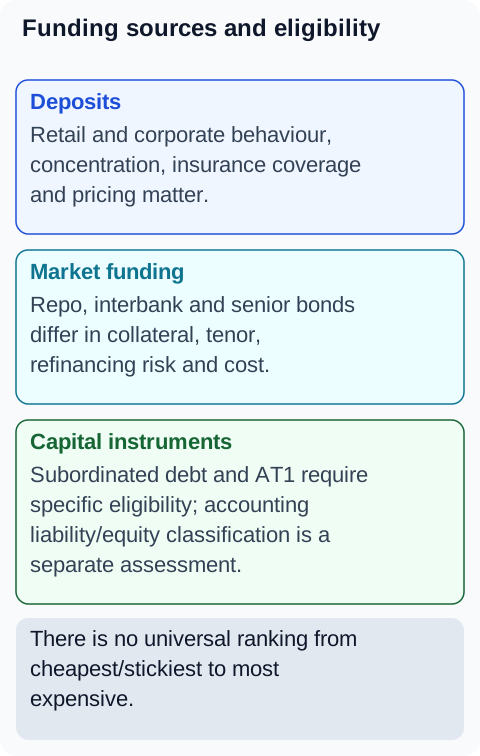
Figure 3. Issued bond at a discount.
12. Tables
| Event | Debit | Credit |
|---|---|---|
| Discount bond issued | Cash and issue-discount adjustment | Bond face liability |
| Eligible issuance cost paid | Liability transaction-cost adjustment | Cash |
| EIR accrued | Interest expense | Coupon payable and amortisation of discount/cost adjustments |
| Coupon paid after accrual | Coupon payable | Cash |
| Redemption | Remaining liability | Cash |
| Buyback below carrying amount | Liability and related adjustments cleared | Cash and extinguishment gain |
| Typical secured repo funding | Cash | Repo liability; retained securities remain separately recorded and encumbered |
Treasury supplies funding contracts, cash-flow ladders, collateral and limit data. Finance supplies accruals, journals and disclosure balances. Actual ownership and meeting/reporting cadence follow the bank’s governance and applicable supervisory requirements.
13. Illustrative bank case study
Funded like a hedge fund, failed like one. A fast-growing bank funded long-dated structured assets with short-term wholesale paper, earning a rich spread while markets were calm. When confidence wobbled, paper couldn't roll, fire sales crystallised losses, and the institution was resolved over a weekend. The balance sheet was solvent months earlier on hold-to-maturity assumptions — funding mismatch exposed refinancing risk and interacted with losses on assets. Lesson: maturity transformation has a speed limit set by funding stability; treasury's ladder is the speedometer. The bank's business model was to originate long-dated, illiquid assets (structured credit products with 5–10 year maturities) and fund them with short-term commercial paper (with 30–90 day maturities). The maturity mismatch was intentional — the bank earned a spread between the long-dated asset yield and the short-term funding cost. This spread was the bank's profit, and it was substantial — enough to compensate investors and pay management bonuses. But the spread was also a measure of the bank's refinancing risk: the bank had to roll its commercial paper every 30–90 days, and if it could not roll, it would face a funding crisis. When the fictional stress scenario hit, the commercial paper market froze — investors refused to roll, demanding repayment instead. The bank was forced to sell its long-dated assets into a market where no one was buying, at fire-sale prices. The losses from the fire sales exceeded the bank's capital, and the institution was resolved over a weekend. (Fictional training case; no specific bank or event is asserted.)
14. BA, developer, tester and operations guidance
- BA: Capture funding instruments with EIR inputs, ladder attributes, encumbrance flags and disclosure tags at product setup — plus ALCO limit definitions as requirements. Ensure that every instrument's terms are captured completely at issuance.
- Developer: Enforce pre-trade limits; automate EIR schedules for issued debt; feed ladders from governed contract data; control and reconcile any spreadsheet interface; flag encumbrance in securities data. Build the EIR engine to handle all bond features (calls, puts, step-ups, currencies) and to regenerate schedules automatically when features are exercised.
- Tester: Discount/premium amortisation to the penny; buyback gain/loss; repo start/end with encumbrance flags; ladder completeness against contract population. Test that the EIR engine produces the correct amortisation schedule for bonds with various features.
- Operations: Match confirmations same-day; escalate settlement fails immediately; monitor maturity diary like a payment queue. Maintain a maturity diary that flags instruments approaching maturity at T-90, T-60, and T-30.
15. Common mistakes
- Expensing qualifying directly attributable costs on amortised-cost debt, or deferring costs on FVTPL debt when immediate expense is required.
- Treating a retained-risk repo as a sale, or deciding accounting from the repo label without the applicable transfer assessment.
- Ignoring encumbrance — pledged assets double-counted as liquidity.
- Funding to the ladder's edge with no pre-funding buffer.
- Using ungoverned amortisation calculations without independent schedule verification and reconciliation.
- Assuming market conditions will be favorable when refinancing is needed.
- Failing to consider MREL/TLAC requirements in the funding plan.
16. Key takeaways
- Treasury manages a funding mix whose stability, price and eligibility depend on actual instruments and counterparties, within approved mandates.
- Front deals, middle challenges, back proves — segregation is structural.
- Amortised-cost issued debt accrues at EIR with eligible discounts/costs incorporated; typical retained-risk repos are financing, subject to the applicable transfer assessment.
- Maturity ladders with limits prevent refinancing cliffs.
- Funding structure and asset quality jointly determine resilience in stress.
17. References and verification notes
-
Basel Framework: NSFR: available and required stable funding are weighted by funding and asset characteristics over a one-year horizon, not a requirement to match every mortgage with equally long funding.
-
Basel Framework: LCR: 100% is the minimum in normal conditions for covered banks; HQLA buffers are intended to be usable in stress. Basel is a standard implemented through local law.
-
Basel Framework: definition of capital: capital eligibility is separate from accounting classification; AT1/Tier 2 and distribution conditions require local implementation assessment.
-
IFRS Foundation: IFRS 9: classification depends on business model and contractual cash flows; initial recognition and directly attributable costs follow IFRS 9. This is the IFRS track, not US GAAP CECL.
-
Amortised-cost/EIR and own-credit presentation per IFRS 9 (Section 8); encumbrance, MREL/TLAC, funding-plan and disclosure rules per the applicable prudential framework (EU/UK/US/RBI) — verify current requirements locally.
-
Typical repos that fail the applicable derecognition/sale criteria receive financing treatment. IFRS and US GAAP transfer tests differ; assess contractual rights, risks/rewards and control or effective control under the applicable framework.
-
FASB: ASU 2014-11, Transfers and Servicing: explains the ASC 860 repurchase effective-control criteria and repurchase-to-maturity secured-borrowing treatment. This amendment document explains the rules; use the current Codification for the complete US GAAP assessment.
-
All amounts, spreads and ladders are fictional training illustrations.