Chapter 018: Deposit Interest and Charges
Section 4: Deposit and Funding Accounting · Chapter 018 of 100
Deposit interest is funding expense; account-service fees are revenue under their applicable recognition rules. This chapter calculates the customer amounts and reconciles accrual, capitalisation, withholding and charges.
1. Chapter opening
Deposit interest is the bank's funding expense; account-service fees are revenue when the relevant service is delivered. Capitalising interest into a customer account transfers an already recognised liability and must not recognise expense again. This chapter distinguishes contractual customer calculations, IFRS carrying amounts, service fees, tax deductions and management funds transfer pricing (FTP).
2. Learning objectives
- Calculate deposit interest using rate, balance, days and convention.
- Post accrual, capitalisation, withholding and payout without duplication.
- Distinguish integral financial-liability economics from separate service fees.
- Reconcile customer accruals and GL balances, including corrections.
- Explain how FTP and green-allocation reporting remain separate from customer interest.
3. Business context
A rate announcement is a product decision; the accounting engine needs effective date, eligible balances, tier method, bonus conditions, compounding and rounding. A threshold can apply progressively to each balance band or apply one rate to the full balance. Those methods produce different amounts even when marketing displays the same rate table.
Define whether interest runs on ledger, cleared or another contractually defined balance. Availability, value date and external settlement are separate fields. Keep earned customer interest separate from a management FTP credit; FTP does not change the legal rate owed to the depositor.
4. Finance and accounting view
4.1 Allocation mechanics (fictional)
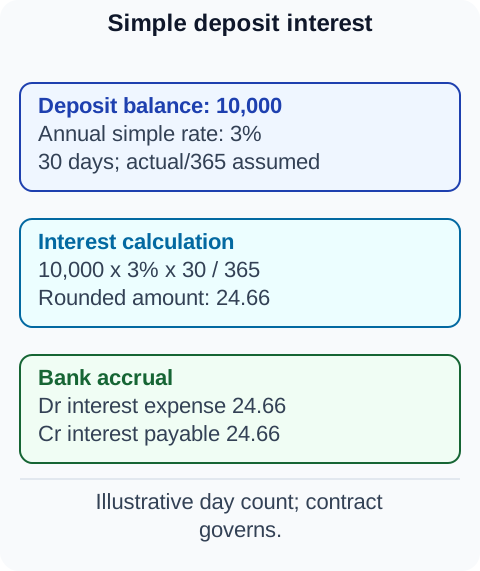
Fictional interest example: a constant 50,000 balance at 4.5% for 30 actual days on Actual/365 earns 50,000 × 4.5% × 30/365 = 184.93 after rounding. On Actual/360 it earns 187.50. Apply the agreed convention, not whichever produces the preferred margin.
For 184.93, accrue Dr Interest expense 184.93 / Cr Deposit accrued interest payable 184.93. At capitalisation with an illustrative 10% withholding: Dr Accrued interest payable 184.93 / Cr Customer deposit 166.44 / Cr Tax payable 18.49. Remit tax Dr Tax payable 18.49 / Cr Cash 18.49. Tax is withheld from the customer's gross entitlement; it does not reduce the bank's recognised interest expense.
At closure, settle accrued and capitalised interest under the contract and applicable law, clear pending fees/holds lawfully and reconcile each liability component. Do not reverse earned interest merely because the account closes.
4.2 Charges and FTP
For a 5 monthly account-service fee earned and debited to the customer, Dr Customer deposit 5 / Cr Service fee income 5. If a fee was previously accrued, clear the receivable instead of recognising revenue twice. Fees paid before service delivery may create an IFRS 15 contract liability released as service is performed. A fee integral to the deposit liability adjusts IFRS 9 measurement/EIR rather than being booked as service income.
Where an illustrative VAT/sales tax of 1 is collected in addition to a 5 service fee, Dr Customer deposit 6 / Cr Fee income 5 / Cr Tax payable 1. Actual exemptions, tax bases and rates depend on jurisdiction. Refunds must reverse the correct income, receivable, liability and tax components.
FTP allocates funding value between Treasury and businesses in management reporting. Reconcile and eliminate internal allocations where appropriate; they are not external interest paid by the bank or extra interest owed to customers.
4.3 Deep dive: allocation-squeeze playbooks and greenium testing discipline
Application to green deposits. A green label does not change ordinary deposit interest, fee or tax recognition. A framework may track allocation to eligible green assets through a pool rather than a separate ring-fenced account. The applicable framework determines eligible uses, temporary unallocated-funds treatment, assurance and reporting. Do not promise principal safety beyond the bank's contractual obligation and applicable deposit-protection coverage. Access follows the product: a green term deposit can have legitimate withdrawal restrictions.
In a fictional pool, deposits 520 and eligible allocated assets 480 imply 92.31% coverage. Do not claim 100% allocation. Govern the shortfall and sales under the actual framework, preserve credit standards on new lending and avoid double-counting the same assets against multiple funding pools. With allocated assets 560, coverage would be 107.69%. Impact estimates are modelled attribution, not proof that one depositor caused a quantified environmental outcome.
5. Product and customer impact
Customers should see contractual rates, effective dates, fee triggers, tax deductions and correction narratives. The bank's IFRS EIR and management FTP are different measures from a customer savings rate or quoted yield. Reconcile the contractual quote to the executed transaction without rewriting the legal principal to equal an accounting carrying amount.
6. Regulatory and supervisory view
IFRS 9 applies to relevant deposit liabilities and IFRS 15 to separate services on this course's IFRS track. Deposit protection, disclosure, rate-change notice, unfair-charge restrictions, withholding and unclaimed balances follow local law. The UK ordinary FSCS limit is £120,000 for eligible deposits at an authorised institution for failures after 30 November 2025, aggregated across shared licences; this is not a universal global limit.
Environmental marketing and any green-deposit framework need a separate applicability assessment. An industry principle or a proposed environmental-claims directive is not automatically a current banking requirement. Avoid universal minimum allocation deadlines, pricing premiums or assurance frequencies without a scoped source.
7. Systems and data view
Maintain versioned contractual rate tables, balance definitions, accrual schedules, fee policy, tax eligibility and journals. Capture source event ID and rate/fee-rule version. Separate accrued-interest payable from capitalised customer principal, and preserve a correction link. Optional green allocation tags should not overwrite financial account ownership or deposit insurance identity.
8. End to end process
- Capture contractual balance/rate/fee/tax terms.
- Calculate interest over the correct dates and populations.
- Accrue expense and interest liability.
- Capitalise or pay once, withholding tax where required.
- Recognise separate service fees under the appropriate trigger.
- Reconcile customer subledger, GL, payouts and tax remittances.
- Correct errors with approval and clear customer explanation.
9. Controls and risks
| Risk | Control | Evidence |
|---|---|---|
| Wrong rate or day count | Effective-date and independent calculation checks | Rate version and recalculation |
| Expense booked twice | Accrual-to-capitalisation liability bridge | Roll-forward and journal check |
| Service fee misclassified | Approved IFRS 9/15 policy | Contract and recognition decision |
| Tax deducted incorrectly | Eligibility/rule controls and tax payable reconciliation | Customer certificates and remittance |
| Replayed batch duplicates | Atomic idempotency | Retry outcome records |
| Unsupported green claim | Framework, allocation and claim review | Reconciled register and qualified impact evidence |
10. Practical examples
Progressive tiers: assume 2% on the first10,000 and 3% on the next10,000. A15,000 balance for a30/360 month earns (10,000×2%+5,000×3%)×30/360=29.17. Applying3% to the whole balance earns37.50 and overpays8.33 under this specified tier contract.
Duplicate capitalisation: interest payable184.93 must reconcile to customer credit166.44 plus tax payable18.49 under the fictional10% withholding assumption. A replay returns the original outcome rather than crediting the account twice.
Green allocation supplement: eligible assets480 versus labelled deposits520 give92.31% coverage. If the bank’s disclosed framework requires100%, assess the shortfall and follow its lawful remediation commitments. Assets560 versus deposits520 give107.69%. No press endorsement, mandatory universal floor or invented enforcement-cost estimate is asserted.
11. Diagrams
Figure 1. Deposit interest accrual.
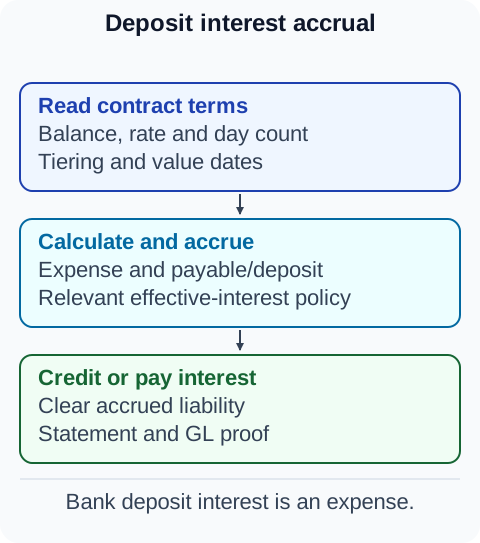
Figure 2. Bank-side deposit entries.
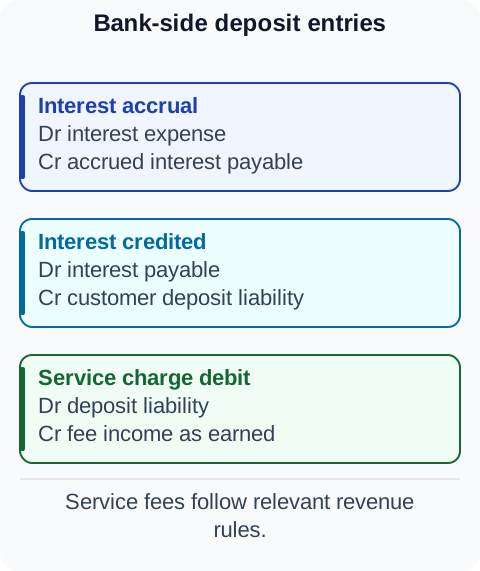
Figure 3. Simple deposit interest.
12. Tables
Table 1: interest liability bridge
| Movement | Amount |
|---|---|
| Gross accrual | 184.93 |
| Customer credit after illustrative withholding | 166.44 |
| Tax liability | 18.49 |
| Accrual liability remaining after capitalisation | 0.00 |
Table 2: different rates, different purposes
| Measure | Purpose |
|---|---|
| Contractual deposit rate | Customer interest entitlement |
| Deposit liability EIR | IFRS amortised-cost expense |
| FTP rate | Internal funding allocation |
| Promotional rate comparison | Marketing, with matched terms and disclosure |
Table 1 — Allocation register extract (fictional m)
| Deposit pool | Tagged assets | Coverage |
|---|---|---|
| Green savings 300 | Green mortgages 320 | 107% |
| Green corporate 200 | Renewable loans 220 | 110% |
Table 2 — Pricing honesty (illustrative)
| Claim | Allowed? |
|---|---|
| "Funds allocated to green assets (audited)" | Only if actual allocation and the stated audit/assurance scope support the claim |
| "Your deposit saves X tonnes" | Evidence, modelled attribution, uncertainty and wording must support it; a causal guarantee cannot be inferred from allocation |
| "Greenest bank" | No (unsubstantiated superlative) |
13. Illustrative bank case study
A tier rule is corrected. In this fictional case, an interest engine applies a whole-balance rate to a progressive-tier product. Finance independently recalculates affected periods, Operations preserves duplicate/reversal identity and Compliance assesses customer remediation and communications. The bank then reconciles contractual entitlement, accrued liability, customer credits and tax corrections before signing off.
14. BA, developer, tester and operations guidance
- BA: specify tier method, dates, balance base, rounding and tax with numbers.
- Developer: separate accrual, capitalisation and fee events with stable retry identity.
- Tester: test tier boundaries, leap days, rate changes, refunds and batch replays.
- Operations: reconcile liability releases, customer credits and remittances; work exceptions promptly.
15. Common mistakes
- Using a contractual rate as a substitute for IFRS EIR where integral economics differ.
- Recognising expense again when capitalising accrued interest.
- Treating withheld tax as bank income or a reduction in expense.
- Ignoring progressive versus whole-balance tiers.
- Assuming a green label changes financial recognition or guarantees allocation.
16. Key takeaways
- Interest expense accrues once; capitalisation settles or reclassifies the payable.
- Integral instrument economics and separate service fees use different recognition rules.
- Contractual rate, EIR and FTP are distinct measures.
- Customer, GL and tax balances require explicit bridges.
- Sustainability claims require separate evidence and scoped frameworks.
17. References and verification notes
-
FSCS: deposit protection: for failures after 30 November 2025, the ordinary limit is £120,000 per eligible person per authorised institution, aggregated across shared licences; exclusions and special temporary high balance rules apply.
-
IFRS Foundation: IFRS 15: service revenue follows performance obligations; integral instrument economics remain within IFRS 9 and taxes collected for authorities are not service revenue.
-
IFRS Foundation: IFRS 9: classification depends on business model and contractual cash flows; initial recognition and directly attributable costs follow IFRS 9. This is the IFRS track, not US GAAP CECL.
The numeric rates and tax examples are fictional assumptions. The sources below support the IFRS and UK deposit-protection distinctions; they do not prescribe other jurisdictions' rates, tax treatment or product terms.