Chapter 088: United States Reporting
Section 18: Regional Regulatory Reporting Tracks · Chapter 088 of 100
US reporting has parallel supervisory, holding-company and securities-disclosure tracks with entity-specific accounting bases. US GAAP and CECL govern covered US reporting populations; eligible foreign private issuers may file SEC financial statements under IFRS as issued by the IASB without US-GAAP reconciliation, with the required unreserved compliance statement and audit opinion. SEC Form 20-F, Item 17(c). A foreign bank therefore maps each reporting entity, form and accounting basis instead of assuming every US filing uses the same framework.
1. Chapter opening
US reporting separates GAAP financial information, charter-specific supervisory returns, holding-company returns and public securities disclosures where applicable. CECL under ASC326 applies to covered amortised-cost assets and eligible commitments; AFS debt has a distinct allowance model. Call Reports, FRY9C, foreign-bank reports, stress-test and capital-plan submissions have their own scopes, instructions and dates. SEC10-K/10-Q obligations apply to covered issuers rather than every bank. Build consistent bridges without treating historical ASC310/450 allowance references or legacy CCAR labels as a complete current framework.
2. Learning objectives
- Name US returns (Call Report, holding-company, advanced schedules) with frequencies.
- Explain GAAP-vs-IFRS headline differences (AFS/HTM, CECL, netting, TDR evolution).
- Reconcile GAAP provisions (CECL) to IFRS ECL for dual reporters.
- Describe SEC disclosure (MD&A credit discussion, risk factors, controls/SOX).
- Map stress-test disclosure duties (DFAST/CCAR heritage) at headline level.
3. Business context
US GAAP and IFRS group reporting require separately identified policies, adjustments and reconciliations. CECL generally estimates lifetime losses for in-scope amortised-cost assets, while IFRS9 Stage 1 records 12-month ECL and Stages 2/3 lifetime ECL. IFRS9 therefore also records a day-one impairment charge; '12-month ECL' means lifetime shortfalls from defaults possible in the next 12 months, not only 12 months of missed payments. Growth does not guarantee a fixed ratio between the two allowances or a universal extra reporting cost percentage.
| Track | Numbers | Readers punish |
|---|---|---|
| GAAP financials | CECL provisions, AFS marks | Earnings misses, reserve builds |
| Supervisory | RWA, stress results | Findings, distribution limits |
| SEC disclosure | MD&A trends, controls | Inconsistency with calls |
4. Finance and accounting view
4.1 GAAP headline mechanics
Under US GAAP, eligible held-to-maturity debt is at amortised cost with ASC326-20 CECL; available-for-sale debt is fair-valued with a separate ASC326-30 credit-loss model and non-credit changes in OCI; trading fair-value movements enter earnings. AFS impairment is not CECL applied indiscriminately to all debt. Sale intent and more-likely-than-not required sale affect AFS write-down treatment. A sale from HTM can call intent into question but specific permitted circumstances exist, so it does not automatically taint every security in every case. IFRS9 FVOCI debt also has ECL recognised in profit or loss with the corresponding allowance in OCI, without deducting the allowance from the fair-value asset. OCC accounting resources.
4.2 Reconciliation discipline
Dual reporters maintain GAAP↔IFRS bridges (provision timing: CECL vs staged ECL; classification: AFS vs FVOCI; netting differences; DTA treatments) published internally each close and summarised for audit committees. Supervisory returns built from GAAP-close lineage with regulatory adjustments (AOCI opt-out elections, CECL transition provisions — verify current phase status). The reconciliation bridge must be maintained at a granularity that enables the audit committee to understand not just the total difference but the components: allowance timing and measurement differences (which can change with originations, repayments, forecast revisions, staging and credit deterioration; convergence is not guaranteed), classification differences (which affect where fair-value movements are recognised), and measurement differences (which affect specific portfolios differently). The bridge must also address regulatory adjustments that diverge from both GAAP and IFRS — the US regulatory capital framework allows certain elections (AOCI treatment according to the organisation's applicable regulatory category and election) that create a third measurement basis for capital purposes. Managing three simultaneous measurement frameworks (GAAP, IFRS, regulatory) requires robust systems and clear ownership of each reconciliation point.
4.3 Deep dive: IHC capital planning and AOCI volatility management
An intermediate holding company’s capital and liquidity planning identifies its applicable US scope, minima, distribution constraints and governance obligations. Assess entity headroom alongside group headroom, as in Cross-Jurisdiction Reporting Case Study. Parent support is subject to actual legal transfer restrictions, capital and liquidity constraints, contracts and authority decisions; neither group surplus nor a support pledge guarantees availability. The Board needs relevant expertise and documented challenge, assessed on evidence rather than directors’ nationality or location. Single-point-of-entry and multiple-point-of-entry resolution strategies require legal recognition, cross-border cooperation and operational execution; home-authority agreement alone does not establish every necessary power.
AFS unrealised fair-value movements enter accounting AOCI; inclusion in regulatory capital depends on the organisation’s applicable rules and election. HTM classification requires positive intent and ability to hold, with specific permitted sale circumstances; a sale is not universally automatic tainting of the whole portfolio. Assess liquidity capacity and duration under stress. An ASC815 fair-value hedge of fixed-rate securities designates an eligible asset risk such as benchmark interest-rate risk, not simply “the floating-rate liability” as the hedged asset risk. Documentation, qualifying instrument and effectiveness requirements determine accounting. A particular quarterly Board approval cycle is bank policy unless an applicable requirement says otherwise.
5. Product and customer impact
CECL and IFRS9 can produce different allowance timing and amounts, affecting reported earnings and capital. Do not compare a lifetime day-one allowance directly with one year’s 25bp lending spread and call the whole product economically unprofitable. Price expected losses, lifetime cash flows, funding, operating cost, capital and return requirements over a consistent horizon. Assess financial reporting effects separately, including IFRS Stage 1 day-one 12-month ECL and lifetime measurement in Stages 2/3.
6. Regulatory and supervisory view
Identify charter and holding-company reporting separately. Call Reports are quarterly, not monthly for CategoryI. FR Y-9C is a consolidated holding-company report where applicable; foreign branches and agencies may use FFIEC002, while foreign banking organisations have their own FRY7-series obligations. Federal Reserve tailoring CategoriesI-IV concern covered large organisations; CategoryIV is not a label for every bank below100bn, and crossing100bn does not automatically create CategoryIII. Stress-test, liquidity and capital-plan duties depend on applicable thresholds and other risk indicators. SEC forms and SOX requirements have their own issuer scope and exemptions. Federal Reserve reporting forms.
7. Systems and data view
US reporting stack: GAAP subledgers/engines (CECL calculator, AFS/HTM trackers), supervisory mapping layer (Call/Y-9C/101 schedules), SEC disclosure workpapers (MD&A tie-outs), stress-test submission environment, GAAP↔IFRS bridge engine. Controls: dual-framework tagging, bridge tie-outs, schedule-completeness checks, disclosure-control (SOX) testing. The CECL calculator is the most complex component: it must support multiple methodologies (PD/LGD, vintage, DCF), multiple asset classes (loans, securities, unfunded commitments), and multiple data sources (internal historical losses, macroeconomic forecasts, peer data). The calculator must also maintain a complete audit trail of assumptions, parameters, and calculations for both internal governance and external audit. The bridge engine must reconcile GAAP provisions to IFRS ECL at portfolio level, flagging and explaining differences that exceed materiality thresholds — differences that cannot be reconciled must be investigated and resolved before the close completes.
8. End to end process
- Close GAAP books with CECL. 2. Build supervisory schedules with lineage. 3. Bridge GAAP↔IFRS for group. 4. Draft SEC disclosures tied to both. 5. Stress-test and capital-plan under scenarios. 6. Attest (SOX + supervisory), file all tracks. 7. Reconcile tracks publicly where required.
9. Controls and risks
| Risk | Control | Evidence |
|---|---|---|
| Framework cross-contamination | Dual tagging, separate engines | Tag audits |
| CECL/IFRS confusion in packs | Labelled lenses, bridge packs | Pack reviews |
| Schedule incompleteness | Completeness checks per charter | Completeness logs |
| Disclosure-control gaps | SOX testing of disclosure controls | Test results |
10. Practical examples
A — CECL vs ECL quarter: US book provisions 2× IFRS equivalent on growth (lifetime vs 12-month staging); management commentary pre-briefs analysts with bridge — no surprise. B — AOCI shock: rate rises push AFS losses through AOCI into capital (prudential AOCI treatment depends on the applicable category and permitted election); distribution plans flexed; hedging strategy revised.
10.3 Worked example: growth requires a rule-specific assessment
A fictional holding company grows from 95bn to 115bn. The control team checks averaging rules, covered-organisation thresholds, foreign status, cross-jurisdictional activity, non-bank assets, weighted short-term wholesale funding and off-balance-sheet exposures. It then identifies each new duty and its transition period from the current Federal Reserve rules. Do not invent 'FRY9C lite', assume modified LCR at 95bn or call 115bn CategoryIII solely by size. Build and test the required capability before its actual effective date. Keep internal quarterly stress exercises separate from statutory supervisory stress-test frequency.
11. Diagrams
Figure 1. US reporting preparation.
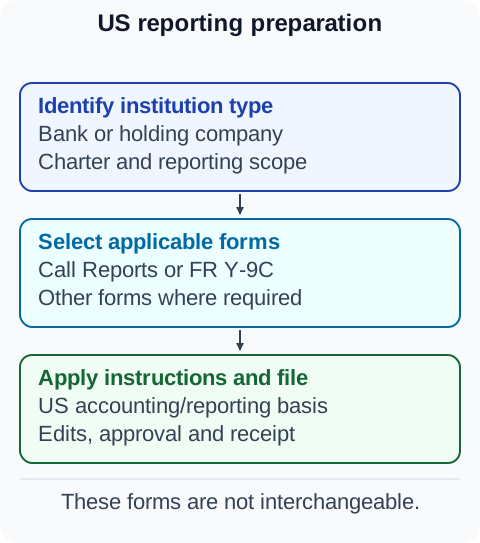 Figure 2. US reporting populations.
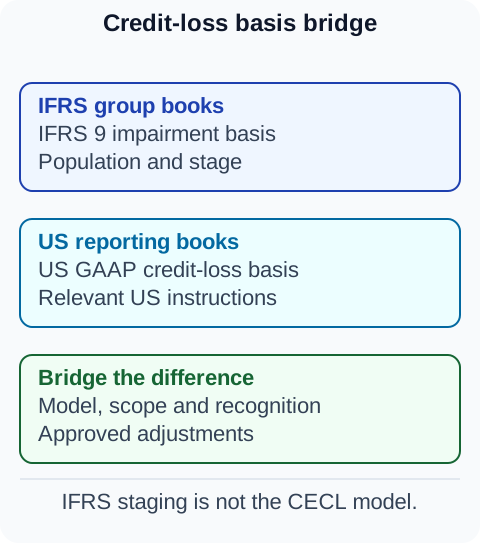
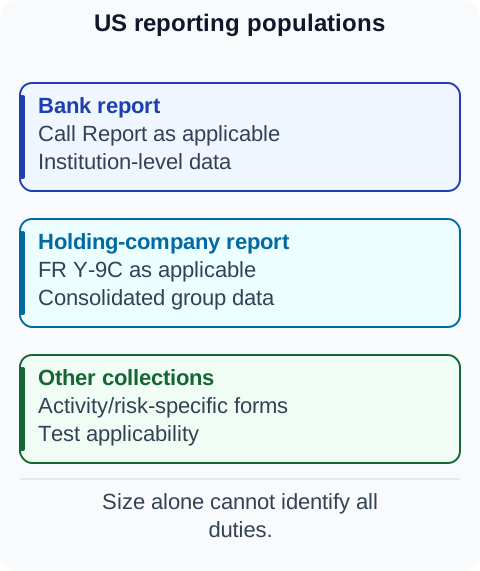 Figure 3. Credit-loss basis bridge.
12. Tables
Table 1 — GAAP vs IFRS headlines
| Area | US GAAP | IFRS |
|---|---|---|
| Impairment | CECL lifetime day-one | Staged ECL |
| Securities | HTM/AFS/trading | AC/FVOCI/FVTPL |
| Equities | Generally earnings | FVTPL or FVOCI-elect |
| Modifications | ASU 2022-02 disclosures | IFRS 9 mod/derecog |
Table 2 — US return map (verify forms)
| Return | Who | Cadence style |
|---|---|---|
| Call Report | Banks | Quarterly |
| Holding-company | BHCs/IHCs | Quarterly |
| Advanced schedules | Advanced banks | Quarterly |
| SEC domestic-issuer 10-K/10-Q | Covered reporting issuers, whether or not exchange-listed | Annual/quarterly under applicable requirements |
| SEC foreign-private-issuer forms | Eligible foreign private issuers; normally 20-F annual and 6-K furnished information | Applicable form and disclosure requirements; not a universal 10-Q cycle |
13. Illustrative banking case study
Accounting labels meet liquidity needs (fictional). A bank holds fixed-rate debt classified as HTM and AFS. Rising yields reduce market values; deposit withdrawals test its ability to hold assets and meet cash needs. Accounting equity, tangible equity and regulatory capital respond differently depending on classification, impairment and permitted AOCI adjustments. Neither the HTM label nor an AOCI filter eliminates economic rate or liquidity risk.
14. BA, developer, tester and operations guidance
- BA: Tag every requirement by framework (GAAP/IFRS/supervisory) with bridge logic.
- Developer: Dual engines with framework tags; automate bridges; version schedule mappings.
- Tester: Cross-framework cases; bridge tie-outs; schedule completeness by charter.
- Operations: Label every pack's lens; pre-brief framework-driven variances.
15. Common mistakes
- Presenting CECL and ECL numbers interchangeably.
- Assuming AFS equals FVOCI (allowance mechanics differ).
- Missing charter-specific schedule obligations.
- Undisclosed framework switches in commentary.
- Stress-test disclosure unprepared (numbers publish).
16. Key takeaways
- Three US tracks (GAAP, supervisory, SEC) plus stress disclosure — reconciled, never mixed.
- CECL front-loads lifetime loss; bridges explain IFRS gaps.
- Tailoring tiers set frequency/scope — confirm current thresholds.
- Securities rate risk affects economics and accounting equity; regulatory-capital effects depend on applicable AOCI treatment and permitted elections.
- Label every number's framework before comparing.
17. References and verification notes
- Federal Reserve reporting forms: form applicability and current instructions.
- OCC allowance/accounting resources: ASC326 CECL versus AFS impairment; links to revised2026 handbook and accounting advisory materials.
- IFRS9: staged ECL; group reconciliation is distinct from US supervisory scope.
- SEC Form 20-F, Item 17(c): IFRS as issued by the IASB exception to US-GAAP reconciliation; general instructions identify foreign-private-issuer scope.
- Figures are fictional training illustrations.