Chapter 089: India Reporting
Section 18: Regional Regulatory Reporting Tracks · Chapter 089 of 100
Indian bank reporting must distinguish RBI prudential classifications, statutory financial statements, supervisory returns and audit evidence. Reporting readiness is continuous: a loan's classification, interest recognition and provisions should agree across the contract system, ledger and applicable RBI return. An inspection timetable is not a substitute for those daily controls.
1. Chapter opening
Maintain a dated register for RBI supervisory returns, prudential information, statutory statements/disclosures and applicable fraud/audit obligations. RBI risk-based supervision and inspection evidence are distinct from the EU SREP procedure. Concurrent audit, statutory audit/LFAR and risk-based internal audit have their own scopes; do not assume every branch receives identical continuous coverage. Track PCA applicability and actual directions rather than treat any adverse inspection as automatic PCA.
Inspection and supervisory findings can require remediation or other action under applicable powers. PCA has specified applicability, indicators and actions; it is not an automatic consequence of every reporting error. Maintain evidence of classification, provisions, fraud-reporting compliance and governance throughout the year. A clean inspection does not guarantee unrestricted execution of every business plan.
2. Learning objectives
- State IRAC headlines (day-end recognition, NPA norms, provisioning, upgrade discipline).
- Run concurrent, statutory (LFAR) and internal audit expectations with evidence standards.
- Meet fraud-reporting timelines with forensic readiness.
- Explain PCA-style triggers and corrective discipline (verify current).
- Maintain inspection-ready packs (always-fresh, not inspection-scrambled).
3. Business context
RBI directions, statutory reporting and audit findings affect the bank’s controls and business decisions. Determine which restrictions are mandatory or discretionary under the actual supervisory framework and decision. Indian prudential provisions and a group’s IFRS adjustments need an explicit bridge; Indian banks do not universally maintain two public IFRS/IRAC books or always apply a higher-of rule.
A bank subject to PCA follows the measures applicable to its risk threshold and supervisory decision. Management assesses capital, profitability, credit, distribution and expansion impacts using those actual measures. Remediation needs owners, funding, milestones and Board oversight; an inspection outcome alone does not prove a predictable market reaction or financing cost.
| Audit layer | Covers | Cadence |
|---|---|---|
| Concurrent | Branches, large advances, treasury | Continuous |
| Statutory + LFAR | Financials + control depth | Annual |
| Internal (risk-based) | Universe per risk rating | Cyclical |
| RBI inspection | Full supervisory scope | Periodic + thematic |
4. Finance and accounting view
4.1 IRAC mechanics (headline, verify current norms)
For current commercial-bank treatment on 3 October 2026, use the RBI Commercial Banks IRAC Directions,2025 as amended, including day-end overdue classification and product-specific NPA criteria. Ordinary term-loan NPA treatment uses amounts overdue for more than 90 days; cash-credit/overdraft uses the out-of-order tests, and agricultural loans have crop-season rules. NPA upgrades require clearance of applicable principal and interest arrears across the borrower's facilities; restructuring frameworks can impose additional conditions. A committee cannot waive a regulatory NPA definition.
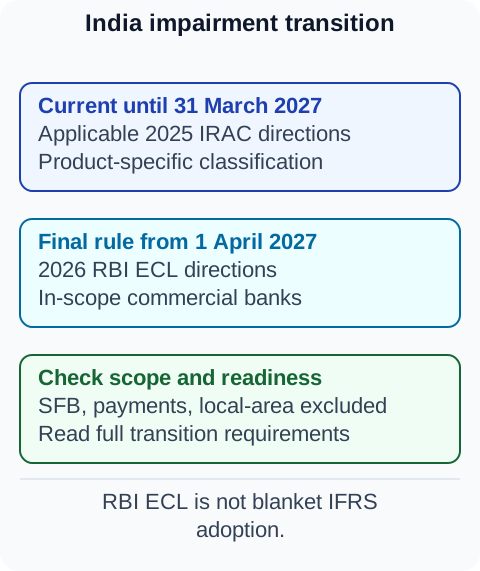
The final RBI Asset Classification, Provisioning and Income Recognition Directions,2026 were issued27 April2026 and commence1 April2027. They introduce ECL staging and effective-interest concepts while retaining NPA norms; they expressly leave the2025 directions governing until commencement. This is final future-effective regulation, not an already-current2026 provisioning requirement or a mere proposal. Its scope excludes small finance, payments and local area banks. RBI2026 directions.
Run day-end classification using contractual due dates and complete receipt evidence. Preserve days past due, borrower-level linkage, security value, NPA ageing and provision category. Reconcile recognised provisions to the GL; statutory IRAC, future RBI ECL and IFRS group ECL are separate frameworks, not a universal 'higher-of IFRS and IRAC' rule. Manual error correction needs controlled evidence and approval, but cannot make a genuinely overdue account performing contrary to regulation.
4.2 Inspection evidence packs
Always-ready packs: IRAC compliance (classification samples, provisioning math, upgrade evidence), fraud monitoring (FMR filings, forensic status, staff accountability), KYC/AML (sampling results, STR filings), governance (Board/committee minutes, RACI, finding trackers), IT controls (access, change, cyber drills). Mock inspections (internal, unannounced to business) test readiness honestly.
The inspection evidence pack is not a collection of documents assembled when the inspector arrives; it is a continuously maintained repository that is updated after every cycle. The IRAC compliance pack contains a random sample of loan files (selected by the inspection team, not pre-selected by the bank) with evidence that each file's classification matches its DPD status, that the provision calculation is mathematically correct, and that any upgrade from NPA to standard was supported by the applicable borrower-level arrears-clearance conditions and, for relevant restructured exposures, any required satisfactory-performance or probation conditions. The fraud monitoring pack contains the filed Fraud Monitoring Returns (FMRs), reconciled to the bank’s internal incident register, with all reportable incidents, their investigation status, forensic reports where applicable, and evidence of staff accountability. The governance pack contains Board and committee minutes with evidence that the required topics were discussed, decisions were made, and actions were tracked. Each pack is designed to be self-contained: an inspector who picks a pack at random should be able to verify its contents without needing to ask the bank for additional documentation.
4.3 Deep dive: divergence self-identification programmes and mock-inspection machinery
Independent asset-quality reviews test current RBI classification and provisioning, investigate evergreening and assess reporting impact. Correct identified errors promptly and make disclosures or notifications when the applicable requirements demand them. Credible remediation is evidence of governance; it does not guarantee supervisory credit or eliminate possible consequences. IFRS overlays do not replace statutory IRAC calculations.
The current commercial-bank financial-statement directions require divergence disclosure if either additional RBI-assessed NPA provisions exceed5% of reported profit before provisions and contingencies, or additional gross NPAs exceed5% of reported incremental gross NPAs. Incremental gross NPAs means additions during the reference year. Disclose in the notes to the ensuing annual financial statements immediately following RBI communication. This is not '15% of NPAs or10% of provisions, whichever lower'. RBI financial-statement directions, divergence disclosure.
Use internal mock reviews to test evidence retrieval, classification, provision arithmetic, control operation and remediation. An independent reviewer chooses risk-based and unpredictable samples. Scope, notice, staffing and cadence are bank-policy choices informed by risk and applicable requirements; neither annual full-scope mocks nor quarterly thematic mocks are universal RBI legal minima.
A review should challenge the evidence rather than reproduce business-selected examples. Unannounced sampling can help expose readiness gaps, while planned exercises can test specific system or control changes. Competent independent staff need sufficient authority and domain knowledge; former regulators or a particular professional-services firm are not mandatory. Grade findings, assign deadlines and re-test closure without promising a clean subsequent inspection.
5. Product and customer impact
IRAC classification supports timely monitoring and borrower communication. For ordinary term loans under the applicable SMA framework, an overdue payment is SMA-0 up to 30 days, SMA-1 above 30 and up to 60 days, and SMA-2 above 60 and up to 90 days; the applicable NPA threshold and other criteria then govern. Do not wait until day 30 to identify an overdue account. Cash-credit/overdraft, agricultural and other specified products have their own tests. Classification does not itself guarantee an offer of restructuring; communicate valid resolution options and contractual consequences accurately.
6. Regulatory and supervisory view
Apply the current entity-specific RBI directions for IRAC, statements and disclosure, fraud, KYC, IT, governance and supervisory returns. Maintain required channels, deadlines, approvals and receipts. Controlled source-error correction does not authorise committee overrides of NPA definitions. Add future-effective 2026 ECL implementation to the change calendar without prematurely replacing current IRAC treatment.
7. Systems and data view
IRAC engine (day-end DPD, auto-classification, provisioning ladders, upgrade gating), fraud monitoring (rules + forensics workflow + FMR filing), audit management (universe, planning, workpapers, finding tracker), inspection portal (pack repository, query workflow). Controls: auto-classification (no override that contradicts regulatory classification criteria), upgrade evidence enforcement, FMR timeline timers. The IRAC engine is the most critical system: it must compute DPD correctly for every account, apply the classification rules automatically, and produce the evidence trail that supports each classification. Corrections to erroneous input records need approval and evidence; committees cannot override the substantive regulatory criteria ; retain a complete correction log for independent review and any samples the inspection team selects.
8. End to end process
- Operate controls daily (IRAC auto, concurrent audit). 2. Maintain always-ready packs. 3. Mock-inspect periodically. 4. Host inspection (scope, samples, queries). 5. Remediate findings on deadline. 6. Report progress to Board/committee. 7. Feed lessons into control design. The process is circular, not linear: the lessons from one inspection inform the controls for the next period, which inform the mock for the next period, which inform the preparation for the next inspection. This continuous-improvement loop is what RBI expects to see: a bank that learns from its findings and adapts its controls, not a bank that fixes findings and waits for the next inspection to discover new ones.
9. Controls and risks
| Risk | Control | Evidence |
|---|---|---|
| Manual NPA overrides | Controlled error correction; no waiver of regulatory criteria | Override logs |
| Upgrade gaming | Full applicable arrears clearance plus restructuring-specific conditions | Upgrade files |
| FMR delays | Timeline timers | Filing records |
| Inspection scramble | Always-ready packs + mocks | Readiness scores |
| Divergence concealment | Independent ARO with Board reporting | Review reports |
| Concurrent audit gaps | Risk-based scope with coverage tracking | Coverage dashboards |
10. Practical examples
A: Divergence trigger (fictional, crore). Reported profit before provisions and contingencies is 1,000; additional RBI-assessed NPA provisions are 60. Since 60 exceeds 5% ×1,000 =50, the disclosure trigger is met even if the separate gross-NPA condition is not met. A provision top-up of 60 is Dr provision expense 60 / Cr loan provision 60, subject to the applicable accounting presentation. Report the required divergence table; do not invent a predictable share-price reaction or assume RBI publishes every bank's individual divergence in its annual report.
B (fictional): Mock identifies upgrade gaps. An internal exercise finds incomplete upgrade evidence. The bank corrects the affected classifications and controls, then re-tests remediation. This improves the evidence available for inspection but does not guarantee a clean examination.
10.3 Worked example: inspection-ready loan evidence
A fictional review checks 60 loan files and finds 8 mismatches between system classification and contractual receipts. For each, operations retains due-date history and settlement confirmations; credit reviews borrower-level facilities and security; finance recomputes provisions and posts approved adjustments. Reconcile corrected records to returns, assess past reporting dates and document root-cause remediation. Mock reviews should use independent, risk-based sampling and follow up deficiencies. Their cadence and cost are internal choices, not a universal annual legal minimum or a guaranteed reduction in inspection time.
11. Diagrams
Figure 1. India reporting preparation.
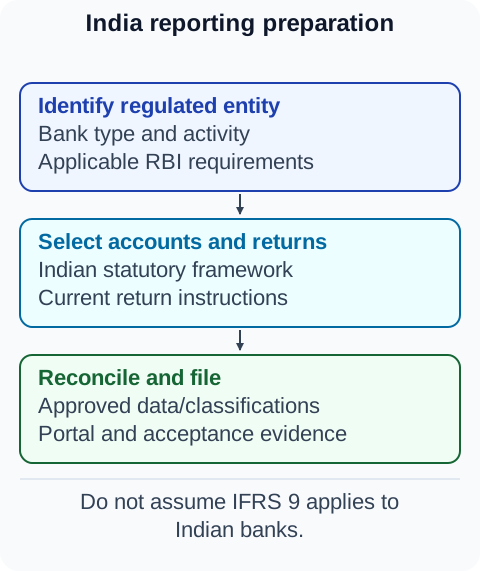 Figure 2. India reporting lenses.
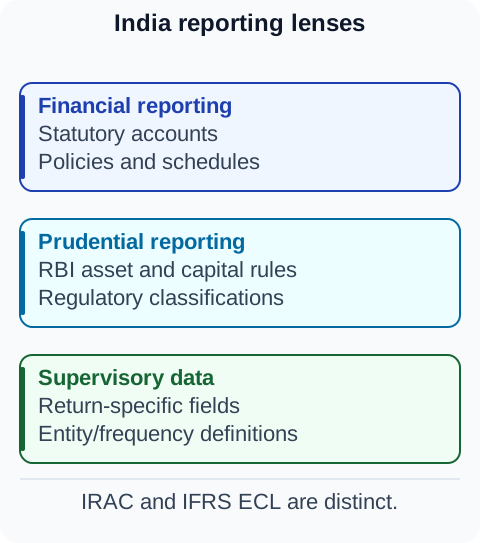 Figure 3. India impairment transition.
12. Tables
Table 1 — Audit universe extract (illustrative)
| Area | Layer | Focus |
|---|---|---|
| Advances | Concurrent + internal | Classification, evergreening |
| Treasury | Concurrent + internal | Dealing controls, valuations |
| Fraud | Forensic + internal | FMR, accountability |
| IT/cyber | Systems audit | Access, change, drills |
Table 2 — Inspection readiness checklist
| Pack | Freshness |
|---|---|
| IRAC compliance samples | Current quarter |
| Finding tracker | Zero overdue |
| Fraud/FMR status | To date |
| Governance minutes | Complete |
13. Illustrative banking case study
Delayed classification (fictional). A payment is overdue but a manual month-end override leaves the loan standard. Independent review identifies the due-date and receipt evidence, corrects the classification, recomputes the required provision and assesses reporting/disclosure impact. Management tracks the system-control repair and borrower-level upgrade gating. A clean inspection is not guaranteed by mock review, and a finding does not automatically trigger PCA; the actual supervisory framework and decision govern restrictions.
14. BA, developer, tester and operations guidance
- BA: Specify IRAC rules, upgrade evidence, FMR timelines and pack contents per circular.
- Developer: Automate classification/upgrades with evidence enforcement; timer FMR filings.
- Tester: DPD-boundary classification; upgrade-path controls; divergence analytics.
- Operations: Maintain packs always-ready; mock periodically; remediate on deadline.
15. Common mistakes
- Manual NPA classification overrides.
- Upgrades without full-clearance evidence.
- FMR timelines missed under "investigation ongoing."
- Inspection preparation started on notification.
- Divergence hoped away instead of disclosed.
- Mock reviews based only on business-selected files, without independent risk-based sampling.
- Treating concurrent audit as a formality rather than a continuous control.
16. Key takeaways
- Day-end auto-classification with evidence-gated upgrades.
- Four audit layers (concurrent, statutory/LFAR, internal, inspection) each with standards.
- Maintain current evidence and test readiness through independent reviews and drills.
- Divergence disclosed promptly beats discovery painfully.
- Apply the current entity-specific RBI directions and retain classification, provisioning, fraud-return and remediation evidence throughout the year.
- Self-identify and repair defects promptly; the supervisor determines any consequential action under applicable law.
- The IRAC engine is the most critical system — its output must be auditable and override-resistant.
17. References and verification notes
- Current RBI commercial-bank IRAC directions,2025, updated1 October2026: present regime; use the operative directions and amendments for the applicable bank category.
- Final RBI ECL directions,2026: commencement1 April2027, covered commercial banks and transition.
- RBI financial-statement presentation/disclosures, updated1 July2026: current divergence thresholds and table.
- RBI Master Directions index: entity-specific consolidated directions; audit, fraud and prudential returns require their relevant instructions.
- RBI stressed-asset resolution framework, 7 June 2019, paragraphs 6–7: ordinary overdue-payment SMA-0 1–30 days, SMA-1 31–60 and SMA-2 61–90; revolving facilities have separate tests. Apply the current entity-specific consolidated directions and amendments.
- Worked scenario amounts are fictional; cited statutory dates and thresholds have their stated scope.