Chapter 072: Accounting Equity versus Regulatory Capital
Section 15: Regulatory Capital and Prudential Foundations · Chapter 072 of 100
This chapter explains accounting equity versus regulatory capital from the reporting bank's perspective. Examples are fictional; accounting follows IFRS unless another framework is expressly identified.
1. Chapter opening
Accounting equity represents the residual interest under the accounting framework. Regulatory capital counts eligible resources after prescribed adjustments. The bridge must distinguish common equity, equity-classified AT1, deductions and eligible capital tiers without double-counting instruments.
2. Learning objectives
- Build a reconciled equity-to-CET1 bridge.
- Distinguish IAS 32 classification from regulatory eligibility.
- Explain capital deductions, minority interests and Tier 2 amortisation.
- Separate capital amount changes from RWA and requirement changes.
3. Business context
An accounting asset may be deducted from capital because it cannot reliably absorb bank losses. An instrument may qualify as AT1 yet have a different accounting classification depending on its terms. Accounting and prudential teams need one instrument register with separate conclusions, not an assumption that every perpetual note is common equity.
4. Finance and accounting view
4.1 Bridge without double-counting
Assume accounting equity 8,800 includes equity-classified AT1 of 800. Common accounting equity is therefore 8,000. Illustrative net prudential deductions are goodwill 600, DTA 200 and other adjustments 150. CET1 is 8,000 - 600 - 200 - 150 = 7,050. Eligible AT1 of 800 gives Tier 1 of 7,850; eligible Tier 2 of 900 gives total capital of 8,750. Adding AT1 without first removing it from the accounting-equity starting point would double-count it.
DTA rules distinguish, among other features, reliance on future profitability and temporary differences. The prescribed threshold bases and netting are not a simple percentage of a casually selected final CET1 balance. Qualifying amounts below applicable thresholds may be risk weighted rather than deducted. Use the actual local calculation, not this simplified illustrative deduction list.
4.2 Instruments and accounting
IAS 32 determines equity versus liability from contractual substance. Regulatory AT1 eligibility is a separate test. For an equity-classified issue, Dr cash / Cr AT1 equity; distributions are accounted for in equity under the relevant rules. A contractual write-down of equity-classified AT1 generally moves amounts within equity, not an automatic P&L gain. Liability-classified instruments require their applicable financial-liability accounting, including modification/derecognition analysis.
Basel Tier 2 requires at least five years' original maturity, not ten. Regulatory recognition amortises in the final five years according to the prescribed rules; that does not mean the accounting liability is written off or principal is no longer owed. A call remains subject to terms and required approval; not calling an eligible instrument does not automatically establish distress.
4.3 Minority interests and movements
Eligible minority capital excludes relevant subsidiary surplus under the prescribed group calculation. If eligible qualifying minority interest is 200 and the computed exclusion is 40, included amount is 160. The required subsidiary and group allocations, scope and instrument conditions must be assessed before calculating the exclusion. Buying the remaining 20% when the parent owns 80% is an equity transaction if control is retained; it does not create a free 40 increase in group CET1. Purchase price, cash, NCI removal and regulatory eligibility all matter.
Retained eligible earnings can raise CET1, while losses and deductions can reduce it. RWA growth changes the ratio denominator, not CET1 itself. A CCyB increase changes required capital/headroom, not a GL capital expense. An AT1 issue increases eligible AT1/Tier 1, not CET1.
5. Product and customer impact
Instrument terms determine investors' contractual rights and possible losses. Neither an accounting label nor a capital ratio replaces accurate customer/investor disclosures or the supervisor's approval requirements.
6. Regulatory and supervisory view
IAS 32 governs accounting classification. Basel capital definitions and its underlying capital standard govern international eligibility/deduction principles; enacted local rules govern a bank's return. Transitional and software/DTA treatments can differ. Distribution restrictions require the complete applicable capital stack and local earnings formula, not a linear interpolation of the headline CET1 ratio.
7. Systems and data view
The bridge stores audited-equity reference, instrument IDs, accounting class, capital tier, maturity/call dates, deductions, thresholds and minority calculations. Reconcile accounting movements to capital movements, then explain denominator changes separately.
8. End to end process
- Reconcile accounting equity and its components.
- Remove non-CET1 instruments from the starting base.
- Apply eligibility, filters, deductions and minority rules.
- Add qualifying AT1 and Tier 2 in their tiers.
- Reconcile the capital movement and RWA separately.
- Review ratios against all required layers and buffers.
9. Controls and risks
| Bridge risk | Control |
|---|---|
| AT1 counted in CET1 and again in Tier 1 | Accounting-component extraction |
| Accounting bond value equals eligible Tier 2 | Separate recognition/amortisation schedule |
| Minority surplus treated as recurring cost | Recompute eligibility from required inputs |
| RWA movement treated as capital loss | Numerator/denominator bridge |
| DTA threshold base guessed | Prescribed sequence and legal review |
10. Practical examples
If 100 of the illustrative goodwill is impaired and was fully deducted, accounting common equity falls from 8,000 to 7,900 while the deduction falls from 600 to 500. Other facts unchanged, CET1 remains 7,050: 7,900 - 500 - 200 - 150. Actual effects need tax, scope and deduction analysis. It is wrong to assert that every goodwill impairment causes an equal CET1 loss.
11. Diagrams
Figure 1. Accounting equity to regulatory capital.
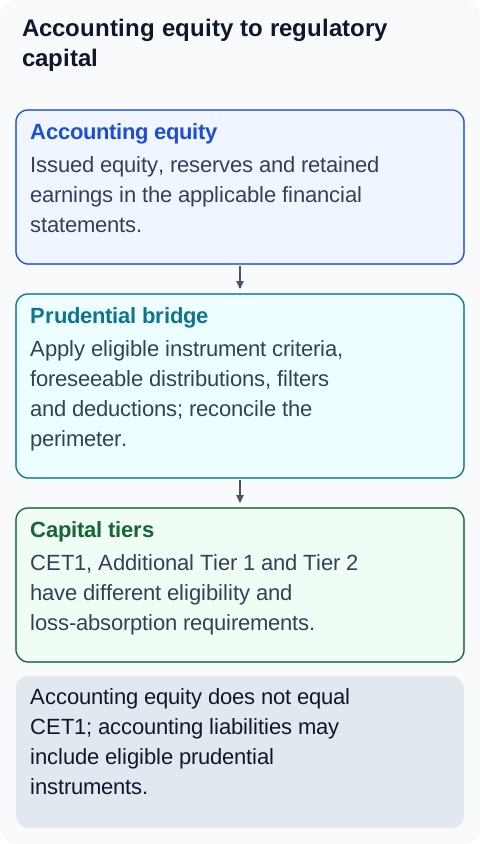 Figure 2. Capital quality and loss absorption.
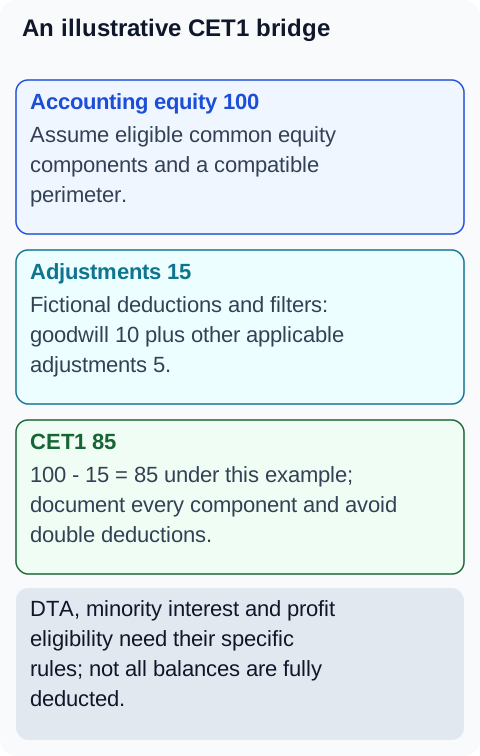
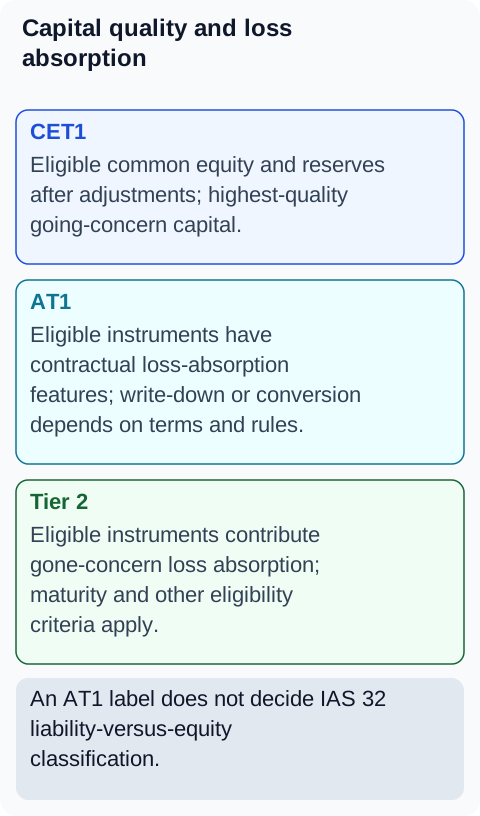 Figure 3. An illustrative CET1 bridge.
12. Tables
| Illustrative capital bridge | Amount |
|---|---|
| Total accounting equity | 8,800 |
| Less equity-classified AT1 | -800 |
| Common accounting equity | 8,000 |
| Net deductions/adjustments | -950 |
| CET1 | 7,050 |
| Eligible AT1 / Tier 1 | 800 / 7,850 |
| Eligible Tier 2 / total | 900 / 8,750 |
13. Fictional banking case study
A fictional bank forecast a CET1 uplift from issuing an AT1 note. Review corrected the forecast to show unchanged CET1 and higher AT1/Tier 1. The bank assessed whether CET1, total capital, leverage or another constraint was binding before approving the funding action.
14. BA, developer, tester and operations guidance
Accounting consolidation establishes equity and NCI. Tax/intangible chapters explain assets that can produce deductions. Capital ratios and planning apply the bridge to exposures and requirements.
15. Common mistakes
- Starting with equity that includes AT1 and adding AT1 again.
- Assuming every regulatory AT1 instrument is accounting equity.
- Treating regulatory Tier 2 amortisation as extinguished debt.
- Claiming a minority buyout is automatically capital-neutral.
- Reducing CET1 amount when RWA or a buffer requirement rises.
16. Key takeaways
Build each capital tier from the right accounting components and prescribed eligibility rules. Explain accounting, deduction and exposure movements separately so a ratio change can be reproduced.
17. References and verification notes
-
Basel CAP30 regulatory adjustments: current international deduction framework, including goodwill/intangibles and DTA rules; domestic implementation determines a bank's enforceable requirements.
-
IAS 32: accounting instrument classification.
-
Basel capital definitions and 2011 capital standard: capital tiers, deductions and minority interests.
-
The bridge is simplified and fictional; actual thresholds, tax netting and domestic rules must be applied.