Chapter 070: Provisions and Employee Obligations
Section 14: Tax and Other Corporate Accounting · Chapter 070 of 100
This chapter explains provisions and employee obligations from the reporting bank's perspective. Examples are fictional; accounting follows IFRS unless another framework is expressly identified.
1. Chapter opening
Provisions and employee obligations recognise present obligations under the appropriate standard. A plan to spend money, a possible future loss and a present legal or constructive obligation are different facts. Scope matters: pensions, termination benefits, leases and financial guarantees do not all follow IAS 37.
2. Learning objectives
- Apply IAS 37 recognition and disclosure criteria.
- Distinguish restructuring obligations from future operating costs.
- Account for defined-contribution and defined-benefit pensions.
- Explain termination and share-based-payment accounting without double-counting.
3. Business context
Legal disputes, remediation and restructuring require evidence from legal, operations and human resources. Management incentives to smooth profit can create unsupported provisions or releases. The estimate should reflect the obligation at the reporting date, with uncertainty and material discounting assessed.
4. Finance and accounting view
4.1 Provisions and restructuring
IAS 37 recognises a provision where a past event creates a present legal or constructive obligation, an outflow is probable and a reliable estimate can be made. Use the required best estimate, with risks, uncertainty and discounting where the time-value effect is material. Review the amount at each reporting date. A possible obligation or one failing recognition may require contingent-liability disclosure unless the outflow possibility is remote. Future operating losses are not provisions and are not automatically contingent liabilities.
A Board decision alone does not necessarily create a restructuring obligation. The relevant detailed plan and communication/implementation must create a valid expectation in affected parties. Include only qualifying direct restructuring expenditure, not future marketing, retraining or ongoing losses. IAS 19 separately determines termination-benefit recognition, including when the offer cannot be withdrawn and qualifying restructuring recognition. IFRS 16 lease obligations must not be provided again under IAS 37. IFRS 9 governs financial guarantees and relevant loan commitments in its scope.
4.2 Employee benefits
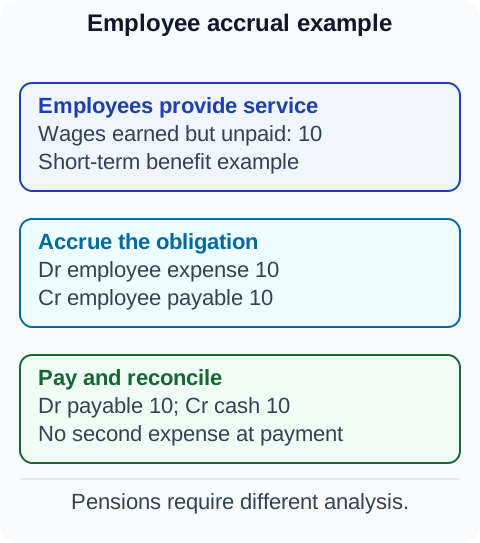
Defined-contribution schemes generally recognise the contribution cost for employee service and an unpaid liability. Defined-benefit schemes measure the obligation and plan assets under IAS 19, subject to the asset ceiling for a surplus. Service cost and net interest generally enter P&L; defined-benefit remeasurements enter OCI without later recycling to P&L.
An employer cash contribution to a defined-benefit plan increases plan assets/reduces the net pension liability: Dr net pension liability / Cr cash, subject to the plan's accounting facts. It is not automatically a second P&L pension cost after the period's service and interest costs. Discount-rate and asset changes can move the deficit; model the actual duration, benefit cash flows and asset mix rather than apply one universal shock percentage.
4.3 Share-based payments
IFRS 2 equity-settled awards use the applicable grant-date fair value and service/vesting rules. True-ups for service and non-market conditions differ from market-condition treatment. Cash-settled awards are remeasured as required through P&L. Falling share prices or underwater options do not by themselves create an automatic cash payout or acceleration of every equity-settled award.
5. Product and customer impact
Customer remediation may create obligations based on the legal and constructive facts even before every customer is identified. Employee communication can affect the restructuring recognition date. Treat these communications accurately and preserve evidence; the accounting estimate cannot replace delivering the remedy or benefit.
6. Regulatory and supervisory view
IAS 37 governs provisions in its scope; IAS 19 governs employee benefits and IFRS 2 governs share-based payments. Proposed IAS 37 amendments must not be presented as current recognition requirements. Actual labour, pension and remediation duties depend on applicable law and contracts.
7. Systems and data view
Registers capture obligating event, scope, legal advice, probability, estimate/range, timing, discount assumptions and review. Pension workpapers reconcile actuary inputs, obligation, assets, employer payments and OCI. Award systems retain grant terms, employee service and modification approvals.
8. End to end process
- Identify the past event and present obligation.
- Select the governing standard.
- Assess recognition versus disclosure.
- Measure and post using approved evidence.
- Reconcile use, new charges, releases and discount unwinding.
- Review changes and disclose material uncertainty.
9. Controls and risks
| Risk | Control |
|---|---|
| Provision for a future budget | Present-obligation assessment |
| Lease obligation counted twice | Scope and liability reconciliation |
| Pension contribution expensed twice | Obligation/asset/expense roll-forward |
| Reserve released to achieve target | Updated independent obligation evidence |
| Equity award remeasured incorrectly | Settlement and condition classification |
10. Practical examples
A fictional remediation provision opens at 12, adds a P&L charge of 5, uses cash of 4 and releases 1 on supported revised evidence. Closing provision is 12 + 5 - 4 - 1 = 12, assuming no discount or FX. Charge: Dr remediation expense 5 / Cr provision 5. Payment: Dr provision 4 / Cr cash 4. Release: Dr provision 1 / Cr expense reversal 1. The unchanged closing balance does not mean there was no expense or cash payment.
11. Diagrams
Figure 1. Assess an IAS 37 provision.
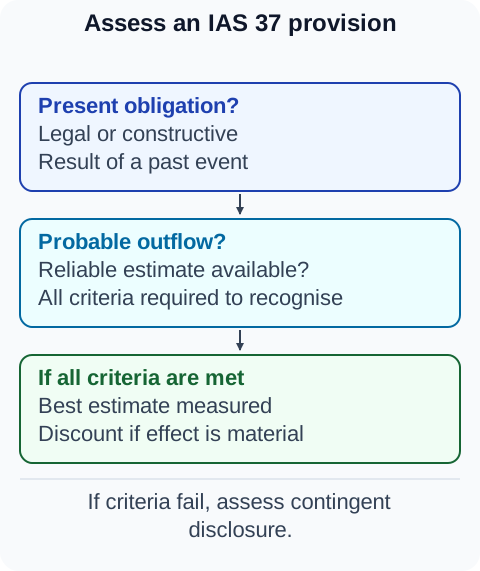 Figure 2. Obligation standards.
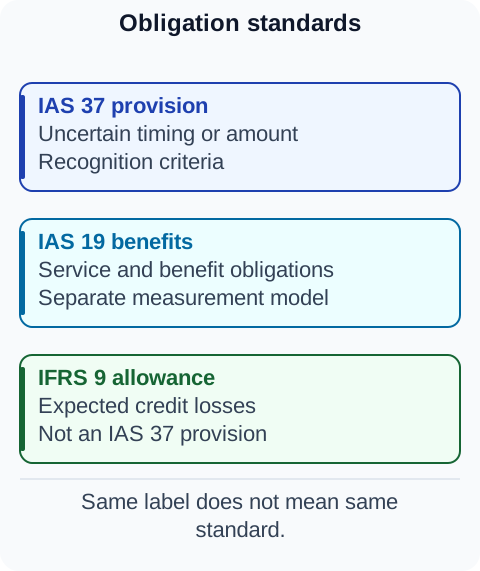 Figure 3. Employee accrual example.
12. Tables
| Simplified pension snapshot | Opening | Closing |
|---|---|---|
| Defined-benefit obligation | 1,000 | 1,100 |
| Plan assets | 900 | 850 |
| Net deficit | 100 | 250 |
The deficit increases by 150. A complete IAS 19 roll must attribute service cost, net interest, remeasurements, benefits and contributions; the two snapshots alone do not establish that all 150 belongs to OCI.
13. Fictional banking case study
A fictional bank booked its entire three-year transformation budget as a provision. Review separated qualifying obligations from future investment and service costs, analysed employee termination benefits separately and removed an extra provision duplicating lease liabilities. The bank corrected its accounting and retained unrecognised future spend in its budget.
14. BA, developer, tester and operations guidance
Close controls prove provision movements. Leases and tax use separate standards. Capital planning incorporates pension and provision effects through the relevant accounting-equity and prudential adjustments.
15. Common mistakes
- Providing for future operating losses or every approved budget.
- Treating any Board announcement as sufficient constructive obligation.
- Using IAS 37 for all employee or lease balances.
- Expensing a pension cash contribution twice.
- Assigning an entire deficit movement to OCI without a roll-forward.
16. Key takeaways
Recognise obligations from the reporting-date facts under the correct standard. Support estimates, distinguish expense from settlement and reconcile pension/provision movements before reporting their impact.