Chapter 036: The Financial Instruments Standards Map
Section 8: Financial Instrument Classification and Valuation · Chapter 036 of 100
1. Chapter opening
Apply four connected standards to a financial instrument: IFRS 9 governs recognition, measurement, impairment and hedge accounting; IAS 32 governs issuer liability/equity presentation and offsetting; IFRS 13 defines how fair value is measured when required or permitted; IFRS 7 governs financial-instrument disclosures. A model-derived fair value does not choose the IFRS 9 category. The issuer's equity component is not an investment asset remeasured under IFRS 9.
Start with the reporting entity's perspective, contract and scope. The same convertible can have a liability/equity split for its issuer while the holder measures the entire financial asset under IFRS 9. Scope exclusions and additional standards matter, including leases, insurance and consolidation.
2. Learning objectives
By the end of this chapter you will be able to:
- State each standard's core question, scope boundary, and primary output.
- Show how classification (IFRS 9) interacts with presentation/netting (IAS 32), measurement (IFRS 13) and disclosure (IFRS 7) for a single instrument.
- Identify common mis-maps (applying the wrong standard, or applying the right standard to the wrong scope) and their typical consequences.
- Build a standards checklist for new products or accounting-policy changes — ensuring all four lenses are applied consistently.
- Recognise where US GAAP diverges on equivalent topics (scope and measurement) for dual-reporters.
3. Business context
A standards map prevents the wrong accounting question being applied to the right product. For a structured deposit issued by a bank, assess the liability host and embedded derivative under IFRS 9. Do not apply the asset SPPI test to the issuer's deposit liability. For a qualifying fixed-for-fixed convertible issued by the bank, IAS 32 may split a debt liability and an equity conversion component; that equity component is not remeasured.
| Standard | Main task | Boundary |
|---|---|---|
| IAS 32 | Liability/equity presentation and offsetting | Issuer and holder perspectives must be explicit |
| IFRS 9 | Recognition, classification, measurement, ECL, hedges | Category follows applicable criteria, not valuation volatility |
| IFRS 13 | Market-participant exit-price measurement | Does not decide when fair value is required; has scope exceptions |
| IFRS 7 | Significance and financial risks, policies and exposures | Disclosures reflect recognition and risks, including relevant unrecognised exposures |
4. Finance and accounting view
4.1 A product-to-standard workflow
Identify the contract and scope, then assess IAS 32 presentation, applicable IFRS 9 recognition/classification, IFRS 13 valuation where needed, and IFRS 7 disclosures. These assessments interact but are not a one-way software pipeline. A Level 3 valuation can occur in FVTPL or FVOCI; uncertainty alone does not justify changing an otherwise correct classification.
4.2 Convertible versus embedded derivative
A bank issues a 100 convertible with a qualifying equity conversion feature. If a comparable liability without conversion has fair value 92, IAS 32 initial split is Dr Cash 100 / Cr Debt liability 92 / Cr Equity component 8. Subsequently apply effective-interest accounting to the 92 liability; leave the 8 equity component unchanged. If conversion terms fail equity classification, assess a derivative liability under IFRS 9 and remeasure that derivative. The holder normally assesses the whole hybrid financial asset and does not mirror the issuer's split.
A deposit return linked to an equity index is not automatically a compound equity instrument. The issuer may need to separate a non-closely-related embedded derivative from the liability host unless the entire eligible hybrid is measured at FVTPL. The precise terms and designation criteria govern.
4.3 IFRS versus US GAAP and current amendments
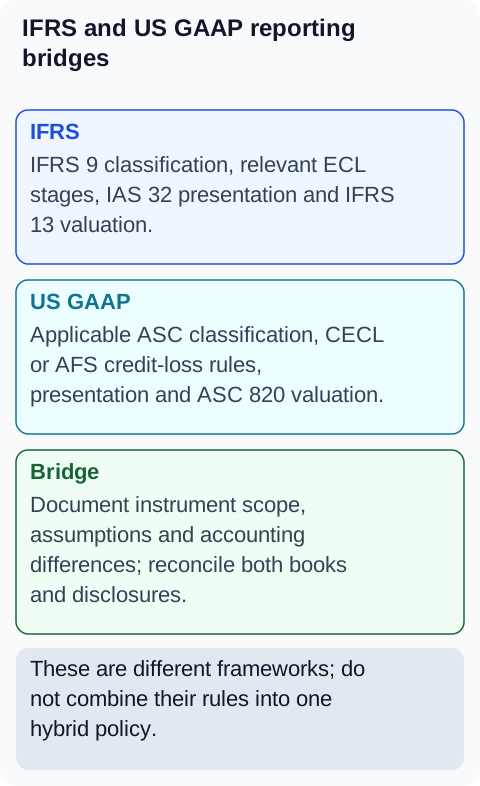
US GAAP is a separate policy assessment: ASC 320 debt securities, ASC 321 equity investments, ASC 326 credit losses, ASC 815 derivatives/hedges and ASC 820 fair value are not a direct translation of IFRS categories. CECL applies to its own scope; available-for-sale debt has a distinct credit-loss approach. IAS 32 and US offsetting differ, including some derivative and repo exceptions.
The IASB's May 2024 IFRS 9/IFRS 7 classification and measurement amendments apply for annual periods beginning on or after 1January2026, subject to local endorsement. They address electronic payment derecognition, contingent contractual features and disclosures, among other matters. IFRS 18 presentation requirements start in 2027, subject to adoption; a future standard is not automatically current for every 2026 report.
5. Product and customer impact
Use the standards map before product approval so pricing, valuation capacity, disclosure data and accounting controls are understood. An instrument's accounting classification does not itself change the customer's contractual payoff or guarantee a capital benefit. Keep issuer obligations and investor rights separate in customer-facing explanations.
6. Regulatory and supervisory view
Accounting equity and regulatory capital are distinct. OCI is part of accounting equity and may affect CET 1 according to prudential adjustments; bypassing P&L does not imply bypassing capital. Basel eligibility, deductions and national filters require a separate reconciliation. The equity FVOCI election is available for eligible investments not held for trading; it is not the debt hold-to-collect business-model test.
7. Systems and data view
Shared instrument data feeds classification, presentation, valuation, impairment and disclosure processes. Maintain bank issuer/holder perspective, contractual terms, business model, cash-flow analysis, counterparty, netting rights, valuation inputs and scope decisions with controlled versions.
The same nominal quantity should reconcile across systems after explaining legitimate splits and adjustments. A compound issuer instrument has separately tracked liability and equity components; a holder's hybrid asset follows its own analysis. Data consistency does not mean forcing every standard to report the same carrying amount.
8. End to end process
Confirm contract, reporting-entity perspective and standards scope; determine IAS 32 issuer presentation where relevant; apply IFRS 9 recognition/classification and impairment/hedge rules; measure required fair value under IFRS 13; design IFRS 7 disclosures; implement linked data and journals; test framework-specific outcomes; approve under the bank's governance; and monitor effective amendments. Supervisory notification is required only where applicable.
9. Controls and risks
| Risk | Control | Evidence |
|---|---|---|
| Wrong standard applied | Scope-check gate in policy approval | Policy sign-off, scope analysis |
| Inconsistent classification vs measurement | Cross-standard reconciliation | Reconciliation reports |
| Netting misapplied | IAS 32 legal opinion + system enforcement | Legal opinions, system logs |
| Disclosure gaps | IFRS 7 checklist at period-end | Disclosure checklist, sign-off |
| US GAAP divergence unmanaged | Parallel policy documentation, reconciling controls | Policy documents, reconciliation |
10. Practical examples
Fictional convertible test: issuer records the 100 proceeds entirely as debt. Terms satisfy equity classification for the conversion option and a 92 liability valuation is supported. Correct to 92 debt and 8 equity, then calculate EIR on debt. A liability-classified conversion feature would produce a different result; 'convertible' alone does not decide.
Fictional asset test: a structured bond is held to collect but has equity-index returns. The holder's whole financial asset fails SPPI and is FVTPL. Issuer liability-host accounting is assessed separately. One contract, two perspectives, two valid analyses.
11. Diagrams
Figure 1. Instrument standards and decisions.
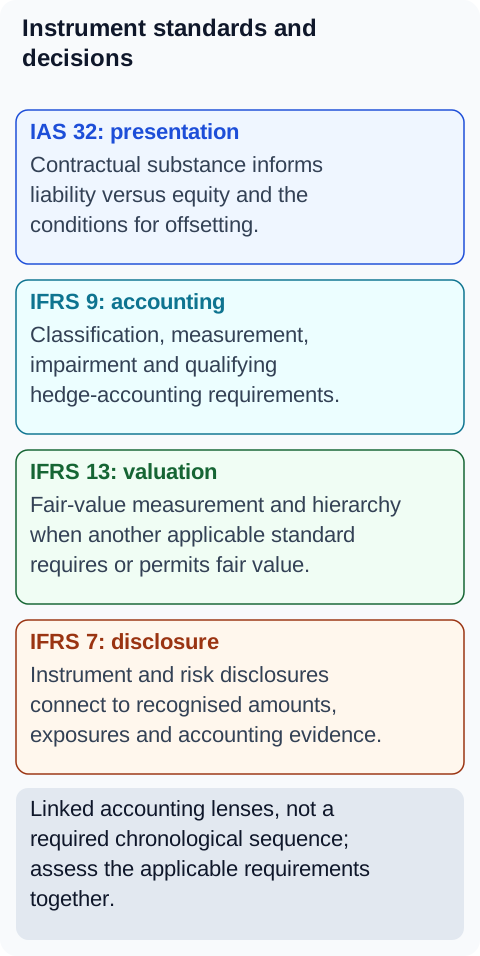
Figure 2. One instrument, linked controlled attributes.
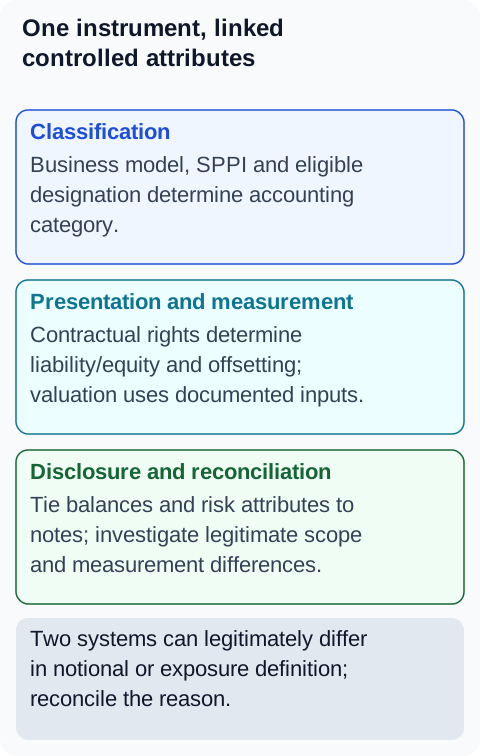
Figure 3. IFRS and US GAAP reporting bridges.
12. Tables
| Error | Correct analysis |
|---|---|
| Volatility decides classification | IFRS 9 business model, cash flows and permitted designations |
| Issuer equity component remeasured FVTPL | Qualifying IAS 32 equity residual stays equity |
| Liability tested for SPPI | Asset SPPI and liability embedded-derivative rules differ |
| Level 3 equals FVTPL | Hierarchy describes inputs; category describes measurement basis |
| OCI cannot affect capital | Accounting equity plus applicable prudential reconciliation |
| CECL covers every financial asset | Check ASC 326 scope, AFS and other exclusions |
13. Illustrative bank case study
Fictional policy gap: a product register records an issued convertible as a single amortised-cost liability without assessing its conversion terms. Review identifies the appropriate IAS 32 split and recalculates liability EIR. The remediation adds issuer/holder perspective and contract-level classification evidence to product approval. No 200m public-bank restatement is asserted.
14. BA, developer, tester and operations guidance
- BA: For every new product, complete a four-standard scope check (IFRS 9, IAS 32, IFRS 13, IFRS 7) before designing the accounting treatment.
- Developer: Build classification, netting, measurement and disclosure as separate but linked engines with shared data lineage.
- Tester: Test appropriate cross-standard scope and data: issuer presentation, valid IFRS 9 category, required fair-value measurement/disclosure and impairment. Do not force an amortised-cost carrying amount to equal fair value.
- Operations: Monitor policy changes across all four standards; ensure that a change in one triggers a review of the others.
15. Common mistakes
- Applying IFRS 9 without considering IAS 32 (compound instruments).
- Applying IFRS 13 without considering IFRS 9 (measurement for wrong category).
- Applying IFRS 7 without considering IFRS 9 (incomplete disclosure).
- Treating each standard in isolation (missing interactions).
- Not mapping US GAAP divergence (dual-reporter confusion).
- Not updating all four standards when a policy changes.
16. Key takeaways
- IFRS 9 classifies, IAS 32 presents, IFRS 13 measures, IFRS 7 discloses — they interlock.
- Scope check first: is this a financial instrument? Which standards apply?
- Compound instruments need IAS 32 before IFRS 9 classification.
- Fair-value hierarchy describes valuation inputs; IFRS 9 category follows its own criteria, and both feed disclosures.
- Policy changes must be mapped across all four standards — a change in one may require changes in others.
17. References and verification notes
-
Rules are applied under the reporting entity's adopted accounting framework and jurisdiction. Basel standards require local implementation; they are not themselves national law. All unnamed cases, amounts and operational thresholds are fictional training examples.