Chapter 037: Financial Asset Classification
Section 8: Financial Instrument Classification and Valuation · Chapter 037 of 100
1. Chapter opening
For debt financial assets under IFRS 9, assess portfolio business model and contractual cash flows. Hold-to-collect plus SPPI normally means amortised cost; collect-and-sell plus SPPI means debt FVOCI; other assets normally use FVTPL. Equity investments and derivatives do not run through a debt SPPI routing test. A permitted fair-value option can override the default category under documented conditions.
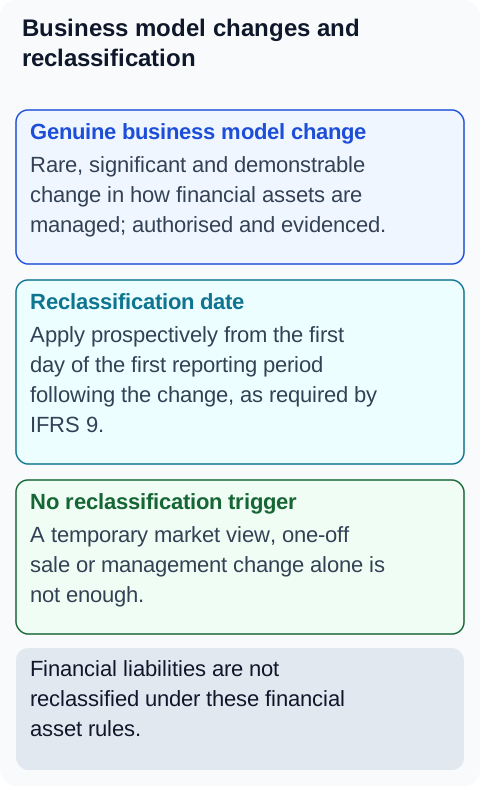
Classification reflects actual management and terms. Sales patterns inform the model but no universal annual percentage determines it. A genuine business-model change triggers prospective reclassification; a desire to avoid losses does not.
2. Learning objectives
By the end of this chapter you will be able to:
- Apply the business-model assessment (hold-to-collect, collect-and-sell, other) using behavioural evidence.
- Run the SPPI test on plain and structured cash flows, naming pass/fail features.
- Route any asset to AC, FVOCI or FVTPL through the decision tree.
- Explain equity FVOCI election vs FVTPL default, and why recycling differs.
- State when reclassification is permitted (and why sales alone don't trigger it).
- Describe FVO (fair value option) designation and its irrevocability.
3. Business context
Portfolio mandates, performance reports, risks and remuneration demonstrate how assets are managed. Identical bonds can legitimately have different categories in different portfolios. Credit-deterioration sales can be consistent with hold-to-collect; other frequent or significant sales need examination of the objective, not an automatic threshold.
An acquisition is assessed under IFRS 3 and applicable IFRS 9 recognition/classification requirements. Do not describe it as automatic retrospective reclassification of the target's old accounts. Subsequent qualifying business-model changes are accounted for prospectively from the relevant reclassification date.
4. Finance and accounting view
4.1 Business model and contractual terms
Assess how groups of assets are managed at the level that reflects actual operations. Collection/sale objectives, risk management and reporting matter together; 'we have never sold' does not prove hold-to-collect if the portfolio is fair-value managed. Internal sales alerts are controls, not IFRS thresholds.
SPPI interest can compensate time value of money, credit risk, other basic lending risks/costs and profit margin. Principal is fair value at initial recognition. Leverage, equity/commodity participation and non-basic exposure may fail. Modified time-value features require the benchmark assessment. Prepayment terms require the detailed IFRS 9 criteria, including reasonable compensation and relevant exceptions; a 1% fee is not automatically reasonable in every contract.
Non-recourse does not automatically fail because collateral value is low. Look through to the underlying assets and contractual arrangements to determine whether cash flows are consistent with basic lending. Credit risk can cause expected losses while contractual cash flows still meet SPPI.
4.2 Current contingent-feature assessment
For annual periods beginning on or after 1January2026, the IASB's May 2024 amendments clarify cash-flow assessment including contingent features. An ESG-linked feature is not automatically SPPI-fail merely because its trigger is non-financial: analyse the nature and magnitude of possible cash-flow changes and the amended criteria. Direct equity/commodity returns remain a different issue. Local endorsement and period start determine application.
4.3 Elections and liability boundary
Debt assets otherwise at AC/FVOCI can be irrevocably designated FVTPL at inception to eliminate or significantly reduce an accounting mismatch, with evidence. Liabilities have additional fair-value designation criteria; do not restrict them to the asset criterion. A genuine example is an eligible asset whose changes would otherwise mismatch a fair-valued derivative, not simply two amortised-cost instruments.
Eligible equity investments not held for trading can use an irrevocable FVOCI presentation election at inception, per investment, with dividends normally in P&L and no recycling of gains/losses to P&L on sale. It is not a hold-to-collect SPPI route. Issued index-linked deposits are liabilities: embedded-derivative analysis differs from the holder's whole-asset assessment.
5. Product and customer impact
Equity/profit-linked asset returns ordinarily expose the lender to non-basic lending risks and can require FVTPL. Examine actual terms, including contingent features under the 2026 amendments, rather than fail every ESG or indexed label automatically. Non-recourse status alone is not failure: assess underlying assets/cash flows and the lender's exposure.
An index-linked deposit issued by the bank is a financial liability, not a debt financial asset undergoing SPPI. Evaluate the liability host, embedded derivative and any valid whole-contract FVTPL designation. Accounting complexity does not alter the customer's contractual payoff.
6. Regulatory and supervisory view
Classification affects financial-statement P&L/OCI and ECL scope. Basel CET 1 begins from eligible accounting equity and applies deductions/adjustments; it does not universally exclude FVOCI debt gains/losses. Determine national prudential filters and transitional provisions by entity and effective date. Financial reporting categories and banking/trading-book capital classification are related but separate decisions.
Dual reporters need specific US GAAP policy. Debt HTM/AFS/trading, equity fair-value rules and ASC 326 allowances have different boundaries; some eligible unquoted equity investments use a US measurement alternative. Do not assume every equity investment under US GAAP is always recurring fair value.
7. Systems and data view
A feature library records tested terms, rationale, scope and version, not a universal label-only verdict. Assess benchmark mismatch, leverage, contingent terms, prepayment and non-recourse features in the actual contract. Maintain portfolio business-model evidence, sale reasons and alert thresholds; alerts trigger review rather than automatic reclassification.
Record valid fair-value options and equity elections at their permitted inception with irrevocability controls. Keep IFRS and USGAAP tags distinct. A changed term or discovered error needs its own accounting assessment; do not silently re-tag to obtain a desired profit result.
8. End to end process
Draft actual terms; complete cash-flow and component analysis; review amended contingent-feature requirements; evidence portfolio business model; consider permitted elections; approve classification and system data before launch; measure and disclose consistently; and review sales, modifications and genuine business-model changes through controlled workflows. Correct errors under IAS 8 rather than describe them as voluntary reclassification.
9. Controls and risks
| Risk | Control | Evidence |
|---|---|---|
| SPPI failure discovered at reporting | Pre-launch SPPI gate per feature | SPPI library, test records |
| Model drift (sales contradict model) | Sales-threshold monitoring, periodic affirmation | Sales reports, affirmation minutes |
| Opportunistic reclassification | Rare-event governance, prospective-only | Change papers, disclosures |
| FVO abuse for volatility management | Mismatch-elimination test, audit of rationale | Designation files |
| Framework cross-contamination | Dual tagging, separate engines | Tag audits, reconciliation |
10. Practical examples
**Fictional property-linked loan:**10m advance with return 3% plus 50% property-index appreciation and leveraged downside. The contract introduces non-basic lending risks; hold intent does not rescue SPPI. Replacing those features with ordinary lending terms allows a fresh assessment, rather than assuming a cap alone makes SPPI pass.
Fictional buffer sale: a collect-and-sell portfolio sells 30% to fund withdrawals. Test whether both collection and sale are integral, with mandate, reporting and historical behaviour. There is no universal 30% trading trigger and no requirement to reinvest withdrawn liquidity immediately in the same portfolio.
11. Diagrams
Figure 1. IFRS 9 debt classification.
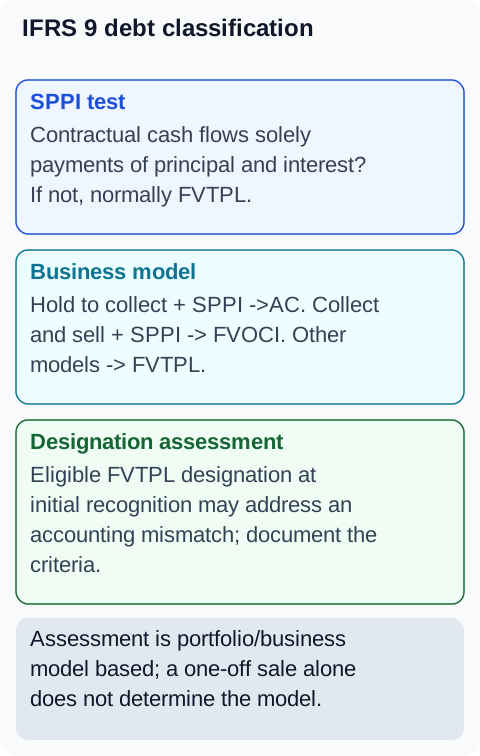
Figure 2. SPPI: assess contractual features.
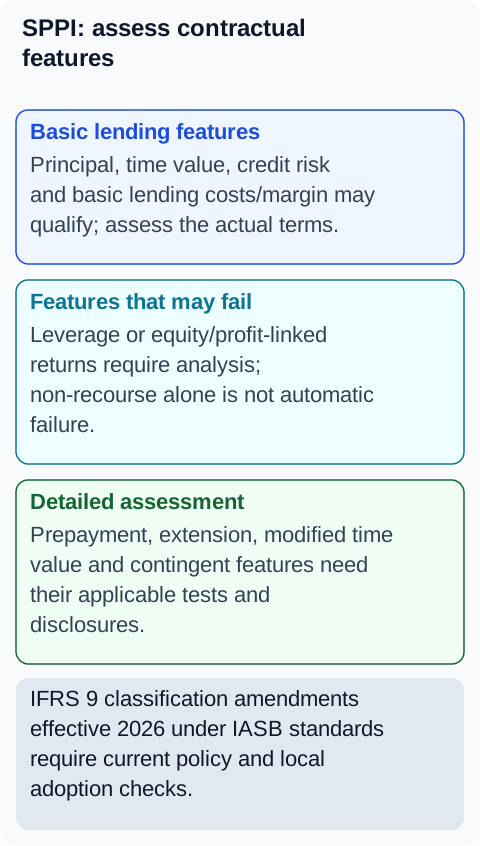
Figure 3. Business model changes and reclassification.
12. Tables
| Model for SPPI debt assets | Default category |
|---|---|
| Hold to collect | Amortised cost |
| Collect and sell | Debt FVOCI |
| Other/fair-value managed | FVTPL |
| Any model, non-SPPI | FVTPL |
| Feature | Assessment |
|---|---|
| Fixed/floating basic lending coupon | Test complete terms, normally SPPI |
| Reasonable prepayment compensation | Detailed IFRS 9 criteria, not automatic fixed threshold |
| Equity/leveraged commodity return | Non-basic lending, normally fail |
| Non-recourse collateral | Look-through; low value alone does not decide |
| Modified time-value tenor/reset | Benchmark cash-flow comparison |
| ESG contingency | Apply current amended contingent-feature criteria |
Equities use FVTPL or a qualifying FVOCI election; derivatives normally use FVTPL. The table does not override permitted FVTPL designations.
13. Illustrative bank case study
Fictional bank scenario. A new loan embeds a borrower-profit-linked return. Product control analyses the contract before launch and identifies the non-basic lending risk. The bank accepts the appropriate FVTPL result or redesigns the actual contract prospectively; it does not relabel the feature to pass SPPI. This training case does not assert an event at an unnamed real institution.
14. BA, developer, tester and operations guidance
- BA: Write SPPI analyses as feature-by-feature verdicts with rationale; register business-model evidence per portfolio; define sales thresholds numerically. Ensure that the SPPI library covers every feature in the bank's product range.
- Developer: Gate bookings on SPPI + model tags; block post-inception election changes; monitor sales vs thresholds automatically. Build the classification engine to prevent booking without a valid SPPI verdict.
- Tester: SPPI matrices (every feature combination), threshold-boundary sales volumes, reclassification workflows, dual-framework tagging. Test that the system blocks post-inception election changes and prevents reclassification without senior approval.
- Operations: Affirm models periodically with evidence packs; log sale rationales at execution; escalate threshold breaches before reporting.
15. Common mistakes
- Classifying by intent slide instead of behavioural evidence.
- Testing the product label instead of each cash-flow feature.
- Treating internal sales-alert thresholds as automatic IFRS reclassification triggers.
- Electing equity FVOCI to "hide volatility" for trading stakes.
- Running one classification register for IFRS and US GAAP.
- Conducting SPPI analysis after product launch instead of before.
- Failing to update the SPPI library when new product features are introduced.
16. Key takeaways
- Two keys: portfolio business model + contractual SPPI — both must be evidenced.
- For in-scope debt financial assets, failure of SPPI leads to FVTPL; SPPI success still requires business-model and valid election assessment.
- Equities default FVTPL; FVOCI election is irrevocable with no recycling.
- Reclassification needs a genuine business-model change; sales are evidence to assess, not an automatic reclassification instruction.
- SPPI gates belong before product launch, not at reporting.
17. References and verification notes
-
Rules are applied under the reporting entity's adopted accounting framework and jurisdiction. Basel standards require local implementation; they are not themselves national law. All unnamed cases, amounts and operational thresholds are fictional training examples.