Chapter 057: The Bank Cash Flow Statement
Section 12: Financial Statements and Group Reporting · Chapter 057 of 100
This chapter explains the bank cash flow statement from the reporting bank's perspective. Examples are fictional; accounting follows IFRS unless another framework is expressly identified.
1. Chapter opening
The cash flow statement explains movements in cash and cash equivalents during the period, classified as operating, investing and financing. Bank operating flows include ordinary customer lending and deposit-taking; securities require classification by their purpose. A historical cash flow statement is different from a forward liquidity survival projection and from an LCR calculation.
Profit, cash and capital can change in different orders. A deposit run can drain cash without an immediate loss; a non-cash impairment can reduce profit and equity without an immediate cash payment. There is no universal "profit first, cash second, capital third" sequence.
2. Learning objectives
- Define cash and cash equivalents under IAS 7.
- Classify bank cash flows by activity.
- Reconcile profit to operating cash without double-counting tax or loan movements.
- Separate non-cash changes and FX effects.
- Distinguish statement analysis from liquidity/capital stress.
3. Business context
Loan growth can consume operating cash while deposit inflows replenish it. A negative operating total therefore does not automatically mean poor earnings quality. Conversely, a deleveraging bank may generate cash while profitability deteriorates. Analyse interest collection, lending, deposit behaviour and non-cash estimates separately, rather than applying corporate cash-conversion benchmarks to banks.
| Item | Profit effect | Cash effect |
|---|---|---|
| New loan disbursement | No immediate interest profit | Outflow |
| Customer deposit inflow | No revenue | Inflow and liability increase |
| ECL charge | Expense | Usually no immediate payment |
| Unpaid interest accrual | Income | Receipt later if collected |
4. Finance and accounting view
4.1 Statement mechanics (fictional, millions, indirect)
Assume IAS 7 before applying IFRS 18 amendments and start with profit before tax of 1,225. Add non-cash impairment 500 and depreciation 120; deduct net loan cash disbursements 6,000, add net customer deposit cash inflows 5,500, deduct other operating accrual adjustments 300 and actual tax paid 250. Operating cash = 1,225 + 500 + 120 - 6,000 + 5,500 - 300 - 250 = 795.
Investing: investment securities purchases net of sales -800 and capex -100 = -900. Financing: qualifying issued debt proceeds 1,000 - dividends 400 - distributions on an equity-classified AT1 instrument 60 = 540, using a disclosed financing classification. Net cash flows = 795 - 900 + 540 = 435. Opening cash/equivalents 12,000 plus 435 gives 12,435 before separately disclosed FX effects. Assume FX effects zero.
If starting with profit after tax 975, add back tax expense 250 before deducting tax paid 250 in this example. Deducting cash tax from after-tax profit without that adjustment double-counts tax. Use actual loan cash flows or a carrying-value bridge stripped of ECL, FX and other non-cash changes; otherwise adding back impairment can duplicate the same adjustment.
4.2 Classification and reconciliation
Cash includes cash on hand and demand deposits. Cash equivalents must be short-term, highly liquid, readily convertible to known amounts and exposed to insignificant value-change risk; an HQLA designation alone is insufficient. Qualifying overdrafts repayable on demand that form an integral part of cash management can enter the cash-equivalent reconciliation. Do not include all borrowing automatically.
Ordinary bank customer loan/deposit flows are operating; trading/dealing securities are operating, while other investments and business acquisitions/disposals are generally investing. Issued funding and owner distributions require analysis of their nature and the applicable IAS 7 policy. Before IFRS 18 adoption, interest and dividend classifications include policy choices and financial-institution considerations, applied consistently. Permitted net reporting of certain financial-institution flows is not permission to net everything.
4.3 Deep dive: non-cash and liquidity bridges
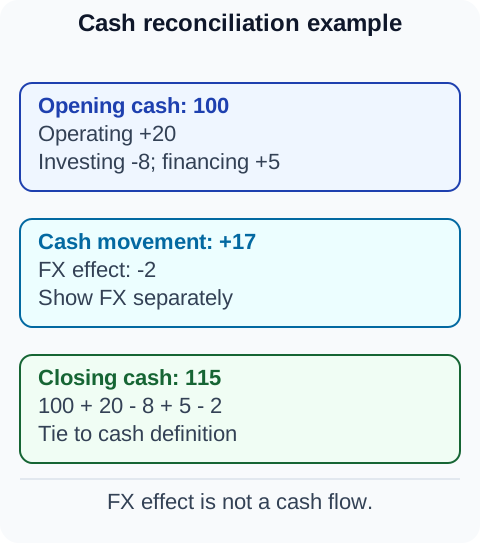
Exclude non-cash investing/financing transactions from cash flows and disclose them separately. New lease recognition, fair-value changes and translation movements need their own bridges. FX effects on cash reconcile opening and closing balances; they are not operating cash receipts.
Liquidity stress uses contractual/behavioural outflows, available liquidity, collateral constraints and intraday needs. An annual cash total cannot establish a 12- or 18-month survival requirement. Distribution capacity also depends on entity cash, distributable reserves, capital and applicable restrictions; the cash flow statement alone does not authorise a dividend.
5. Product and customer impact
Deposits are funding liabilities, not customer revenue. A growing deposit base can improve cash while increasing interest cost. Loan repayments improve cash without generating profit equal to the principal. These distinctions help explain how lending and deposit campaigns affect the bank and customers differently.
6. Regulatory and supervisory view
IAS 7 governs IFRS cash flow presentation. IFRS 18 is effective for annual periods beginning on or after 1 January 2027, permits early application subject to endorsement, and amends IAS 7's indirect-method starting point and interest/dividend classification. Apply the version relevant to the bank's reporting period. LCR and NSFR are prudential measures, not IAS 7 cash classifications.
7. Systems and data view
A movement engine needs cash/non-cash tags, source cash records, accounting-date rules and approved classification mappings. Validate that a securities sale is not counted again through a balance movement, and that ECL and FX changes are removed from loan cash movements. Tie cash/equivalent components to the balance sheet with restrictions and overdraft treatment explained.
8. End to end process
- Define cash/equivalent components and the applicable IAS 7 policy.
- Identify actual cash flows and non-cash movements.
- Classify operating, investing and financing activities.
- Build the direct or indirect statement.
- Reconcile net flows and FX effects to closing cash.
- Review financing-liability and non-cash disclosures.
- Analyse lending, funding and collection drivers separately.
9. Controls and risks
| Risk | Control | Evidence |
|---|---|---|
| Tax double-counted | Starting-profit and tax-charge bridge | Independent calculation |
| ECL treated as cash | Loan cash/non-cash roll-forward | Movement schedule |
| HQLA equated to cash equivalent | IAS 7 eligibility assessment | Instrument policy |
| Missing FX bridge | Separate FX-effect reconciliation | Currency schedule |
| Liquidity inferred from year total | Separate timed liquidity projection | Survival model |
10. Practical examples
Fictional example: operating cash declines because the bank disburses 6bn new net lending while deposits increase 5.5bn. Review whether that growth is funded, collectible and within risk appetite; a corporate-style operating-cash/profit ratio would obscure the explanation. A second bank loses 2bn deposits in a day without an immediate equivalent P&L loss, illustrating a cash shock preceding a solvency loss.
11. Diagrams
Figure 1. Prepare cash flow statement.
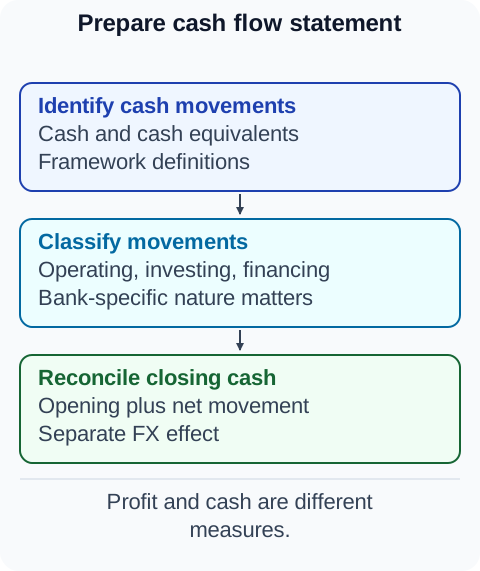 Figure 2. Bank cash flow categories.
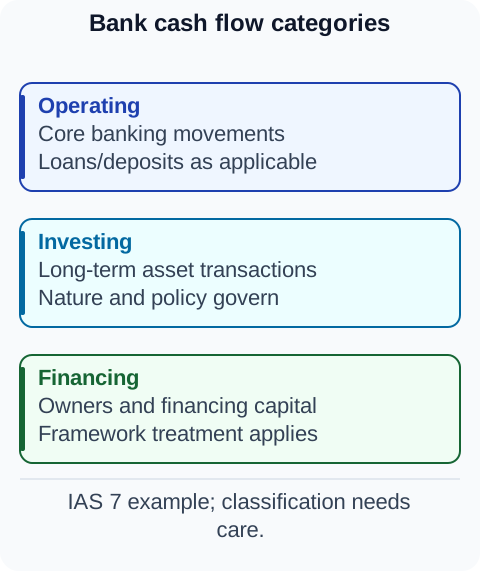 Figure 3. Cash reconciliation example.
12. Tables
| Statement line | Amount |
|---|---|
| Operating cash | +795 |
| Investing cash | -900 |
| Financing cash | +540 |
| Net cash flows | +435 |
| FX effect (assumed) | 0 |
| Opening / closing cash | 12,000 / 12,435 |
| Item | Analysis |
|---|---|
| Trading securities cash | Operating |
| Other investment securities | Investing, subject to instrument purpose |
| Lease inception | Non-cash, separately disclosed |
| Customer loans and deposits | Ordinary bank operating activities |
13. Fictional banking case study
A fictional bank appears highly profitable while a deposit run drains available settlement cash. Treasury raises secured funding against eligible collateral and assesses its timed liquidity needs. Finance separately records funding, interest expense and any asset-sale loss. The run's size is neither revenue nor an automatic CET1 loss.
14. BA, developer, tester and operations guidance
Business analysts should define classifications and cash/non-cash rules. Developers should use movement bridges without double counting. Testers should independently reconcile profit/tax, ECL, securities and FX cases. Operations should reconcile the statutory cash statement and timed liquidity reports on their respective bases.
15. Common mistakes
- Subtracting cash tax twice from after-tax profit.
- Treating deposit inflows as earnings.
- Treating HQLA as synonymous with cash equivalents.
- Inferring survival from an annual net cash figure.
- Applying one corporate cash-conversion benchmark to all banks.
- Counting impairment or FX in loan cash disbursements.
16. Key takeaways
Classify real cash movements, isolate non-cash and FX changes, and reconcile to defined cash/equivalent balances. Bank loan and deposit flows strongly influence operating cash. Profit, liquidity and capital remain distinct analyses with no fixed transmission order.
17. References and verification notes
- IAS 7: definitions, activity classification, direct/indirect methods and reconciliation.
- IFRS 18: effective date and consequential cash-flow changes.
- Basel liquidity-risk principles: separate liquidity-risk management.
- All figures are fictional; FX is assumed zero and the disclosed financing treatment is an example, not a universal AT1 classification.