Chapter 058: Group Consolidation
Section 12: Financial Statements and Group Reporting · Chapter 058 of 100
This chapter explains group consolidation from the reporting bank's perspective. Examples are fictional; accounting follows IFRS unless another framework is expressly identified.
1. Chapter opening
Group consolidation presents a parent and its controlled subsidiaries as one economic entity. Under IFRS 10, control combines power over the investee, exposure or rights to variable returns, and the ability to use that power to affect returns. A majority voting interest commonly provides power, but 50% is not a universal recognition threshold; structured entities and substantive rights require judgement.
Accounting consolidation and prudential consolidation can include different entities or treatments. Prepare the accounting group first, then an explicit regulatory-scope bridge. Regulatory capital is not obtained by adding together each entity's solo capital ratio.
2. Learning objectives
- Assess control and consolidation scope.
- Align entity policies and reporting inputs.
- Eliminate investments, reciprocal balances and internal income.
- Present non-controlling interests correctly.
- Build a distinct prudential scope/capital bridge.
3. Business context
Group structure affects funding and dividend availability. Parent debt used to subscribe subsidiary equity remains external group debt after consolidation; the internal investment disappears. This is why debt-funded downstream capital does not create new consolidated common equity.
| Accounting issue | Group treatment |
|---|---|
| Controlled subsidiary | Consolidate, subject to specific exemptions |
| Parent investment in subsidiary | Eliminate against relevant subsidiary equity |
| External non-controlling ownership | Present non-controlling interest within equity |
| Intercompany receivable/payable | Eliminate reciprocal balance |
| External customer loan | Retain and apply impairment |
4. Finance and accounting view
4.1 Worked consolidation (fictional, millions)
Assume a subsidiary with fair-value net assets and equity of 1,200 at acquisition. The parent buys 5/6 for 1,000; non-controlling interests (NCI) are measured at their proportionate net-asset share of 200. Assume no goodwill, other adjustments or post-acquisition profits. Parent equity is 8,000. The consolidation entry is Dr subsidiary equity 1,200 / Cr parent investment 1,000 / Cr NCI 200. Debits and credits both total 1,200. Group equity is 8,200: 8,000 attributable to the parent plus 200 NCI.
The parent's investment is an asset, not part of its 8,000 equity. The numerical bridge 8,000 + 1,200 - 1,000 = 8,200 works only under these explicitly simplified assumptions. If the acquisition creates goodwill or post-acquisition changes, use the actual acquisition and equity bridge rather than reusing the shortcut.
4.2 Group adjustments and prudential bridge
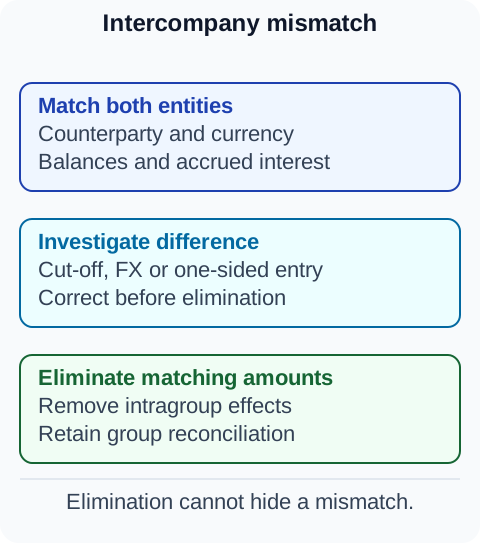
Align accounting policies, measurement and reporting dates, and eliminate reciprocal assets/liabilities, income/expenses and cash flows. Reporting dates should align; IFRS 10 provides limited accommodation where different dates are impracticable to avoid, with appropriate adjustments and restrictions. An unmatched intercompany balance needs investigation rather than a plug.
Prudential scope may exclude an insurance entity that remains an accounting subsidiary. The resulting investment treatment follows the applicable capital rules and thresholds; it is not invariably a full deduction. Goodwill and other regulatory adjustments enter the capital calculation, while NCI recognised for prudential purposes is restricted by eligibility and surplus rules. AT1 and Tier 2 do not become CET1.
4.3 Deep dive: acquisitions, minority interests and trapped capital
Under IFRS 3, goodwill reflects acquisition consideration, NCI measurement and identifiable net assets, not arbitrary additions for integration costs. Acquisition-related costs generally do not increase goodwill; assess specific costs under their standards. Transactions with NCI without loss of control are equity transactions under IFRS 10.
A minority surplus exclusion from group regulatory capital is not an annual cash leak. A buyout may reduce CET1 through consideration and the NCI/equity adjustment; funding it with AT1 does not make the CET1 result neutral. Model both the accounting entry and prudential eligibility.
Capital that cannot readily move between entities still appears according to the consolidation rules. Separately assess legal, tax, supervisory and liquidity constraints when planning transfers. Do not subtract all "trapped capital" from a reported group ratio without a rule requiring that adjustment.
5. Product and customer impact
Local customers borrow from and deposit with a legal entity, even when a group brand is shared. The group's strength does not automatically remove that entity's capital, liquidity or deposit-protection constraints. Local lending plans therefore need both entity and group analysis.
6. Regulatory and supervisory view
IFRS 10 defines accounting consolidation. IFRS 3 governs acquisition accounting. Basel capital definitions address regulatory eligibility and deductions; national law implements them with its own scope and transitional rules. Solo waivers and ring-fencing have specific local conditions, rather than a universal no-customers/no-risk exemption.
7. Systems and data view
Version the entity hierarchy, control assessment, ownership dates and reporting scope. Match intercompany pairs by entity, currency and reference. Keep acquisition and NCI schedules separate from the regulatory eligibility calculator. Preserve elimination entries as consolidation adjustments without silently overwriting each entity's statutory ledger.
8. End to end process
- Confirm controlled entities and effective dates.
- Collect aligned and reconciled entity trial balances.
- Apply acquisition and uniform-policy adjustments.
- Match and eliminate investments and reciprocals.
- Translate foreign operations and present NCI.
- Prove consolidated statements.
- Build regulatory scope and own-funds bridges separately.
9. Controls and risks
| Risk | Control | Evidence |
|---|---|---|
| Wrong control scope | Documented control assessment | Rights and ownership register |
| Double-counted internal capital | Investment/equity elimination | Acquisition bridge |
| Missing internal income elimination | Balance and P&L reciprocal match | Pair schedules |
| Incorrect goodwill | IFRS 3 acquisition allocation | Consideration/net-assets workpaper |
| Overstated regulatory NCI | Eligible-surplus calculation | Capital schedule |
10. Practical examples
Fictional acquisition example: consideration for 100% of a target is 1,200 and fair-value identifiable net assets are 800, giving goodwill 400 under the stated assumptions. Integration spending is not automatically another 200 goodwill. A post-acquisition capital ratio also needs the consideration's funding, target capital, goodwill deduction, acquired RWA and every other material adjustment; subtracting goodwill and adding an arbitrary 200 cannot prove it.
Reciprocal example: entities translate a USD loan and payable using inconsistent closing rates. Reconcile the original USD balance, align group translation inputs and explain the adjustment. Assess whether any remaining FX income must survive consolidation under IAS 21.
11. Diagrams
Figure 1. Consolidate an IFRS group.
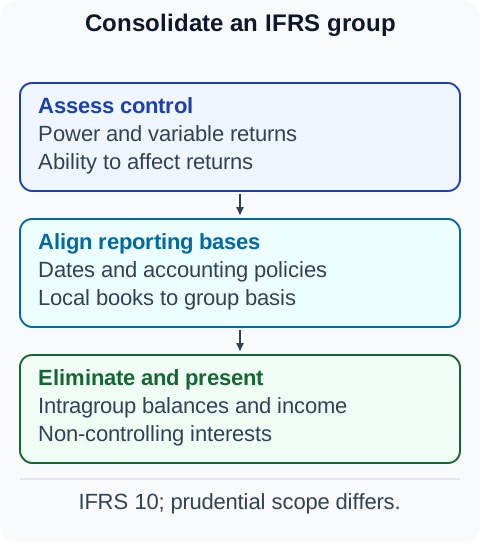 Figure 2. Consolidation boundaries.
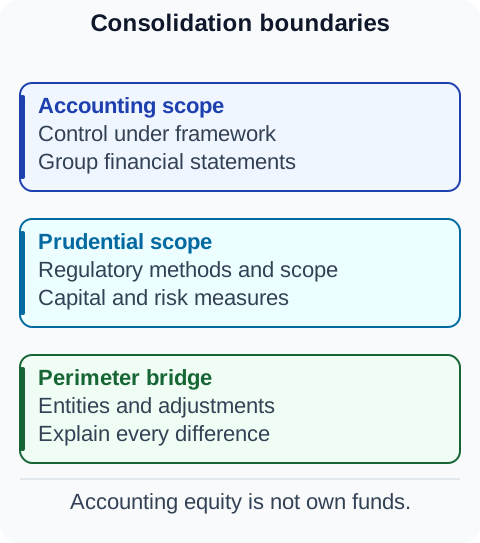 Figure 3. Intercompany mismatch.
12. Tables
| Simplified acquisition elimination | Debit | Credit |
|---|---|---|
| Subsidiary pre-acquisition equity | 1,200 | - |
| Parent investment | - | 1,000 |
| NCI | - | 200 |
| Total | 1,200 | 1,200 |
| Group equity attribution | Amount |
|---|---|
| Parent shareholders | 8,000 |
| NCI | 200 |
| Total accounting equity | 8,200 |
13. Fictional banking case study
A fictional parent raises 500 external debt and injects 500 equity into a wholly owned bank subsidiary. Solo subsidiary equity increases; consolidated group equity does not increase from this transaction. Consolidation removes the investment/equity pair but retains the debt and the use of the funds. Parent debt service depends on available cash and legally permitted subsidiary distributions, which are assessed separately.
14. BA, developer, tester and operations guidance
Business analysts should specify accounting control, regulatory scope and NCI assumptions separately. Developers should version hierarchies and elimination rules. Testers should verify both balance and P&L eliminations and a debt-funded equity injection. Operations should reconcile entity submissions and track transfer constraints.
15. Common mistakes
- Treating majority voting ownership as the only control test.
- Adding solo capital to create group capital.
- Putting eligible AT1/T2 inside CET1.
- Treating integration costs as automatic goodwill.
- Calling excluded minority surplus an annual cash expense.
- Assuming a minority buyout funded by AT1 is CET1-neutral.
16. Key takeaways
Consolidate controlled entities using aligned accounting policies and full internal eliminations. Retain external transactions and correctly attribute NCI. Prudential scope, minority eligibility and capital deductions require a distinct bridge. Group reporting and entity transfer capacity answer different questions.
17. References and verification notes
-
Basel CAP30 regulatory adjustments: current international deduction framework, including goodwill/intangibles and DTA rules; domestic implementation determines a bank's enforceable requirements.
-
IFRS 10: control, consolidation and NCI transactions.
-
IFRS 3: acquisition measurement and goodwill.
-
Basel capital definitions: capital eligibility, deductions and minority interests, subject to local implementation.
-
All figures are fictional with acquisition assumptions stated explicitly.