Chapter 056: Preparing Bank Financial Statements
Section 12: Financial Statements and Group Reporting · Chapter 056 of 100
This chapter explains preparing bank financial statements from the reporting bank's perspective. Examples are fictional; accounting follows IFRS unless another framework is expressly identified.
1. Chapter opening
Bank financial statements present the bank's recognised assets, liabilities, equity, income, expenses and cash flows under its applicable accounting framework. A complete IFRS set includes the statement of financial position, profit or loss and other comprehensive income, changes in equity, cash flows, and notes, with comparatives and an opening balance sheet where required. FINREP is supervisory financial reporting; it does not replace the statutory financial statements.
Preparation starts with a reconciled trial balance and approved accounting judgements, not with allocation into a regulator's template. Statutory accounts, prudential returns and management views need explicit bridges when their perimeter or measurement differs.
2. Learning objectives
- Build a complete set of bank financial statements from a controlled trial balance.
- Reconcile profit, OCI, equity and cash.
- Assess presentation, offsetting and accounting-policy consistency.
- Coordinate consolidation, tax and notes.
- Distinguish statutory statements from supervisory templates.
3. Business context
A bank's balance sheet concentrates financial instruments: customer loans, securities, derivatives, deposits and issued funding. Presentation should explain their measurement basis and risk, supported by granular source records. A liquidity-order presentation can be appropriate when it provides more relevant information; IFRS does not force every bank into a corporate current/non-current layout.
| Output | Core question | Source/control |
|---|---|---|
| Financial position | What is recognised at the reporting date? | Subledger/GL and valuation proof |
| Profit or loss | What income and expenses belong to the period? | Accrual and recognition review |
| OCI/equity | Which changes bypass profit, and who owns equity? | Reserve and owner-transaction bridges |
| Cash flows | How did cash and equivalents change? | Cash/non-cash movement analysis |
| Notes | What judgements and risks explain the totals? | Model, contract and disclosure lineage |
4. Finance and accounting view
4.1 Financial-statement mechanics (fictional, millions)
Assets: cash 120 + gross loans 700 - allowance 10 + securities 180 + other assets 10 = 1,000. Liabilities: customer deposits 800 + issued debt 100 + other liabilities 20 = 920. Equity 80 completes 1,000 = 920 + 80. Explain whether accrued interest and integral fees sit within the loan balance and whether securities are at amortised cost, FVOCI or FVTPL.
Period performance: net interest 30 + net fees 10 + trading 2 - operating costs 20 - impairment 4 = profit before tax 18. Tax 5 gives profit 13. With OCI loss 3, total comprehensive income is 10. Opening equity 75 + profit 13 - OCI 3 - dividends 5 = closing equity 80. Assume no other owner transactions or non-controlling interests. These are separate proofs: the equality of assets and liabilities plus equity alone cannot validate profit.
4.2 Recognition, offsetting and presentation
Apply instrument recognition and measurement before presentation. Under IAS 32, offset a financial asset/liability only when the required enforceable right and settlement intention exist; economic hedging or a netting agreement by itself is insufficient. Keep derivatives, collateral and customer deposits correctly distinguished.
4.3 Deep dive: disclosure and supervisory mapping
Create a disclosure checklist from the applicable standards. Link each note number to its GL/source/model evidence and check consistency with the primary statements. Map FINREP separately using the framework and taxonomy applicable to the reporting date; not all IFRS classifications or risk-stage attributes apply to every asset. NPE, default and IFRS stage are related but not interchangeable labels. Unknown mandatory dimensions need investigation, not silent allocation to "other". Real permitted residual categories should not be eliminated merely to improve a dashboard.
5. Product and customer impact
Statements help depositors, investors and counterparties understand the bank. They aggregate customer records and do not replace individual statements. A reporting reclassification is not necessarily a customer account correction; assess both when source errors arise.
6. Regulatory and supervisory view
IAS 1 governs IFRS presentation until IFRS 18 is applied. IFRS 18 is IASB-effective for annual periods beginning on or after 1 January 2027, with early application permitted, subject to local endorsement. Preparing comparatives is a practical readiness task; early adoption must not be presumed. US GAAP or other local GAAP accounts require their own recognition and presentation analysis, rather than a few adjustments to an IFRS template.
7. Systems and data view
The reporting layer combines a versioned trial balance, consolidation adjustments and approved presentation mappings. The note layer also needs source attributes not carried in the GL, such as maturity, collateral and credit quality. Reconcile enriched records to the accounting population, preserve mapping versions and distinguish accounting journals from reporting-only reclasses.
8. End to end process
- Confirm framework, reporting entity, period and standards effective for it.
- Complete source/GL reconciliation and estimates.
- Consolidate where required and assess tax.
- Prepare statements and their cross-statement bridges.
- Build and reconcile notes and comparatives.
- Review judgements, subsequent events and going concern.
- Obtain required authorisation and publish/file the approved version.
9. Controls and risks
| Risk | Control | Evidence |
|---|---|---|
| Incorrect measurement | Accounting-policy and estimate review | Policy/model workpaper |
| Improper netting | IAS 32 criteria and legal analysis | Contract and settlement assessment |
| Note-number inconsistency | Disclosure-to-statement proof | Disclosure matrix |
| Wrong scope | Entity and framework bridge | Consolidation register |
| Silent residual allocation | Exception owner and evidence | Mapping case log |
10. Practical examples
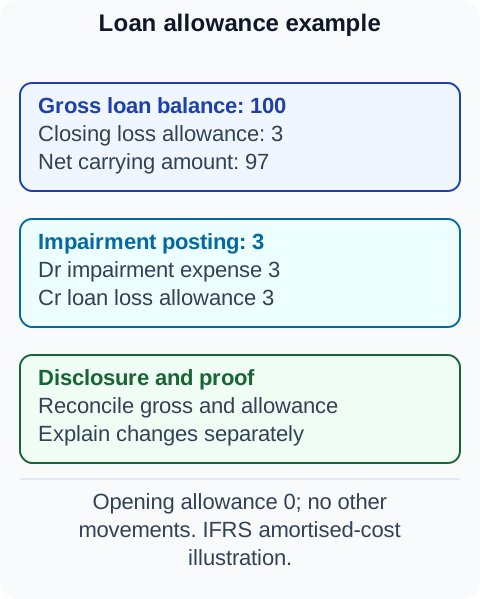
Fictional example: a loan allowance of 10 is presented as an expense rather than the closing contra-asset. Correct the balance-sheet presentation and separately reconcile the period impairment expense: opening allowance + charge + other movements - write-offs = closing allowance. The closing allowance is not automatically the current-period charge.
Mapping example: a new 300m loan product lacks a supervisory product code. Determine the appropriate classification from its contract and the applicable instructions. It still requires IFRS 9 measurement and impairment regardless of where the reporting team first placed it.
11. Diagrams
Figure 1. Prepare financial statements.
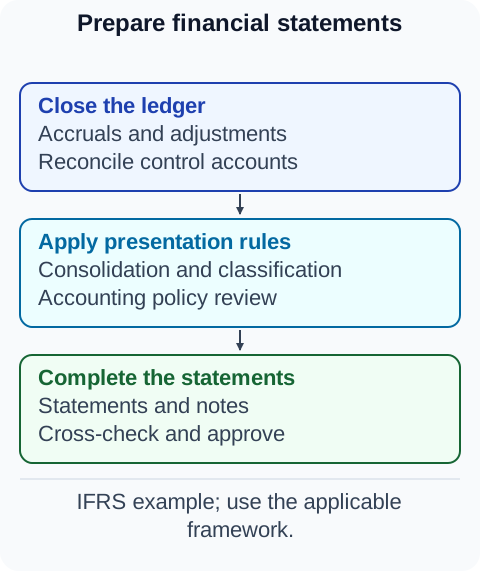 Figure 2. Statements connect.
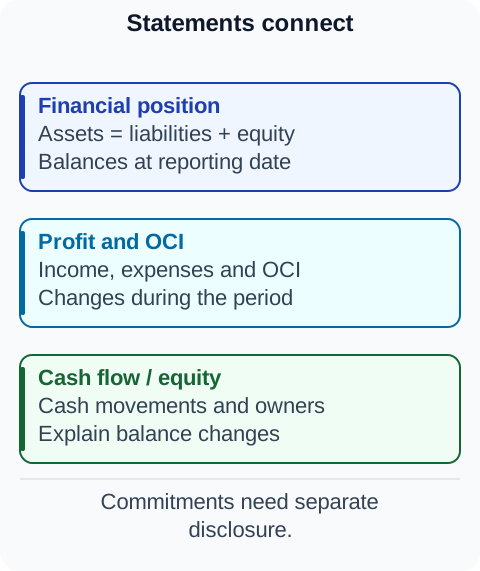 Figure 3. Loan allowance example.
12. Tables
| Proof | Equation or test |
|---|---|
| Balance sheet | 1,000 assets = 920 liabilities + 80 equity |
| Profit | 30 + 10 + 2 - 20 - 4 - 5 = 13 |
| Comprehensive income | 13 - 3 = 10 |
| Equity | 75 + 13 - 3 - 5 = 80 |
| Cash | Opening cash + cash flows + FX effects = closing cash/equivalents |
13. Fictional banking case study
A fictional acquisition brings a loan portfolio into the group. Finance applies the acquisition and financial-instrument accounting, while reporting builds the missing product mapping. The portfolio does not escape impairment merely because it is in a residual template category. Correct each accounting or reporting defect on its own basis and assess affected filings.
14. BA, developer, tester and operations guidance
Business analysts should define source-to-statement and source-to-note lineage. Developers should keep statutory mappings distinct from prudential transformations. Testers should recompute cross-statement bridges and seed an impermissible netting case. Operations should preserve the exact approved version and monitor source/mapping changes before each close.
15. Common mistakes
- Treating FINREP as the complete statutory accounts.
- Confusing a closing allowance with the period expense.
- Netting assets and liabilities solely because they share a counterparty.
- Treating stage, NPE and default as identical.
- Applying IFRS 18 as universally mandatory in 2026.
- Using an unknown mapping as permission to skip measurement.
16. Key takeaways
Prepare the complete set under the applicable framework. Prove assets, profit, OCI, equity and cash separately and together. Notes need traceable risk and judgement data. Supervisory mappings are a related but distinct reporting layer.
17. References and verification notes
- IAS 1: complete IFRS statements and presentation.
- IFRS 18: future mandatory presentation standard and effective date.
- IFRS 9: financial-instrument measurement and impairment.
- IAS 32: financial-instrument presentation/offsetting.
- All statement amounts are fictional. Local law determines endorsement, filing, audit and authorisation.