Chapter 012: Subledgers and the General Ledger
Section 3: Finance Systems and Accounting Architecture · Chapter 012 of 100
A contract subledger and the general ledger serve different purposes. This chapter follows a loan across their boundary and proves accounting balances before continuing to regulatory reports.
1. Chapter opening
Subledgers preserve contract and transaction detail; the general ledger (GL) records recognised accounting balances under a chart of accounts and period controls. A reporting mart adds dimensions and risk data required by financial or prudential returns. These are connected records with different purposes, not interchangeable totals.
This chapter explains the control-account boundary, posting versus settlement, account-level reconciliation and the continuation from GL to filing. Regulatory exposure measures may include undrawn commitments or netting adjustments absent from a financial-statement line; reconcile using explicit bridges rather than forcing the totals to match.
2. Learning objectives
- Distinguish a contract subledger from a GL control account.
- Post a same-bank loan and distinguish later external settlement.
- Reconcile principal, interest, integral fees and ECL separately.
- Prove control-account roll-forwards and rejected-event coverage.
- Continue from accounting balances to reporting data using explicit measurement and perimeter bridges.
3. Business context
A customer statement needs contract detail; the GL needs recognised balances under controlled accounts and periods. Posting many accepted events as one GL journal can be sound if the aggregation preserves drill-down and the same movements are reconciled once. A posted loan is not proof that payment has settled. A reporting mart can require risk attributes absent from the GL; enrichment does not make a new accounting posting.
| Link | Independent proof |
|---|---|
| Source events → subledger | Accepted/rejected/pending event population |
| Subledger → GL | Control-account movement and balance reconciliation |
| GL → reporting | Accounting, perimeter and measurement bridge |
| Reporting → filing | Versioned mappings and final acceptance |
4. Finance and accounting view
4.1 Chain mechanics (fictional mortgage)
A fictional bank disburses a 250,000 mortgage to a current account held at the same bank: Dr Loan control account 250,000 / Cr Customer deposit control account 250,000. The loan subledger identifies the borrower, terms and schedule; the GL records the summarised debit. This posting creates no external cash outflow. When the borrower transfers the proceeds externally, Dr Customer deposit / Cr Settlement payable, then Dr Settlement payable / Cr Cash at settlement.
At cut-off, reconcile gross loan principal, integral fee adjustments, accrued interest and loss allowance separately. A principal-only loan extract cannot tie directly to a net carrying-amount report without those bridges. The loan's household, performing/non-performing, stage and collateral attributes feed appropriate reporting data points under the applicable release. IFRS 9 Stage 2 does not automatically mean non-performing.
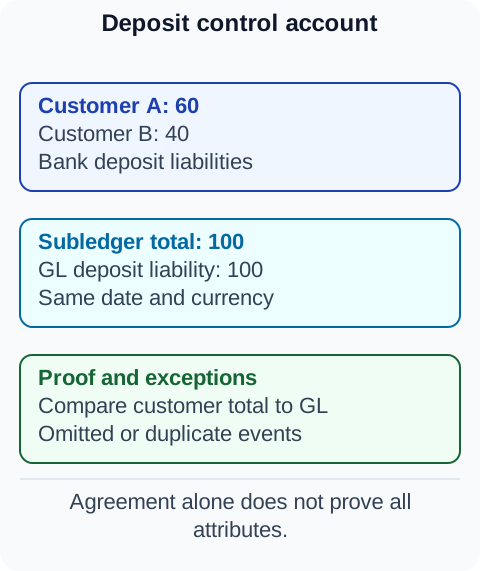
For each control account, prove opening + recognised movements + approved adjustments = closing. Tie event counts and totals to source populations, identify rejected/pending events, and preserve customer/contract drill-down even if GL journals aggregate many events.
4.2 Upgrade and blocker governance
Keep journal, chart-of-accounts and reporting mappings versioned separately. A chart change may alter GL aggregation without changing customer contracts; a taxonomy change may alter reporting dimensions without changing either ledger. Regression tests must show which balances and movements changed and why. Block material incomplete or invalid normal output, escalate before the deadline and use the applicable authorised correction/exception process where permitted.
4.3 Deep dive: parallel-run proof standards and blocker-escalation economics
Upgrade mappings on frozen inputs. Compare the full affected population and classify differences as changed taxonomy semantics, approved policy/mapping changes, timing or errors. Explain rounding separately from substantive breaks; the duration and approval thresholds are bank policy, not universal law.
A material failed tie-out or invalid required data point should stop normal submission and trigger escalation before deadline. Follow the regulator's correction, extension or permitted exceptional-submission process where needed. Not all validation warnings are blocking errors. Record authorised treatment and remediation; never hide an override or assume that filing late is legally harmless.
4.3 Deep dive: link-gate engineering and version-stamp architecture
Link gates verify independent reconciliations, required evidence and compatible versions. The internal run manifest records source snapshot, journal population, mapping, model and taxonomy versions plus generation time. Do not put invented metadata facts into a regulatory instance that does not permit them.
Archive the accepted filing, regulator receipt, input data and the reconciliation/adjustment bridge. A transport receipt may mean successful upload rather than acceptance of the business contents; track the gateway's final validation status separately.
5. Product and customer impact
Opening a product requires approved subledger balances, GL accounts, interest/fee events, reversals and reporting mappings. Customer statements and regulatory reports can legitimately use different measures and dates, but each difference needs an explanation. Shared data alone does not guarantee consistent disclosures.
6. Regulatory and supervisory view
Use the applicable financial-reporting and regulatory data instructions for the entity and date. BCBS 239 supports accuracy, completeness and traceability within its supervisory scope; it does not require one specific subledger architecture. A gateway upload receipt is distinct from final content acceptance. A warning, override or missed tie-out requires investigation; it does not alone prove deliberate misconduct.
7. Systems and data view
The controlled chain includes source events, a contract subledger, posting/aggregation service, GL, reconciliation and reporting enrichment. Store unique event IDs, account mappings, journal identifiers, amount/currency, legal entity, recognition and processing dates, rule versions and reversals. Capture transport success, accounting acceptance and external settlement as distinct states. A reconciliation should be reproducible from preserved populations rather than a live total that changes while the reviewer checks it.
8. End to end process
- Capture and validate the business event.
- Record its subledger effect and accepted journal identity.
- Aggregate accepted movements where designed and post once to the GL.
- Reconcile control-account opening, movement and closing balances.
- Resolve timing, measurement, missing and duplicate-event breaks.
- Preserve the reporting-date snapshot and approved adjustments.
- Map to reports and confirm final filing status.
9. Controls and risks
| Risk | Control | Evidence |
|---|---|---|
| Missing/duplicate events | Population, count and amount reconciliation | Event/journal IDs |
| Net/gross mismatch | Principal, fee, accrual and allowance bridge | Control-account pack |
| External payment mistaken for posting | Separate settlement status | Scheme/nostro evidence |
| Journal aggregation loses detail | Stable drill-down and grouping rule | Batch membership |
| Reporting snapshot changes | Versioned data and adjustments | Approved run manifest |
10. Practical examples
Loan bridge: assume legal principal 250,000, accrued interest 1,000, unamortised integral fee 2,000 and ECL allowance 3,000. Gross carrying amount before allowance is 249,000; net carrying amount is 246,000. A principal extract of 250,000 cannot tie directly to the net amount without the +1,000 −2,000 −3,000 bridge.
Missing batch: a source population contains 10,000 accepted events, but only 9,980 appear in accepted GL journal membership. Identify the 20 missing events and their amounts. A balanced trial balance and a matching file hash cannot establish population completeness.
Reporting mapping: an 80m balance needs a new reporting classification. Approve and test the mapping without inventing an accounting adjustment merely to force one report cell to a preferred value.
11. Diagrams
Figure 1. Subledger to GL flow.
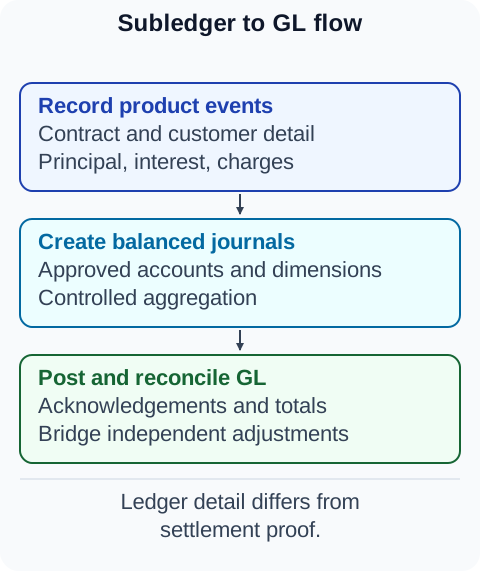 Figure 2. Ledger responsibilities.
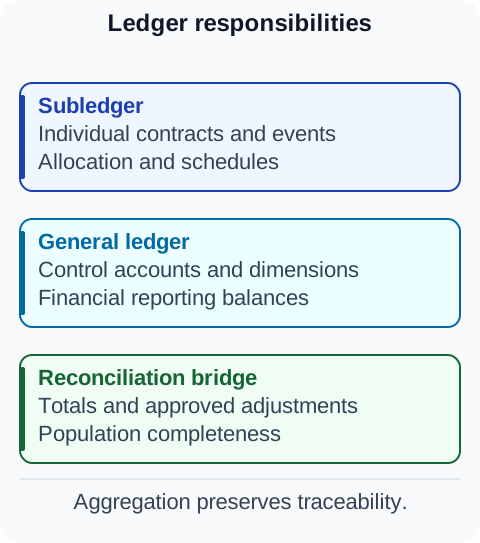 Figure 3. Deposit control account.
12. Tables
| Measure | Includes |
|---|---|
| Contractual loan principal | Legal outstanding principal |
| Gross IFRS carrying amount | Eligible fee/cost and accrued-interest adjustments, before allowance |
| Net IFRS carrying amount | Gross amount less applicable allowance |
| Prudential exposure | Relevant regulatory measurement and scope, potentially undrawn amounts |
| Break type | Resolution |
|---|---|
| Timing | Prove expected recognition/settlement dates |
| Measurement | Provide explicit component bridge |
| Missing/duplicate | Correct event completeness/exactly-once effect |
| Classification | Correct approved mappings with version history |
13. Illustrative bank case study
A validation error exposes a missing bridge. In this fictional case, a bank's net loan GL total is compared with gross prudential exposure and produces a material difference. The team decomposes ECL, accrued interest, undrawn commitments and consolidation perimeter. It corrects the actual mapping defect, documents legitimate differences and obtains approval before filing. A warning or override alone does not establish deliberate misconduct; the facts, rules and documented decisions matter.
14. BA, developer, tester and operations guidance
- BA: specify measures, GL control accounts and independent reconciliation populations.
- Developer: preserve accepted event-to-journal membership and reversals.
- Tester: test gross/net bridge, same-bank funding and missing/duplicate events.
- Operations: prove open items and escalate unexplained breaks.
15. Common mistakes
- Treating the GL as a customer contract register.
- Equating balanced journals with a complete population.
- Tying principal-only data directly to net carrying amount.
- Treating posting success as settlement success.
- Changing accounting balances to conceal reporting-mapping defects.
16. Key takeaways
Subledgers preserve detail; GL control accounts preserve recognised accounting balances. Reconcile movements and measurement components, preserve event drill-down, then bridge to the distinct reporting requirements.
17. References and verification notes
-
BCBS 239: risk data aggregation principles: governance, architecture, accuracy, completeness, timeliness and adaptability underpin risk-data aggregation; scope and supervisory application vary. It prescribes neither one warehouse architecture nor universal numeric reconciliation tolerances.
-
IFRS Foundation: IFRS 9: classification depends on business model and contractual cash flows; initial recognition and directly attributable costs follow IFRS 9. This is the IFRS track, not US GAAP CECL.
-
DPM/XBRL versions, validation rules and filing channels per current EBA/national frameworks — verify release locally.
-
Chain designs are illustrative training architectures.