Chapter 013: Accounting Rules Engines
Section 3: Finance Systems and Accounting Architecture · Chapter 013 of 100
An approved banking event becomes a journal through versioned accounting rules. This chapter shows the event, account selection, debit/credit direction, dates, replay and reconciliation controls that make that posting reproducible.
1. Chapter opening
An accounting rules engine transforms an approved business event and its attributes into a balanced journal. It chooses accounts, debit/credit direction, amounts, dimensions, dates and reversal linkage. A risk engine computes ECL or RWA; a capital calculator computes prudential ratios. Their outputs may feed the accounting engine, but those functions are distinct.
The goal is reproducible posting treatment: the same approved event, input versions and applicable rule produce the same journal. This chapter follows a loan event from source through validation, posting and reconciliation, then distinguishes the journal outputs from downstream risk and reporting measures.
2. Learning objectives
- Define event-to-journal rules with bank-perspective debit/credit entries.
- Distinguish accounting rules, valuation/ECL models and capital calculations.
- Design effective dates, precedence, reversals and replay safely.
- Validate journals and reject unsupported events without losing coverage.
- Prove the posting chain and its downstream reporting effects.
3. Business context
A product system knows that a loan was disbursed; Finance must determine what that event recognises. A new fee, a rate reset or a repayment creates different accounting questions. Rules scattered across processors can still work if governed, but inconsistent policies, undocumented overrides and stale mappings create errors. A separate accounting hub is one possible architecture, not a standard mandated for all banks.
A usable rule specification names the source event, recognition policy, accounts, amount derivation, dimensions, dates, journal grouping, reversal path and owner. Do not translate a business label directly into a GL account without assessing the economic event.
4. Finance and accounting view
4.1 Engine chain worked (fictional, millions)
Consider a 10,000 loan credited to a customer account at the same bank, with a 200 integral origination fee and an initial ECL of 60.
| Event | Debit | Credit |
|---|---|---|
| Disbursement | Loan principal 10,000 | Customer deposit 10,000 |
| Integral fee collected from deposit | Customer deposit 200 | Loan integral-fee adjustment 200 |
| Initial ECL | Impairment expense 60 | Loan loss allowance 60 |
Gross carrying amount after the fee adjustment is 9,800; net carrying amount after allowance is 9,740. Fee accounting does not book 200 as immediate service revenue. The deposit balance rises by a net 9,800; no external cash moves merely because those journals post. If the customer transfers funds to another bank, separately post the customer debit, settlement liability and external cash leg.
For an IFRS 15 account-service fee, the rule instead recognises service income when the performance obligation is satisfied. An amount called an arrangement fee is not sufficient evidence of either treatment; assess contractual substance.
4.2 Attribution and gates
Validate recognition eligibility, rule selection, open period, valid postable accounts, dimensions, currency amounts and equal debits/credits before commit. Use a stable event/action identity and an atomic posting boundary so retries cannot double-book. Reversals reference the original journal and policy; a reversed event is not deleted.
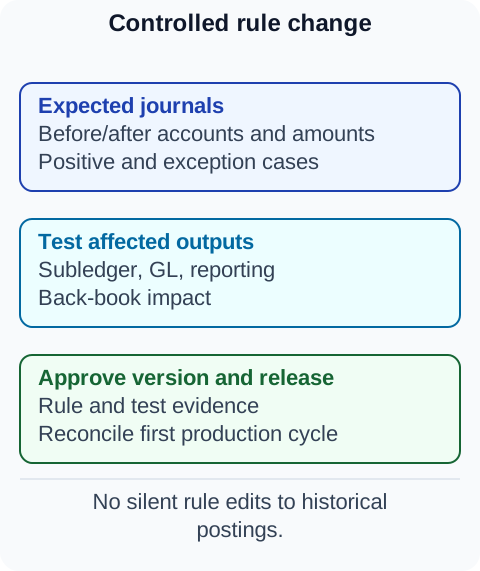
Rule precedence must be explicit. A general loan-disbursement rule and a product-specific rule cannot both fire accidentally. Events without an applicable rule go to an owned exception queue and remain in completeness reconciliation. Changes require Finance approval and meaningful cases, including cash versus same-bank funding, accrued-interest collection, fee refund and closed-period correction.
4.3 Deep dive: attribution-completeness gates and version-lockdown discipline
Effective-date each rule and record the selected version in journal provenance. Separate contract terms from accounting-policy version: a fixed-rate contract retains its agreed rate, but a new accounting requirement may change future postings on an existing contract. Replaying a historical journal for reproduction uses its historical versions; recalculating a correction uses an approved correction policy.
Version the associated chart of accounts, dimension mappings, calendars, rates, rounding conventions and valuation/ECL input files. An engine binary alone is insufficient to reproduce a posting. Freeze approved reporting runs, retain corrections as new versions and compare differences before sign-off.
Downstream input bridge: the engine posts the 10,000 principal, 200 integral fee adjustment and 60 loss allowance above. A prudential calculator may use these balances plus counterparty, collateral and approach data to determine exposure and RWA. Keep an explicit measurement/scope bridge; an RWA result or a management capital allocation is not an additional statutory asset or expense journal.
5. Product and customer impact
Correct rules protect customer balances, interest statements and reversals. Preserve readable journal narratives and separate pending holds from posted entries. A GL interface failure must not silently discard a completed customer transaction: track the split, contain it and reconcile recovery according to the bank's design.
6. Regulatory and supervisory view
IFRS 9 governs instrument recognition and measurement on this course's IFRS track; IFRS 15 governs relevant service revenue. Prudential RWA, capital eligibility and distribution restrictions follow the applicable jurisdiction and reporting period. Basel standards are not themselves domestic law, and an accounting engine does not replace a separate prudential calculation. The bank must evidence the selected policies, mappings, change approvals and reconciliations.
7. Systems and data view
A possible implementation is source event → validated input → selected rule → journal template → atomic GL posting → acknowledgements → source-to-GL reconciliation. Add explicit rejected, pending and reversed states. Store event, journal and run IDs, rule version, source amounts, amount derivation, accounts, dimensions and timestamps. Use independent reconciliation logic so the engine does not certify only its own output.
8. End to end process
- Accounting Policy approves the treatment.
- BA specifies events and numeric journals.
- Engineering implements effective-dated rules and valid account mappings.
- Testers independently verify recognition, arithmetic, retries and reversals.
- Run affected populations in parallel and explain differences.
- Release under change control, monitor exceptions and reconcile every source event.
- Preserve evidence through close and downstream reporting.
9. Controls and risks
| Risk | Control | Evidence |
|---|---|---|
| Wrong recognition | Policy-approved event specification | Signed numeric examples |
| Double firing | Explicit rule precedence and uniqueness | Conflict tests |
| Duplicate retries | Atomic idempotent posting | Crash/retry evidence |
| Unmapped event | Owned exceptions plus population reconciliation | Event disposition ledger |
| Historical drift | Rule/input versions and reproducible runs | Comparison and approval record |
10. Practical examples
Accrual and collection: Dr Interest receivable100 / Cr Interest income100; later Dr Customer deposit100 / Cr Interest receivable100. Crediting income again on collection doubles revenue even though both journals balance.
Replay after lost acknowledgement: the journal commits but the producer misses the response. A stable event/action ID returns the original committed journal on retry. A new ID can create a duplicate. Reconciliation tests accepted business events against journal membership.
Controlled reversal: link a reversal to the original journal and the contractual reason. A service-fee refund, integral-loan-fee change and deposit-interest correction require distinct rules; a generic refund-to-fee-income template can misstate profit.
11. Diagrams
Figure 1. Accounting rules engine.
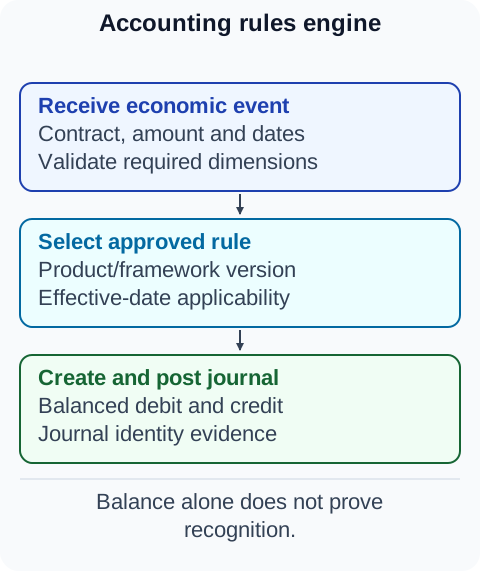
Figure 2. Accounting rule dimensions.
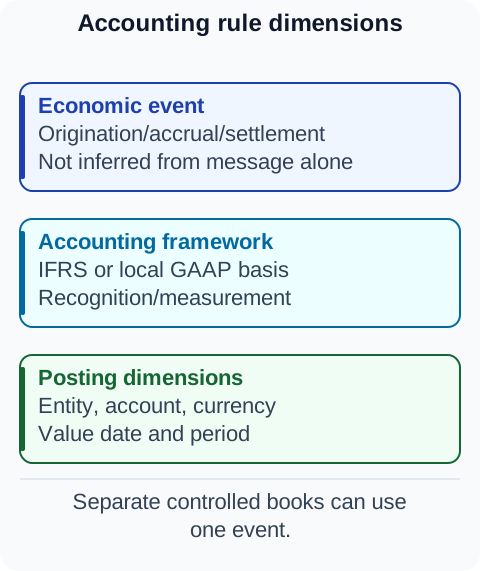
Figure 3. Controlled rule change.
12. Tables
Table 1: minimum rule specification
| Field | Required meaning |
|---|---|
| Event and predicate | Which economic action qualifies |
| Recognition policy | IFRS/GAAP treatment and scope |
| Amount and direction | Formula, debit/credit, currency and rounding |
| Accounts and dimensions | Governed mapping, valid leaves and attributes |
| Dates and versions | Recognition period, operational dates, rule effective date |
| Recovery | Retry identity, reversal/correction and exception path |
Table 2: accounting and prudential engines
| Engine | Output | GL relationship |
|---|---|---|
| Accounting rules | Balanced journals | Posts recognised balances |
| ECL model | Allowance measurement | Approved result informs allowance journal |
| RWA engine | Prudential risk measure | Reconciled exposure inputs; RWA itself is not a GL asset |
| Capital calculator | Eligible capital/ratios | Starts from accounting inputs and applies prudential adjustments |
Table 3 — Posting acceptance cases
| Input case | Expected result | Independent proof |
|---|---|---|
| Same-bank loan draw 10,000 | Dr Loan / Cr Customer deposit; no external cash | Contract, event and deposit balance |
| Integral fee 200 | Contra-loan adjustment, not service income | Gross loan 9,800 and deposit increase 9,800 |
| Initial ECL 60 | Dr Impairment expense / Cr Allowance | Net loan 9,740; approved model output |
| Lost acknowledgement and same-ID retry | Original journal returned, one posting | Source action count equals unique committed outcome |
| Same ID with different amount | Conflict quarantined, no second journal | Payload comparison and owned exception |
| Collected accrued interest | Clear receivable; no second income | Accrual/collection roll-forward |
13. Illustrative bank case study
The duplicated fee rule. In this fictional case, both a generic service-fee rule and a loan-origination rule process the same integral fee. Journals balance but interest yield and fee income are wrong. Independent expected-journal tests reveal the overlap. The bank corrects affected balances under its error policy, gives the rules a clear precedence and adds a population-level check that each event has one approved accounting disposition.
14. BA, developer, tester and operations guidance
- BA: specify numeric bank-perspective entries, not only event names.
- Developer: make rule selection, posting and retry outcomes auditable.
- Tester: test balanced-but-wrong journals, accrued collections and overlapping predicates.
- Operations: reconcile source events against posted, pending, rejected and reversed populations.
15. Common mistakes
- Treating an RWA calculator as an accounting journal engine.
- Assuming a balanced journal proves correct recognition.
- Crediting income again when collecting an accrued receivable.
- Losing exceptions from completeness totals.
- Replaying events with the wrong rule/input versions.
16. Key takeaways
- Accounting rules translate recognised economic events into balanced journals.
- Recognition, amount derivation, dates and accounts need governed specifications.
- Stable event identity and atomic effects make retries safe.
- Reconciliation includes every event state and checks more than balancing.
- Accounting and prudential calculations connect through controlled input bridges.
17. References and verification notes
-
BCBS 239: risk data aggregation principles: governance, architecture, accuracy, completeness, timeliness and adaptability underpin risk-data aggregation; scope and supervisory application vary. It prescribes neither one warehouse architecture nor universal numeric reconciliation tolerances.
-
IFRS Foundation: IFRS 9: classification depends on business model and contractual cash flows; initial recognition and directly attributable costs follow IFRS 9. This is the IFRS track, not US GAAP CECL.
-
Accounting and prudential engines have different outputs; the applicable local reporting framework governs any downstream capital calculation.
-
Figures are fictional training illustrations.