Chapter 032: Spot FX and Forward Contracts
Section 7: Foreign Exchange and Treasury Instruments · Chapter 032 of 100
1. Chapter opening
The FX lifecycle links a recorded quote, approved deal, complete capture, independent confirmation, funded settlement, valuation and reconciliation. Define deadlines by product, currency and scheme; T+0/T+1 matching, hourly break review or daily IPV are controlled operating choices where appropriate, not one universal legal timetable.
Capture both currencies and their direction, quote convention, amount, value date and approved instructions. PvP reduces principal settlement risk for eligible transactions; funding, replacement-cost and operational exposures remain. Separate dealing from confirmation, settlement and valuation controls proportionately.
Retained authenticated email with an actual comparison and approved conclusion can evidence matching. An undocumented conversation cannot. Preserve what was compared, by whom, when and how exceptions were resolved, without claiming every supervisor demands a universal 200-trade sample within hours.
2. Learning objectives
- Operate pre-trade limits (counterparty, settlement, tenor, trader) with hard stops.
- Capture deals completely (economics, value dates, settlement instructions) same-day.
- Match confirmations with break-ageing discipline.
- Settle via PvP/CLS or funded nostro with fails management.
- Prove maker-checker segregation with access analytics.
3. Business context
FX transfers can expose the bank to principal settlement risk if one currency is paid before the other arrives. Compare timestamps in one time zone:10:00CET is 09:00UTC, while 16:00EST is 21:00UTC, a 12-hour difference on those fixed offsets, not six hours. Actual daylight-saving dates must be specified.
Payment-versus-payment makes final transfer of one leg conditional on final transfer of the other, reducing principal risk. CLS supports eligible currencies and transactions within its procedures; it does not eliminate every liquidity, replacement-cost, operational or legal risk. Bilateral trades need settlement limits, funding, accurate instructions and controlled release.
4. Finance and accounting view
4.1 Spot deal, functional-currency balance and spread
Use USD as functional currency. A bank buys EUR 10m and sells USD 11.02m at USD 1.1020/EUR. If settlement-date reporting uses that same spot rate, the illustrative cash exchange is Dr EUR nostro (USD equivalent 11.02m) / Cr USD nostro 11.02m. Cash moves at settlement, not automatically at trade inception. Regular-way recognition policies may use trade-date or settlement-date accounting under IFRS 9, with receivable/payable or commitment tracking and intervening valuation as appropriate.
The difference from a mid-rate of 1.1000 is USD 0.0020 × EUR 10m = USD 20,000, not 200,000. Whether that is revenue for this bank depends on the customer direction, offsetting trade, fair value and day-one recognition rules. A bank paying above mid to buy EUR cannot simply declare the spread income. FX dealing spreads are not automatically an IFRS 15 fee or IFRS 9 EIR income.
4.2 Forward contract
Fictional EUR 3m forward: bank sells EUR and buys USD at 1.1050, with contemporaneous spot 1.1020 and forward points 30 pips. An at-market forward typically starts at zero fair value, then remeasures at current forward curves discounted to the settlement date, with gains/losses in P&L absent hedge accounting. Forward points reflect relative currency interest rates and other market effects; they are not automatically fee income.
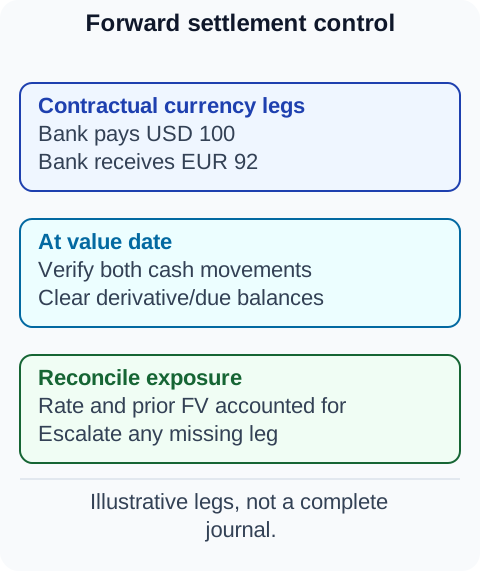
At maturity assume spot remains 1.1020. Contractual receipt is USD 3.315m and EUR cash given is USD-equivalent 3.306m. The forward asset is 9,000 immediately before settlement. Journal: Dr USD nostro 3,315,000 / Cr EUR nostro (USD equivalent) 3,306,000 / Cr Derivative asset 9,000. Debits equal credits; do not switch the 3m notional to 10m or reverse a completed spot exchange at settlement.
4.3 Controls and settlement risk
Match economics, value dates and independently verified standing settlement instructions. PvP reduces FX principal settlement risk but not all credit, replacement-cost, liquidity or operational risk. Bilateral exposure runs from irrevocable payment until confirmed receipt, including weekends and payment-system closures. Exposure is measured in currency amounts over time; multiplying money by hours is a duration-weighted metric, not a capital or settlement limit.
Valuation of forwards uses forward curves and discounting, not simply closing spot. Options require an appropriate market-participant model and volatility inputs; delta/gamma sensitivities do not replace full fair-value measurement. SSI-change authentication, escalation periods and retention are bank-policy and local-rule parameters, not globally fixed cut-offs.
5. Product and customer impact
Explain currency direction, quote convention, dealt rate, spread, forward points, charges and settlement date. A 20pip difference on EUR 10m is USD 20,000; whether it is the bank's income depends on which currency it buys/sells, offsetting execution and accounting. Do not label every above-mid quote a positive bank margin.
Execution and conduct obligations depend on jurisdiction, service and instrument scope. Spot FX should not be presented as universally covered by MiFID investment-service duties. Confirmations and standing settlement instructions should match the agreed economics before settlement; timing and retention requirements come from applicable rules and controlled bank policies.
6. Regulatory and supervisory view
The FX Global Code is a voluntary good-practice code, separate from local law. Use its current GFXC edition for execution, confirmation and settlement principles; do not attach an unverified principle number or claim 55 immutable principles. Derivative trade reporting, conduct duties, recording retention and product appropriateness depend on jurisdiction and contract scope. Spot FX is not automatically within every MiFID investment-service obligation.
The Basel FX settlement-risk guidance expects identification, measurement and control of principal, replacement-cost, liquidity, operational and legal risks. Payer/receiver time-zone examples must use a single time convention; 10:00 CET and 16:00 Eastern are not six hours apart.
7. Systems and data view
Connect pricing inputs, deal capture, confirmation, settlement, valuation and journals using stable IDs. Capture currency direction, amount in each currency, rate convention, value date, counterparty, trader and approved settlement instructions. Preserve market-data versions for IPV and remeasurement.
Use risk-approved limit overrides and independent SSI change verification. Recording retention follows applicable law and policy, not one universal 5/7 year rule. Monitor confirmation and settlement breaks by actual cut-off; a daily dashboard must not conceal an imminent currency-leg deadline. Reconcile native-currency positions and nostro cash separately from functional-currency valuation.
8. End to end process
- Quote with sourced rate + spread (rate from pricing engine, spread from matrix, recorded with timestamp).
- Limit-check and deal (pre-trade system check: counterparty limit, settlement limit, tenor limit, trader limit — all pass before trade entry).
- Capture same-day completely (all economics: rate, amount, currency pair, value date, settlement instructions, counterparty codes, trader ID, timestamp).
- Confirm T+0/T+1 with break ageing (electronic match against counterparty confirmation; breaks aged hourly with escalation protocol).
- Fund/settle via PvP/nostro (CLS if eligible and within cut-off; bilateral with funded nostro if not; settlement proof captured).
- Revalue daily with IPV (independent price verification against market sources; stale marks escalated).
- Post, reconcile, attest (GL journals with event linkage; nostro reconciliation daily; position reconciliation weekly).
9. Controls and risks
| Risk | Control | Evidence |
|---|---|---|
| Limit breach | Pre-trade hard stops | Breach-attempt logs |
| Unconfirmed trades | Same-day matching + ageing | Match-rate packs |
| Settlement fails | Cut-off + SSI discipline | Fail analytics |
| Self-checking | Segregation analytics | Access reviews |
| Misdirected payment | SSI dual control + callback | Callback logs |
| Stale marks | Daily IPV with escalation | IPV reconciliation packs |
10. Practical examples
Fictional SSI fraud attempt: an urgent change request gives a new contact number. Operations authenticates through the established channel, discovers the mismatch and holds release under the agreed contingency procedure. Voice callback is one control; independently authenticated digital processes may also be valid.
Fictional pre-cut-off triage: six unmatched trades include PvP-eligible, bilateral and NDF positions. Prioritise by irrevocable exposure, deadline, currency funding and confirmed facts. Dividing a payment into smaller tranches does not reduce cumulative exposure if all are paid before the counter-currency arrives. Do not settle an unconfirmed economic obligation merely to meet a cut-off.
11. Diagrams
Figure 1. FX contract lifecycle.
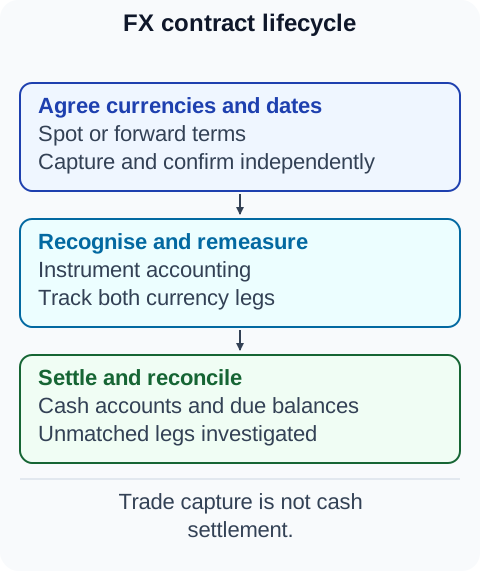 Figure 2. Spot versus forward.
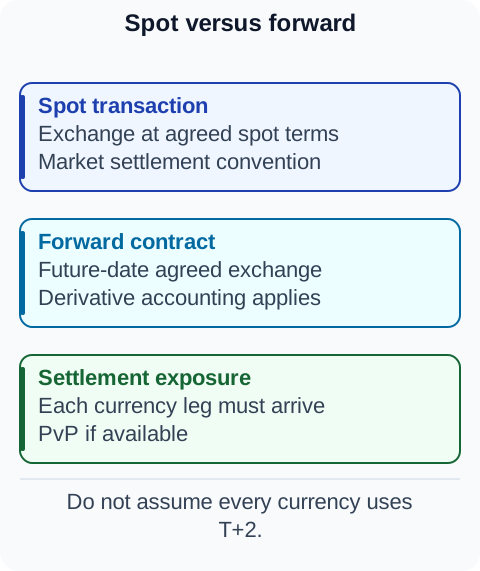 Figure 3. Forward settlement control.
12. Tables
| Event | Accounting/control |
|---|---|
| Spot execution | Record economic commitment; apply regular-way recognition policy |
| Spot settlement | Exchange currency cash legs, balanced in functional currency |
| Forward inception | Recognise fair value, typically zero if at market |
| Forward remeasurement | Derivative asset/liability versus P&L, absent qualifying hedge treatment |
| Forward settlement | Cash legs plus derecognition of derivative carrying value |
| NDF settlement | Net cash difference; no principal currency exchange |
The worked examples in section 4 use distinct spot and forward notionals and explicit quote direction. Maintain trade-date, value-date and accounting-date fields separately.
13. Illustrative bank case study
Fictional case: the limit that forgot cumulative payments. Operations splits a 50m sold-currency payment into five 10m releases while awaiting the bought currency. A nominal 10m per-transfer limit passes every release, but total principal exposure becomes 50m. Controls aggregate outstanding irrevocable payments by counterparty and settlement window, and use PvP where available. This is an illustrative failure mode; no unverified 2015 bank-loss episode is asserted.
14. BA, developer, tester and operations guidance
- BA: Define required economics, quote conventions, calendars, limit semantics and settlement methods per product.
- Developer: Version inputs and SSI changes; keep independent approvals and replay-safe journals.
- Tester: Test currency direction, pip conversion, limit boundaries, holidays, failed legs and authorised overrides.
- Operations: Resolve confirmation breaks before relevant deadlines; verify SSI changes independently and reconcile cash.
15. Common mistakes
- Soft limits approvable by the trader breaching them.
- Confirmation backlogs treated as admin queues.
- SSI changes without callback verification.
- Self-checking via shared logins or excessive rights.
- Marks without IPV feeding P&L and bonuses.
- Settlement limits set generically without currency-specific cycles.
- Voice recordings not linked to deal capture records.
- CLS cut-off monitoring as end-of-day, not real-time.
16. Key takeaways
- Rate convention and bank buy/sell perspective determine amounts and journal signs.
- Trade recognition, cash settlement and fair-value remeasurement are different events.
- PvP reduces principal risk; remaining risks still need control.
- SSI verification, funding and confirmation matching protect settlement.
- Apply conduct, reporting and retention rules only within their actual jurisdiction and scope.
17. References and verification notes
- IFRS 9 derivative and recognition requirements
- Global Foreign Exchange Committee FX Global Code
- BCBS supervisory guidance for FX settlement risk
- Rules are applied under the reporting entity's adopted accounting framework and jurisdiction. Basel standards require local implementation; they are not themselves national law. All unnamed cases, amounts and operational thresholds are fictional training examples.