Chapter 031: Foreign Currency Accounting
Section 7: Foreign Exchange and Treasury Instruments · Chapter 031 of 100
1. Chapter opening
IAS 21 distinguishes functional currency, presentation currency and native contract currency. Determine functional currency from the primary economic environment: sales/pricing and labour/material/other cost influences are primary indicators, with financing and retained operating receipts as supporting information. It is not a free election or necessarily the local regulator's currency. A genuine change in the underlying environment is applied prospectively.
Initially record foreign-currency transactions at the transaction-date spot rate; a representative average may approximate it, but is unsuitable for significant fluctuations. Retranslate monetary items at closing rates and generally recognise differences in P&L, subject to specific net-investment and hedge requirements. Non-monetary historical-cost items use the transaction-date rate; fair-value items use the fair-value measurement-date rate, with the exchange component following the relevant P&L/OCI treatment.
Translate a foreign operation into presentation currency using closing asset/liability rates and transaction-date income/expense rates or appropriate approximations. Recognise translation differences in OCI under IAS 21 and apply its actual disposal/partial-disposal rules. IAS 29 hyperinflation and the effective Lack of Exchangeability amendments require separate analysis, not a generic holiday-rate workaround.
2. Learning objectives
- Distinguish functional vs presentation currency with IAS 21 indicators.
- Post foreign transactions (initial, settlement, retranslation) correctly.
- Translate foreign operations (close/average/OCI mechanics + disposal recycling).
- Migrate multi-currency balances (rate mapping, timing, rounding, calendars).
- Handle hyperinflation (IAS 29 trigger) at headline level.
- Document functional-currency determinations with IAS 21 indicators.
- Distinguish monetary from non-monetary items for retranslation purposes.
3. Business context
A fictional 0.01% rate error on a €50bn equivalent book produces€5m misstatement. Evaluate its nature and materiality under IAS 8; persistence alone does not establish a mandatory restatement. Explain exchange movements separately from posting errors, native-principal differences and actual conversion fees.
Migration comparisons normalise rate source, quote direction, timestamp, transaction versus close date and rounding. Preserve native balances first. Reporting translation reserves and prudential capital use different policies and adjustments, so reconcile their effects instead of equating every OCI move to a one-for-one CET 1 change.
4. Finance and accounting view
4.1 Foreign transaction and closing retranslation
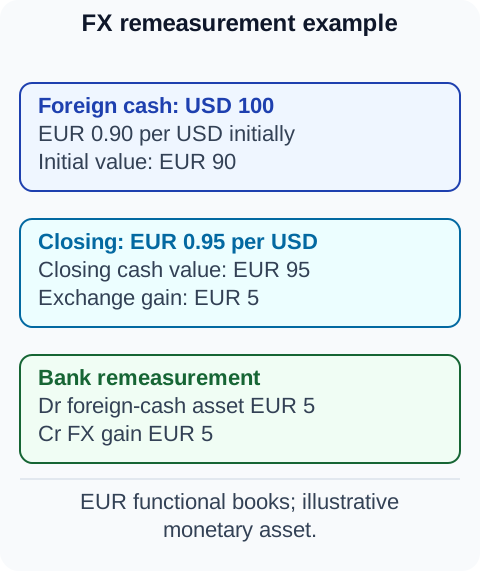
Fictional EUR-functional bank receives USD 100,000 into a USD nostro from a customer's deposit. At EUR 0.90 per USD: Dr USD nostro asset EUR 90,000 / Cr Customer USD deposit liability EUR 90,000. The underlying customer balance remains USD 100,000. At EUR 0.92 per USD, retranslate each monetary balance to EUR 92,000: Dr Nostro EUR 2,000 / Cr FX gain EUR 2,000 and Dr FX loss EUR 2,000 / Cr Deposit liability EUR 2,000. The matched positions offset; a customer's USD balance does not change because the bank's functional-currency rate changed.
Initially record transactions at the transaction-date spot rate. A suitable average can approximate actual dates when exchange rates do not fluctuate significantly; it is not a licence to use a monthly average during material volatility. Monetary items retranslate at closing rates, generally through P&L. Non-monetary historical-cost items keep transaction-date rates; fair-value items use the valuation-date rate, with FX following the underlying gain/loss presentation where applicable.
4.2 Foreign operation and disposal
For a USD-functional subsidiary translated into EUR presentation currency, translate assets/liabilities at close and income/expenses at transaction-date rates (a valid average may approximate them). Translation differences are OCI, accumulated in the foreign-currency translation reserve. Translated revenue remains revenue in consolidated P&L; the difference from translation is OCI, not the whole income statement.
Goodwill and acquisition fair-value adjustments relating to the operation are treated as assets/liabilities of that foreign operation and translated at closing rate. Disposal, loss of control and certain partial disposals require different recycling or reattribution treatments under IAS 21; not every partial sale retains all OCI, and not every reorganisation triggers recycling.
4.3 Rates, exchangeability and migration proof
Document rate source, quote direction, timestamp, fallback and historical archive; convert currency legs consistently and reconcile native-currency balances separately from reporting-currency values. Settlement calendars govern value dates, not whether an existing monetary balance can be valued on a holiday.
IAS 21 Lack of Exchangeability amendments apply for annual periods beginning on or after 1 January 2025. Assess whether a currency is exchangeable for the specified purpose/date; estimate an appropriate spot rate and disclose required information when it is not. IAS 29 is a separate hyperinflation framework applied before translation where relevant. Country determinations require current facts, not an assumed inflation threshold alone.
A rate-source migration should bridge explained valuation differences and genuinely erroneous balances using archived data. Rounding follows the transaction, reporting and contractual requirements; half-even at position level is not a universal banking rule.
5. Product and customer impact
A USD deposit remains a USD contractual liability even if the bank's functional or presentation currency is EUR. A displayed EUR equivalent can change with exchange rates; that does not change the customer's USD principal. Explain native balances, translated equivalents, rate timestamp and any actual conversion charge separately.
During migration, compare balances in native currency first, then attribute functional-currency differences to rate, timing, rounding and genuine error. Customer contracts and applicable notice requirements govern any change to a conversion product.
6. Regulatory and supervisory view
Translation-reserve volatility feeds capital (AOCI treatment varies — verify); country-risk and transfer-risk provisioning (cross-border currency exposure) per local rules; hyperinflation determinations follow IASB guidance with auditor agreement; migration change-risk examined (parallel evidence, rollback, data-integrity proof). FX conversion consumer rules (disclosure of rates/costs) vary by jurisdiction — verify.
Supervisory examination of currency migration focuses on three areas. First, data integrity: supervisors want to see that all balances migrated completely and accurately, with reconciliation evidence proving zero unexplained breaks at the balance level. Second, valuation continuity: the parallel run must demonstrate that rate-source changes create only explainable, quantified differences — unexplained differences are treated as potential errors requiring remediation. Third, rollback readiness: if the migration fails, the bank must be able to revert to the legacy system and resume operations within a defined timeframe — supervisors may require demonstration of rollback capability before approving cutover. Cross-border transfer-risk provisioning — where foreign-currency exposure creates risks beyond normal FX translation, such as capital controls preventing repatriation — adds another layer of supervisory concern that must be addressed in the migration plan.
7. Systems and data view
Version rate sources, quotation direction, timestamps, fallbacks, calendars and rounding rules. Preserve native amount, functional-currency amount and presentation translation separately. Transaction-date rates, closing rates and valid approximations serve different purposes; an average is inappropriate when significant rate fluctuations make it unrepresentative.
For foreign-operation translation, balance-sheet assets/liabilities use closing rates and income/expense use transaction-date rates or appropriate approximations. Do not apply that template blindly to every foreign-currency item: non-monetary historical-cost and fair-value items have different rate dates, and hyperinflation/exchangeability need their own policy. Retain the exact inputs used for every close and migration comparison.
8. End to end process
- Set functional currencies with indicators. 2. Govern rate sources + calendars. 3. Migrate with rate mapping + timing alignment. 4. Parallel-run with normalised attribution. 5. Cut over per currency window. 6. Translate operations with OCI discipline. 7. Recycle on disposals with evidence.
9. Controls and risks
| Risk | Control | Evidence |
|---|---|---|
| Rate-source divergence | Single policy + timestamp tags | Source registers |
| Rounding leakage | Policy tests at scale | Rounding analytics |
| Calendar gaps | Pre-holiday verification | Verification logs |
| Translation errors | Close/average discipline + tie-outs | Translation packs |
| Archive loss | Immutable rate storage with redundancy | Archive integrity checks |
| Functional-currency misclassification | IAS 21 indicator documentation | FC determination register |
10. Practical examples
Fictional rate-source change: a JPY book with functional-currency value 50bn has a 0.2% difference between two timestamps, equal to 100m. Reperform both using archived rates, distinguish timing from data errors and quantify actual P&L/OCI by balance type. If a 0.3m residual remains, it is 0.3% of the 100m difference, not 12 basis points; investigate it rather than deeming it acceptable solely because the source changed.
Fictional rounding defect: 50,000 daily conversions cannot generate 800 per day solely from a maximum one-cent rounding difference per transaction; the absolute bound is 500. Diagnose quote direction, fee allocation and precision before calling a much larger loss 'rounding'. Contractual transaction rounding and financial-statement aggregation can operate at different levels.
11. Diagrams
Figure 1. Foreign-currency transaction.
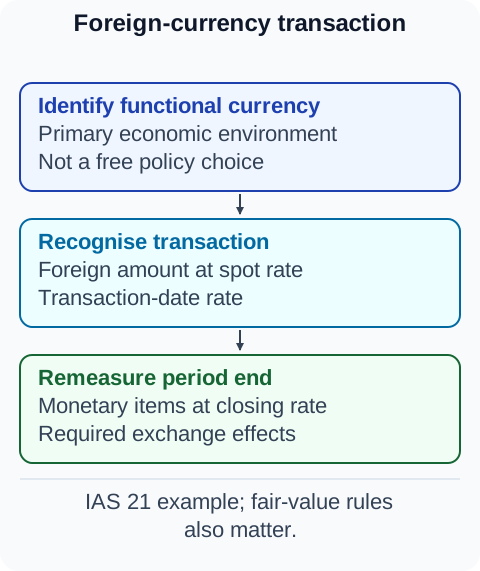 Figure 2. FX item categories.
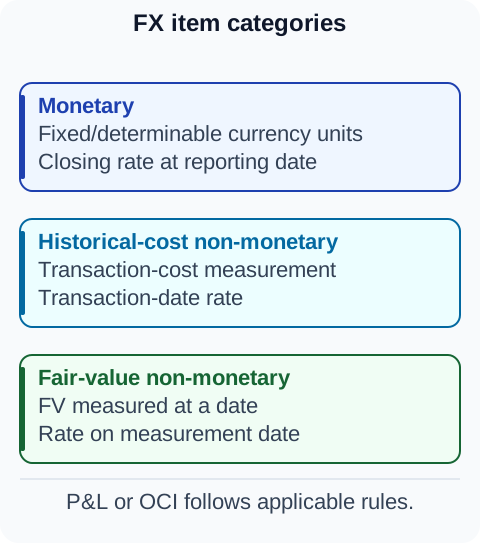 Figure 3. FX remeasurement example.
12. Tables
| Item | Rate | Presentation |
|---|---|---|
| Foreign-currency monetary asset/liability | Closing | FX normally P&L, subject to applicable exceptions |
| Non-monetary historical cost | Transaction date | No closing retranslation |
| Non-monetary fair value | Valuation date | FX follows relevant underlying gain/loss treatment |
| Foreign operation assets/liabilities | Closing | Translation differences OCI |
| Foreign operation revenue/expense | Transaction date or valid average | Translated P&L; resulting translation differences OCI |
| Qualifying disposal | IAS 21 disposal rules | Recycle or reattribute relevant reserve as required |
13. Illustrative bank case study
Fictional case: a reporting change mistaken for customer FX. A USD deposit remains USD 100,000 while its EUR reporting equivalent changes with the closing rate. Migration staff mistakenly overwrite the USD principal with the EUR-equivalent difference. Native-currency reconciliation catches the defect. The corrected migration preserves contractual currency balances and adjusts only reporting conversion, with separate proof of any customer exchange transaction.
14. BA, developer, tester and operations guidance
- BA: Specify functional currencies, rate sources, calendars, rounding and translation rules per entity.
- Developer: Timestamp everything UTC; version sources/calendars; archive rates immutably.
- Tester: Multi-currency migrations; holiday matrices; rounding at scale; translation tie-outs.
- Operations: Verify calendars pre-holiday; monitor rate-source health; attest translation packs.
15. Common mistakes
- Multiple rate sources without governance ("different rates, same event").
- Rounding at wrong level (transaction vs position).
- Unversioned holiday calendars.
- Historical rates discarded (re-performance impossible).
- Hyperinflation triggers unmonitored.
- Functional-currency determination undocumented.
- Translation recycling before disposal (premature P&L recognition).
16. Key takeaways
- Functional vs presentation discipline (IAS 21) underpins everything.
- Single rate-source policy with timestamp tags and archives.
- Translation (close/average/OCI/recycle) needs tie-out packs.
- Migrations prove market-vs-error attribution in parallel.
- Rounding and calendars are controls, not trivia.
- Archive immutability enables re-performance — the auditor's trust anchor.
- Customer communication during migration prevents complaints and regulatory findings.
17. References and verification notes
- IAS 21 and Lack of Exchangeability
- IAS 29 hyperinflation accounting
- Rules are applied under the reporting entity's adopted accounting framework and jurisdiction. Basel standards require local implementation; they are not themselves national law. All unnamed cases, amounts and operational thresholds are fictional training examples.