Chapter 033: Debt Securities and Investment Portfolios
Section 7: Foreign Exchange and Treasury Instruments · Chapter 033 of 100
1. Chapter opening
Debt-security accounting and liquidity-buffer eligibility answer different questions. IFRS 9 classification uses portfolio business model and contractual SPPI cash flows; the LCR applies asset and operational requirements, haircuts and caps. A security at amortised cost is not automatically HQLA, and a fair-valued security is not automatically a trading-book position.
Basel Level 1 assets are not capped at 70%. Level 2 assets are limited to 40% of the adjusted stock, with Level 2B limited to 15%, after specified transaction unwinds and adjustments. Level 2A normally has a 15% haircut; Level 2B rates vary by eligible category. Central-bank collateral eligibility is useful but is neither sufficient nor universally necessary for HQLA. Local implementation and actual availability determine recognition.
2. Learning objectives
- State HQLA eligibility (asset + operational requirements) with tiering.
- Post purchase (par/premium/discount), accruals, fair moves and disposals per bucket.
- Explain repo-pledging vs sale (encumbrance consequences for HQLA status).
- Prove monetisation (repo lines tested, sale history, diversification).
- Manage concentration, currency and wrong-way risks in buffers.
- Differentiate Level 1, 2A and 2B eligibility with haircaps and caps.
- Assess central-bank collateral eligibility as a secondary monetisation channel.
3. Business context
Liquidity buffers support stressed outflows and can impose carry cost. Fictional €50bn yielding 2.5%, funded at 3.8%, costs 1.3%×€50bn=€650m annually before hedging, operating costs and other effects. This illustration is not a current market-yield assertion.
Own-sovereign concentration can combine bank and sovereign stress. Monitor issuer/currency risks and apply actual policy and supervisory requirements; there is no universal 50-70% home-sovereign cap. Classification follows actual portfolio business model and SPPI, not a desired buffer label. Test monetisation without assuming every test sale contradicts hold-to-collect.
4. Finance and accounting view
4.1 Purchase, effective yield and valuation
Fictional 10-year bond, face 100m, annual coupon 3m, purchased just after coupon for 101m with no transaction costs. The effective yield solves 101 = sum of 3/(1+y)^t for t=1...10 +100/(1+y)^10, approximately 2.8835%. Year-one interest is about 2.913m. Accrue Dr Coupon receivable 3m / Cr Interest income 2.913m / Cr Bond premium 0.087m. Coupon cash then clears the receivable. EIR interest and contractual coupon must not be treated as identical for a premium bond.
At amortised cost, recognise the net carrying amount after ECL; pure market-rate price moves do not create a fair-value journal but remain relevant to liquidity and disclosures. At FVOCI debt, the balance-sheet amount is fair value; EIR interest, relevant FX and ECL are P&L, other fair-value changes OCI, and accumulated OCI is recycled on derecognition. FVTPL changes are P&L, with no separate ECL allowance. Transaction costs join the effective yield for non-FVTPL instruments and are expensed for FVTPL.
4.2 Classification and capital
Hold to collect plus SPPI permits amortised cost; hold to collect and sell plus SPPI permits debt FVOCI; other assets normally use FVTPL. Portfolio evidence governs, not the category treasury prefers. FVTPL valuation changes affect earnings, not AOCI. FVOCI affects accounting equity through OCI; prudential inclusion/filters must be assessed locally. A zero sovereign risk weight does not exempt an in-scope security from ECL.
4.3 Repo and monetisation
A usual financing repo records cash and a repo liability while retaining the security. Pledged collateral is generally unavailable for HQLA use, but LCR calculations must also apply prescribed maturity/unwind rules and the treatment of cash received. Undrawn pre-positioned central-bank collateral may remain eligible if the operational requirements and access rights permit it. Do not mechanically remove every pre-positioned security or count both reused collateral and the associated cash.
Test sale and repo access with recorded amount, time to cash and price impact. A small test in normal markets does not prove an eightfold stressed-sale capacity; scaling needs market-depth, concentration and stress evidence. Carry cost of 50bn funded at 3.8% and yielding 2.5% is 650m annually before hedging and other effects, on those fictional assumptions.
5. Product and customer impact
FTP can allocate liquidity-buffer carry and contingent-funding cost to businesses and credit stable funding providers. Estimates should reflect actual outflow assumptions and funding tenor. Marketing a deposit as green does not itself change its LCR runoff category or NSFR stability factor.
Covered bonds can provide funding while encumbering a cover pool; those consequences need separate records. Product pricing and customer credit availability should reflect the bank's actual liquidity appetite rather than treat every buffer purchase as unavailable customer lending.
6. Regulatory and supervisory view
Use the Basel LCR text as an international baseline, then the applicable national rulebook for entity-level eligibility, caps, haircuts and reporting. Internal concentration limits are bank policies; there is no universal 50-70% home-sovereign cap. ILAAP is a jurisdiction-specific supervisory process and FR 2052a is a US liquidity report, not an alternative set of accounting classifications.
Treat market haircuts and regulatory LCR haircuts separately. Market stress can change prices and repo terms without automatically changing statutory haircuts. Transfer restrictions limit recognition of surplus group liquidity; solo and consolidated availability must be evidenced.
7. Systems and data view
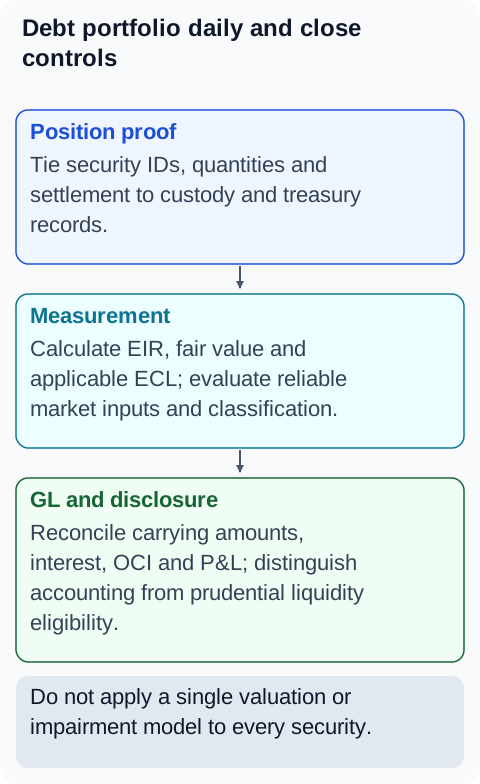
The securities master records accounting category, EIR, fair value, ECL applicability, issuer, currency, HQLA category and encumbrance. Reconcile it to securities custody, collateral management and GL. Identify operationally available quantities and transfer restrictions by entity.
The liquidity calculation applies actual regulatory haircuts/caps and transaction-unwind mechanics. Market repo haircuts may change without a corresponding statutory LCR haircut change. Update regulatory rules only from an applicable effective rule; revalue holdings using current marks and controlled inputs. Preserve tests of sale/repo access and the actual settlement capacity.
8. End to end process
- Define buffer mandate (size, tiers, currencies). 2. Purchase with bucket tags. 3. Accrue/revalue with ECL. 4. Test monetisation (sales, repo draws). 5. Monitor concentration/encumbrance. 6. Report composition; attribute carry costs. 7. Rebalance on strategy/regulatory change.
9. Controls and risks
| Risk | Control | Evidence |
|---|---|---|
| Ineligible holdings counted | Eligibility engine + re-certification | Eligibility packs |
| Encumbered counted as HQLA | Encumbrance-flag integrity | Flag tie-outs |
| Untested monetisation | Test-sale/repo-draw calendar | Test records |
| Wrong-way concentration | Issuer caps, nexus monitoring | Concentration reports |
| Eligibility downgrade missed | Real-time rating monitoring + alerts | Rating change logs |
| Haircut miscalculation | Automated haircut engine with version control | Haircut validation packs |
10. Practical examples
Fictional monetisation test: a 25bn portfolio is sold/repo-tested in selected small lots. One corporate-bond lot settles T+4 rather than assumed T+2. Revisit settlement and stressed capacity assumptions; do not certify the entire portfolio by multiplying the tested pace by eight.
Fictional encumbrance break: a collateral feed omits 2bn of pledged holdings. Reconcile security ID, quantity, legal availability and repo maturity to the eligibility engine, calculate the actual LCR effect including unwind treatment, and correct affected reports. A wrong eligibility flag does not itself change IFRS 9 carrying value.
11. Diagrams
Figure 1. Debt securities: classification and recognition.
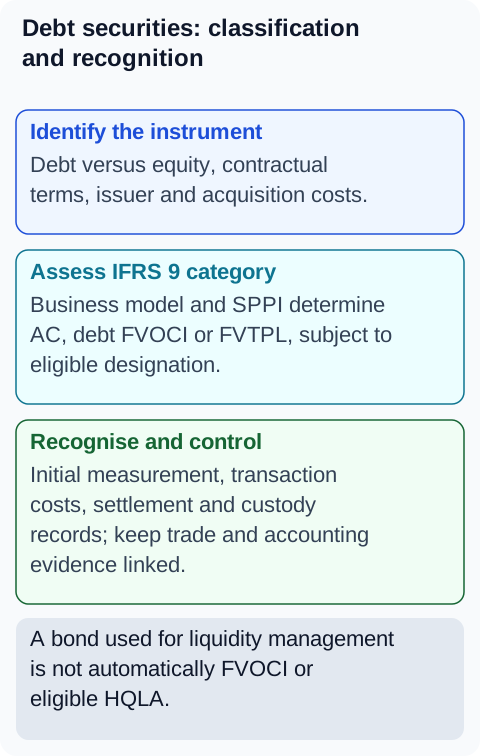 Figure 2. Debt securities: coupon and yield.
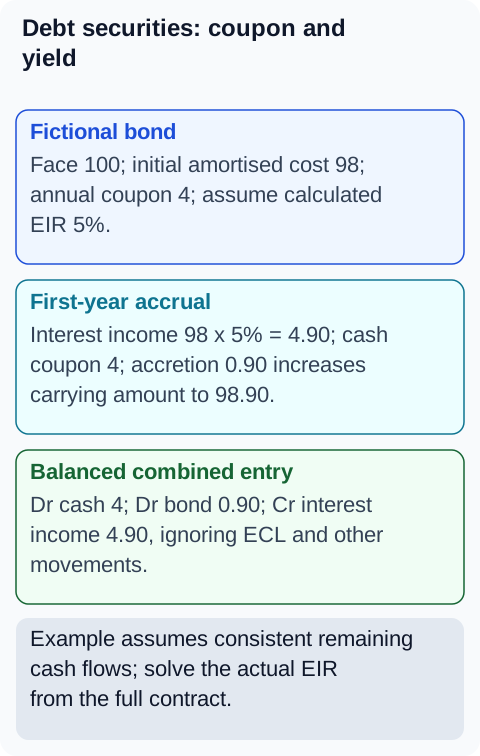 Figure 3. Debt portfolio daily and close controls.
12. Tables
| Measure | Governing lens | Key distinction |
|---|---|---|
| Amortised cost | IFRS 9 business model + SPPI | EIR carry and ECL, not market price |
| Debt FVOCI | IFRS 9 business model + SPPI | Fair value, P&L interest/ECL, OCI and recycling |
| FVTPL | IFRS 9 | Fair-value movement in P&L |
| HQLA level/cap/haircut | Adopted LCR rules | Prudential eligibility, separate from accounting bucket |
| Central-bank collateral | Facility rules | Not synonymous with HQLA |
| Encumbrance | Contract and operational rights | Availability plus prescribed prudential treatment |
13. Illustrative bank case study
Fictional bank scenario. A fictional group holds otherwise eligible securities in a subsidiary with transfer restrictions. It tests local monetisation, solo needs and the rules limiting consolidated recognition of surplus liquidity. The group establishes usable local liquidity and an explained recognition bridge. A high securities total alone does not prove funds can meet another entity's outflows. This training case does not assert an event at an unnamed real institution.
14. BA, developer, tester and operations guidance
- BA: Specify eligibility rules, bucket policies, encumbrance logic and test-sale requirements.
- Developer: Flag eligibility/encumbrance immutably; automate test calendars; attribute carry costs.
- Tester: Tier-boundary holdings; pledge/unpledge HQLA counting; sale-recycling paths; cap math.
- Operations: Run test sales and repo draws on schedule; monitor concentration/encumbrance daily.
15. Common mistakes
- Counting encumbered bonds as HQLA.
- Never testing monetisation until stress tests it for you.
- Home-sovereign concentration without wrong-way monitoring.
- Buffer sales for P&L signalling distress accidentally.
- Premium/discount mishandled in EIR vs OCI split.
- Assuming asset eligibility equals full eligibility without operational testing.
- Ignoring haircut changes during market stress.
16. Key takeaways
- HQLA = eligible + unencumbered + tested + diversified + correctly located.
- Buffer accounting follows its category; pledging is not selling, and HQLA availability follows operational/encumbrance rules, including applicable exceptions.
- Test sales and repo draws prove buffers; paper facilities don't.
- Carry costs allocate via FTP — buffers have visible owners.
- Location and currency match outflows or buffers are theoretical.
- Wrong-way monitoring is the discipline that keeps diversification real.
- Central-bank access is the final backstop but requires stigma-aware preparation.
17. References and verification notes
-
Rules are applied under the reporting entity's adopted accounting framework and jurisdiction. Basel standards require local implementation; they are not themselves national law. All unnamed cases, amounts and operational thresholds are fictional training examples.