Chapter 042: Significant Increase in Credit Risk and Default
Section 9: Credit Impairment and Expected Credit Losses · Chapter 042 of 100
1. Chapter opening
SICR compares current default risk over the expected life with risk at initial recognition using reasonable/supportable information. Changes in expected loss alone are not the test: collateral may reduce LGD without preventing SICR. Quantitative thresholds need comparable horizons and qualitative/collective evidence.
More than 30 days past due creates a rebuttable SICR presumption; IFRS 9 default has a rebuttable presumption no later than 90 days past due. Earlier information can establish deterioration, default or credit impairment. A fictional 100m exposure's allowance increasing from 0.2m to 2.5m is a 12.5-fold estimate change, not a universal result of one rating notch.
2. Learning objectives
- Compare origination vs current PD using absolute and relative SICR thresholds.
- List qualitative SICR indicators (forbearance, covenants, sector, behaviour).
- Apply 30 DPD (SICR) and 90 DPD/unlikely-to-pay (default) backstops correctly.
- Define cure criteria for return to Stage 1 or 2.
- Explain why staging needs collective (portfolio) assessment alongside individual review.
3. Business context
SICR compares default risk over the expected life now with the risk at initial recognition, using reasonable/supportable information, not just arrears or changes in the allowance. Quantitative thresholds are portfolio-specific and must work with qualitative and collective assessment. No universal 'optimal 5-8% Stage 2 share' or PD multiple follows from IFRS 9.
| Indicator | Assessment |
|---|---|
| Lifetime-risk/rating change | Origination and current risk on comparable horizons |
| Arrears/behaviour | Early indicators, with more-than 30DPD SICR presumption |
| Concession/forbearance | Assess actual difficulty and risk; not every holiday is distressed |
| Sector/regional stress | Collective assessment where individual data is delayed |
| Unlikely to pay | Credit impairment/default assessment before 90DPD if evidenced |
4. Finance and accounting view
4.1 Threshold logic and low credit risk
Fictional calibrated rule: current lifetime PD is at least twice comparable origination PD OR has increased by at least 100bp. Origination 1.0%, current 2.5% breaches both.0.1% to 0.2% breaches relative but not absolute;5% to 6% breaches absolute but not relative. Other validated policies may use different combinations. IFRS 9 prescribes neither these thresholds nor universally OR/AND logic. Time elapsed and remaining maturity must be reflected in the comparison.
Low-credit-risk simplification is available if credit risk is low at reporting date. Investment-grade status is an example, not the sole mechanical definition or a relief limited to liquid securities. Strong capacity to meet near-term obligations and sensitivity to longer-term adverse changes matter. Assess current contradictory information; rating alone is not a substitute for evidence.
4.2 Arrears, default and credit impairment
IFRS 9 has a rebuttable SICR presumption when contractual payments are more than 30 days past due. Assess earlier indicators; document any rebuttal with evidence that credit risk has not significantly increased. The default definition must be consistent with internal credit-risk management and consider qualitative factors, with a rebuttable presumption that default does not occur later than 90 days past due. Current local regulatory default rules may have distinct materiality and counting provisions.
Credit-impaired status reflects events detrimental to expected future cash flows. Default, regulatory NPE and accounting Stage 3 often overlap but are not identical by definition. Distressed restructuring, bankruptcy and unlikely-to-pay information can identify impairment before arrears. Normal commercial renegotiation or a broadly offered holiday does not automatically imply Stage 2/3.
4.3 Cure and collective assessment
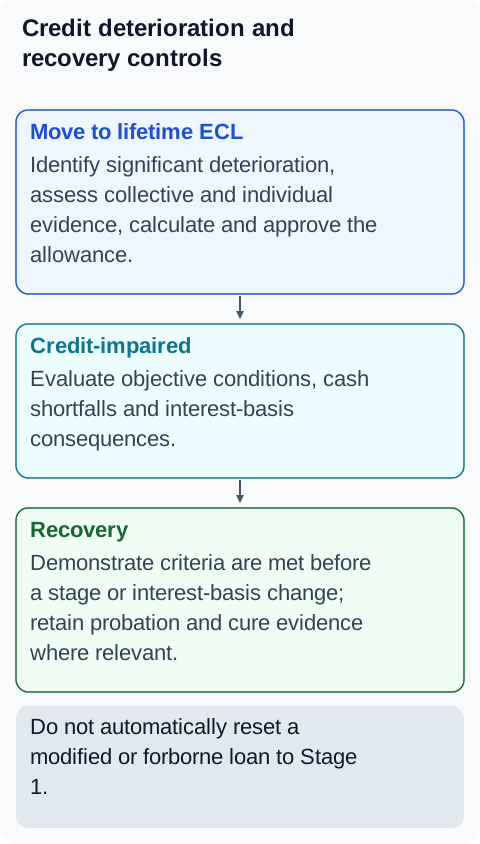
Return to 12-month ECL when the assessment no longer shows SICR relative to origination; cure from impairment requires supported improvement. Probation is a useful governed policy or a specific regulatory requirement where applicable, not a universal IFRS 3/6/12-month calendar by product. Reconcile regulatory cure/NPE rules separately.
Collective assessment groups exposures with shared risk characteristics and can identify SICR before individual ratings or DPD change. Do not confuse a collective stage migration with an ECL amount overlay: one changes measurement horizon, the other changes estimated cash shortfalls. Record both when needed and avoid double counting.
5. Product and customer impact
Staging may prompt enhanced monitoring or workout handling under bank policy. It does not automatically change customer instalments, interest or legal rights. Financial-difficulty concessions require risk/impairment assessment, while a generic holiday does not establish a particular stage by itself.
Explain the actual concession, residual obligation and support options without presenting an accounting label as a conduct obligation to pursue collections. Monitoring intensity should reflect risk and exposure. Cure is supported improvement in risk, not merely one resumed payment or removal of an arrears flag.
6. Regulatory and supervisory view
IFRS 9 staging and prudential default/NPE rules serve related purposes but can differ. Supervisory review examines evidence, missing flags, overrides, comparison horizons and cure controls. A provision understatement affects accounting equity net of tax and applicable prudential adjustments; a 175m difference divided by 50bn assets is not a 175m/RWA capital-ratio effect. Use actual CET 1 and RWA denominators when illustrating capital ratios.
7. Systems and data view
Preserve origination and current default-risk estimates, remaining life, rating histories, DPD, qualitative flags, concessions and collective assessment. Version quantitative policies and show which evidence caused each staging decision. Keep regulatory NPE/default/cure flags distinct from accounting stage.
Rebuttal workflows retain evidence and approval. Test the more-than 30DPD boundary precisely and allow earlier deterioration signals. Probation timers reflect bank policy or specific applicable prudential requirements; IFRS 9 does not impose one universal cure duration for every stage and product.
8. End to end process
Refresh risk and arrears information at an appropriate frequency; reconcile qualitative/concession feeds; assess SICR, impairment and default using the relevant definitions; apply supported individual/collective decisions; measure allowance changes with linked journals; document cures and rebuttals; and review sensitivity and re-defaults. A stage transfer does not automatically create a fixed lifetime top-up.
9. Controls and risks
| Risk | Control | Evidence |
|---|---|---|
| Thresholds never fire | Sensitivity testing, benchmarking | Calibration packs |
| Backstop overrides | Rebuttal evidence standard, dual approval | Override logs |
| Forbearance missed | Concession-detection rules, file reviews | Detection metrics |
| Cure too easy | Probation periods, re-default tracking | Cure performance reports |
| Collective overlay abuse | Documented triggers, governance | Overlay register |
| Watchlist gaps | Reconciliation (every watchlisted name has staging decision) | Watchlist-to-stage reports |
10. Practical examples
Fictional administrative arrears: a payment was received on time but misallocated for 35 days. Correct the actual arrears record and review credit risk using evidence; do not describe a four-hour outage as causing 35 days of unpaid contractual instalments that were already settled within five days.
Fictional collective deterioration: hospitality exposures remain contractually current, but forecasts and borrower data show significant lifetime-risk increases. Apply supported collective staging and then measure lifetime ECL. The decision need not wait for 30DPD and need not migrate every sector borrower indiscriminately.
11. Diagrams
Figure 1. Assess significant increase in credit risk.
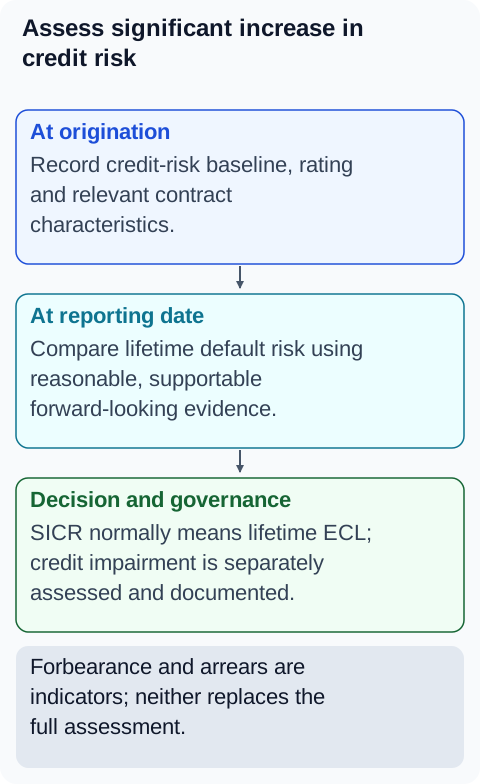 Figure 2. SICR and default indicators.
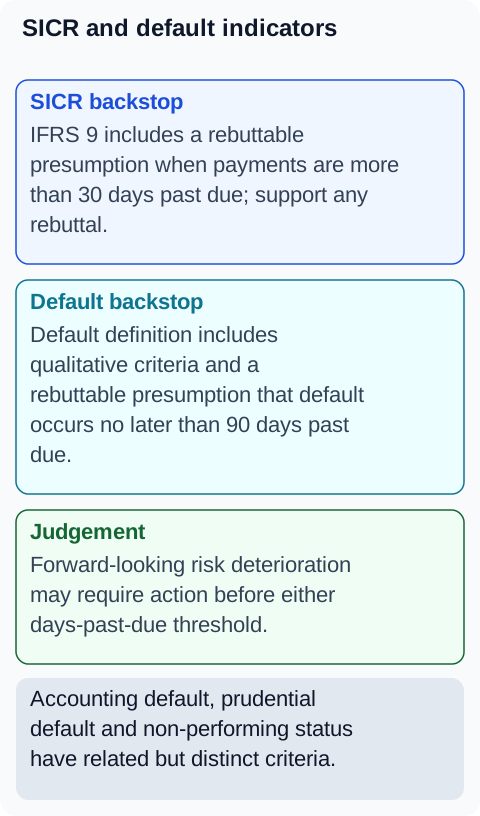 Figure 3. Credit deterioration and recovery controls.
12. Tables
| Rule | Basis |
|---|---|
| Quantitative PD thresholds | Validated portfolio policy, not IFRS numeric rule |
| More-than 30DPD | Rebuttable SICR presumption |
| Default by 90DPD | Rebuttable IFRS default backstop; qualitative evidence may act earlier |
| Financial difficulty plus concession | Assess forbearance, SICR and impairment |
| Low credit risk | Current supported assessment, optional simplification |
| Cure | Evidence of risk improvement; separate regulatory probation where applicable |
13. Illustrative bank case study
Fictional missing-concession feed: a 3bn portfolio contains distressed concessions not supplied to the staging engine. On simplified assumptions,0.5% PD×40% LGD×3bn gives 6m undiscounted Stage 1 loss, not 15m. A 10% lifetime PD on the same exposure/LGD gives 120m; the 114m difference is before discounting and other adjustments. Identify genuinely distressed concessions, reassess staging and correct the feed; do not automatically treat every payment holiday as financial difficulty.
14. BA, developer, tester and operations guidance
- BA: Document portfolio-specific thresholds, comparable lifetime horizons, qualitative indicators and rebuttal/cure evidence.
- Developer: Preserve origination histories and decision versions; reconcile all watchlist/concession feeds.
- Tester: Test 29/30/31DPD and 89/90/91DPD, early qualitative deterioration, rebuttal, generic holidays and distressed concessions.
- Operations: Challenge unexpectedly static portfolios and track cure/re-default performance against documented policy.
15. Common mistakes
- Using 30 DPD as the SICR definition rather than the backstop.
- Comparing point-in-time PDs without lifetime consistency.
- Curing on one good payment without probation.
- Missing forbearance in staging feeds.
- Calibrating thresholds that can never fire.
- Qualitative overlays without documented triggers and governance.
- Watchlist entries without corresponding staging decisions.
- Re-default tracking stopped after cure — not monitoring the full post-cure period.
16. Key takeaways
- SICR compares lifetime risk now vs origination — absolute and relative lenses.
- Backstops (30/90 DPD) catch what models miss; rebuttals need evidence.
- Financial-difficulty concessions require explicit SICR/impairment assessment; generic holidays do not automatically determine stage.
- Cure needs supported risk improvement; apply separately scoped probation requirements and track re-default.
- Collective assessment catches downturns individuals hide.
17. References and verification notes
- IFRS 9 staging
- BCBS credit risk and ECL governance
- Rules are applied under the reporting entity's adopted accounting framework and jurisdiction. Basel standards require local implementation; they are not themselves national law. All unnamed cases, amounts and operational thresholds are fictional training examples.