Chapter 041: Expected Credit Loss Foundations
Section 9: Credit Impairment and Expected Credit Losses · Chapter 041 of 100
1. Chapter opening
IFRS 9 recognises expected credit losses before a loss event becomes unavoidable. Under the general approach, assets not credit-impaired at initial recognition begin with 12-month ECL; significant increase in credit risk (SICR) requires lifetime ECL; credit-impaired assets also use lifetime ECL and ordinarily net-basis interest in subsequent reporting periods.
The general three-stage shorthand has exceptions. Purchased/originated credit-impaired (POCI) assets use credit-adjusted EIR and subsequent changes in lifetime ECL. The simplified approach requires lifetime ECL for eligible trade receivables/contract assets without a significant financing component (including the permitted IFRS 15 practical expedient). It can apply by accounting-policy choice to trade receivables/contract assets with a significant financing component and to lease receivables. Do not say every in-scope exposure starts in Stage 1.
2. Learning objectives
- State ECL scope (AC, FVOCI debt, commitments, guarantees; not FVTPL/equities).
- Explain the three stages and what moves assets between them.
- Describe ECL measurement (PD × LGD × EAD, discounted, probability-weighted).
- Post staging, provision, write-off and recovery journals.
- Explain day-one ECL and why new lending reduces day-one profit.
3. Business context
Fictional new lending 10bn with day-one ECL 0.5% recognises 50m impairment. That initial expense is not directly comparable to an annual 6% interest margin: pricing must compare cash flows, funding, costs, expected loss and capital over consistent horizons. Stage migration is an accounting estimate, not permission to change a borrower's contractual rate automatically.
| General-approach status | Allowance | Interest |
|---|---|---|
| Stage 1, no SICR | 12-month ECL | Gross carrying amount |
| Stage 2, SICR but not credit-impaired | Lifetime ECL | Gross carrying amount |
| Stage 3, subsequently credit-impaired | Lifetime ECL | Net amortised cost in subsequent periods |
POCI has a separate credit-adjusted-interest treatment; simplified-approach receivables do not require the same staging process.
4. Finance and accounting view
4.1 Scope and horizon
ECL covers eligible AC assets, debt FVOCI, contract assets, lease receivables and in-scope loan commitments/financial guarantees not measured FVTPL. FVTPL assets and equity investments do not have a separate IFRS 9 ECL allowance. Financial guarantees normally use the higher of the relevant ECL amount and the initially recognised amount less qualifying cumulative income; not a blanket 'shorter of commitment period and borrower's lifetime' formula.
12-month ECL is the portion of lifetime cash shortfalls arising from defaults possible within the next 12 months. It is not cash losses expected to be paid only in those 12 months. Lifetime ECL considers defaults over the expected life, limited by applicable contractual exposure provisions and specific revolving-facility exceptions.
4.2 Measurement
Measure probability-weighted discounted cash shortfalls using reasonable/supportable historical, current and forecast information available without undue cost or effort. A PD×LGD×EAD model is an implementation method, not the mandatory universal formula. Term structures, default timing, recovery timing and scenarios must be consistent. Avoid discounting the same recovery shortfall twice.
Multiple discrete scenarios are one way to capture a range of outcomes and nonlinearity; IFRS 9 does not prescribe exactly three or always require a separately named multi-scenario engine. A single most-likely outcome alone can be insufficient if it omits material nonlinear or alternative outcomes.
4.3 Journals and distinction from capital
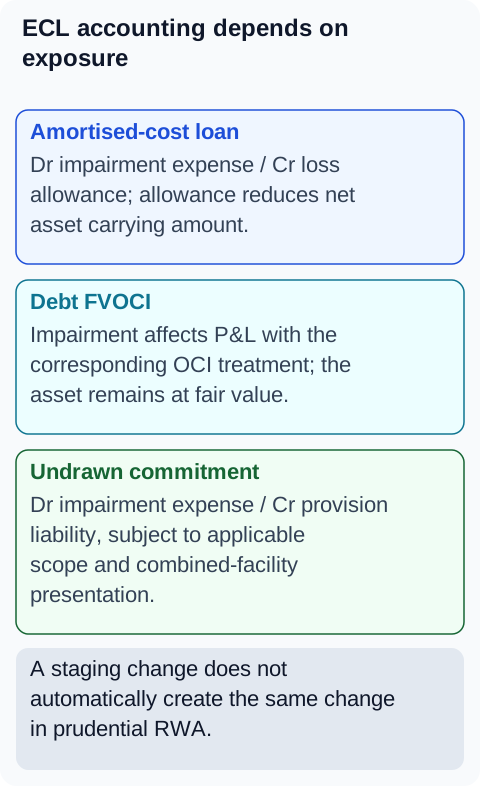
AC provision: Dr Impairment expense / Cr Loss allowance. Debt FVOCI: Dr Impairment / Cr OCI allowance offset, without reducing the fair-valued asset. Undrawn commitment: Dr Impairment / Cr Provision liability, subject to applicable combined-facility presentation. Stage transfer itself changes classification; any top-up is the change in measured required allowance, not an arbitrary percentage.
Write off all/part when no reasonable expectation of recovery: Dr Allowance / Cr Gross asset, topping up insufficient allowance through impairment expense as needed. A later recovery is Dr Cash / Cr Impairment recovery income under the policy. Write-off need not wait for every possible legal action, and legal collection may continue.
Accounting ECL and Basel expected/unexpected-loss capital have different objectives and calibrations. Reconcile allowance impacts through profit/equity and prudential rules; no universal one-to-one direct CET 1 deduction applies to every provision.
5. Product and customer impact
Borrowers still owe contractual balances regardless of the bank's allowance. A payment holiday is not automatically forbearance or SICR: assess financial difficulty, concession terms and risk change. Staging can lead to enhanced monitoring, but pricing changes, collections and communications must respect contract and conduct requirements.
6. Regulatory and supervisory view
IFRS 7 requires relevant credit-risk and allowance disclosures. Supervisory guidance challenges timely risk recognition, data, models and governance; regulatory default and non-performing classifications need documented alignment with accounting rather than an assumed identity.
US CECL uses lifetime expected losses from inception for its in-scope AC assets; AFS debt uses a separate model and other assets are excluded. It does not impose IFRS three-stage classifications. Different scenario methodologies are permitted by each framework; 'CECL always single scenario, IFRS always multiple' is not a rule. Indian bank prudential requirements and transition dates must be assessed separately from IFRS 9.
7. Systems and data view
Reconcile exposure, commitment, guarantee, collateral and staging populations before calculating ECL. Preserve origination/current risk, scenarios, parameters, rates, model versions and approvals. Fixed-rate instruments use original EIR or the permitted approximation; floating-rate instruments require the applicable current EIR treatment; POCI uses credit-adjusted EIR.
The allowance subledger reconciles by facility, category, stage and entity to GL and disclosures. Models and overlays require independent challenge appropriate to their risk, not one universal annual validation rule. Overlay expiry initiates review; a valid unresolved risk must remain in the estimate until evidence supports removal or model incorporation.
8. End to end process
Identify the applicable ECL approach and scope; recognise the supported initial allowance; monitor reasonable/supportable individual and collective risk indicators; reassess staging and expected cash shortfalls; calculate the required allowance change; apply the correct interest basis in the relevant reporting periods; govern cure/write-off/recovery events; and reconcile the disclosure bridge. A staging event is a status change, while the journal is the separately measured ECL movement.
9. Controls and risks
| Risk | Control | Evidence |
|---|---|---|
| Late staging | Automated SICR rules, backstop enforcement | Migration timeliness reports |
| Optimistic scenarios | Independent weight challenge, benchmarking | Challenge minutes, sensitivity packs |
| Overlay abuse | Approval, expiry, attribution | Overlay register |
| Allowance tied wrong | Exposure-allowance tie-out, stage analytics | Reconciliation packs |
| Day-one ECL understated | Mandatory provision on origination | Origination-provision reports |
| Write-off too early | Recovery-expectation standard | Write-off approval logs |
10. Practical examples
**Fictional day-one provision:**100m lending at 0.4% required ECL creates 0.4m expense and allowance. This is a measurement at origination, not a permanent annual margin deduction of 0.4%.
**Fictional horizon comparison:**1m loan, EAD constant, LGD 40%, Stage 1 default probability 0.8%, all resulting shortfalls assumed at year 1, EIR 6%: ECL=3,200/1.06=3,018.87. If Stage 2 lifetime default probability 6.5% and all associated shortfalls are assumed at year 2, ECL=26,000/(1.06²)=23,139.91. This deliberately simplified single-timing example shows the horizon change; real models distribute defaults and recoveries over time.
11. Diagrams
Figure 1. ECL scope and measurement.
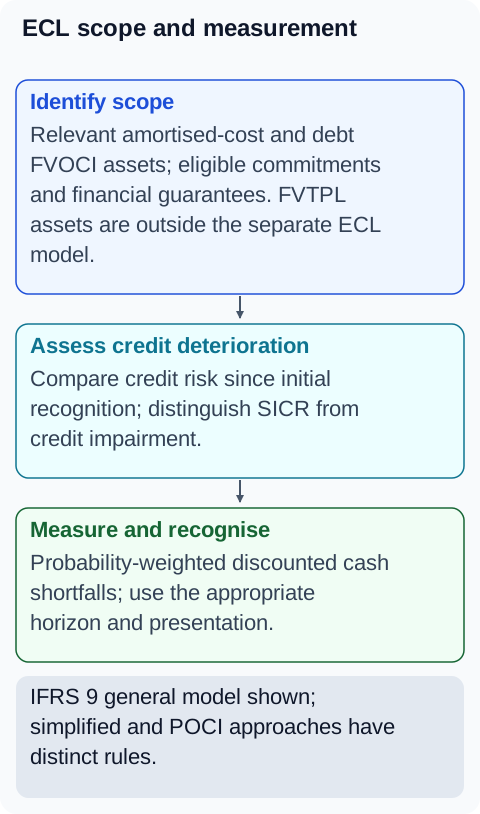 Figure 2. ECL horizons and interest basis.
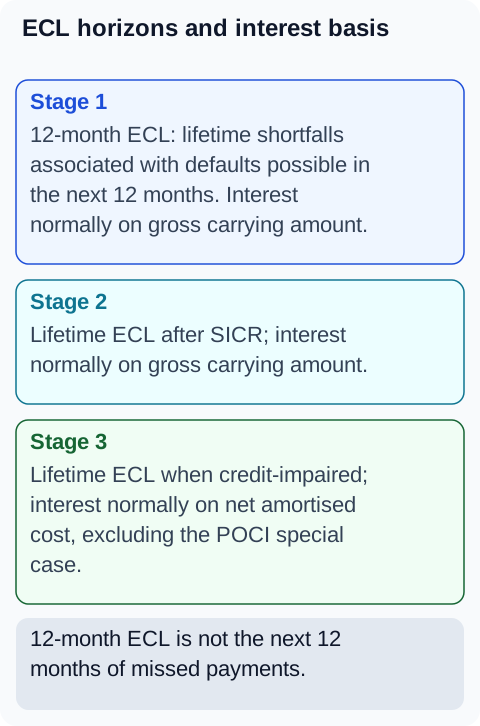 Figure 3. ECL accounting depends on exposure.
12. Tables
| Event | Accounting effect |
|---|---|
| AC allowance increase | Dr Impairment expense / Cr Allowance |
| Status transfer alone | Stage information changes; no arbitrary preset journal |
| Subsequent credit impairment | Net-basis interest in subsequent reporting periods |
| Write-off | Remove relevant gross asset against supported allowance; top up if required |
| Recovery after write-off | Recognise cash and appropriate recovery income |
| Scope | IFRS 9 | US ASC 326 headline |
|---|---|---|
| General AC approach | 12-month versus lifetime based on SICR; impairment/POCI exceptions | CECL lifetime estimate under its applicable scope |
| FVOCI/AFS debt | IFRS 9 ECL with OCI offset | Separate AFS credit-loss model; not ordinary CECL |
| Off-balance commitments | Relevant expected cash shortfalls | Apply scoped commitment rules and cancellation terms |
Framework differences need detailed policy; this comparison is not a complete USGAAP specification.
13. Illustrative bank case study
Fictional case: staging under commercial pressure. A distressed portfolio remains Stage 1 although supported risk information indicates SICR. Review measures 400m additional lifetime ECL, corrects the reporting period and evaluates control failures and distribution implications. A prior dividend is not automatically reversed or recoverable; legal and governance assessment is separate. Credit-risk challenge and origination-risk histories must be independent of commercial profit targets.
14. BA, developer, tester and operations guidance
- BA: Specify scope, approach, SICR/rebuttal evidence, interest basis, cure and overlay decisions.
- Developer: Preserve origination histories and reproducible input versions; reconcile allowances to exposures.
- Tester: Test general/simplified/POCI cases, more-than 30DPD boundaries, floating EIR, credit-impaired interest periods and write-off chains.
- Operations: Review migration, model/overlay evidence and allowance movements without automatically releasing aged valid risk.
15. Common mistakes
- Treating 30 DPD as the SICR test instead of the backstop.
- Netting allowances against gross in disclosures.
- Forgetting ECL on commitments and guarantees.
- Evergreen overlays without expiry or attribution.
- Comparing pre-provision margins across stages.
- Day-one ECL not loaded into pricing (relationship managers shown gross income).
- Scenario weights adjusted for profit management without evidence.
- Write-off used as a staging tool (writing off performing exposures to reduce Stage 2).
16. Key takeaways
- ECL is an unbiased, probability-weighted measure of discounted cash shortfalls.
- General staging has simplified and POCI exceptions.
- Twelve-month ECL includes lifetime shortfalls from defaults possible in the next 12 months.
- Stage 3 net interest applies in subsequent reporting periods under the standard's conditions.
- Parameter models are implementations of the measurement requirement, not the only permitted method.
17. References and verification notes
- IFRS 9 ECL framework
- IFRS 7 credit-risk disclosures
- BCBS credit risk and ECL guidance
- Rules are applied under the reporting entity's adopted accounting framework and jurisdiction. Basel standards require local implementation; they are not themselves national law. All unnamed cases, amounts and operational thresholds are fictional training examples.