Chapter 073: Risk-Weighted Assets
Section 15: Regulatory Capital and Prudential Foundations · Chapter 073 of 100
This chapter explains risk-weighted assets from the reporting bank's perspective. Examples are fictional; accounting follows IFRS unless another framework is expressly identified.
1. Chapter opening
Risk-weighted assets (RWA) express prescribed risks in a common capital denominator. They are not a forecast loss, market value or accounting asset balance. The calculation depends on exposure class, method, applicable rules, collateral and aggregation constraints.
2. Learning objectives
- Distinguish credit, market, operational and CVA risk components.
- Calculate ratios using total RWA rather than a credit-only denominator.
- Assess eligible credit-risk mitigation and its limitations.
- Explain the aggregate output floor and local phase-in status.
3. Business context
Two equal-size asset books can consume different RWA because their credit quality, collateral, maturity and methods differ. Low RWA does not eliminate liquidity, concentration, interest-rate or operational risks. Manage risk and pricing rather than target one universal density.
4. Finance and accounting view
4.1 Components and methods
Standardised credit RWA use prescribed exposure and risk-weight rules; IRB methods use approved parameters subject to constraints. A mortgage is not universally 35% risk weighted, and a corporate weight cannot be selected from an obsolete rating table without checking the applicable approach. Off-balance-sheet items require the prescribed credit-conversion treatment. Counterparty credit risk applies to relevant derivatives and securities financing.
Market risk covers the prescribed trading positions and relevant FX/commodity risks, including applicable banking-book positions. CVA has separate requirements where in scope. Under the final Basel standardised operational-risk architecture, operational RWA = 12.5 × business indicator component (BIC) × applicable internal loss multiplier (ILM). Jurisdictions may exercise prescribed discretion, including setting ILM to one. Internal losses are not simply multiplied by the business indicator; use the method implemented locally.
4.2 Correct denominator
Assume credit RWA 2,450, market RWA 300 and operational RWA 250, with zero CVA RWA under the stated scope. Total RWA is 3,000. CET1 of 320 gives 10.667%, not 13.061% obtained from credit RWA alone. If a 300 exposure's prescribed weight increases from 100% to 150%, credit RWA rises 150 and total RWA becomes 3,150; CET1 ratio is 10.159%, a decline of about 0.508 percentage point. These weights are example inputs, not a current universal corporate rule.
4.3 Mitigation and floor
Eligible collateral/guarantees can reduce credit RWA subject to legal enforceability, provider eligibility, valuation, haircuts, maturity and currency mismatch rules. Assume recognised mitigation reduces credit RWA by 200 and 120: credit RWA is 2,130; other components remain 550; total RWA is 2,680 and CET1 ratio is 11.940%. A zero assigned risk weight does not eliminate operational or legal risk.
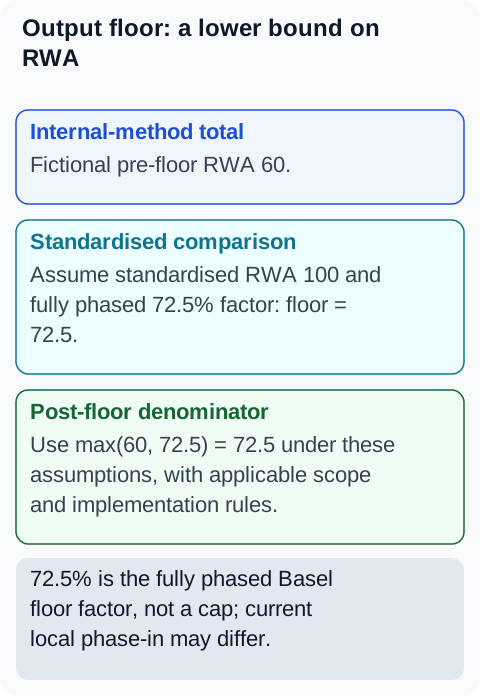
The fully phased Basel output floor is 72.5% of the specified aggregate standardised RWA comparator, compared with the aggregate model-based result. If those totals are 45 and 30, respectively, the end-state floor is 32.625 and binds over 30. This is not a 72.5% risk weight for each IRB exposure. Actual current use requires the jurisdiction's effective date, phase-in percentage, scope and implementation; do not automatically use the end-state factor today.
5. Product and customer impact
Capital-sensitive pricing may reflect RWA but must not substitute for borrower affordability, actual credit assessment or fair treatment. A collateral guarantee must be genuine and enforceable rather than a data flag inserted solely to improve the ratio.
6. Regulatory and supervisory view
Basel 2017 reforms set out revised credit/operational methods and the output-floor design. The consolidated Basel risk-based standard and local implementation govern application. No single current PD floor, mortgage weight, credit-conversion factor or risk-density target is asserted for all banks and methods.
7. Systems and data view
Source exposure, counterparty, rating, maturity, collateral, guarantee and netting data need controlled identifiers and effective dates. Reconcile exposures to the GL with documented accounting/regulatory differences. Store rule versions, parameter approvals and movement explanations.
8. End to end process
- Confirm method, scope and effective rules.
- Reconcile exposure completeness and off-balance-sheet data.
- Apply classifications and eligible mitigation.
- Calculate each RWA component and aggregate.
- Apply floor/constraints if currently required.
- Validate movements and capital ratios.
9. Controls and risks
| RWA risk | Control |
|---|---|
| Credit-only ratio denominator | Total component reconciliation |
| Old risk-weight table | Effective-dated method rules |
| Unsupported guarantee | Legal eligibility and provider assessment |
| Output floor per loan | Aggregate comparator proof |
| Operational loss formula wrong | BIC/ILM/capital-to-RWA method check |
10. Practical examples
The mitigation example improves the ratio from 320/3,000 = 10.667% to 320/2,680 = 11.940%, or 1.274 percentage points. The CET1 amount remains 320. If mitigation also changes accounting profit, tax or costs, those numerator effects require a separate bridge; they are not assumed away in a live decision.
11. Diagrams
Figure 1. RWA calculation and capital denominator.
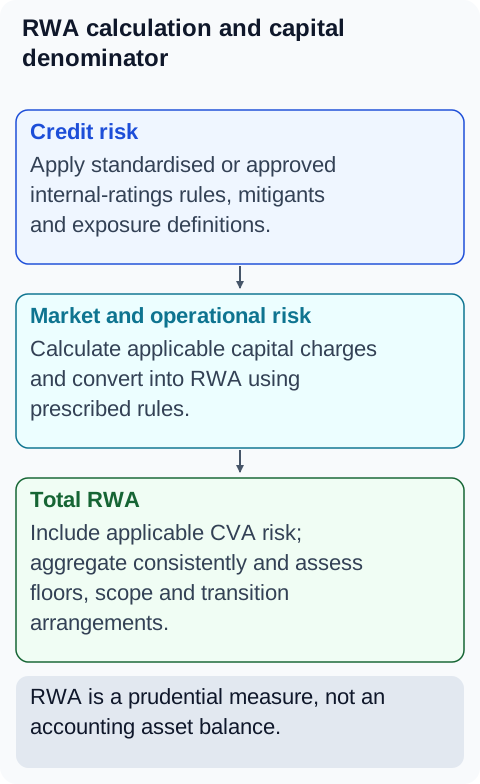 Figure 2. A simple standardised RWA example.
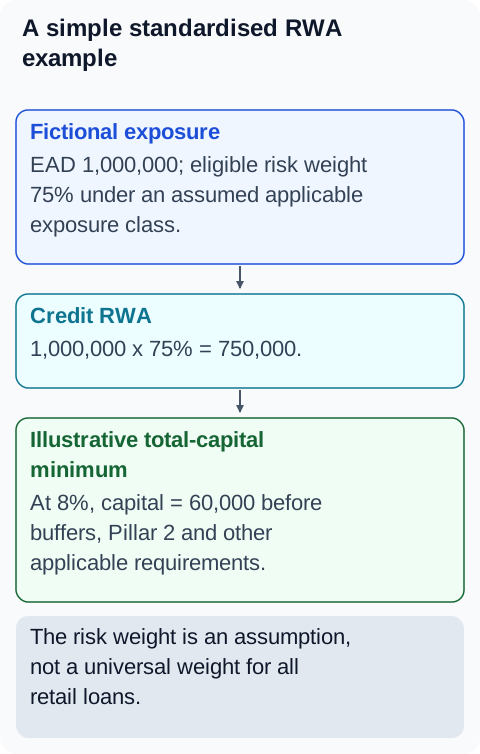 Figure 3. Output floor: a lower bound on RWA.
12. Tables
| Scenario | Credit RWA | Other RWA | Total | CET1 ratio |
|---|---|---|---|---|
| Opening | 2,450 | 550 | 3,000 | 10.667% |
| Weight increase | 2,600 | 550 | 3,150 | 10.159% |
| Mitigation, from opening | 2,130 | 550 | 2,680 | 11.940% |
13. Fictional banking case study
A fictional bank reported its CET1 ratio against credit RWA only. Review added market and operational components and corrected the ratio from 13.061% to 10.667%. Finance reconciled the capital return, performance dashboard and planning model so all used the same total denominator.
14. BA, developer, tester and operations guidance
Capital definitions supply the numerator. Ratios/buffers apply requirements to total RWA. Pricing uses a supported assigned capital basis, while prudential reporting maintains exposure and rule lineage.
15. Common mistakes
- Using credit RWA alone for the total capital ratio.
- Treating a historic mortgage weight as universally current.
- Multiplying loss data directly by the operational business indicator.
- Treating the floor as a per-exposure weight.
- Assuming mitigation reduces CET1 required and increases CET1 held by the same amount.
16. Key takeaways
RWA accuracy requires complete components, current method rules and defensible exposure/mitigation data. Keep numerator changes separate and label end-state floor examples clearly.
17. References and verification notes
- Basel 2017 reforms: revised methods and floor design.
- Basel risk-based standard: consolidated framework; jurisdiction implementation controls current requirements.
- Portfolio amounts and risk weights are fictional assumptions, not universal live reporting instructions.