Chapter 065: Risk-Adjusted Returns and Pricing
Section 13: Management Finance and Bank Profitability · Chapter 065 of 100
This chapter explains risk-adjusted returns and pricing from the reporting bank's perspective. Examples are fictional; accounting follows IFRS unless another framework is expressly identified.
1. Chapter opening
Risk-adjusted pricing compares prospective after-tax profit with the capital assigned to the exposure. Define expected loss, funding, operating cost, tax, capital basis and hurdle consistently. The resulting quote is a management decision; it is not an IFRS journal or a universal regulatory minimum price.
2. Learning objectives
- Calculate RAROC with consistent after-tax earnings and allocated capital.
- Solve the required spread rather than guess a pricing uplift.
- Distinguish annual pricing loss from IFRS 9 accounting ECL.
- Apply collateral and capital relief only when supported by the governing rules.
3. Business context
A loan that earns a positive accounting spread can still fail to cover its credit cost, servicing cost and shareholders' required return. Conversely, relationship fees and deposit value may improve the decision if supported and not counted twice. Pricing also needs competition, affordability, conduct and concentration constraints.
4. Finance and accounting view
4.1 Return calculation
RAROC here = expected after-tax profit / allocated capital. A 10 million loan earns a 1.2% spread above full FTP: 120,000. Annual expected loss is 50,000 and operating cost 20,000. Pre-tax profit is 50,000; at an illustrative 25% tax rate, after-tax profit is 37,500. Capital of 1.2 million gives RAROC 3.125%. If valid mitigation halves the assigned capital to 0.6 million with other assumptions unchanged, return is 6.25%; neither meets a 12% hurdle.
To earn 12% on 1.2 million, after-tax profit must be 144,000. Required pre-tax profit is 144,000/0.75 = 192,000. Add expected loss 50,000 and cost 20,000: required spread income is 262,000, or 2.62% on 10 million. The uplift from 1.20% is 142 basis points, not 90 or 105.
4.2 Constructing an all-in quote
A five-million fixed-rate loan uses an illustrative three-year swap base of 3.20% plus funding/liquidity spread of 0.45%: full FTP 3.65%. Annual expected loss is 0.60% (30,000), operating cost 0.50% (25,000) and allocated capital 600,000. A 12% after-tax hurdle needs 72,000 after tax or 96,000 pre-tax, equivalent to 1.92% of the loan. The required rate is 3.65 + 0.60 + 0.50 + 1.92 = 6.67%. These are invented inputs, not a current EURIBOR or market quote; three-year EURIBOR is not a standard quoted tenor.
4.3 Loss and capital bases
PD × LGD × EAD can be an annual expected-loss pricing approximation when horizons and definitions match. It is not a substitute for IFRS 9 lifetime ECL, scenarios or staging. A pricing view replaces or bridges the accounting loss basis rather than deducting both. Avoid adding a separate capital cost when the numerator already deducts that same charge and then testing against the same hurdle again.
Economic-capital diversification does not automatically reduce standardised Pillar 1 RWA. Collateral, guarantees and risk transfer need legal enforceability and method-specific recognition. An equity-capital denominator generally uses a cost-of-equity hurdle; WACC is not interchangeable without changing the financing and cash-flow basis.
5. Product and customer impact
A hurdle failure can lead to a different price, collateral, tenor, structure or a decline. The bank cannot assume the customer accepts a higher rate or that extra collateral is legally available. Relationship revenues must be evidenced and customer treatment reviewed.
6. Regulatory and supervisory view
IFRS 9 governs accounting ECL. Basel capital definitions and relevant credit-risk rules govern prudential resource recognition, subject to local law. There is no universal 10-15% regulatory RAROC hurdle; management sets and approves the return objective.
7. Systems and data view
The pricing engine records curve date, expected-loss horizon, cost drivers, capital method, tax assumption and hurdle. Retain overrides and approved reasons. Integrate with credit approval while preserving separate model-risk and conduct checks.
8. End to end process
- Define loan cash flows and full FTP.
- Estimate annual loss, costs and relevant fees.
- Assign supported regulatory or economic capital.
- Calculate after-tax return and solve the hurdle price.
- Stress credit, funding and customer behaviour.
- Approve terms and monitor realised economics against the quote.
9. Controls and risks
| Pricing risk | Check |
|---|---|
| Funding spread omitted | Full FTP includes base and funding/liquidity |
| Pre-tax return compared with after-tax hurdle | Explicit tax bridge |
| ECL counted twice | Loss-basis reconciliation |
| Unsupported collateral relief | Legal and prudential eligibility |
| Cross-sell assumed certain | Evidenced scenario and sensitivity |
10. Practical examples
For the five-million quote, 6.67% produces interest 333,500. FTP at 3.65% is 182,500, leaving 151,000. After expected loss 30,000 and operating cost 25,000, pre-tax profit is 96,000; tax is 24,000 and after-tax profit 72,000. RAROC is 72,000/600,000 = 12%. At 6.44%, after-tax profit is only 63,375 and return 10.5625%. The tax rate and recognition of all costs are illustrative assumptions.
11. Diagrams
Figure 1. From risk and cost to loan pricing.
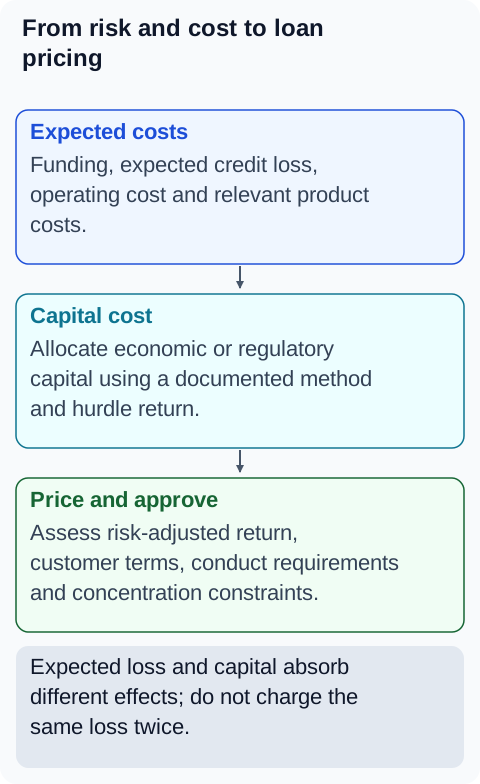 Figure 2. A simplified risk-adjusted return.
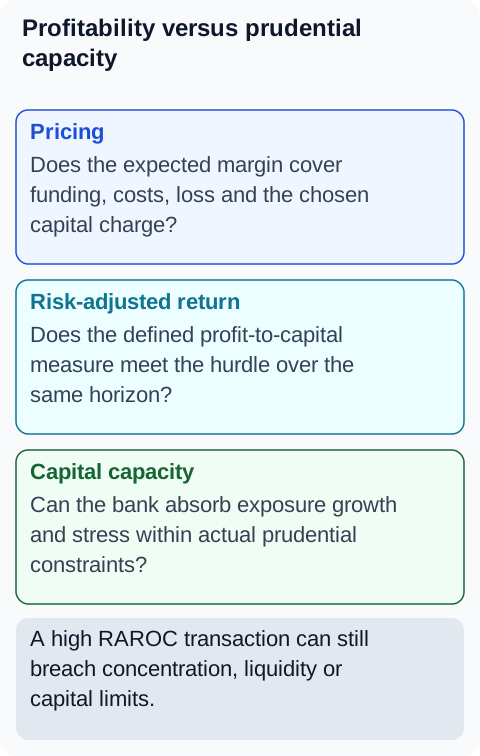
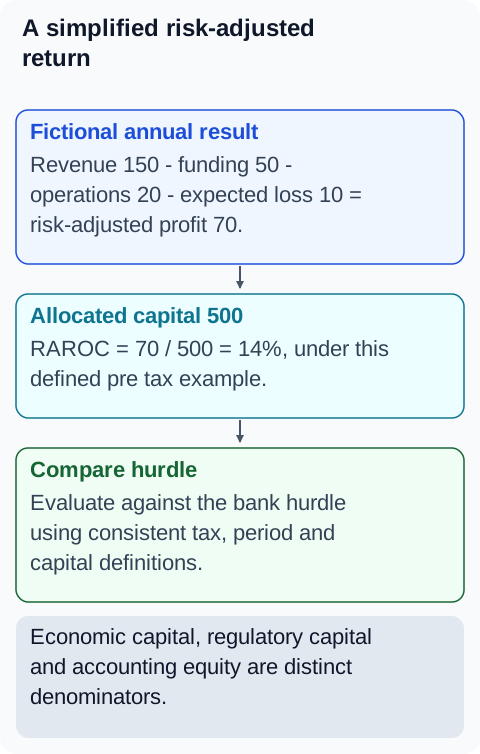 Figure 3. Profitability versus prudential capacity.
12. Tables
| Five-million annual pricing component | Rate | Amount |
|---|---|---|
| Full FTP | 3.65% | 182,500 |
| Expected loss | 0.60% | 30,000 |
| Operating cost | 0.50% | 25,000 |
| Pre-tax target profit | 1.92% | 96,000 |
| Required customer interest | 6.67% | 333,500 |
13. Fictional banking case study
A fictional lender approved a 6.44% quote after omitting the funding spread from its return check. Independent review recalculated the full FTP and found the loan below hurdle. Credit and pricing teams considered a higher quote or different structure; no retrospective revenue was booked to make the model pass.
14. BA, developer, tester and operations guidance
FTP establishes funding economics. Profitability explains actual results. RWA and capital planning determine constraints, while accounting ECL may differ from the annual expected-loss measure used to quote a new deal.
15. Common mistakes
- Ignoring tax when solving an after-tax hurdle.
- Adding a funding spread to the price but omitting it from the return check.
- Treating economic diversification as automatic regulatory relief.
- Comparing equity returns to WACC without consistent bases.
- Treating a management pricing allowance as an accounting provision.
16. Key takeaways
Make the price reproducible from the cash-flow, cost, loss and capital assumptions. Solve the target profit explicitly and verify the completed quote against the same full-cost return formula.
17. References and verification notes
-
Basel CAP30 regulatory adjustments: current international deduction framework, including goodwill/intangibles and DTA rules; domestic implementation determines a bank's enforceable requirements.
-
IFRS 9: accounting loss model.
-
SR 16-3: FTP principles.
-
Basel capital framework: prudential resources, subject to local rules.
-
Loan amounts, curves, tax rates and hurdles are fictional.