Chapter 066: Current and Deferred Tax
Section 14: Tax and Other Corporate Accounting · Chapter 066 of 100
This chapter explains current and deferred tax from the reporting bank's perspective. Examples are fictional; accounting follows IFRS unless another framework is expressly identified.
1. Chapter opening
Current tax measures income taxes payable or recoverable for taxable results. Deferred tax addresses qualifying differences between accounting carrying amounts and tax bases, and unused losses/credits where recognition criteria are met. The analysis is jurisdiction-specific and must distinguish taxable profit from its tax effect.
2. Learning objectives
- Calculate current tax, temporary differences and deferred tax.
- Assess recoverability with evidence and correct units.
- Reconcile effective tax rate and recognise tax in the right statement.
- Distinguish accounting recognition from regulatory capital deductions.
3. Business context
Bank tax adjustments often include accounting ECL not yet deductible, fair-value movements, leasing, pensions and tax-loss carryforwards. A profitable consolidated group does not prove that each entity can recover its DTA: tax consolidation, expiry, loss utilisation limits and available taxable income depend on local rules.
4. Finance and accounting view
4.1 Measurement and journals
IAS 12 uses tax rates enacted or substantively enacted at the reporting date for current and deferred tax. US GAAP uses enacted rates; do not blend the frameworks. An ECL provision of 500 that is deductible only on a later write-off creates a deductible temporary difference of 500, assuming the tax base otherwise remains unchanged. At 25%, the potential DTA is 125, recognised only to the extent recovery criteria are met. The initial P&L entry, where the underlying ECL is in P&L, is Dr DTA 125 / Cr deferred-tax benefit 125.
Tax generally follows the underlying transaction: P&L, OCI or equity as applicable. A tax adjustment on an OCI item is not automatically a P&L charge, and a DTA write-down is not automatically charged to OCI. Trace its origin and the relevant allocation rules.
4.2 Recoverability and uncertainty
Assess probable taxable profits, eligible reversing taxable temporary differences, tax-planning opportunities, expiry and utilisation limits in the appropriate taxable entity. Taxable profit and DTA are different units. At 25%, deductible losses of 800 imply a potential DTA of 200; future usable taxable profits of 600 support only 150, absent other sources. An ECL temporary difference of 400 represents another potential DTA of 100. Allocate the same taxable-profit capacity once and model reversal/expiry timing.
A stress scenario informs judgement but does not automatically require a write-off of every DTA whenever stress profit is negative. Challenge the probability and evidence in the recognised case, including a history of losses.
IFRIC 23 requires the appropriate assumption about tax-authority examination and knowledge. If acceptance of the treatment is probable, use that treatment; otherwise measure using the most-likely amount or expected value, whichever better predicts resolution. There is no universal formula that recognises a separate third tax expense at a mechanically chosen 50% dispute probability. Uncertainty affects current/deferred tax measurement within IAS 12.
4.3 Capital and Pillar Two
Accounting recognition of a DTA does not establish its capital eligibility. Some DTAs dependent on future profitability are deducted; temporary-difference DTAs may be subject to thresholds and risk weighting under the relevant prudential rules. If an already fully deducted DTA is written off, reduced accounting equity may be offset by release of that deduction; the CET1 effect is not necessarily one-for-one.
IAS 12 contains a temporary exception from deferred-tax accounting for Pillar Two income taxes and targeted disclosures. Current Pillar Two tax and disclosure obligations still require assessment. Local enactment, scope and effective dates determine application; this is not a universal extra tax on every bank.
5. Product and customer impact
Withholding tax collected for customers is generally an agency liability, not the bank's own income-tax expense. Customer tax reporting and own-company tax are separate operational processes even where they share tax teams.
6. Regulatory and supervisory view
IAS 12 governs current/deferred income tax and the Pillar Two amendments. IFRIC 23 addresses uncertain income-tax treatments. Regulatory capital treatment requires the applicable implementation of Basel capital definitions. The illustrative 25% rate is not a jurisdiction's current statutory rate.
7. Systems and data view
A tax register links each carrying amount, tax base, difference, rate, expected reversal, entity and recognition evidence. Maintain tax returns, loss-expiry schedules, uncertain-treatment assessments and forecast versions. Reconcile tax-payable and DTA/DTL accounts to both movement analysis and the tax return.
8. End to end process
- Reconcile accounting profit to taxable profit by entity.
- Measure current tax and uncertain treatments.
- Identify temporary differences and losses/credits.
- Assess recovery without double-counting taxable capacity.
- Allocate tax to P&L, OCI or equity appropriately.
- Reconcile ETR, balances, disclosures and prudential adjustments.
9. Controls and risks
| Tax risk | Control |
|---|---|
| Profit compared directly with DTA | Consistent rate and units |
| Same profit supports several DTAs | Integrated utilisation schedule |
| Group profit supports wrong entity | Local tax-group/legal analysis |
| Rate not substantively enacted | Enactment evidence at reporting date |
| DTA recognition equated with CET1 | Separate regulatory bridge |
10. Practical examples
Fictional ETR reconciliation: accounting profit is 1,300 and base tax at 25% is 325. Adjustments are +5 non-deductible expense, -7.5 exempt income, +10 rate differences, -8 credits and +15 non-recognition/write-down effects. Total tax is 325 + 5 - 7.5 + 10 - 8 + 15 = 339.5. ETR is 339.5/1,300 = 26.1154%. Each line is already a tax amount, not the underlying profit adjustment. The split between current and deferred tax needs the detailed tax computation.
11. Diagrams
Figure 1. Current and deferred tax.
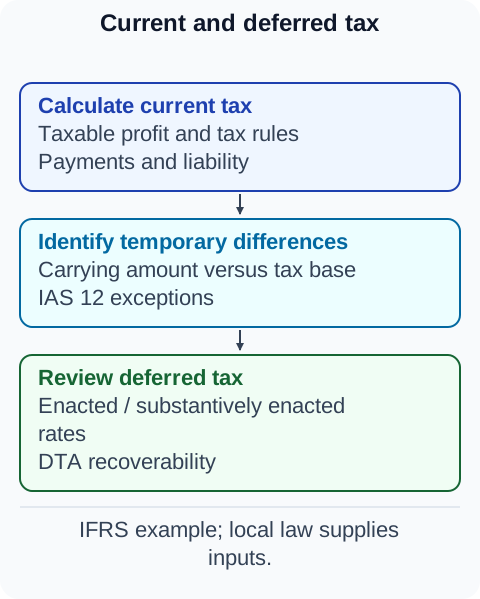 Figure 2. Tax accounting concepts.
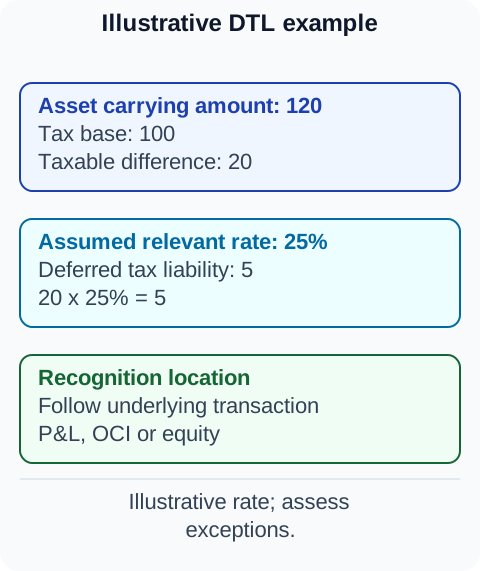
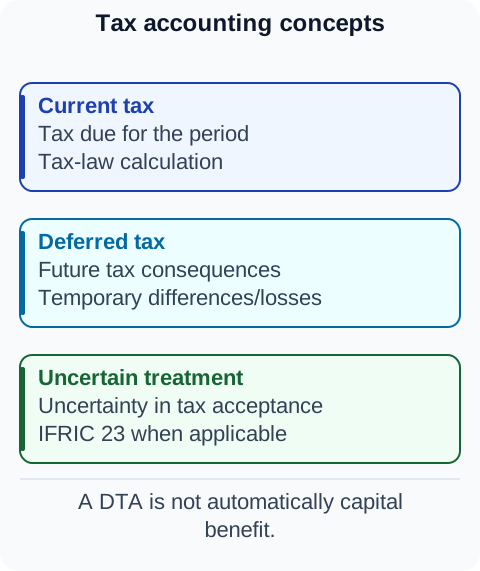 Figure 3. Illustrative DTL example.
12. Tables
| Deductible item | Underlying amount | Rate | Potential DTA |
|---|---|---|---|
| Tax losses | 800 | 25% | 200 |
| ECL temporary difference | 400 | 25% | 100 |
| Total | 1,200 | 25% | 300 |
Recognition is assessed separately; these are potential amounts, not automatically recognised assets.
13. Fictional banking case study
A fictional bank supported a DTA of 300 by comparing it with forecast taxable profit of 300. Review exposed the unit error: at 25%, that profit supplied only 75 of tax capacity before timing and utilisation limits. Finance rebuilt the schedule and adjusted recognition to the supported amount.
14. BA, developer, tester and operations guidance
ECL, leases and pensions create potential temporary differences. Forecasting provides recovery evidence. The equity-to-capital bridge explains which recognised tax assets are deducted or risk weighted.
15. Common mistakes
- Confusing a deductible loss with its DTA.
- Using a worldwide tax rate or group profit as local recovery evidence.
- Treating every stress loss as an automatic DTA write-off.
- Putting all tax movements in P&L or all write-downs in OCI.
- Treating recognised DTA as fully eligible CET1.
16. Key takeaways
Tax accuracy requires a legal-entity computation, correct tax units and recoverability evidence. Reconcile expense, balances and ETR, then assess capital treatment separately.
17. References and verification notes
-
Basel CAP30 regulatory adjustments: current international deduction framework, including goodwill/intangibles and DTA rules; domestic implementation determines a bank's enforceable requirements.
-
IAS 12: current/deferred tax and Pillar Two.
-
IFRIC 23: uncertain treatments.
-
Basel capital definitions: tax-asset prudential treatment.
-
Tax rates, balances and cases are fictional; local tax law is required for an actual filing.