Chapter 034: Repos, Reverse Repos and Securities Lending
Section 7: Foreign Exchange and Treasury Instruments · Chapter 034 of 100
1. Chapter opening
This chapter uses a fictional book of 12bn repos,8bn reverse repos and 3bn securities lending to connect financing journals, collateral records and regulatory measures. In a usual fixed-price repo, the seller retains the security and recognises borrowing; the reverse-repo lender recognises a receivable and records collateral rights separately. Analyse unusual transfers under IFRS 9 rather than infer recognition solely from the product name.
Securities lending can involve cash or non-cash collateral and principal or agent roles. Record fee accruals, collateral return obligations, reuse and indemnification exposure according to the actual contract. Accounting recognition, HQLA availability, LCR/NSFR and leverage answer different questions.
2. Learning objectives
- Post repo/reverse-repo/securities-lending lifecycles (start, margin, end).
- Track encumbrance (flags, HQLA exclusion, disclosure).
- Compute LCR/NSFR effects of secured books (asymmetric treatments).
- Manage collateral (haircuts, margin calls, rehypothecation rights).
- Report secured financing (disclosure, leverage, large-exposure touchpoints).
3. Business context
A dealer matched book borrows by repo and lends by reverse repo; shorter borrowing tenor creates refinancing exposure even when principal amounts match. Haircut, collateral category, maturity and counterparty drive funding capacity and margin calls. Example haircuts are contract assumptions, not universal market levels.
Agent indemnifications may create financial-guarantee obligations requiring accounting and prudential assessment; they are not automatically 'capitalised' assets. Recognise the actual guarantee contract and disclose risk where required. Quarter-end balance reductions do not establish sustained risk reduction; reconcile daily/average measures when applicable.
| Trade | Typical recognition | Collateral record |
|---|---|---|
| Repo | Cash and borrowing liability | Retained security, pledged/encumbered |
| Reverse repo | Secured receivable and cash outflow | Received collateral and reuse rights |
| Securities lending, cash collateral | Retained security and collateral-return obligation where appropriate | Lent position and cash collateral |
| Securities lending, non-cash collateral | Retained security and fee accrual | Collateral rights/obligations; sale of collateral is separately recognised |
4. Finance and accounting view
4.1 Financing and securities ownership
Under the usual fixed-price repo retaining substantially all risks and rewards, the seller keeps the security and recognises a borrowing: Dr Cash 1bn / Cr Repo liability 1bn. The buyer records Dr Reverse-repo receivable / Cr Cash and normally does not recognise the collateral as its own security. Reuse as collateral does not itself create ownership recognition; sale of borrowed collateral creates cash and an obligation to return equivalent securities. Apply the full IFRS 9 transfer/derecognition analysis to unusual arrangements rather than declaring every legal repo always a financing.
4.2 Interest and margin, ACT/365 example
For 1bn at 4% simple annual interest, 7 days interest is 767,123; 30 days is 3,287,671. Daily accrual: Dr Interest expense / Cr Repo interest payable (or repo liability). At maturity repay 1,003,287,671. This example does not compound weekly accruals. If collateral market value falls from 1bn to 980m and the contract has zero haircut for this simplified example, post 20m additional market value. The combined current collateral value is 1bn, not 1.02bn; 1.02bn refers to original face amounts only if face and initial market values coincide.
Cash margin held as security: Dr Margin receivable / Cr Cash for the poster; Dr Cash / Cr Margin payable for the receiver. Securities margin is normally tracked in inventory/encumbrance records without a new security asset for the recipient. Securities-lending fee and cash-collateral rebate are distinct: a lender typically earns a lending fee, while rebate interest on received cash can be an expense under the agreement.
4.3 LCR, NSFR and leverage are separate calculations
Basel LCR secured-funding outflows depend on counterparty, collateral and maturity. A qualifying Level 1/central-bank secured funding transaction may receive 0% runoff; Level 2A secured funding commonly receives 15%; other categories differ. Reverse-repo inflows likewise depend on collateral category and whether it is reused to cover a short position. The overall inflow cap is generally 75% of outflows. A 5% repo haircut is not a generic 95% inflow rule.
NSFR short encumbrance does not universally set RSF to 5%. Under Basel, encumbrance of less than six months generally retains the unencumbered asset's factor; six months to less than one year can impose at least 50%; one year or longer normally requires 100%, subject to specified exceptions. ASF depends on funding provider as well as maturity. Financial-institution funding under six months is generally 0%, while other funding may differ.
The leverage measure starts from SFT asset exposures plus relevant counterparty exposure/add-ons and agency rules, with narrow qualifying netting. Repo liabilities are not simply added as asset exposure. Legal close-out enforceability for risk mitigation is different from IAS 32 balance-sheet offsetting, which also requires current right and intent to settle net/simultaneously. Map accounting, LCR, NSFR and leverage independently from the same trades.
5. Product and customer impact
Repo desks serve leveraged clients (hedge funds, dealers) with margin-call discipline communicated contractually; securities-lending beneficial owners (pension funds) earn fees against borrower-default risk (indemnification terms decisive); fails/buy-ins regimes (CSDR-style where applicable — verify) penalise settlement indiscipline end-to-end. The product dimension is critical: a bank that manages its own repo book well but fails to manage client-facing repo (e.g., repo financing provided to hedge fund clients) faces the same liquidity and capital consequences. Margin-call discipline must be contractually clear: the GMRA specifies initial margin, minimum transfer amounts, andValuation Agent mechanics. The bank must run daily margin calculations and issue margin calls promptly — delayed margin calls increase counterparty exposure and reduce the bank's ability to fund itself through the repo book.
6. Regulatory and supervisory view
Secured-financing-transactions regulation (SFTR-style reporting: UTI, collateral, reuse data — verify scope/timing locally); leverage-ratio gross treatment with narrow netting; window-dressing scrutiny (averaged leverage/LCR in some regimes); large-exposure counting of secured exposures post-mitigation; resolution stays (bail-in recognition for SFT liabilities where applicable). Documentation standards (GMRA/GMSLA) examined for close-out enforceability. The regulatory expectation is that secured financing is treated with the same rigour as unsecured exposures — haircuts are validated, margin calls are enforced, encumbrance is tracked, and disclosures are complete. Supervisors who find inadequate haircut models, unenforced margin calls, or incomplete encumbrance tracking treat these as risk-management findings.
7. Systems and data view
Link legal terms, trade capture, securities positions, collateral, margin, cash and GL. Track reusable collateral separately from owned securities; sale of borrowed collateral creates an obligation to return equivalent securities. Reconcile encumbrance to actual trade maturity and release conditions.
Accounting offsetting, leverage SFT adjustments and liquidity treatment use different criteria. Keep separate outputs with explained bridges; 'gross' is not the entire leverage methodology. Apply SFTR only to entities/transactions within its scope and reconcile reportable trades to source capture as well as accounting.
8. End to end process
Capture agreed legal/economic terms; assess recognition; post actual cash and financing legs; record collateral rights and encumbrance; calculate margin under the contract; reconcile securities/cash and failed transfers; feed scoped liquidity, capital and reporting calculations; and manage maturity, close-out or rollover with linked evidence. A rollover is a real contract event, not permission to erase accrued interest or an aged break.
9. Controls and risks
| Risk | Control | Evidence |
|---|---|---|
| Unmargined drift | Daily margin discipline | Margin reports |
| Reuse breaches | Reuse-limit monitoring | Reuse registers |
| Window-dressing | Averaged metrics + intent review | Average-vs-point packs |
| Netting without opinions | Legal-opinion-gated netting | Opinion files |
| Haircut inadequacy | Model validation + backtesting | Haircut reports |
| Encumbrance leakage | Daily encumbrance reconciliation | Encumbrance reports |
| SFTR reporting errors | Pre-submission validation | Validation logs |
10. Practical examples
Fictional margin stress: the bank's repo lenders demand 2bn more collateral after prices fall. The bank provides 0.5bn already available eligible assets and actually draws 1.5bn under a permitted facility, posting the cash/borrowing before obtaining or providing eligible collateral. Undrawn headroom is not cash or collateral; financing and collateral movements reconcile separately. On reverse repos, the bank is ordinarily the collateral receiver and makes the margin call, not automatically its payer.
Fictional netting correction: disallowed netting increases leverage exposure from 150bn to 155bn. With Tier 1 capital 8bn, ratio falls from 5.33% to 5.16%. This 5bn exposure increase is not 8bn and is not a 5bn capital charge.
**Fictional funding mismatch:**5bn emergency funding at 150bp extra annual spread for 30 days ACT/365 costs 6.164m, not 50m. A 'matched'12bn asset/liability book can still have a major maturity gap; prove cumulative cash and collateral requirements by day and currency.
11. Diagrams
Figure 1. Repo: cash borrower view.
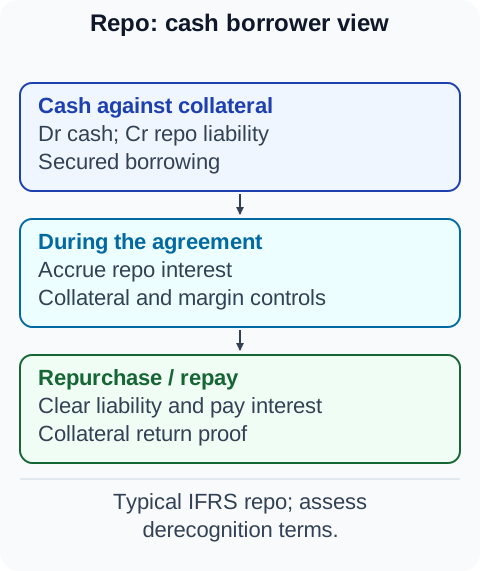 Figure 2. Repo and reverse repo.
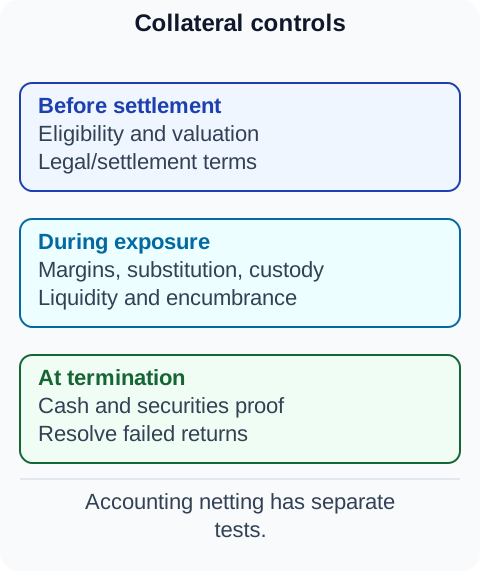
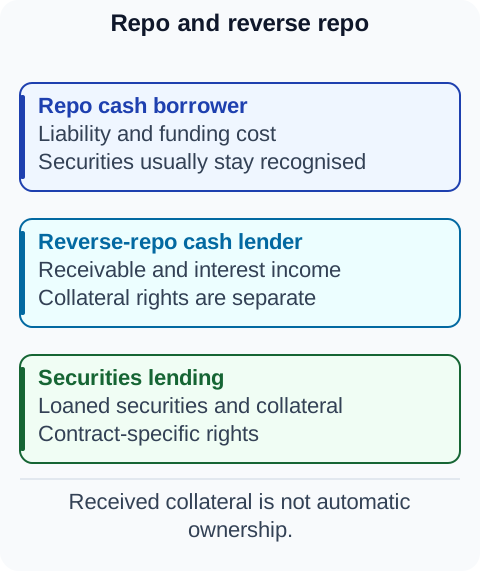 Figure 3. Collateral controls.
12. Tables
| Event | Bank as cash borrower | Bank as cash lender |
|---|---|---|
| Start | Dr Cash / Cr Repo liability | Dr Reverse repo / Cr Cash |
| Interest | Dr Expense / Cr Payable | Dr Receivable / Cr Income |
| Cash margin posted | Dr Margin receivable / Cr Cash | If posting is actually owed, same pattern |
| End | Dr Liability/payable / Cr Cash | Dr Cash / Cr Receivable |
| Prudential measure | Do not assume |
|---|---|
| LCR | Every repo has 100% runoff |
| NSFR | Every short pledge has 5% RSF |
| Leverage | Repo liabilities are added as assets |
| HQLA | Reused collateral and cash can both be counted without adjustment |
13. Illustrative bank case study
Fictional case: a book matched only in totals. Repos of 12bn fund reverse repos of 12bn, but 5bn of funding matures before the assets. Market withdrawal forces a real liquidity gap despite equal totals. Treasury extends funding, maintains collateral capacity, runs maturity ladders by currency and tests non-rollover scenarios. No exact regulatory finding or public-bank cost is asserted.
14. BA, developer, tester and operations guidance
- BA: Specify GMRA terms, haircuts, margin rules, reuse rights and reporting needs per desk.
- Developer: Flag encumbrance immutably; track reuse; feed liquidity maturity-aware.
- Tester: Margin-call paths; close-out netting logic; window-dressing detection analytics.
- Operations: Margin daily without exception; monitor reuse limits; attest encumbrance packs.
15. Common mistakes
- Skipping IFRS 9 derecognition analysis because an instrument is labelled repo.
- Counting encumbered bonds as HQLA.
- Netting without legal opinions + intent.
- Applying a blanket LCR runoff without collateral/counterparty rules.
- Quarter-end balance-sheet engineering via repos.
- Tenor-ladder monitoring without collateral-class granularity.
- Margin-call discipline reliant on manual processes.
- Reconciling scoped SFTR reports only to one ledger while omitting source trades and lifecycle events.
16. Key takeaways
- Usual repos are financing with retained collateral; unusual transfers require full derecognition analysis.
- Margin daily; reuse within rights; close-out documented (GMRA/GMSLA).
- Secured-book LCR and leverage effects depend on collateral, counterparties, maturity and applicable adjustment/netting criteria.
- Encumbrance tracked, disclosed, limited — HQLA honesty depends on it.
- Match tenors per collateral type; monitor ladders daily.
17. References and verification notes
- IFRS 9 transfer and derecognition
- Basel LCR secured funding and inflows
- Basel NSFR encumbrance/funding factors
- Basel leverage SFT treatment
- Rules are applied under the reporting entity's adopted accounting framework and jurisdiction. Basel standards require local implementation; they are not themselves national law. All unnamed cases, amounts and operational thresholds are fictional training examples.