Chapter 023: Repayment Structures
Section 5: Lending and Credit Product Accounting · Chapter 023 of 100
Repayment schedules determine what the customer pays and when the bank recovers principal. Work those cash flows first, then apply EIR, impairment and prudential exposure rules separately.
1. Chapter opening
Repayment structure determines the timing of contractual principal and interest. It also informs credit and liquidity analysis, but does not by itself prescribe a capital credit conversion factor (CCF), an accounting impairment horizon or a regulatory maturity. Start with a correct cash-flow schedule, then apply each reporting framework separately.
2. Learning objectives
- Calculate equal-principal, level-payment and bullet schedules.
- Post accrued interest and repayments without counting income twice.
- Reconcile revolving draws, repayments and remaining availability.
- Distinguish drawn accounting balances from modelled or regulatory EAD.
- Control amendments, residual balances and maturity concentrations.
3. Business context
Equal-principal structures repay principal steadily and produce declining total payments at a fixed rate. Level-payment amortisers retain the same payment while its interest/principal split changes. Bullets retain principal until maturity and create refinancing concentration. Revolvers permit draw and redraw within a limit. An evergreen review date is not necessarily the legal cancellation date or an IFRS 9 credit-risk horizon. Pricing depends on borrower, security, competition and funding as well as the schedule; there is no universal cheapest-to-most-expensive ranking.
4. Finance and accounting view
4.1 Three comparable fixed-rate schedules
Assume a loan of 1,200, fixed 10% annual interest, three annual periods, payments in arrears, no fees, costs or prepayments and initial measurement at par. Interest equals opening principal × 10%.
Equal principal: repay 400 each year.
| Year | Opening principal | Interest | Principal repaid | Total cash | Closing principal |
|---|---|---|---|---|---|
| 1 | 1,200 | 120 | 400 | 520 | 800 |
| 2 | 800 | 80 | 400 | 480 | 400 |
| 3 | 400 | 40 | 400 | 440 | 0 |
Total cash 1,440; principal 1,200; interest 240.
Level payment: 1,200 × 10% / [1 − (1.10)^−3] = 482.53776435 each year. Compute with full precision; display cents.
| Year | Opening principal | Interest | Principal repaid | Total cash | Closing principal |
|---|---|---|---|---|---|
| 1 | 1,200.00 | 120.00 | 362.54 | 482.54 | 837.46 |
| 2 | 837.46 | 83.75 | 398.79 | 482.54 | 438.67 |
| 3 | 438.67 | 43.87 | 438.67 | 482.54 | 0.00 |
Total interest = 3 × 482.53776435 − 1,200 = 247.61. A cent-rounding residual follows the contractual rounding rule, not an arbitrary accounting plug.
Interest-only bullet: receive 120 in year 1, 120 in year 2 and 1,320 in year 3. Total cash 1,560; interest 360; principal stays 1,200 until maturity. Compared with the amortisers, more principal remains outstanding longer.
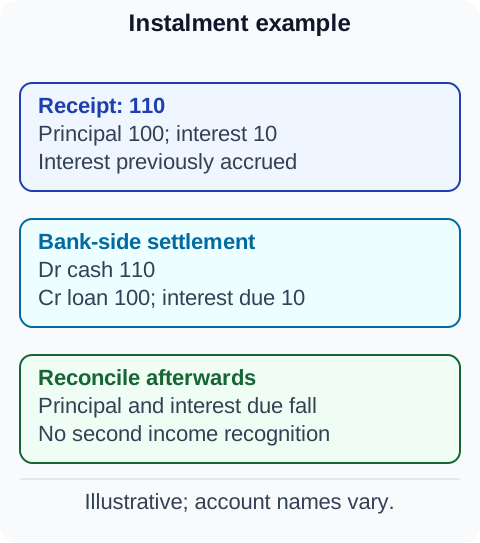
At origination to another bank: Dr Loan 1,200 / Cr Settlement cash 1,200. Equal-principal year 1 accrual: Dr Interest receivable 120 / Cr Interest income 120. Receipt: Dr Cash 520 / Cr Interest receivable 120 / Cr Loan principal 400. Principal repayment is not income. If the borrower pays from a deposit at the same bank, debit that deposit liability instead of cash; external settlement has not occurred. Where integral fees/costs exist, retain the contractual schedule and reconcile it to the separate EIR schedule.
4.2 Revolving availability and exposure
For a 10m committed limit with 4m drawn, undrawn availability is 6m, subject to contract conditions and other utilisations. An external 1m draw is Dr Loan 1m / Cr Cash 1m: drawn becomes 5m, undrawn 5m. A 0.5m principal repayment is Dr Cash 0.5m / Cr Loan 0.5m: drawn 4.5m, available 5.5m if redraw is permitted. Interest and fees have separate recognition events.
A simplified EAD illustration using an assumed 50% conversion of the undrawn 6m gives 4 + 6 × 50% = 7m. This is not the drawn loan’s accounting carrying amount, and 50% is not asserted as the current applicable regulatory factor. A fully disbursed amortiser with no undrawn commitment has no extra undrawn CCF amount merely because it amortises.
4.3 Maturity and monitoring
Legal maturity, scheduled cash-flow timing, behavioural life and regulatory effective maturity are different fields. Where an IRB weighted-cash-flow maturity formula applies, include the specified principal, interest and fee cash flows and apply its floors, caps and exceptions. An interest-paying bullet does not necessarily have weighted maturity exactly equal to its final principal date. Apply the actual approach and local implementation rather than a generic rule for all COREP cells.
Monitor bullet maturities by borrower group, year, currency and source of repayment. Policy appetite limits and review cadences must be labelled as bank policy. Covenant breach or extension triggers a documented review of legal terms, accounting modification, credit risk, ECL and prudential fields; it does not automatically prescribe full EAD, forbearance or derecognition.
5. Product and customer impact
Show the customer the payment amount, its interest/principal split, final balloon, fees and any variable-rate assumptions. Test affordability against the actual structure; a small interest-only payment does not prove ability to refinance the final principal. Amendment and early-payment quotations follow the contract and local conduct requirements.
6. Regulatory and supervisory view
Basel standardised and IRB approaches have different CCF and maturity rules. IFRS 9 ECL exposure estimates and credit-risk horizons are not automatically the statutory capital calibration. Large-exposure and liquidity regimes also have their own exposure rules. Use the reporting date, approach, entity scope and national implementation; do not overwrite a prescribed standardised CCF with an internal stressed drawdown assumption.
7. Systems and data view
The facility model needs limit, drawn principal, other utilisations, undrawn commitment, cancellability, cash-flow dates, rate/reset fields, amortisation type, redraw rights, maturity and amendment versions. Reconcile the schedule to accepted events and keep EIR and ECL measures separately identified. A servicing balance, EAD estimate and COREP exposure amount should never share an ambiguous “balance” field.
8. End to end process
- Confirm terms and classify structure.
- Generate contractual schedule and independently verify totals.
- Post draw, accrual and payment events uniquely.
- Reconcile principal and arrears to the subledger and GL.
- Recompute affected schedules and reporting inputs on amendment.
- Apply each prudential approach with versioned mappings.
- Monitor maturity concentrations and legal review dates.
9. Controls and risks
| Risk | Control | Evidence |
|---|---|---|
| Payment split wrong | Independent schedule arithmetic | Contract and calculation |
| Principal credited to income | Event journal review | Repayment journal |
| Stale redraw availability | Limit/utilisation reconciliation | Facility roll-forward |
| Contract maturity mistaken for ECL horizon | Separate field and framework mapping | Policy decision |
| Prescribed CCF overwritten by stress model | Approach/version controls | Prudential mapping |
10. Practical examples
Revolver cohort: limits 2,000, drawn 700, undrawn 1,300 and an illustrative 40% CCF give EAD 1,220. For a stressed subset with limits 150 and drawn 52.5, the initial converted estimate is 52.5 + 97.5 × 40% = 91.5. A realised 72% conversion of undrawn capacity gives drawn-at-default 122.7 (81.8% utilisation), a 31.2 increase. If utilisation instead rises from 35% to 78%, the realised conversion is (78% − 35%)/(100% − 35%) = 66.1538%, not 72%. These are model-validation examples; a prescribed regulatory CCF does not automatically change because the realised conversion differs.
Maturity concentration: a 3bn principal tower against a 1bn expected refinancing capacity leaves a 2bn planning gap. It signals a funding/workout problem, not a debit/credit error. Assess contractual options, timing and stressed cash availability rather than asserting that an extension is always a cure.
11. Diagrams
Figure 1. Repayment processing.
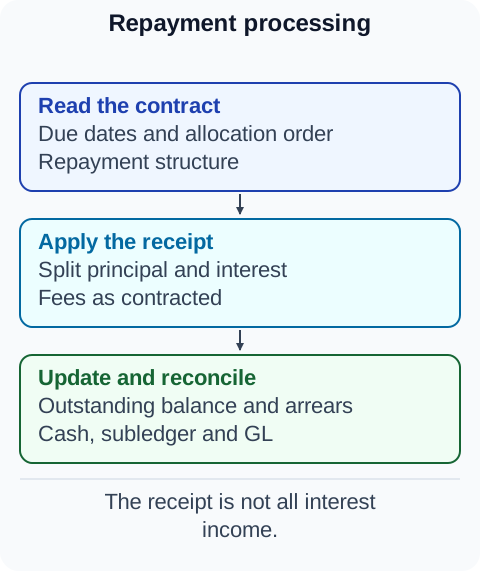 Figure 2. Repayment structures.
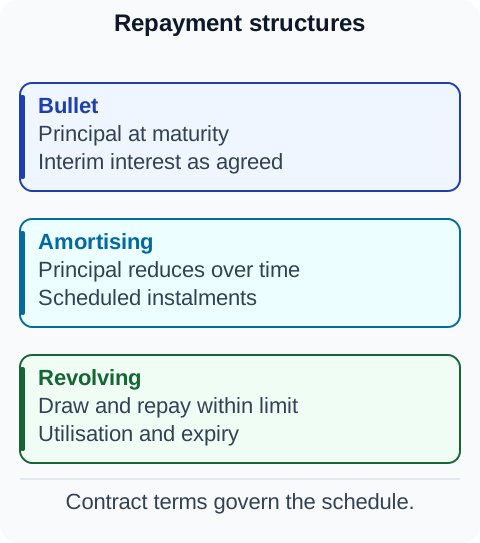 Figure 3. Instalment example.
12. Tables
| Structure | Principal profile | Distinct control |
|---|---|---|
| Equal principal | Fixed reductions | Falling cash-payment check |
| Level payment | Rising principal portion | Rate and rounding check |
| Bullet | Principal at maturity | Credible final repayment plan |
| Revolver | Draw and redraw | Drawn/undrawn/limit bridge |
| Evergreen | Contract-specific renewal/cancellation | Legal rights and review evidence |
13. Illustrative bank case study
The residual balloon. A fictional bank imported an amortisation code that repaid interest but omitted scheduled principal. The customer’s payments looked plausible, but the principal roll-forward exposed an unintended balloon. The bank corrected the schedule using the signed terms, reviewed affected communications and reconciled accounting periods rather than treating the code as proof of the contract.
14. BA, developer, tester and operations guidance
- BA: specify exact repayment, redraw and rounding terms.
- Developer: version schedules and separately label accounting/regulatory measures.
- Tester: check the three 1,200 schedules and revolving availability independently.
- Operations: resolve residuals and maturity reviews from the contract.
15. Common mistakes
- Treating principal repayment as interest income.
- Adding an undrawn CCF to a fully drawn facility with no commitment.
- Equating a review date with a one-year ECL horizon.
- Mixing utilisation percentage and undrawn conversion percentage.
- Using one EAD calculation for accounting, capital, liquidity and large exposures.
16. Key takeaways
Repayment shape determines contractual timing. Interest accrual, principal collection, EIR measurement and prudential exposure each require their own explicit measures and controls.
17. References and verification notes
- IFRS Foundation: IFRS 9: classification depends on business model and contractual cash flows; initial recognition and directly attributable costs follow IFRS 9. This is the IFRS track, not US GAAP CECL.
- Basel Framework: credit risk: Basel credit risk approaches have distinct exposure, conversion-factor and maturity rules; national implementation governs actual capital reporting.
Worked rates, CCFs and amounts are fictional, not local prudential calibrations. Basel sources explain the framework; binding implementation and template instructions govern the actual reporting date.