Chapter 022: Effective Interest Rate and Amortised Cost
Section 5: Lending and Credit Product Accounting · Chapter 022 of 100
The bank’s net carrying amount and the customer’s repayment schedule differ when integral fees and costs exist. This chapter derives the difference, reproduces every movement and explains the IFRS 9 treatment of later changes.
1. Chapter opening
A contractual coupon tells the borrower what to pay; the effective interest rate (EIR) allocates the bank’s recognised interest income or expense over the instrument’s expected life. Integral fees and directly attributable transaction costs explain why those rates differ. This chapter follows IFRS 9 amortised cost: it does not import US GAAP CECL, or treat the customer’s contractual principal as the bank’s net carrying amount.
2. Learning objectives
- Reproduce a balanced amortised-cost schedule from the contract and initial carrying amount.
- Separate contractual cash, EIR interest, integral fees and credit-loss allowances.
- Distinguish market-rate resets, cash-flow re-estimates and negotiated modifications.
- Explain Stage 3 net interest and credit-adjusted EIR for POCI assets.
- Reconcile the schedule, subledger, GL and customer statement without changing contractual cash flows.
3. Business context
A loan processor may hold contractual principal, accrued interest and arrears; Finance also needs unamortised integral fees/costs and an impairment allowance. These are related measures with different purposes. A customer early-settlement quotation follows the contract and applicable consumer law, not the bank’s net IFRS carrying amount. EIR changes revenue timing; it does not itself increase the customer’s instalment.
4. Finance and accounting view
4.1 Contractual annuity and independently solved EIR
Assume a fixed-rate loan of 200,000, 6% contractual interest, five equal annual payments in arrears, an integral origination fee of 2,000 withheld, no other costs, no expected prepayment and no credit loss in this schedule. The bank pays 198,000 net. Contractual payment = 200,000 × 6% / [1 − (1.06)^−5] = 47,479.280086. Solve 198,000 = Σ payment/(1+r)^t: r = 6.37053379%. Carry full precision; the table displays cents.
| Year | Opening gross carrying amount | EIR interest income | Cash received | Closing gross carrying amount |
|---|---|---|---|---|
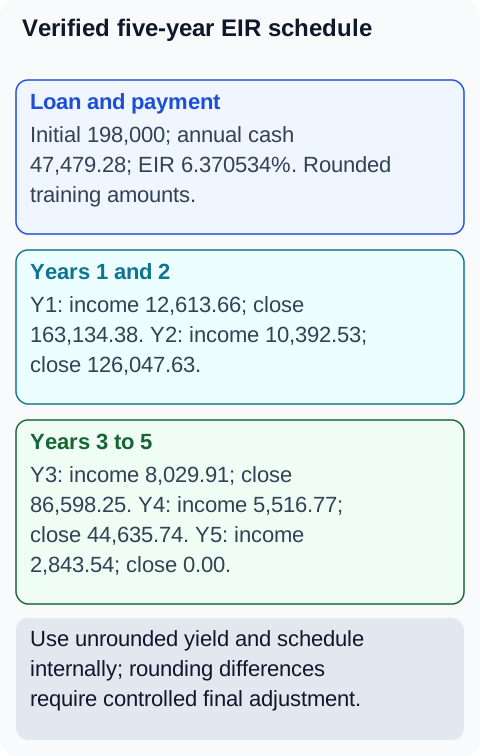
| 1 | 198,000.00 | 12,613.66 | 47,479.28 | 163,134.38 |
| 2 | 163,134.38 | 10,392.53 | 47,479.28 | 126,047.63 |
| 3 | 126,047.63 | 8,029.91 | 47,479.28 | 86,598.25 |
| 4 | 86,598.25 | 5,516.77 | 47,479.28 | 44,635.74 |
| 5 | 44,635.74 | 2,843.54 | 47,479.28 | 0.00 |
“Gross” here means before the credit-loss allowance, but after integral fee adjustments. Total cash is 237,396.40; lifetime interest income is 39,396.40 = cash less initial 198,000. Contractual interest totals 37,396.40; the 2,000 difference is fee amortisation. The final zero follows the solved schedule, not a fabricated balancing payment. A contract that rounds every payment to cents can require a small contractual final-payment adjustment; document that separately.
At inception: Dr Contractual loan principal 200,000 / Cr Cash 198,000 / Cr Integral-fee contra-asset 2,000. Total debits = credits. For year 1, contractual interest is 12,000 and fee accretion is 613.66: Dr Interest receivable 12,000; Dr Integral-fee contra-asset 613.66 / Cr Interest income 12,613.66. Receipt: Dr Cash 47,479.28 / Cr Interest receivable 12,000 / Cr Contractual principal 35,479.28. Net carrying amount = 164,520.72 principal − 1,386.34 remaining fee = 163,134.38. If interest has already accrued, receipt clears the receivable; it must not recognise the income a second time.
4.2 Rate resets and cash-flow re-estimates
For a floating-rate instrument, periodic re-estimation reflecting movements in market interest rates alters the EIR under IFRS 9 B5.4.5; it normally does not create the same original-rate catch-up used for a fixed-rate cash-flow revision. Separate a contractual index reset from a concession or other negotiated change. For a non-credit cash-flow re-estimate within B5.4.6, discount revised estimated flows using the original EIR (or credit-adjusted EIR for POCI), adjust carrying amount and recognise the resulting catch-up in profit or loss. Expected credit shortfalls belong in the ECL assessment; do not count the same credit loss in both calculations.
4.3 Modification versus derecognition
A financial asset is derecognised when contractual rights expire or a qualifying transfer occurs. Assess a substantial modification of asset terms using the applicable IFRS 9 analysis and documented policy; IFRS 9 does not prescribe the liability 10% test as a mandatory asset bright line. If an asset is retained, IFRS 9 5.4.3 recalculates its gross carrying amount using modified contractual cash flows discounted at the original EIR and recognises the modification gain/loss. Eligible modification costs adjust the carrying amount and are amortised over the remaining term.
For financial liabilities, IFRS 9 B3.3.6 has a 10% discounted-cash-flow test, including the specified fees between borrower and lender; qualitative changes also require assessment. Do not apply that rule mechanically to loan assets. If a loan is derecognised, measure the new asset at fair value, determine its classification and EIR, and assess whether it is credit-impaired at origination. PV at the old rate is not automatically fair value.
4.4 Stage 3 and POCI
For assets that become credit-impaired after origination, subsequent reporting periods apply EIR to amortised cost net of the loss allowance, subject to the IFRS 9 recovery conditions. POCI assets use a credit-adjusted EIR from initial recognition that includes expected credit losses in expected cash flows. POCI is not simply Stage 3 with an ordinary EIR, and its yield is not necessarily higher than a non-credit-adjusted yield. Keep the gross/net basis, allowance and interest-recognition basis separately auditable.
4.5 Deposit-liability fee direction
Assume a one-year 50,000 deposit repays 52,250, with no other cash flows. If the bank pays an incremental eligible cost 50, net proceeds and initial liability are 49,950; EIR=52,250/49,950−1=4.60460460%, total expense 2,300. If the customer instead pays an integral fee 50 in addition to principal, initial liability is 50,050; EIR=4.39560440%, total expense 2,200. The contract repays 52,250 in both cases. Tax collected for an authority remains a payable, and distinct service fees follow their own revenue rules. Received fees and paid costs must not share the same adjustment direction.
5. Product and customer impact
Explain customer payments from the contractual schedule and disclosures. Explain the accounting schedule separately to Finance. A waiver, early settlement or reset requires an authorised contractual event, a customer communication where applicable and a reproducible accounting consequence.
6. Regulatory and supervisory view
This is the IFRS track. Use the endorsed IFRS 9 version for the reporting period and distinguish published amendments, their effective dates and local endorsement. US GAAP interest recognition, CECL and modification rules require a separate policy map; the old debtor troubled-debt-restructuring guidance is not a universal current creditor rule.
7. Systems and data view
Store contractual and accounting cash-flow versions, dates, day-count rules, fees, costs, original/current EIR, gross carrying amount, allowance and interest basis. Version a modification rather than overwriting history. Keep a reversible link from each schedule movement to an accepted, unique journal and reporting snapshot.
8. End to end process
- Validate the signed contract and cash settlement.
- Classify each fee/cost and determine initial measurement.
- Solve EIR and prove the cash-flow PV and closing balance.
- Accrue and collect using separate event IDs.
- Process resets, prepayments and modifications under the appropriate rule.
- Reconcile principal, accrual, fee/cost and ECL components to the GL.
- Preserve the reporting-date schedule and approved assumptions.
9. Controls and risks
| Risk | Control | Evidence |
|---|---|---|
| Wrong fee sign | Bank-perspective classification and net-cash bridge | Initial journal and contract |
| Duplicate interest | Separate accrual and collection events | Interest receivable roll-forward |
| False final zero | Independently solved PV and contract rounding rule | Residual report |
| Wrong catch-up | Event type distinguishes reset, estimate, credit loss and modification | Decision and calculation file |
| Net/gross confusion | Explicit interest basis and allowance bridge | Stage/POCI history |
10. Practical examples
Prepayment estimate: a change in expected life can change the timing of an unamortised fee. Recalculate using the applicable IFRS 9 cash-flow rule and investigate the direction from the actual fee/cost sign; do not assume all longer lives increase profit.
Full contractual repayment: obtain the settlement quote from the servicing contract. Clear contractual principal, accrued receivables and residual accounting adjustments according to the extinguishment event. The customer owes neither the bank’s ECL allowance nor an unexplained EIR balancing amount.
11. Diagrams
Figure 1. EIR from contractual loan cash flows.
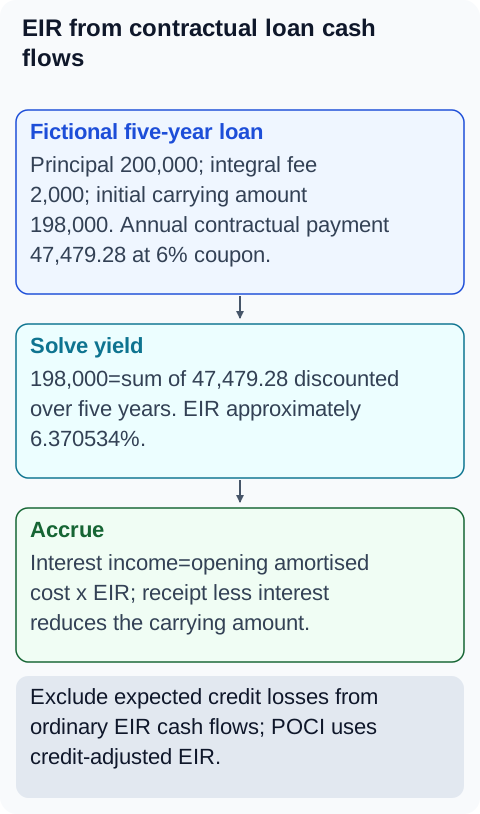
Figure 2. Floating-rate, Stage 3 and POCI interest.
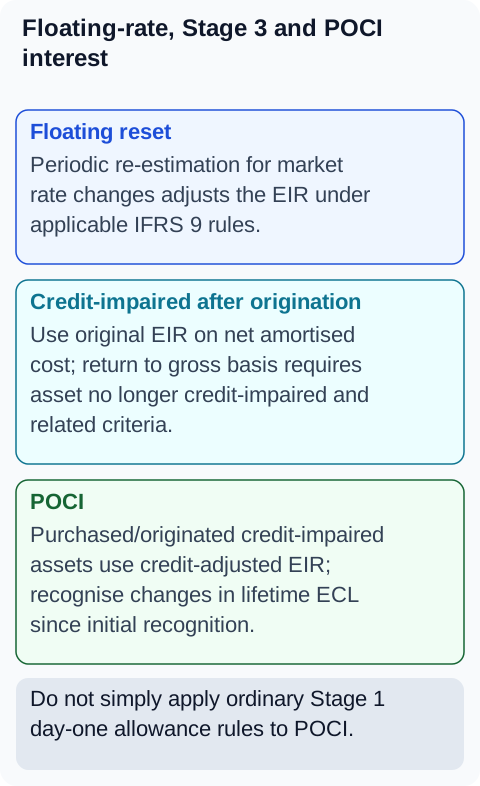
Figure 3. Verified five-year EIR schedule.
12. Tables
| Event | Accounting question |
|---|---|
| Floating index reset | Is the change a contractual market-rate reset? |
| Fixed-rate estimated non-credit cash-flow change | Does B5.4.6 require original-rate catch-up? |
| Contractual modification | Retain asset with modification gain/loss, or derecognise? |
| New credit-impaired asset | Does POCI apply? |
| Credit-impaired after origination | Is interest recognised on the required net basis? |
Test the worked schedule independently, then test fee signs, date conventions, leap years, prepayments, missing/duplicate receipts, reset versus concession and stage changes. A debit/credit check alone cannot establish correct measurement.
13. Illustrative bank case study
The fee sign was reversed. In this fictional bank, a fee received on an asset was added to rather than deducted from initial carrying amount. Finance reconciled bank cash, legal principal and the fee contra-account, re-solved the schedule and assessed the error under the applicable accounting correction rules. The investigation retained the old/new schedules and affected-period bridge; it did not hide the error through a final-period payment.
14. BA, developer, tester and operations guidance
- BA: specify contractual versus accounting balances and event-specific rules.
- Developer: use reproducible date/precision rules and versioned schedules.
- Tester: independently solve the EIR and test collection after accrual.
- Operations: clear exceptions using contractual and accounting evidence.
15. Common mistakes
- Using the coupon as EIR when integral fees/costs exist.
- Treating the customer’s principal as net carrying amount.
- Applying a liability 10% test mechanically to assets.
- Counting interest twice at accrual and collection.
- Changing contractual payments to force the accounting schedule to zero.
16. Key takeaways
- EIR allocates contractual economics, including eligible fees and costs.
- Contractual and accounting schedules reconcile but serve different purposes.
- Market resets, estimate changes, modifications and credit losses have distinct rules.
- Stage 3 and POCI require an explicit interest basis.
- A schedule needs independent arithmetic and balanced event journals.
17. References and verification notes
- IFRS Foundation: IFRS 9: classification depends on business model and contractual cash flows; initial recognition and directly attributable costs follow IFRS 9. This is the IFRS track, not US GAAP CECL.
All amounts and assumptions are fictional. Paragraph references identify the IFRS rule to inspect in the endorsed standard; the public IFRS Foundation overview is not a substitute for the complete text. Source access and scope limitations are recorded in the audit ledger.