Chapter 024: Loan Modifications and Derecognition
Section 5: Lending and Credit Product Accounting · Chapter 024 of 100
A loan restructure can change cash flows, accounting measurement and regulatory status. This chapter separates those decisions and works their journals and evidence.
1. Chapter opening
A change in loan terms raises separate questions: is the existing asset retained, what modification gain/loss arises, has credit risk changed, and do regulatory forbearance/NPE definitions apply? Answer them separately. A new contract or a reporting flag does not by itself determine IFRS 9 derecognition or stage.
2. Learning objectives
- Recalculate a retained loan using the original EIR.
- Distinguish financial-asset derecognition from the liability 10% test.
- Identify concessions to a borrower in financial difficulty.
- Keep accounting impairment, NPE and forbearance statuses distinct.
- Preserve classification, calculation and reporting evidence.
3. Business context
A sustainable restructure can support repayment; repeated concessions can also hide deterioration. Assess borrower viability and contractual rights, then record the accounting and regulatory consequences. Sale or securitisation accounting derecognition and prudential significant-risk transfer are separate analyses: either result does not automatically prove the other.
4. Finance and accounting view
4.1 Reproducible retained-asset example
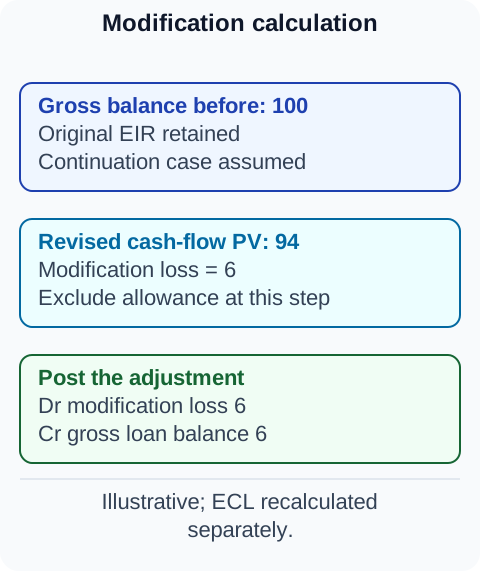
Assume an existing loan has gross carrying amount 50m and original EIR 5%. The old contract has a 5% coupon and a 50m bullet repayment in five years. The agreed revised terms are principal 48m, annual coupon 3.5% on 48m (= 1.68m), and principal repayment after seven annual periods. Assume, after a documented asset derecognition assessment, that the existing loan is retained; no modification costs are included.
PV at original 5% = Σ(1.68 / 1.05^t), t=1…7, + 48 / 1.05^7 = 43.833811m. Modification loss = 50 − PV = 6.166189m. Journal: Dr Modification loss 6.166189m / Cr Loan gross carrying amount 6.166189m. Reassess ECL separately and retain the original EIR for the retained asset. Expected credit shortfalls must not be counted a second time as the same modification loss.
IFRS 9 does not prescribe the financial-liability 10% test as a mandatory financial-asset derecognition threshold. Document qualitative and quantitative factors under the applicable asset policy; a currency change, counterparty change or new legal paper requires analysis rather than automatic derecognition. If derecognition occurs, remove the old asset and its allowance, recognise the new asset at fair value, determine classification/EIR and assess whether it is POCI. PV at the old rate is not automatically that fair value.
4.2 Accounting impairment and regulatory flags
Forbearance generally concerns a concession to a borrower experiencing or about to experience financial difficulty under the applicable prudential definition. A normal commercial renegotiation is not automatically forbearance. Forbearance is evidence relevant to SICR and credit impairment, but IFRS 9 does not impose an automatic universal “Stage 2 minimum” solely from that flag. Assess the asset’s actual credit status and, for a newly recognised credit-impaired asset, POCI rather than a mechanical Stage 1/2 reset.
NPE, prudential default and accounting credit impairment are related but distinct classifications. A material past-due test and unlikeliness-to-pay indicators require the relevant rules; neither a partial payment nor a new account number automatically cures them. In the EU-style lifecycle described in the ECB’s March 2017 supervisory guidance, non-performing forborne exposures generally need at least a one-year cure period and other conditions before returning to performing; a subsequent performing-forborne probation generally lasts at least two years, again with conditions. These are sequential, distinct clocks—not “two years for NPE, one year for forbearance”. The current binding local reporting definition governs the actual return; no elapsed timer alone authorises exit.
4.3 Serial concessions and vintage evidence
Track original contract, all amendments, borrower-level concessions, financial-difficulty assessment, legal dates, NPE/forbearance start dates, probation tests, ECL stage/POCI and exits. A serial holiday may indicate unresolved difficulty; investigate affordability and recovery rather than merely resetting arrears. Vintage analysis should distinguish sustained cures, redefaults, repayments, sales and write-offs. Falling coverage on an older cohort can reflect improved recoveries or weak estimates; investigate the underlying evidence rather than declaring either automatically.
5. Product and customer impact
Explain revised payments, interest, term, total cost and local credit-reporting consequences without promising a universal credit-file outcome. A borrower needs an affordable repayment plan; a shorter monthly payment may still create an unaffordable final balance.
6. Regulatory and supervisory view
Apply the jurisdiction’s current NPE, default, forbearance and reporting definitions. Prudential backstops, supervisory coverage expectations and accounting ECL are different measures and have different scope/effective dates. EU definitions, Indian IRAC rules and US GAAP modification rules cannot be merged into a single “most stringent” formula. Do not present a proposal or dated supervisory guideline as current binding law.
7. Systems and data view
Keep immutable pre/post contractual schedules and linked accounting/regulatory decisions. The reporting snapshot must preserve flags as of the return date, not overwrite prior quarters when a later concession is entered. Reconcile the asset population, gross balances, allowances and movements across servicing, GL and regulatory outputs.
8. End to end process
- Capture the signed concession and borrower assessment.
- Determine asset retention/derecognition with review.
- Reproduce PV or new fair-value measurement.
- Post the accounting event and reassess impairment.
- Apply distinct prudential statuses and applicable probation tests.
- Reconcile reporting populations and movements.
- Monitor actual payments, viability and sustained cure.
9. Controls and risks
| Risk | Control | Evidence |
|---|---|---|
| Liability test used for an asset | Asset-specific decision policy | Derecognition memo |
| PV mistaken for fair value | Separate valuation basis | Valuation evidence |
| New account clears old credit history | Linked borrower and contract history | Stage/POCI assessment |
| Timer-only cure | All legal exit conditions tested | Probation file |
| Double-counted loss | Modification/ECL bridge | Gross/allowance roll-forward |
10. Practical examples
Retained loan: the fully specified 50m example above produces a modification loss from the revised contractual cash flows; its percentage difference does not itself impose a liability-style derecognition result.
Derecognition contrast: assume old gross carrying amount 50m, allowance 4m and independently measured new-asset fair value 44m. A simplified exchange with no other consideration is Dr New loan 44m; Dr Old allowance 4m; Dr Exchange loss 2m / Cr Old loan 50m. Assess the new asset’s credit impairment and classification separately; this journal does not prescribe POCI or Stage 1 without the facts.
Repeated holiday: assess the borrower’s financial difficulty, viability and credit deterioration even when payments are contractually not yet due. Contractual arrears of zero does not prove low credit risk or a regulatory cure.
11. Diagrams
Figure 1. Modify a loan: IFRS 9.
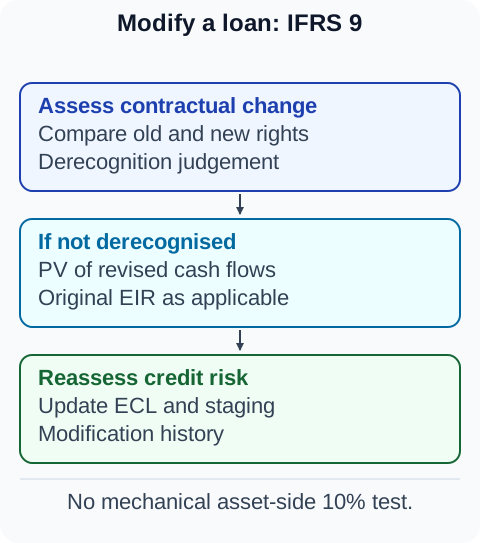 Figure 2. Modification outcomes.
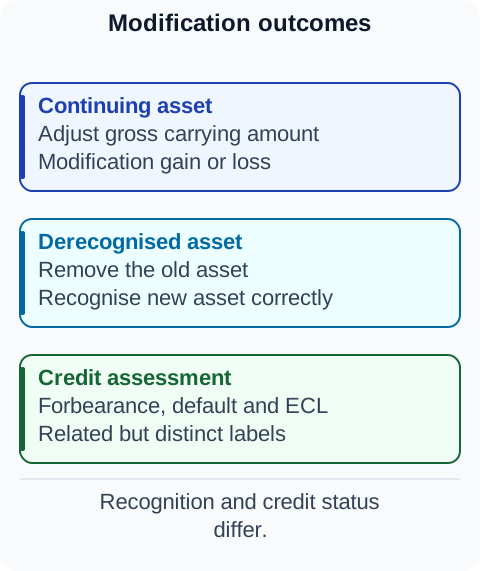 Figure 3. Modification calculation.
12. Tables
| Decision | Accounting | Separate regulatory question |
|---|---|---|
| Asset retained | Original-EIR modification calculation; reassess ECL | Does concession meet forbearance/NPE rules? |
| Old asset derecognised | Remove old asset/allowance; new fair-value recognition | Do borrower-level flags persist? |
| Borrower improves | Apply IFRS 9 impairment evidence | Are all cure/probation conditions met? |
| Sale/securitisation | Analyse transfer derecognition | Does prudential risk transfer qualify? |
13. Illustrative bank case study
The timer-only cure. A fictional bank cleared a forbearance flag after a calendar period despite further concessions and insufficient payment evidence. Review restored the borrower’s linked history, recalculated the classifications under the applicable rules and reconciled the reporting corrections. A new facility ID did not erase the previous difficulty.
14. BA, developer, tester and operations guidance
- BA: define separate accounting and prudential decision fields.
- Developer: preserve amendments, borrower history and reporting snapshots.
- Tester: reproduce PV and test serial concessions, POCI and failed exit criteria.
- Operations: monitor signed terms, actual payments and viability evidence.
15. Common mistakes
- Applying a mandatory 10% asset test.
- Using original-rate PV as new-asset fair value.
- Prescribing Stage 2 solely from a forbearance label.
- Reversing NPE cure and performing-forborne probation clocks.
- Treating SRT as proof of accounting derecognition.
16. Key takeaways
Contract change, asset derecognition, impairment and prudential classification are separate decisions. Reproducible cash-flow arithmetic and preserved borrower history make them reviewable.
17. References and verification notes
- IFRS Foundation: IFRS 9: classification depends on business model and contractual cash flows; initial recognition and directly attributable costs follow IFRS 9. This is the IFRS track, not US GAAP CECL.
- ECB NPL guidance, March 2017: dated supervisory guidance, sections 5.3–5.5; accounting impairment, NPE and forbearance are separate classifications. Current binding reporting rules must be applied for the actual jurisdiction and return date.
All cash flows and journals are fictional. IFRS 9 is the accounting track. The dated ECB guidance illustrates the lifecycle; confirm the current binding reporting provisions for the jurisdiction and reporting date. Public-source access limitations are recorded in the audit ledger.