Chapter 093: MREL and TLAC
Section 19: Disclosure, Resolution and Emerging Reporting Requirements · Chapter 093 of 100
Capital keeps banks alive; MREL/TLAC lets them die safely. Gone-concern loss-absorbing capacity — eligible liabilities plus own funds, positioned where resolution needs them — is disclosed, calibrated and tested like capital's resolution twin. This chapter covers eligibility, calibration, internal MREL positioning, disclosure and the reporting that proves resolvability.
1. Chapter opening
The FSB external TLAC standard applies to covered G-SIBs with both risk-based and leverage constraints. Its fully phased minima are 18% RWA and 6.75% leverage exposure; the term sheet has distinct conformance dates, including 16%/6% from 2025 and 18%/6.75% from 2028 for the specified emerging-market-headquartered cohort, unless an accelerated/local requirement applies. Check the actual firm’s national rules and designation date. Eligible regulatory capital can count toward TLAC, while CET1 used for the risk-based TLAC minimum cannot also meet capital buffers. EU and UK MREL are separately authority-set requirements with their own calibration and distribution mechanics.
Loss-absorbing resources must be sufficient and located where the preferred resolution strategy needs them. Going-concern capital and gone-concern capacity overlap: MREL includes eligible own funds as well as eligible liabilities. A shortfall needs prompt remediation and may interact with distribution restrictions under applicable law; there is no universal automatic ban on every dividend or acquisition for any shortfall.
2. Learning objectives
- Distinguish going-concern capital from gone-concern MREL/TLAC.
- State eligibility (subordination, maturity, no acceleration, issuance entity).
- Explain internal MREL pre-positioning and surplus/deficit mechanics.
- Read disclosure tables (requirement vs resources, maturity, creditor hierarchy).
- Plan issuance to close shortfalls with market-window discipline.
3. Business context
MREL-eligible issuance is a standing funding programme (benchmark bonds from resolution entities, internal loans downstream); eligibility shapes liability structure (holding-company clean balance sheets, structural subordination); shortfalls gate M&A and growth (resolution-constrained planning). Investor base (dedicated bail-in debt funds) needs trigger/mechanics education — non-call or coupon features price on resolution credibility.
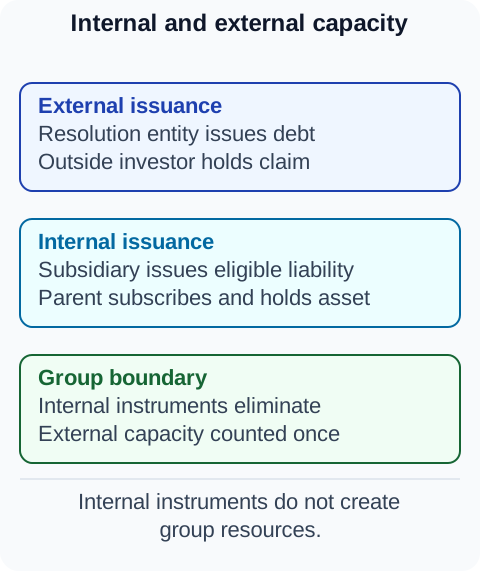
Treasury plans external issuance and internal positioning together. External debt raised by the resolution entity adds eligible external resources only if it satisfies the applicable tests. An operating subsidiary issues an eligible internal liability to the resolution entity, which subscribes and holds the corresponding asset; this channels subsidiary losses to the parent under the documented strategy. The internal asset/liability eliminates on consolidation and does not create additional external group capacity.
| Layer | Absorbs when | Example |
|---|---|---|
| CET1/AT1/T2 | Going + gone concern | All layers bail-in-able |
| Senior non-preferred | Resolution | MREL workhorse |
| Internal MREL | Subsidiary resolution | Downstreamed loans |
| Non-eligible for this resource measure | Eligibility differs from legal bail-in scope | Covered deposits and excluded operational liabilities; apply local law |
Disclose the actual national insolvency ranking, applicable bail-in powers, secured portions, exclusions and safeguards. A simplified capital sequence is CET1, AT1 and Tier 2; treatment of senior preferred/non-preferred debt and uninsured deposits then depends on governing law. Covered-deposit protection and depositor preference are distinct concepts, and preference is not universally limited to retail. Instrument eligibility as MREL/TLAC is separate from legal bail-in scope.
4. Finance and accounting view
4.1 Eligibility and calibration (headline, verify)
Screen paid-in amount, residual maturity of at least one year where required, issuer, holder, subordination, governing law, set-off/netting, acceleration and funding arrangements against the actual applicable eligibility rules. MREL calibration generally considers loss absorption and recapitalisation needs with authority-specific adjustments. The FSB internal TLAC range of 75–90% of a material subgroup’s hypothetical external requirement is not a universal EU internal-MREL scaling rule. Maintain each subsidiary’s actual decision and calculation basis.
The eligibility criteria are deceptively simple but operationally demanding. A single term sheet defect — for example, a clause permitting holder acceleration on credit events — can render an instrument ineligible, creating a shortfall that must be addressed through replacement issuance. Resolution entities must be identified with legal certainty: in single-point-of-entry structures, typically the parent holding company; in multiple-point-of-entry structures, each material subsidiary may have its own resolution entity with a separate requirement.
Calibrate and review according to the authority’s decision and applicable cycle. EU MREL distinguishes loss-absorption and recapitalisation amounts with adjustments, and requirements can be expressed against both total risk exposure and leverage exposure. Post-resolution resources must meet the relevant ongoing authorisation and capital requirements; recapitalisation is not a universal requirement to replenish only CET1. Record the strategy, subordination requirements, buffer interaction and eligibility rather than assume identical treatment for every resolution entity.
4.2 Disclosure and monitoring
Tables: requirements (RWA/leverage-based), resources (by layer/maturity), shortfall/surplus, creditor hierarchy (insolvency ranking visualisation), maturity profile of eligible stock. Monitoring: eligibility flags per instrument, maturity decay (sub-1y instruments exit eligibility — refinancing diary), internal-vs-external reconciliation, distribution interaction (M-MDA restrictions where MREL breaches bite — verify local mechanics).
Pillar 3 disclosure must present MREL/TLAC in a format that allows market participants and supervisors to assess resolvability at a glance. The requirement-vs-resources table reconciles the calibrated requirement against eligible own funds and eligible liabilities, broken down by layer and maturity. The maturity profile table shows when existing eligible stock expires, enabling investors and supervisors to assess refinancing risk. The creditor hierarchy table visualises the insolvency ranking, making explicit which instruments absorb losses first in resolution.
Monitoring is continuous, not annual. Eligibility flags must be maintained per instrument: if a bond's terms are amended (for example, adding a holder put option on credit events), its eligibility status must be reassessed immediately. Maturity decay is tracked by quarter: any instrument with less than one year of residual maturity exits the eligible pool, creating a cliff in resources that must be planned for well in advance. Internal-vs-external reconciliation ensures that material subsidiaries' internal MREL requirements are fully pre-positioned — deficits are not observations; they are aged findings with remediation deadlines.
4.3 Deep dive: internal MREL pre-positioning mechanics and maturity-decay management
Track each subsidiary’s actual internal requirement, eligible own funds and eligible internal liabilities, holder identity, write-down/conversion powers and maturity. The subsidiary issues the liability and the parent holds the asset. Match issuer and holder records, cash funding and legal terms; eliminate the reciprocal balances in consolidation. Trigger sequence follows applicable law and the resolution strategy, not a universal promise that every internal instrument always converts before an external PONV determination.
Example: a parent subscribes 0.4bn for a subsidiary’s eligible internal bond. Subsidiary entry: debit cash 0.4, credit internal bond liability 0.4. Parent entry: debit internal bond asset 0.4, credit cash 0.4. Consolidation eliminates the bond asset and liability and the cash transfer has no net group cash effect. Eligibility and later write-down/conversion require their own legal, accounting and prudential analysis; the journal is not proof of qualification.
Internal surpluses must not be added again to external group resources. Assess restrictions on transferability and authority requirements when deciding where to position existing resources. Subsidiary deficits require a dated plan under the actual resolution decision; no universal six-month remediation period applies.
Maturity-decay management (eligibility evaporates below 1-year residual): decay forecasting (eligibility cliffs by quarter for 3 years forward), refinancing sequencing (replacement issuance 6–12 months before decay, market-window aware), sub-1y exclusion automation (engine drops ineligible stock from resources without manual judgement), and market communication (maturity profile published — investors price refinancing risk, surprises reprice spreads). Liability-management exercises (exchanges, buybacks, consent solicitations) optimise maturity at cost-benefit discipline — every exercise needs net-present-value justification with resolution-benefit quantification, not just maturity extension for comfort.
A2bn bond with 14 months residual maturity reaches the one-year eligibility boundary in 2 months, not two quarters. Maintain exact contractual dates, applicable early-redemption provisions and daily eligibility calculations. Schedule refinancing using market capacity and approved risk tolerances;6–12 months pre-funding can be an internal policy, not a universal legal standard.
4.4 Deep dive: market-window discipline and liability-management economics
Monitor issuance capacity, spreads, volatility and projected eligibility cliffs. ALCO chooses a pre-funding policy and negative-carry budget appropriate to its risk;6–12 months early funding or a 12-month market drought are illustrative scenarios, not universal standards. Model inability to issue under stress, rather than assume markets reopen whenever a shortfall needs funding. Replacement plans need legal eligibility, execution capacity and accountable approval.
Market-window discipline requires institutional patience. Treasury teams must issue when the window is open, not only when funding is cheapest. The cost of negative carry — holding cash from an early issuance not yet needed — is the insurance premium against issuing in stressed markets. Pre-funding policies set at ALCO level with explicit negative-carry budgets quantify the trade-off between carry cost and resolution-safety.
A 12-month loss of primary-market access can be a documented internal stress scenario; assess funding and eligibility resources without claiming a universal horizon or guarantee of survival. The model is stress-tested against historical drought episodes (2008, 2011–12, 2020). When a benchmark fails, pre-agreed alternatives activate: eligible external private placements or liability-management exercises; a bank’s retained own issuance adds no external loss-absorbing resource. No improvisation under deadline pressure.
Assess tender offers, exchanges, consent solicitations and calls using projected cash flows, fees, spread changes, maturity benefit and eligibility. Model consent thresholds, holdouts and execution risk. Record potential effects on future investor demand rather than assume a non-call reprices every issuance by a predictable amount. Approve liability management alongside issuance and pre-funding plans under bank policy, with documented economic and resolution benefits.
5. Product and customer impact
Senior non-preferred bonds carry bail-in prospectus language explicitly describing trigger events, write-down/conversion mechanics, and hierarchy position. Investors accept this language for higher spread — the market price of resolution risk. Disclose deposit-guarantee coverage and the actual national depositor hierarchy, including treatment of eligible uninsured balances; preference is not the same as a guarantee of full payment. Corporate depositors above insurance limits study the hierarchy carefully: transparency influences willingness to maintain large balances.
Resolution planning can require structural changes: continuity arrangements aim to preserve critical functions through resolution, subject to lawful stays, moratoria and actual execution capability, potentially requiring separable IT systems, ring-fenced entities, or customer-migration planning.
6. Regulatory and supervisory view
TLAC standard (FSB), MREL (BRRD/SRMR, BoE MREL framework — verify calibrations, phase-ins, internal scaling, M-MDA mechanics locally); resolution planning cycles (resolvability assessments, impediment removal, testing); disclosure ITS with templates. Shortfalls draw supervisory issuance plans with deadlines; resolvability findings can force structural change (the ultimate supervisory lever).
Resolution authorities assess resolvability on their applicable cycle and after relevant changes, evaluating progress against the entity’s requirements. Impediments (operational continuity gaps, cross-border information barriers, insufficient loss-absorbing capacity) are identified and remediated on deadlines set by the resolution authority. Failure to remediate can result in structural requirements: ring-fencing, entity restructuring, or increased eligible liabilities. Disclosure ITS templates standardise presentation for cross-institution comparability.
7. Systems and data view
MREL engine: instrument eligibility flags (subordination/maturity/acceleration/entity), internal-MREL tracker (downstreamed vs requirement per entity), maturity-decay forecaster, hierarchy mapper, disclosure-table generator. Controls: eligibility-at-issuance checklists, maturity monitoring, internal/external reconciliation, hierarchy legal-review.
Keep separate external and internal resource ledgers, reconciled to instrument positions and legal-entity accounts. Apply rules at the correct consolidation level, deduplicate holdings and prevent internal instruments or own holdings from inflating external capacity. Version authority decisions and eligibility opinions alongside the calculation snapshot.
8. End to end process
- Set requirement per strategy (calibration). 2. Flag eligible stock; identify shortfall. 3. Plan issuance (entity, tenor, market). 4. Pre-position internal MREL. 5. Monitor decay; refinance ahead. 6. Disclose tables; test resolvability.
9. Controls and risks
| Risk | Control | Evidence |
|---|---|---|
| Ineligible stock counted | Issuance eligibility review | Eligibility files |
| Maturity-decay surprise | Sub-1y monitoring, refinancing diary | Decay forecasts |
| Internal/external mismatch | Per-entity reconciliation | Recon packs |
| Hierarchy misstatement | Legal ranking review | Hierarchy opinions |
10. Practical examples
A (fictional): Maturity cliff. An eligible 3bn debt instrument passes below one year residual maturity. Recompute resources and requirements on the actual eligibility date; a percentage drop needs the opening resource denominator. B (fictional): Internal gap. A subsidiary’s actual authority-set internal requirement is 3.0bn and eligible resources 2.6bn. A qualifying subsidiary-issued 0.4bn instrument held by the parent can close the local positioning gap, but is eliminated in the group external-resource view.
10.3 Worked example: closing separate external and internal shortfalls (fictional, billions)
Assumed authority requirements are 25% of RWA 60=15 and 6% of leverage exposure 200=12. Both must be met;15 is binding in amount terms under this simplified example. Eligible external resources are CET1 7.0+AT1 0.8+Tier 2 0.9+senior non-preferred 4.5=13.2, leaving 1.8 shortfall. Assume buffer requirements and instrument eligibility are separately satisfied.
External issuance 1.5 plus qualifying retained earnings 0.3 raises resources to 15.0 and closes the 1.8 gap, with no surplus. Separately, a subsidiary needs 3.0 internal resources but has 2.6. The parent subscribes 0.4 of eligible subsidiary-issued debt to address that internal gap; it positions existing resources and does not raise consolidated external resources to 15.4. Reconcile both views and assess any applicable prudential treatment of holdings.
At an assumed 180bp spread over the reference rate,1.5bn issuance costs 27m a year in spread, in addition to reference-rate interest and fees. A1.2bn bond with 14 months remaining reaches the one-year boundary in 2 months; forecast the resource reduction and refinance before the applicable eligibility cliff. Disclosure frequency follows the actual required template, not an assumed quarterly rule for all tables.
11. Diagrams
Figure 1. Loss-absorbing capacity.
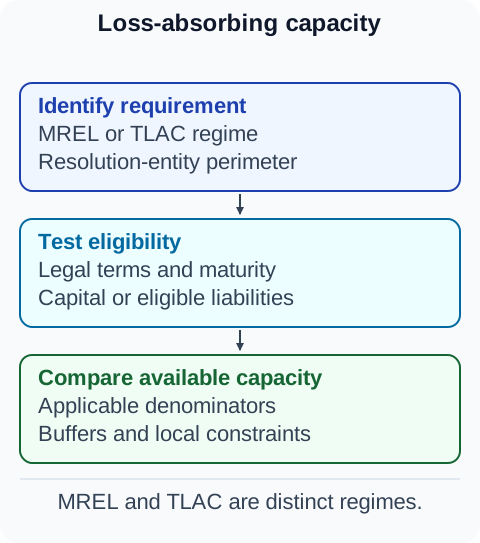 Figure 2. Capacity concepts.
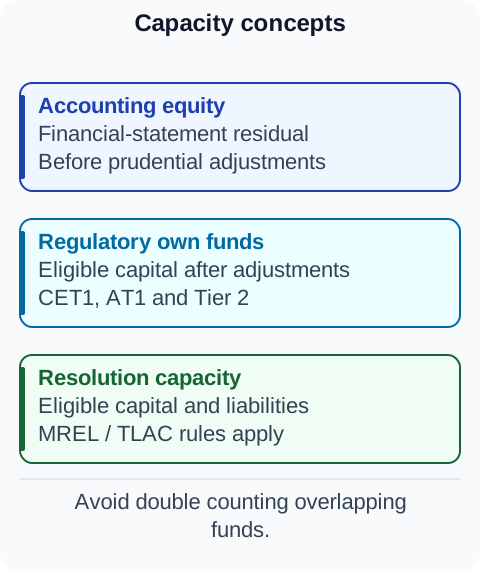 Figure 3. Internal and external capacity.
12. Tables
Table 1 — Eligibility screen (headline, verify)
| Test | Pass |
|---|---|
| Residual maturity | Perpetual or at least one year where required; assess applicable call and redemption terms |
| Subordination | Strategy-compliant |
| Acceleration/set-off | Meets the actual eligibility restrictions and any permitted exceptions |
| Issuer | Resolution entity (external) |
Table 2 — Disclosure contents (headline)
| Table | Shows |
|---|---|
| Requirement vs resources | Shortfall/surplus |
| Maturity profile | Decay visibility |
| Creditor hierarchy | Ranking in insolvency |
| Internal MREL | Per-entity positioning |
13. Illustrative banking case study
Internal capacity counted twice (fictional). Treasury adds a subsidiary’s internally issued bond to group external resources. The parent holds the matching asset, so consolidation eliminates both positions and reveals an external shortfall. Remediation separates external-resource and subsidiary-positioning dashboards, reconciles holdings and applies legal eligibility reviews. A successful data rehearsal does not certify that a real resolution would execute as planned.
14. BA, developer, tester and operations guidance
- BA: Specify eligibility rules, internal scaling, hierarchy mapping and disclosure tables.
- Developer: Flag eligibility at issuance; forecast decay; reconcile internal/external automatically.
- Tester: Maturity-boundary eligibility flips; hierarchy accuracy; shortfall math.
- Operations: Diary refinancing years ahead; monitor internal positioning quarterly.
15. Common mistakes
- Counting sub-1y instruments as eligible.
- Ignoring internal MREL scaling per entity.
- Hierarchy disclosures stale after issuances.
- Planning issuance only when shortfall bites.
- Confusing MREL with going-concern capital.
16. Key takeaways
- MREL/TLAC = gone-concern resources, calibrated to strategy, disclosed publicly.
- Eligibility (maturity, subordination, entity) needs issuance-time review.
- Internal MREL pre-positions loss-absorption where subsidiaries fail.
- Decay monitoring prevents overnight shortfalls.
- Resolvability is tested, not asserted.
17. References and verification notes
- FSB TLAC principles and term sheet: dual minima, capital-buffer interaction, eligibility and internal TLAC.
- SRB MREL policy: applicable EU policy and authority-set requirements.
- Bank of England MREL: UK implementation; consult the current policy and entity decision.
- Figures are fictional training illustrations.