Chapter 055: Balance Sheet Substantiation
Section 11: Reconciliation, Financial Control and Close · Chapter 055 of 100
This chapter explains balance sheet substantiation from the reporting bank's perspective. Examples are fictional; accounting follows IFRS unless another framework is expressly identified.
1. Chapter opening
Balance-sheet substantiation demonstrates what each material balance represents and whether it is supported. The owner reconciles the GL to suitable evidence, explains movement and tracks unresolved items; an independent reviewer tests the important assertions. Certification is a control conclusion, not a guarantee that future misstatements cannot occur.
2. Learning objectives
- Assemble a certification pack (agree/explain/clear/sign) for any account.
- Set certification frequency by risk (materiality × volatility × judgement).
- Code errors by root cause and track repeat patterns.
- Explain audit-trail requirements (immutability, linkage, retention).
- Describe how certification failures escalate to restatement decisions.
3. Business context
A bank may have a perfectly agreeing loan subledger and GL but still use an unsupported valuation or omit a source population. Choose evidence for existence, completeness, valuation, rights/obligations and presentation as applicable. Signature coverage, reviewer question counts and elapsed review time do not independently prove control quality.
| Pack component | Purpose |
|---|---|
| GL and supporting proof | Reconcile the defined population |
| Movement explanation | Quantify economic and accounting drivers |
| Open items | Preserve owner, risk and resolution plan |
| Review conclusion | Evidence procedures and judgement |
| Signed version | Link approval to the actual inputs/results |
4. Finance and accounting view
4.1 Pack mechanics (fictional loan-accrual account, 45m)
The source schedule is 45.2m versus GL 45.0m. Prove the 0.2 difference against specific cut-off events; it is not "auto-cleared" simply because someone labelled it timing. The movement from 42m to 45m consists of 2.4m rate effects plus 0.6m book growth. The pack records the remaining item's owner, expected posting and review conclusion. Subsequent clearance confirms the explanation.
Proof must address existence, completeness, valuation, rights/obligations and presentation as relevant. A subledger tie-out demonstrates agreement; it does not independently validate valuation assumptions. A creditor statement can support a liability; absence of an invoice does not prove that services were not received.
4.2 Audit trails and restatement triggers
Retain each signed version, the input snapshot and correction linkage. Evaluate an error individually and with other errors, including qualitative effects on covenants, trends and compensation. Under IAS 8, material prior-period errors generally require retrospective restatement unless impracticable; new information changing a reasonable estimate is generally treated prospectively. Regulatory resubmission rules are a separate assessment.
4.3 Deep dive: repeat-pattern analytics and plug forensics
Use root-cause codes that lead to action: missing feed, mapping, cut-off, unsupported estimate or override. Recurrence requires source repair rather than repeated manual correction. Journal analytics can flag unusual round amounts, vague descriptions and period-end reversals. Balanced debit/credit pairs are normal double entry, not themselves evidence of manipulation. Investigate the lack of economic support, authorisation or appropriate period.
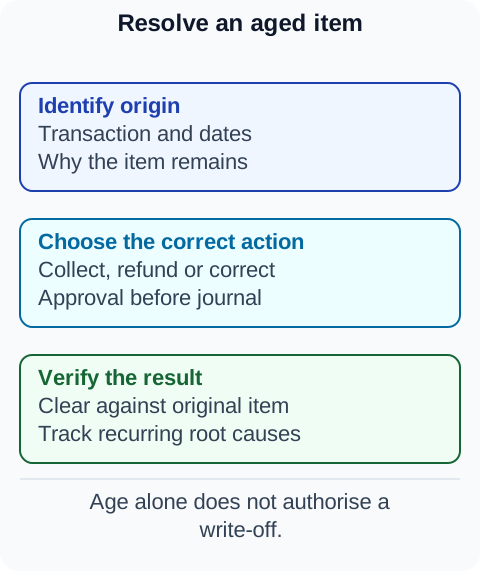
Review static accruals against contract, service-delivery and cancellation evidence. Release only an obligation that no longer exists or an estimate demonstrably in excess, using the correct accounting treatment. A cancellation after services were supplied does not extinguish the accrued payable.
5. Product and customer impact
A fee account misclassification may affect reporting without changing the customer's charge. Integral loan fees may correctly belong within effective-interest income rather than IFRS 15 fee income; determine the fee's economics before proposing correction. If customer rates or transactions were wrong, investigate account-level effects separately.
6. Regulatory and supervisory view
Substantiation supports the bank's internal-control framework. Frequency and coverage are risk-based and follow bank policy and local expectations; ordinary monthly certification does not replace daily active cash reconciliation. IAS 8 governs IFRS error correction. Neither 100% signature coverage nor a high query count proves that balances are supportable.
7. Systems and data view
Link controlled GL snapshots, evidence, account owners, reviewer procedures and exception records. Preserve signed versions and correction links; apply retention according to the actual regime and policy. Workflow flags unsupported material balances for escalation. It must support documented approved exceptions without allowing an unsupported plug or a backdated approval.
8. End to end process
- Scope balances and assertions by risk.
- Obtain the controlled GL and suitable supporting proof.
- Quantify movements and identify residual items.
- Investigate and post supported corrections.
- Independently review evidence and unresolved risk.
- Approve the version, archive proof and repair recurring source defects.
An explained timing difference can remain open when its evidence and risk assessment support the conclusion. An unsupported material balance requires escalation. Risk-based frequency follows actual activity and policy, not an automatic relaxation to quarterly after one clean period.
9. Controls and risks
| Risk | Control | Evidence |
|---|---|---|
| Uncertified balances | Coverage tracking with blockers | Coverage dashboards |
| Boilerplate explanations | Quantification standards, returns | Explanation QA |
| Error repeats | Root-cause coding + analytics | Repeat trend packs |
| Trail gaps | Immutable versioning | Archive audits |
10. Practical examples
Fictional examples: a 2m accrual for a cancelled future project is released only after confirming no services or termination obligation remain. An unexplained 12m movement includes a 4m misclassification discovered through quantified movement analysis. In both cases, book an approved correction and repair the process.
10.3 Worked example: stale-accrual review (fictional, millions)
Fourteen static accruals are examined: nine remain evidenced, three no longer represent obligations (1.2 + 0.8 + 0.5 = 2.5), and two (0.9 + 0.6 = 1.5) need further investigation because support is missing. Release the proven 2.5 with Dr accrued liabilities / Cr relevant expense, subject to the period-error assessment. Keep the 1.5 under review; missing paperwork alone cannot justify profit recognition. Report the supported releases and unresolved balances separately, rather than inventing an annualised benefit or rotation success rate.
11. Diagrams
Figure 1. Substantiate a balance.
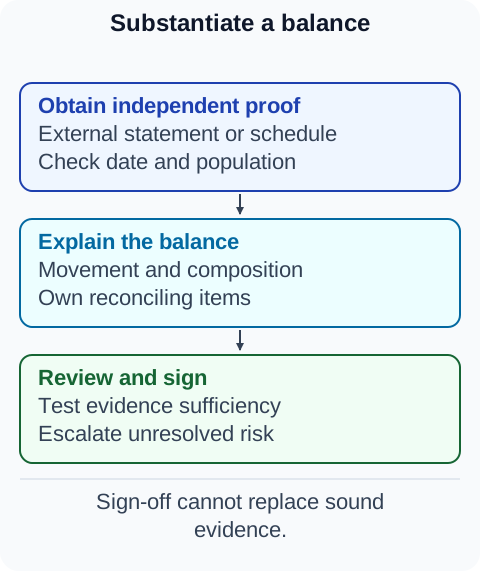 Figure 2. Balance evidence types.
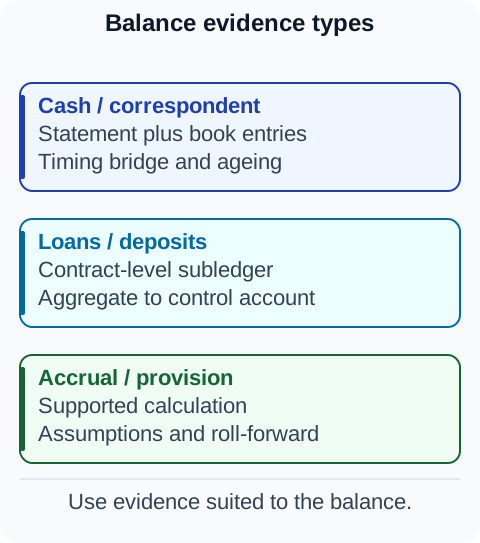 Figure 3. Resolve an aged item.
12. Tables
| Illustrative account | Active transaction control | Formal substantiation |
|---|---|---|
| Cash/nostro/clearing | Daily reconciliation as designed for activity | Risk-based month-end certification |
| Loans/ECL | Feed controls and valuation governance | Reconciled exposures and allowance roll |
| Accruals/provisions | Obligation and estimate review | Movement and supporting schedules |
| Stable low-risk assets | Relevant change/impairment checks | Approved risk-based cadence |
Certification frequency does not replace active payment or cash reconciliation.
13. Fictional banking case study
A fictional team proposes a 40m "timing" adjustment to force an unproved accrual account to agree. The reviewer blocks it and traces the underlying postings. Finance determines the actual corrections, affected periods and disclosure consequences. A technically balanced journal can still be unsupported; software can block missing references, but evidence review remains necessary.
14. BA, developer, tester and operations guidance
Business analysts specify assertions, evidence and account coverage. Developers preserve versions and exception history. Testers challenge missing proof, offsetting breaks, stale approvals and permitted documented exceptions. Operations protect review capacity and track source remediation to evidenced closure.
15. Common mistakes
- Treating a tie-out as independent valuation proof.
- Accepting generic movement explanations without amounts.
- Plugging a residual to meet a deadline.
- Releasing an accrual solely because paperwork is absent.
- Replacing daily cash reconciliation with monthly certification.
- Assuming a sign-off proves every control assertion.
16. Key takeaways
Support each balance with evidence appropriate to its assertions, quantify movements and track residuals to resolution. Separate errors from estimate changes. Investigate static accruals and unusual journals without treating every paired entry or absent invoice as wrongdoing.
17. References and verification notes
- IAS 8: IFRS errors, material prior-period restatement and estimate changes.
- Basel corporate governance principles: effective controls and accountability.
- Examples and certification frequencies are fictional operating designs. They do not prescribe universal thresholds, retention periods or mandatory owner rotation.