Chapter 029: Card and Merchant Settlement Accounting
Section 6: Payment and Settlement Accounting · Chapter 029 of 100
1. Chapter opening
The four-party card model comprises cardholder, merchant, issuer and acquirer, connected by a payment scheme. Authorisation usually reserves availability; clearing creates actual customer/merchant and scheme positions; settlement moves cash according to scheme arrangements. Disputes can create provisional credits and claims whose eventual outcome determines recovery or loss.
Issuer interchange, scheme charges and merchant discount are distinct flows. Credit-card principal creates a receivable for the issuer, while debit-card principal reduces a deposit liability. Acquirer reserve holds ordinarily retain a merchant payable rather than create bank income. Timing varies by scheme, transaction type, capture and funding contract; no universal domestic 1-3 day or cross-border 3-7 day settlement rule applies.
Reconcile transaction detail, net settlement files, subledgers, GL and actual cash. Authorisation controls also need separate monitoring: customer availability can be wrong even when booked balances and GL reconcile.
2. Learning objectives
By the end of this chapter you will be able to:
- Post authorisation (memo), clearing, settlement and fee journals for issuer and acquirer sides.
- Explain interchange, scheme fees and merchant discount economics with a worked split.
- Process chargebacks: provisional journals, representment, arbitration outcomes, loss recognition.
- Classify card losses correctly (fraud vs credit vs operational) and explain why it matters.
- Reconcile scheme settlement files to subledgers and clear breaks.
- Describe penalty/fee accounting under conduct caps (jurisdiction-dependent).
3. Business context
Cards are high-volume, low-value, fraud-exposed businesses where pennies per transaction decide profit: interchange caps (for example EU-regulated caps — verify current rates locally) compress issuer income; merchant discount competition compresses acquirer income; fraud losses grow with e-commerce; and revolving-credit interest carries conduct constraints. Finance must attribute every penny to fee, interest or loss buckets correctly, because product pricing, FINREP splits and conduct reporting all consume the same postings.
The interchange-fee dynamic is the central economic tension in the card business. Interchange is the fee that the acquirer pays to the issuer for each card transaction — it compensates the issuer for the cost of extending credit (or holding deposits), the risk of fraud, and the cost of the card programme. The interchange fee is set by the scheme (Visa, Mastercard) and is typically a percentage of the transaction value plus a fixed fee (with jurisdiction-specific caps; the EU baseline for covered consumer credit transactions is 0.3% of value, not a generic 0.3% plus 10p). The acquirer passes the interchange cost through to the merchant as part of the merchant discount fee (the total fee the merchant pays for accepting card payments). The merchant discount fee also includes the scheme fee (paid to Visa/Mastercard) and the acquirer's margin.
The interchange-cap debate is politically charged. Merchants argue that interchange fees are too high and are ultimately passed through to consumers as higher prices. Card issuers argue that interchange fees fund the card programme — rewards, fraud protection, and the interest-free period — and that capping interchange will reduce card benefits and increase card costs. The regulatory response has been to cap interchange fees in several jurisdictions (EU IFR, US Durbin Amendment, Australia RBA intervention). The caps have reduced issuer income, compressed margins, and forced issuers to find alternative revenue sources (annual fees, foreign-transaction fees, interchange differentiation by merchant category).
| Role | Earns | Bears | Key ledger |
|---|---|---|---|
| Issuer | Interchange, annual/late fees, revolving interest | Credit losses, fraud, chargeback handling | Card receivables, scheme payables/receivables |
| Acquirer | Merchant discount (net of interchange + scheme fees) | Merchant default, delayed-delivery risk, PCI costs | Merchant payables, scheme positions |
| Scheme | Assessment fees, processing fees | Network operation | (External to the bank; counterparty) |
4. Finance and accounting view
4.1 Issuer clearing and settlement
Illustrative credit-card purchase 100; interchange 1.50 is a fictional fee, not an EU-covered consumer rate. Authorisation reserves available credit without a GL posting. Clearing: Dr Cardholder receivable 100 / Cr Scheme payable 100. Earned interchange: Dr Scheme receivable 1.50 / Cr Interchange income 1.50. Net settlement: Dr Scheme payable 100 / Cr Cash 98.50 / Cr Scheme receivable 1.50. The journal balances and clears both positions. For a debit card, the principal debit reduces a deposit liability instead of creating a loan receivable.
Customer repayment: Dr Cash / Cr Cardholder receivable. Interest and integral lending fees follow IFRS 9 effective-interest mechanics where applicable, with ECL on in-scope credit exposures. A separate service fee follows IFRS 15 according to the actual performance obligations; 'annual fee' alone does not decide the standard or recognition pattern.
4.2 Acquirer and reserve
For the same purchase, merchant discount 2.00: Dr Scheme receivable 98.50 / Cr Merchant payable 98.00 / Cr Acquiring income 0.50. A separately incurred scheme assessment of 0.20 posts Dr Scheme expense / Cr Scheme payable; the illustrative net contribution is 0.30 before other costs. Gross versus net revenue presentation requires a principal-agent assessment, not just the settlement-file layout.
Pay the merchant: Dr Merchant payable 98 / Cr Cash 98. A 3 reserve withheld from this payable instead posts Dr Merchant payable 3 / Cr Merchant reserve liability 3; pay 95 and retain a liability of 3. Do not debit cash when merely withholding an existing payable. Reserve percentages, release dates and safeguarding terms are contractual.
4.3 Dispute outcomes
A provisional credit of 100 on a credit-card receivable may post Dr Chargeback receivable 100 / Cr Cardholder receivable 100, but recognise a receivable only when supported by enforceable rights and the applicable accounting policy. For a debit account, the credit increases a customer deposit liability. Provisional customer credit is distinct from an interbank chargeback already settled.
If the issuer's claim succeeds and the acquirer pays: Dr Cash 100 / Cr Chargeback receivable 100. That recovery clears an asset; it is not automatically an issuer fraud loss. The acquirer may post Dr Merchant recovery receivable / Cr Scheme payable and recognise impairment or another loss if the merchant cannot repay. If the claim fails and the customer is legally liable: Dr Cardholder receivable / Cr Chargeback receivable. If the customer is protected and the issuer must absorb the amount: Dr Appropriate loss / Cr Chargeback receivable. Reversals depend on which provisional and settled legs actually exist.
Reason codes, evidence, rights and deadlines depend on scheme and transaction facts. Refund, chargeback, representment and arbitration are separate events. A payment authentication result alone never determines every dispute's outcome.
4.4 Fee and loss classification
Distinguish lending interest/EIR fees, services, scheme assessments, customer reimbursements, credit impairment and operational losses. Fraud can involve a recognised loan or an unauthorised debit; identify the legal receivable before classifying the loss. Regulatory operational-loss taxonomies and financial-statement expense lines are related but not identical. Use documented mapping rather than a rule that every fraudulent card loss belongs in one P&L line.
5. Product and customer impact
Pending authorisations affect available credit or funds; cleared transactions affect booked balances. Explain both clearly. Interest-free purchase periods, exclusions, payment allocation and due dates are contract-specific: 'up to 56 days' is an example, not a universal card rule. Recompute accrual from actual terms, partial payment and cash-advance treatment.
Merchants need settlement timing, discount charges, reserve conditions and dispute deadlines. Under the EU Interchange Fee Regulation, distinguish Article 9 unblending obligations from Article 12 post-transaction information: neither should be summarised as a universal obligation to show every acquirer-margin component on each transaction. Local scope, merchant requests and permitted aggregation matter.
6. Regulatory and supervisory view
EU Regulation 2015/751 sets baseline caps of 0.2% for covered consumer debit and 0.3% for covered consumer credit interchange, with scope exclusions and national options. Merchant discount includes other charges and is not itself capped at those rates.
PSD 2 Article 74(2) addresses loss allocation when strong customer authentication is not required/applied: it does not say that successful SCA shifts all fraud liability to the acquirer. Scheme liability shifts, exemptions, unauthorised-payment protections and merchant disputes must be assessed separately.
PCI DSS is an industry card-data security standard enforced through scheme/acquiring arrangements. Current version, validation obligations and applicable contracts determine controls; avoid generic invented fine bands or claims that every entity must undergo the same annual validation.
7. Systems and data view
Connect authorisation holds, capture/clearing, scheme net settlement, customer billing, merchant funding and disputes through stable transaction references. Reconcile scheme detail and totals to card/merchant subledgers, the GL and actual settlement cash. Scheme-file correctness alone cannot prove a nostro settled.
Track holds by age, amount and merchant category; expiry periods vary by scheme and transaction type. Link captures, reversals and incremental authorisations to their original holds. Dispute deadlines and provisional credit logic follow the applicable scheme and legal obligations. Bank SLA thresholds are controls, not universal 2-5 day resolution law.
8. End to end process
- Record authentication and authorisation without inventing a settled cash movement. 2. Match capture/clearing, release the hold and post actual principal/fees. 3. Reconcile and settle net scheme positions. 4. Apply customer billing and interest terms. 5. Assess the dispute and record any supported provisional credit/claim. 6. Monitor scheme deadlines and evidence. 7. Post recovery, reversal or bank loss according to the actual decision. 8. Reconcile all customer, merchant and scheme legs. A successful merchant defence normally reverses the chargeback; an accepted issuer claim leaves the customer credit funded by the recovered value.
9. Controls and risks
| Risk | Control | Evidence |
|---|---|---|
| Scheme totals untied to ledgers | Daily three-way match, break ageing | Match reports, break packs |
| Stale memo holds blocking balances | Memo expiry rules, authorised-never-cleared review | Memo-ageing reports |
| Missed dispute deadlines | Deadline diary with escalation | Deadline compliance metrics |
| Loss misclassification | Classification policy with decision tree, QA sampling | QA results, reclassification logs |
| Merchant collapse exposure | Reserve policy, delayed-delivery monitoring | Reserve adequacy reviews |
10. Practical examples
Fictional reserve: an acquirer retains 10% of a merchant's 100,000 payable under the agreed rolling-reserve terms. Dr Available merchant payable 10,000 / Cr Reserve merchant payable 10,000 reclassifies the obligation; no cash is received and no reserve income is earned. Pay 90,000 by debiting available payable and crediting cash. Use/release of the remaining 10,000 requires actual contractual events and supported entries.
Fictional disputed identity theft: the issuer assesses whether it has an enforceable customer receivable and a supported scheme recovery claim. Fraud labels alone do not settle accounting classification. Correct an earlier credit-loss classification only if the actual rights/facts show it was wrong; recognise recovery, customer liability or an appropriate bank loss under the outcome and policy. The customer's provisional credit and the bank's chargeback claim need separate reconciliation.
11. Diagrams
Figure 1. Card purchase: clearing and settlement.
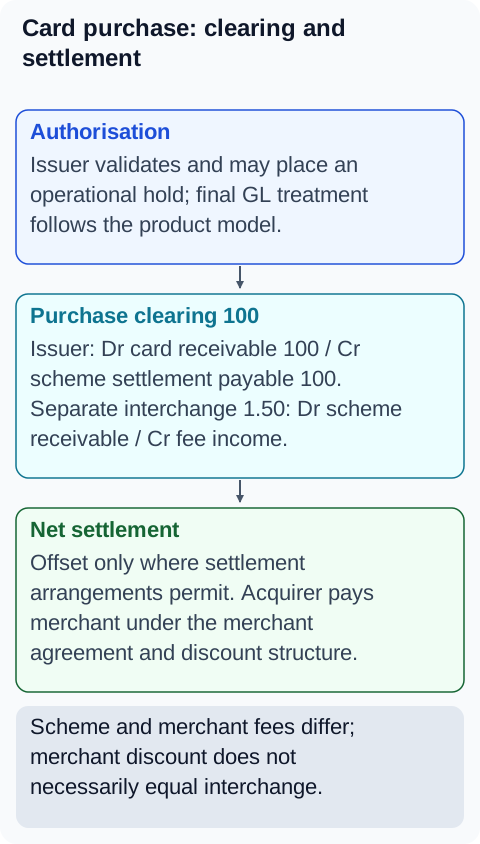
Figure 2. Dispute accounting and final outcome.
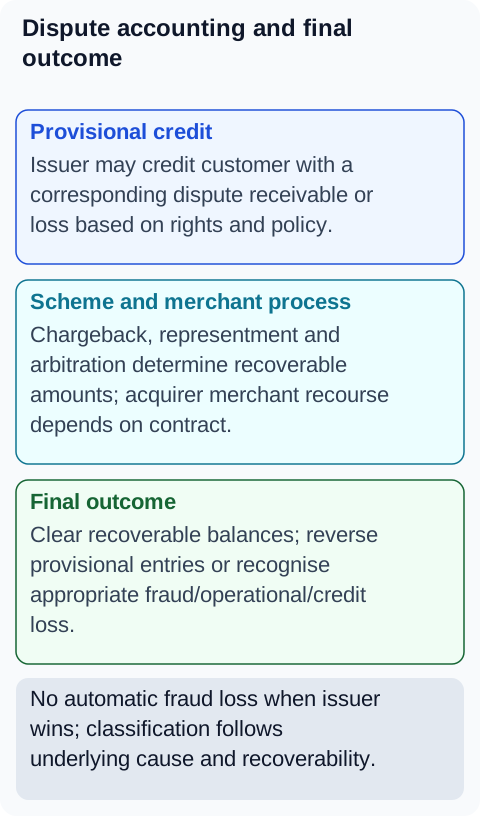
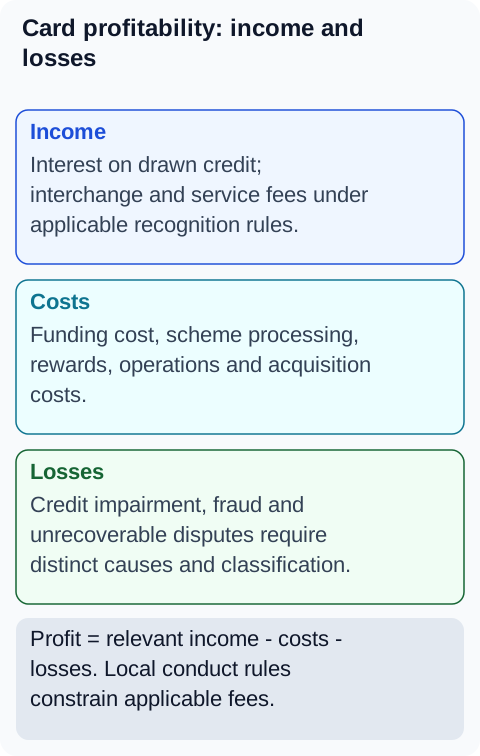
Figure 3. Card profitability: income and losses.
12. Tables
| Event, credit-card issuer | Debit | Credit |
|---|---|---|
| Clearing principal | Cardholder receivable | Scheme payable |
| Earn interchange | Scheme receivable | Interchange income |
| Net settlement | Scheme payable | Cash plus scheme receivable |
| Supported provisional claim | Chargeback receivable | Cardholder receivable |
| Claim recovered | Cash | Chargeback receivable |
| Claim fails, customer liable | Cardholder receivable | Chargeback receivable |
| Claim fails, issuer liable | Appropriate loss | Chargeback receivable |
Debit-card customer legs use deposit liabilities. Acquirer losses depend on merchant recovery rights, reserves and solvency. Neither party should record a loss merely because a case is final.
13. Illustrative bank case study
Fictional bank scenario. A release disables the authorisation-expiry job. Stale holds reduce customer available balances while booked balances remain correct. Operations restores the governed expiry process, investigates captured/reversed items and assesses redress. Hold ageing is monitored independently of GL reconciliation because a clean GL can coexist with incorrect customer availability. This training case does not assert an event at an unnamed real institution.
14. BA, developer, tester and operations guidance
- BA: Map all four parties' legs per scenario (purchase, refund, dispute win/lose, partial settlement) with journals, timing and reason codes before build.
- Developer: Idempotent clearing keyed on scheme references; memo lifecycle with expiry; dispute deadlines as workflow SLAs; classification derived from reason codes at posting.
- Tester: Three-way match with seeded breaks; duplicate-file replays; deadline-boundary disputes; partial reversals; multi-currency clearing with FX splits.
- Operations: Reconcile scheme files daily before value-release decisions; work deadline diaries as strictly as payment deadlines.
15. Common mistakes
- Treating authorisation as a GL posting (it's a memo).
- Force-matching scheme breaks instead of investigating.
- Classifying fraud as credit loss (or vice versa) at month-end.
- Ignoring whether a fee belongs in IFRS 9 EIR or IFRS 15 revenue and its relevant recognition period.
- Letting memo holds accumulate without expiry monitoring.
- Failing to reconcile scheme settlement files to the subledger daily.
- Misclassifying chargeback losses — fraud vs credit vs operational.
16. Key takeaways
- Cards chain four parties across memo, clearing, settlement and dispute stages — one event ID throughout.
- Interchange, discount and scheme fees split each transaction three ways; caps compress both sides.
- Chargebacks are provisional journals with deadlines — outcomes decide final loss homes.
- Loss classification at first posting protects dashboards, returns and prevention budgets.
- Reconcile scheme, subledger, GL and settlement cash at a frequency appropriate to the actual processing cycle.
17. References and verification notes
- EU Interchange Fee Regulation
- PSD 2 including Article 74
- IFRS 9 fee and impairment framework
- PCI Security Standards Council
- Rules are applied under the reporting entity's adopted accounting framework and jurisdiction. Basel standards require local implementation; they are not themselves national law. All unnamed cases, amounts and operational thresholds are fictional training examples.