Chapter 060: Notes and Presentation Requirements
Section 12: Financial Statements and Group Reporting · Chapter 060 of 100
This chapter explains notes and presentation requirements from the reporting bank's perspective. Examples are fictional; accounting follows IFRS unless another framework is expressly identified.
1. Chapter opening
Bank financial statements combine primary statements and notes that explain measurement, judgements, risk and changes in balances. Notes must reconcile to the same reporting perimeter and period as the statements. A regulatory template is not a substitute for an IFRS disclosure assessment.
2. Learning objectives
- Assemble material accounting policies and judgement disclosures.
- Reconcile interest, fees, impairment and OCI to ledgers and supporting rolls.
- Distinguish current IAS 1 presentation from future IFRS 18 requirements.
- Explain which OCI items recycle and which do not.
3. Business context
A balance can reconcile yet remain inadequately disclosed. Examples include concentrated funding, uncertain tax recovery, valuation uncertainty and a change in ECL assumptions. Finance needs risk, treasury, legal and tax input; the notes explain significant economic facts rather than repeat generic policy text.
4. Finance and accounting view
4.1 Statements and reconciliations
Illustrative revenue is net interest income 625, fees 275 and trading income 100. Operating costs of 550 and impairment of 125 give profit before tax of 325. Tax of 80 gives profit of 245; OCI of negative 40 gives total comprehensive income of 205. OCI does not alter this period's profit of 245.
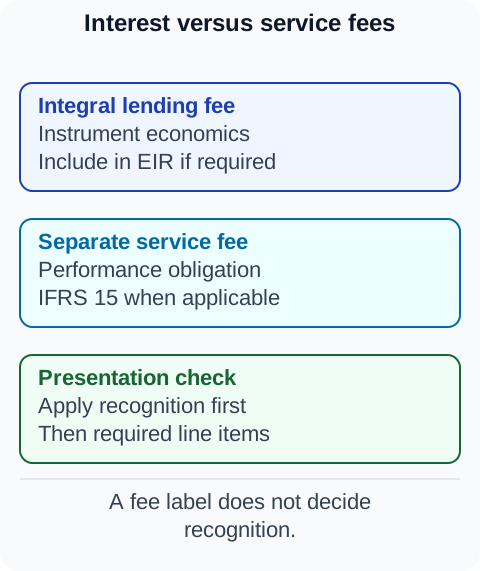
The net-interest note combines interest income and expense. An interest-receivable roll proves only the relevant asset accruals; also reconcile interest payables, cash receipts/payments, effective-interest fees, modifications and classifications. Customer APR and accounting effective interest rate answer different questions and need not be equal.
An allowance roll can include opening balance, impairment charges/releases, write-offs, FX, acquisitions, disposals and other relevant movements. Cash recoveries of previously written-off assets may be recognised through profit or loss rather than added to the allowance; reflect the actual policy and entries. Reconcile gross exposures and staging movements as well as the allowance.
4.2 OCI and presentation
Debt instruments measured at FVOCI generally recycle the cumulative OCI balance on derecognition. Market losses may recover as rates change; holding a bond does not guarantee a future loss cliff. FVOCI equity-election gains/losses and defined-benefit remeasurements do not recycle to profit or loss. Equity OCI can be transferred within equity. Classify each reserve by its governing standard and include tax effects appropriately.
IFRS 18 replaces IAS 1 for annual periods beginning on or after 1 January 2027, with early application permitted, subject to local endorsement. It introduces defined categories and subtotals; banks must apply the specific main-business-activity requirements, rather than copy a non-financial company's presentation. Management-defined performance measures are qualifying income/expense subtotals used in public communications; not every internal KPI, ratio or net-interest figure is automatically an MPM.
5. Product and customer impact
Disclosure quality helps customers and investors understand the bank's funding, credit exposures and earnings. Avoid presenting a non-GAAP adjusted measure as statutory profit or treating a favourable market-value movement as cash available for distribution.
6. Regulatory and supervisory view
As of 3 October 2026, IAS 1 remains the presentation basis for entities that have not early adopted IFRS 18 under their applicable regime. IFRS 18 has a 2027 IASB effective date. IFRS 7 requires relevant financial-instrument risk information, including applicable sensitivity disclosures; it does not universally mandate publication of every IPV exception or a one-point GDP sensitivity for every portfolio. IFRS and US GAAP must be assessed separately; US GAAP has removed the extraordinary-item concept, so it is not a current presentation distinction.
7. Systems and data view
Maintain a disclosure checklist linked to applicability, workpapers, ledger accounts, reviewed narrative and final statement version. Roll-forward automation needs controlled classifications and a residual check; drafting software cannot decide materiality or the completeness of significant judgements.
8. End to end process
- Confirm framework, perimeter and period.
- Reconcile statement totals and supporting rolls.
- Identify material judgements, risks and events.
- Draft entity-specific notes and comparative information.
- Review cross-references, arithmetic, policy consistency and presentation.
- Approve one controlled financial-statement version.
9. Controls and risks
| Disclosure risk | Review test |
|---|---|
| Generic policy omits judgement | Trace material estimates to specific narrative |
| Note total differs from statement | Reconcile reporting version and scope |
| OCI described as deferred profit | Check recycling rule for each reserve |
| IFRS 18 treated as already mandatory | Confirm period, adoption and endorsement |
10. Practical examples
A fictional bank's allowance moves from 120 to 130: impairment charge 25, write-offs 12, FX decrease 3 and no other movements. The proof is 120 + 25 - 12 - 3 = 130. A separate recovery of 2 on a previously written-off loan is recorded under the bank's recovery policy, not inserted into this roll without an allowance entry. Explain the 25 charge, including model and portfolio changes, rather than claim that the net 10 movement equals the expense.
11. Diagrams
Figure 1. Presentation and notes.
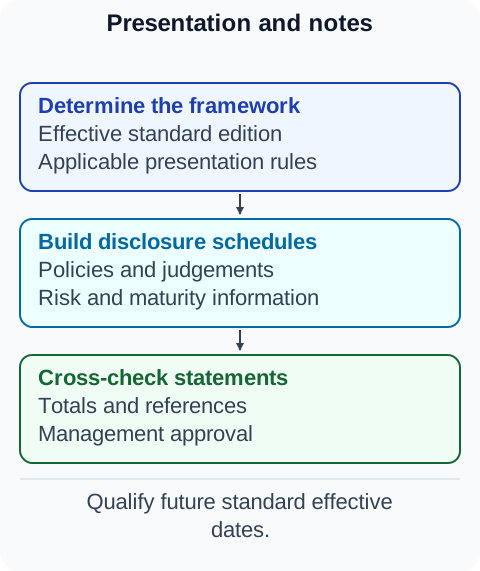 Figure 2. Disclosure purposes.
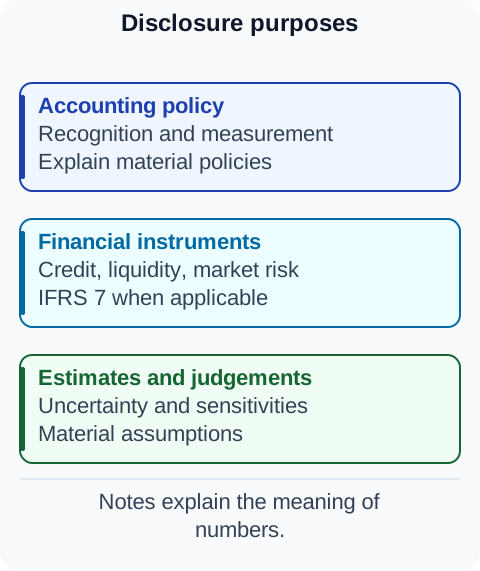 Figure 3. Interest versus service fees.
12. Tables
| Measure | Amount |
|---|---|
| Net interest + fees + trading | 1,000 |
| Operating costs + impairment | 675 |
| Profit before tax | 325 |
| Tax / profit | 80 / 245 |
| OCI / total comprehensive income | -40 / 205 |
13. Fictional banking case study
A fictional bank published adjusted profit excluding repeated remediation costs. Finance retained statutory profit, explained the adjustment and challenged whether the public subtotal required an MPM disclosure under its adopted framework. No unsupported share-price or enforcement outcome is inferred.
14. BA, developer, tester and operations guidance
Statement preparation supplies the numbers; notes explain their basis and risk. IFRS 9 valuation and ECL chapters provide supporting measurements. Performance measures need transparent bridges to the statutory statements.
15. Common mistakes
- Treating FINREP completion as complete IFRS disclosure.
- Proving NII solely from asset interest receivables.
- Calling all OCI future profit or loss.
- Treating every internal metric as an IFRS 18 MPM.
- Publishing boilerplate that conceals a material bank-specific judgement.
16. Key takeaways
Complete notes reconcile, explain and qualify. Separate profit from OCI, identify the recycling rule for each reserve and prepare for IFRS 18 using the correct adoption date and banking-specific requirements.
17. References and verification notes
- IAS 1 and IFRS 18: presentation and adoption timing.
- IFRS 7: financial-instrument disclosures.
- IFRS 9: effective interest, ECL and FVOCI.
- FASB ASU 2015-01: communicates the removal of the US GAAP extraordinary-item concept; amendments effective for fiscal years beginning after 15 December 2015.
- Figures and case study are fictional.