Chapter 052: Subledger-to-GL Reconciliation
Section 11: Reconciliation, Financial Control and Close · Chapter 052 of 100
This chapter explains subledger-to-gl reconciliation from the reporting bank's perspective. Examples are fictional; accounting follows IFRS unless another framework is expressly identified.
1. Chapter opening
Subledger-to-GL reconciliation proves that detailed accounting records agree with their general-ledger control accounts for the same entity, currency, accounting basis and cut-off. A separate reporting bridge then explains differences between accounting balances and a supervisory measure. A COREP exposure value is not necessarily the GL loan carrying amount: commitments, credit-conversion factors, netting and prudential adjustments can change it.
2. Learning objectives
- Reconcile subledger and GL populations with controlled cut-off.
- Distinguish timing, scope, mapping and error differences.
- Require zero unexplained cash differences while evidencing legitimate timing items.
- Assign each break an owner, risk assessment and resolution evidence.
- Bridge the reconciled GL to reporting adjustments separately.
3. Business context
Start with a defined population and controlled snapshots. Compare gross loans with gross loans, and allowances with allowances, before comparing net carrying values. Include accrued interest and integral fees consistently. A net difference of zero can conceal offsetting missing and duplicated records.
| Difference | Evidence required | Treatment |
|---|---|---|
| Cut-off or processing timing | Event and batch timestamps, expected completion | Track to actual clearance |
| Scope or measurement | Approved rule and quantified bridge | Retain and refresh |
| Posting/feed error | Source event and incorrect or missing entry | Correct, rerun and root-cause |
4. Finance and accounting view
4.1 Tie-out mechanics (fictional loan book)
All amounts are millions. A broader source population totals 60,050. It contains 80 of next-day activity outside the agreed cut-off. The GL contains a separate entity balance of 20 not present in that source population and a valid 10 manual accrual not yet included in the product extract. The bridge is 60,050 - 80 + 20 + 10 = 60,000. Prove each component; these signs matter. If the 10 instead represented an omitted GL feed, it would be an error requiring correction, not a permanent bridge.
Perform one-to-one event matching where journals are available. Where the GL receives summarised batches, prove batch counts and debit/credit totals as well as account totals. For FX, reconcile in original currency first, then explain translation and rounding using consistent rates. Do not set a tolerance from the size of unexplained historical breaks.
4.2 Pack and analytics
The pack identifies the snapshots, population filters, control accounts, matching-rule version and residual items. Every residual has an amount, currency, cause, owner, due date and evidence. Cash accounts can have valid statement timing items; the goal is zero unexplained difference, not denial that cut-offs differ. Material accounting errors cannot be accepted merely because they fall below an automated matching tolerance.
4.3 Deep dive: tolerance analytics and scope-bridge stability monitoring
Rounding tolerances should be small, justified and tested against known-correct cases. They never authorise writing off or concealing a residual. Monitor value and count cleared under each rule, offsetting items and repeated causes. Scope-bridge amounts may change naturally as included entities' balances change; stability of the rule, explanation of the movement and reassessment of applicability matter more than a flat balance.
A regulatory bridge is different from the source-to-GL bridge. For example, a 100 gross loan less a 2 accounting allowance gives 98 carrying value; a prudential exposure may then include undrawn commitments or approach-specific adjustments. Prove both bases instead of forcing them to match.
5. Product and customer impact
A reconciled GL does not prove every customer account is correct. A fee may be allocated to the wrong customer while the control account still agrees. Complement aggregate reconciliation with customer-level exceptions and assess redress separately where a posting defect affects customers.
6. Regulatory and supervisory view
Reconciliation supports the control expectations in Basel corporate governance principles. Frequency, tolerances and return-notification procedures follow the applicable rulebook and bank policy. For IFRS, errors and estimate changes follow IAS 8; a prior-period error cannot be called immaterial simply because it was found in a small feed.
7. Systems and data view
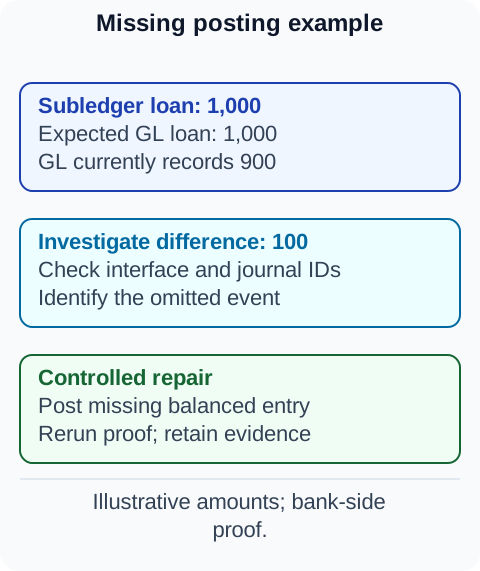
The engine consumes controlled extracts from both sides; it does not generate the external truth. Version account scopes and matching rules. Preserve original amounts, record match groupings and prevent a replayed batch posting twice. Report missing feeds explicitly even if total balances happen to agree.
8. End to end process
- Define the entity, currency, basis and cut-off.
- Prove extract completeness and batch controls.
- Match gross balances, allowances and associated accruals.
- Classify and evidence residuals.
- Correct errors and rerun.
- Review the pack and build the separate regulatory bridge.
- Track recurring causes to source-system repair.
9. Controls and risks
| Risk | Control | Evidence |
|---|---|---|
| Tolerance creep | Approval + trend review | Tolerance logs |
| Scope drift | Bridge stability monitoring | Bridge variance reports |
| Break ageing | Escalation timers | Age compliance metrics |
| Manual plugs | Plug prohibition + analytics | Plug-attempt logs |
| Feed omission | Completeness checks against source counts | Feed reconciliation logs |
| Reciprocal mismatches | Mirror-matching with zero tolerance | Match reports |
10. Practical examples
Fictional example: a 120 difference between risk and finance consists of 80 attributable to regulatory scope, 30 from an omitted feed and 10 from a wrong GL mapping. The 80 is supported by the perimeter decision; the 30 and 10 are corrected. An unsupported 120 "timing" label would conceal three different treatments.
Tolerance example: cleared residuals of 3.1, 3.4, 2.9, 3.8, 4.1 and 4.4 rise by 41.9% from first to last. If investigation finds cumulative omitted accruals of 42, assess their affected periods and aggregate materiality before selecting correction or retrospective restatement. A declining tolerance is not a substitute for booking the missing transactions.
11. Diagrams
Figure 1. Subledger-to-GL proof.
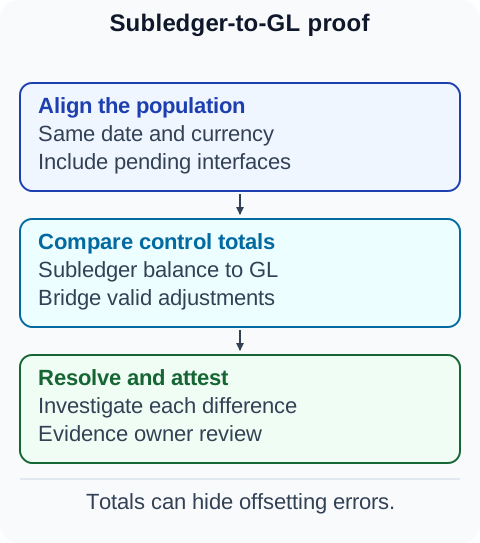 Figure 2. Reconciliation breaks.
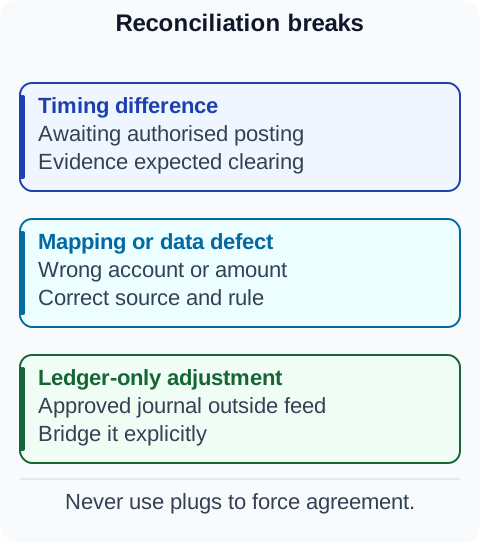 Figure 3. Missing posting example.
12. Tables
| Population | Accounting proof | Further regulatory bridge |
|---|---|---|
| Loans | Gross principal, EIR/accruals, allowances | Exposure measure, commitments and scope |
| Deposits | Customer balances and interest payable | Counterparty class and liquidity assumptions |
| Treasury | Positions, valuations and cash | Risk and netting rules |
| Fees | Events and revenue timing | Required presentation dimensions |
| Residual | Policy response |
|---|---|
| Unexplained cash item | Prompt investigation and risk-based escalation |
| Evidenced statement timing | Track expected clearing date |
| Rounding | Approved minimal tolerance with monitoring |
| Material error | Correct and assess reporting consequences |
13. Fictional banking case study
A fictional bank excluded an entity from a reporting measure under an approved rule. The exclusion grew by 200 as the entity originated more loans. Growth alone did not invalidate the bridge; the failure was that nobody reassessed whether the entity's changed activities affected the rule. Finance and reporting review the scope decision, correct any resulting return errors and retain the evidence.
14. BA, developer, tester and operations guidance
Business analysts define populations, cut-off, matching rules and the separate return bridge. Developers preserve unmatched items and prevent unexplained plugs. Testers seed legitimate timing differences, missing feeds and offsetting errors. Operations assess risk and escalate according to the approved policy rather than clearing items automatically when a timer expires.
15. Common mistakes
- Plugging differences to force agreement.
- Labelling errors "timing" without auto-clear evidence.
- Tolerances that grow to fit breaks.
- Scope bridges that drift unexamined.
- Attesting over material aged breaks.
- Reviewing reconciliation packs only at quarter-end instead of each cycle.
- Allowing the same person to set matching rules and approve break resolutions.
16. Key takeaways
Prove source records to GL control accounts on a common basis. Explain regulatory measurement separately. Track timing to actual clearance, correct errors and reassess scope rules when facts change. Zero net difference and automated tolerance clearance are insufficient evidence on their own.
17. References and verification notes
- Basel corporate governance principles: reliable control processes.
- IAS 8: estimates and error correction under IFRS.
- Amounts, timelines and methods are fictional operating illustrations; no universal cash tolerance, bridge-amount stability rule or resubmission threshold is asserted.