Chapter 028: Instant Payments and Continuous Accounting
Section 6: Payment and Settlement Accounting · Chapter 028 of 100
1. Chapter opening
Instant payments compress customer service time, but speed does not determine whether interbank settlement is gross or net. Faster Payments and UPI use arrangements distinct from central-bank RTGS services. SEPA Instant is a scheme whose participants can use different clearing and settlement infrastructures. FedNow, RTP, TIPS and Pix must each be assessed under their own operating rules.
Continuous accounting means timely event capture, position monitoring, reconciliation and controlled period snapshots. It does not abolish financial close, require event sourcing, or require each customer transaction to become a separate enterprise GL journal.
2. Learning objectives
- Separate customer funds availability from interbank settlement.
- Design balanced postings for gross and deferred settlement.
- Reconcile an operational subledger to aggregated GL journals.
- Define event, settlement, value and reporting timestamps.
- Maintain a reproducible period cut-off without stopping a 24/7 service.
- Manage prefunding, limits and out-of-hours incidents.
3. Business context
A bank may update customer balances and settlement obligations instantly, then send complete controlled totals to its enterprise GL. This works if aggregation preserves currency, entity, account, booking date and lineage, and if unmatched or delayed events are visible. A realtime GL is another valid design, not a universal mandate.
| Service/infrastructure | Customer-facing service | Settlement distinction |
|---|---|---|
| UK Faster Payments | Rapid 24/7 availability | Deferred net interbank settlement with system risk controls |
| India UPI | Immediate retail transfer service | Clearing/net settlement arrangements; not RBI RTGS |
| US FedNow | 24/7 instant payments | Gross settlement in Federal Reserve accounts |
| US RTP | 24/7 payments | Prefunded settlement arrangement, distinct from FedNow |
| SEPA Instant | Euro instant-transfer scheme | Infrastructure-specific; TIPS is central-bank settlement |
| Brazil Pix | Instant retail service | SPI settles in central-bank money; on-us flows differ |
Customer service deadlines, limits and contingency arrangements belong in the current system specification. Do not transfer one system's parameters to another.
4. Finance and accounting view
4.1 Balanced postings
Assume a 5,000 incoming transfer is settled in central-bank money before customer credit: Dr Settlement asset 5,000 / Cr Customer deposit liability 5,000. If the bank receives value but cannot allocate it, Dr Settlement asset 5,000 / Cr Unallocated receipt liability 5,000. Allocation later: Dr Unallocated receipt liability / Cr Customer deposit liability. An alert or memo hold alone has no cash journal.
If a deferred-settlement system makes a confirmed 5,000 customer credit before interbank settlement, an illustrative sequence is Dr Scheme settlement receivable / Cr Customer deposit liability; at settlement Dr Settlement asset / Cr Scheme settlement receivable. Scheme-specific prefunding or collateral movements are separate assets or obligations, reconciled independently. Do not use a fictitious cash debit before cash actually moves.
4.2 Continuous capture and periodic close
Capture unique event ID, business date, time zone, event time, receipt time, booking time and settlement reference. A reporting snapshot uses an agreed boundary and event-sequence watermark. Processing continues into the next period; late-arriving events are assigned through controlled cut-off and adjustment rules. A midnight snapshot does not require stopping the payment engine.
Reconcile accepted instructions, operational postings, scheme acknowledgements and settlement statements. GL batch totals require counts and sums, completeness checks, duplicate controls and drill-down to every event. A delayed GL batch can be acceptable under a controlled design; a delayed spendable customer balance on a confirmed instant receipt is a different service defect.
4.3 Liquidity and prefunding
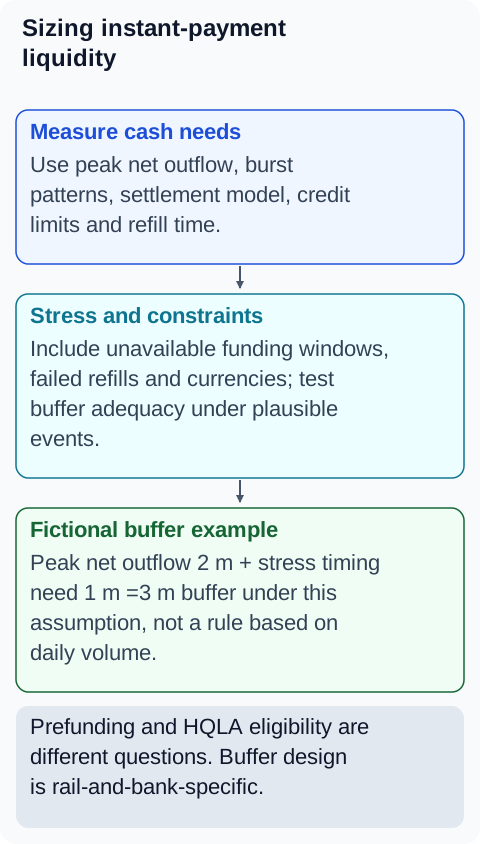
Forecast out-of-hours outflows, liquidity trapped in settlement accounts, replenishment access and scheme exposure limits. Buffer size follows stress tests and the actual settlement arrangement, not a universal 10-20% of payment volume. LCR covers a prescribed 30-day stress and does not substitute for intraday monitoring. Classification as central-bank balances, due from banks or another asset follows the legal counterparty and rights; HQLA eligibility is a separate prudential assessment.
5. Product and customer impact
Customers need correct available balances, clear pending/confirmed statuses and prompt incident handling. Real-time service can be supported by a customer ledger even where the enterprise GL receives reconciled totals periodically. Product disclosures must distinguish acceptance, beneficiary availability and settlement where relevant.
6. Regulatory and supervisory view
Use the current operator rules for settlement and service availability. EU Regulation 2024/886 introduced phased instant euro transfer obligations for covered providers, with differing euro-area and non-euro-area dates; it also changed how covered providers check users against targeted financial restrictive measures. Avoid asserting that every instant payment worldwide must undergo identical per-transaction sanctions or machine-learning checks.
Operational resilience, fraud prevention, AML monitoring and prudential reporting have separate legal and supervisory bases. A continuous service still needs period-end financial and regulatory reports, controlled adjustments and sign-off.
7. Systems and data view
One possible architecture is channel → validation and risk controls → scheme gateway → atomic customer/settlement-obligation postings → settlement and position monitor → reconciliation → controlled GL aggregation → reporting snapshot. Event sourcing can preserve immutable history, but journal tables with immutable audit logs can also support these controls. Retain replay guards, sequence checkpoints and recovery proof regardless of architecture.
8. End to end process
- Validate the instruction and available funds. 2. Apply applicable risk and scheme controls. 3. Exchange scheme messages within service deadlines. 4. Post the customer and settlement obligation according to confirmed state. 5. Reconcile value and any prefunding. 6. Feed complete GL totals. 7. Snapshot reporting periods while new-period processing continues. 8. Resolve breaks with event-linked corrections.
9. Controls and risks
| Risk | Control | Evidence |
|---|---|---|
| Lost or replayed event | Durable event ID, replay guards, completeness totals | Count/sum and replay logs |
| Premature cash booking | State-driven settlement posting | Scheme confirmation and account statement |
| Period misallocation | Time-zone policy, watermark and late-event workflow | Cut-off pack |
| Weekend liquidity shortage | Prefunding and replenishment stress tests | Position limits and contingency drill |
| GL aggregation omission | Subledger-to-GL proof by currency/entity/day | Reconciled batch and event population |
10. Practical examples
Illustrative example A: 10,000 confirmed receipts total 25m in a customer subledger. The GL feed contains 9,999 events totalling 24.995m. The missing 5,000 must be located and posted once; customer balances need not be delayed while the controlled finance feed is repaired.
Illustrative example B: An event settles at 23:59:59 UTC and reaches reporting at 00:00:03. The cut-off policy uses the confirmed economic event and watermark to include it in the correct day. Receipt-time sorting alone would misstate two daily positions.
11. Diagrams
Figure 1. Instant customer service and settlement.
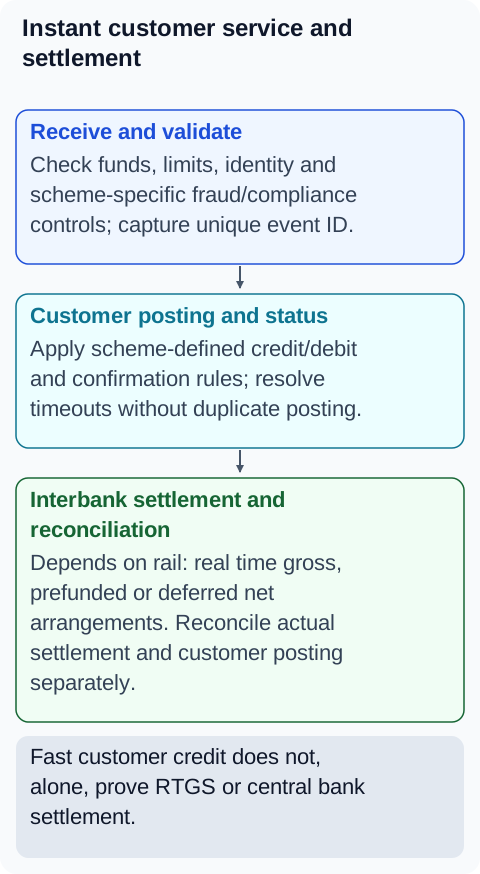
Figure 2. Continuous processing and period controls.
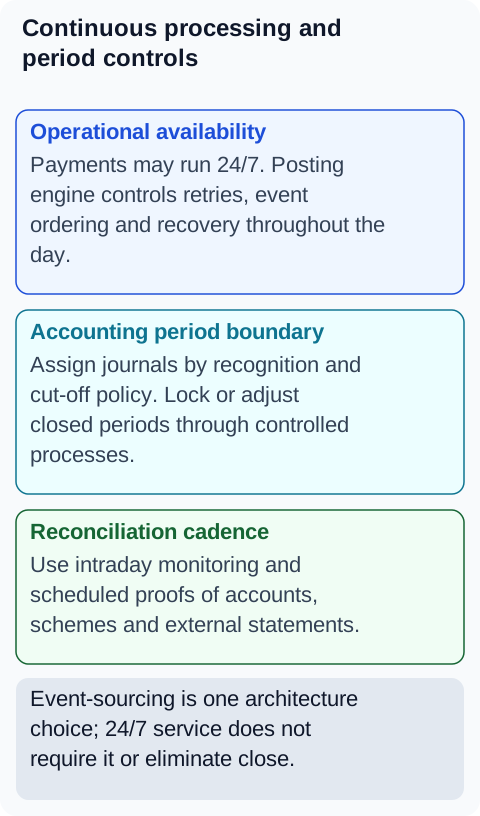
Figure 3. Sizing instant-payment liquidity.
12. Tables
| Record | Must prove |
|---|---|
| Customer ledger | Available and booked balances, event uniqueness |
| Settlement ledger | Actual cash plus valid unsettled obligations |
| Enterprise GL | Complete controlled totals and drill-down |
| Period snapshot | Boundary, watermark, adjustments and reconciliation |
| Incident pack | Customer impact, recovery and corrected postings |
13. Illustrative bank case study
Fictional case: the midnight double count. A failed GL feed is replayed after midnight. Customer postings were already complete, but the finance feed lacks a batch replay key and posts the totals again. The fix links batch IDs to constituent events, reconciles both days and corrects duplicate journals. This is a finance completeness and uniqueness defect, not evidence that periodic GL aggregation is inherently unsuitable.
14. BA, developer, tester and operations guidance
- BA: Specify state-to-journal mapping, cut-off semantics and settlement mechanism per scheme.
- Developer: Make customer postings atomic and GL feeds complete, replay-safe and traceable.
- Tester: Exercise midnight, time-zone, late-event, replay, partial-feed and weekend-liquidity cases.
- Operations: Monitor scheme limits, settlement positions and aged breaks with out-of-hours escalation.
15. Common mistakes
- Calling every instant service RTGS.
- Booking cash from a message acceptance rather than settlement evidence.
- Confusing operational customer balances with the enterprise GL.
- Stopping the service to take a reporting snapshot.
- Sizing intraday liquidity from a generic percentage.
- Treating a fraud alert as automatic permission to reverse final settlement.
16. Key takeaways
- Customer speed and settlement mechanism are separate.
- Continuous capture can coexist with controlled GL aggregation.
- Snapshots preserve cut-off without halting new-period payments.
- Reconciliation proves events, obligations and actual cash.
- Liquidity controls follow each system's funding and settlement design.
17. References and verification notes
- CPMI-IOSCO settlement and risk principles
- EU Instant Payments Regulation 2024/886
- Federal Reserve FedNow service
- Basel liquidity framework
- Rules are applied under the reporting entity's adopted accounting framework and jurisdiction. Basel standards require local implementation; they are not themselves national law. All unnamed cases, amounts and operational thresholds are fictional training examples.