Chapter 044: Forward-Looking Scenarios and Overlays
Section 9: Credit Impairment and Expected Credit Losses · Chapter 044 of 100
1. Chapter opening
Under IFRS 9, ECL is an unbiased probability-weighted measure of discounted cash shortfalls using historical, current and forecast information. A central forecast is not sufficient if nonlinear credit losses or material alternative outcomes are omitted. Discrete base/upside/downside scenarios are a common implementation, not a mandatory three-scenario rule.
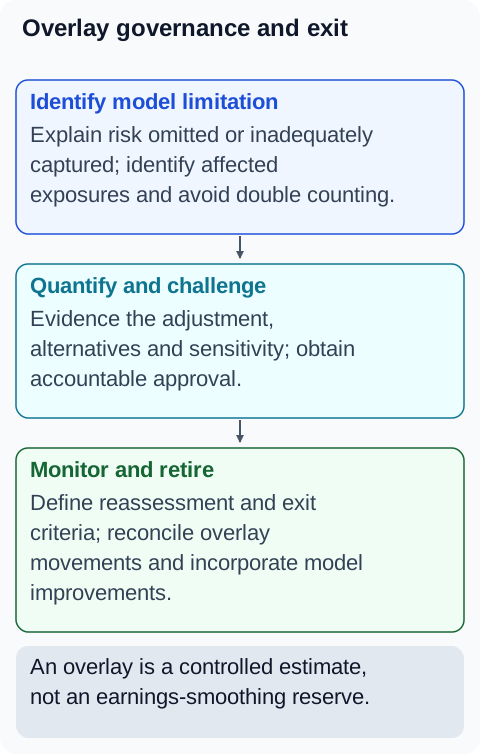
An overlay, or post-model adjustment, changes the model result for an evidenced gap such as delayed borrower data, new products or a risk not captured by existing relationships. It is not a reserve for desired profit smoothing. Liquidity stress tests answer a different question, ability to meet cash outflows, and their severe scenarios cannot simply become ECL probabilities.
2. Learning objectives
- Connect macro forecasts to PD, LGD and EAD.
- Calculate a weighted ECL with consistent scenario inputs.
- Explain why nonlinear losses matter.
- Quantify and govern an overlay without double counting.
- Attribute changes to scenarios, parameters, stage and exposure.
- Distinguish forecast uncertainty from stress-test severity.
3. Business context
Finance, credit risk and economists need a common dated scenario set. Forecast unemployment, property prices, interest rates, sector demand and exchange rates affect borrowers differently. Forecast horizons and reversion beyond supportable information require documented methods, not invented precision.
| Driver | Possible credit transmission | Control |
|---|---|---|
| Unemployment | Retail repayment capacity/PD | Segment and lag validation |
| Property value | Recovery/LGD and borrower incentives | Updated collateral and dependence |
| Interest rates | Affordability, refinancing, utilisation | Fixed/floating borrower distinction |
| Sector disruption | Revenue/default and recovery | Exposure mapping and borrower evidence |
| Currency shock | Unhedged borrower debt service | Currency mismatch analysis |
4. Finance and accounting view
4.1 Probability-weighted example
Fictional portfolio model produces discounted ECL 2m upside,4m base,10m downside. Weights 20%,50%,30% sum to 100%. Required weighted model ECL=0.20×2+0.50×4+0.30×10=5.4m. Using only the base 4m would omit 1.4m on these inputs. Averaging economic drivers first then computing a single ECL may give a different result because defaults and recoveries are nonlinear.
If supported new forecasts change weights to 20%,40%,40%, ECL becomes 6.0m, an increase 0.6m. Do not describe a ten-percentage-point shift as a 10% change in every PD. Keep scenario ECLs and probability changes separately attributable.
4.2 Overlay quantification and booking
Suppose borrower data omit a documented sector closure risk affecting 100m exposure. Evidence supports an incremental discounted cash-shortfall estimate 0.8m, after removing overlap with the downside scenario and existing individual adjustments. Total required ECL=5.4+0.8=6.2m. If previous allowance 5.0m, post Dr Impairment expense 1.2m / Cr Loss allowance 1.2m for an AC asset population. Debt FVOCI or commitment provisions use their respective offset accounts.
An overlay can increase or decrease model output if supportable and unbiased. Separate stage decisions from amount adjustments: a model gap can require SICR reassessment as well as ECL adjustment. Do not add a generic prudence percentage on top of an already captured risk.
4.3 Review, removal and disclosure
Register model gap, population, calculation, overlap assessment, owner, independent challenge, approver, review date and model-remediation plan. An expiry is a review/escalation trigger, not permission to remove a valid risk automatically. Remove or reduce the overlay when evidence shows the gap is resolved or incorporated in a validated model, reconciling the remaining estimate.
For material judgement/uncertainty, explain method, inputs, scenario weighting and sensitivities consistent with IFRS 7 and applicable presentation requirements. Maintain a dated forecast snapshot. Subsequent events may provide evidence of conditions at reporting date or be non-adjusting; apply IAS 10 rather than a blanket ban on all later information.
5. Product and customer impact
Scenario changes affect accounting allowance and management decisions, but they do not rewrite customer contracts. Distinguish accounting risk estimates from pricing, credit-line restrictions, forbearance and customer support decisions. Those actions need their own authority and conduct assessment.
6. Regulatory and supervisory view
IFRS 9 and IFRS 7 govern the financial-reporting measurement/disclosures where adopted. Basel ECL guidance emphasises sound credit assessment and governance without turning every prudential stress parameter into an accounting requirement. Local supervisors may require additional data or controls. US CECL has its own scope, reasonable-and-supportable forecast/reversion provisions and methods; do not assume identical scenario rules.
7. Systems and data view
Version forecasts, probabilities, transmission models, exposure/stage snapshots and overlays. The engine should show model-only output, each approved adjustment and final allowance. Retain the complete population and GL mapping so the same period can be reperformed. Keep forecasts for ECL, capital stress and liquidity risk linked where relevant but distinguished by purpose and calibration.
8. End to end process
- Snapshot exposures and risk data. 2. Approve dated scenarios/probabilities. 3. Condition parameters and cash flows. 4. Calculate weighted discounted losses. 5. Identify evidenced model gaps and overlap. 6. Independently challenge/approve overlays. 7. Post total required allowance change. 8. Attribute/disclose and review remediation.
9. Controls and risks
| Risk | Control | Evidence |
|---|---|---|
| Profit-driven weights | Independent economic challenge | Dated forecasts and probability rationale |
| Scenario inconsistency | Cross-parameter coherence checks | Scenario transmission pack |
| Duplicate provision | Overlay overlap analysis | Model/adjustment bridge |
| Automatic expiry release | Risk reassessment and approval | Review/closure record |
| Stale forecast | Event-driven refresh and reporting-date snapshot | Forecast version and change reason |
10. Practical examples
**Fictional weight change:**5.4m becomes 6.0m when 10percentage points shift from base to downside on the fixed scenario values in section 4. The 0.6m journal is the allowance change if nothing else changes.
**Fictional overlay closure:**0.8m addresses a missing sector effect. A validated model later captures 0.65m of that same risk; reassessment supports 0.15m remaining. Replace the separate overlay with that residual and reconcile the total, rather than releasing 0.8m by calendar date while simultaneously adding 0.65m unnoticed.
11. Diagrams
Figure 1. Forward-looking ECL scenarios.
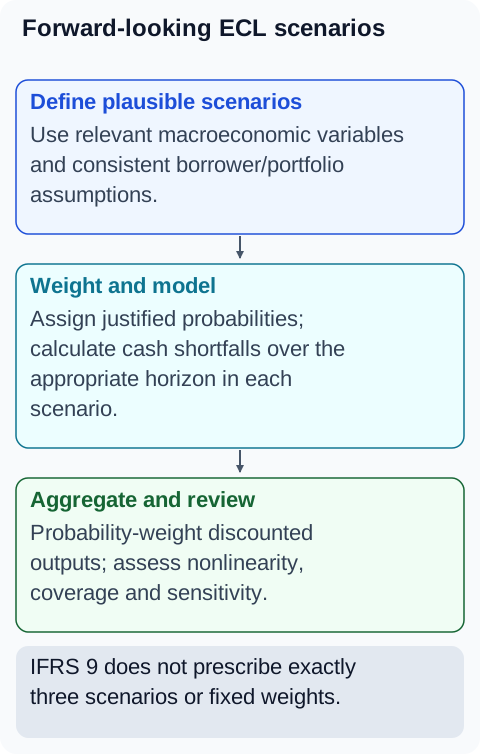 Figure 2. A weighted scenario example.
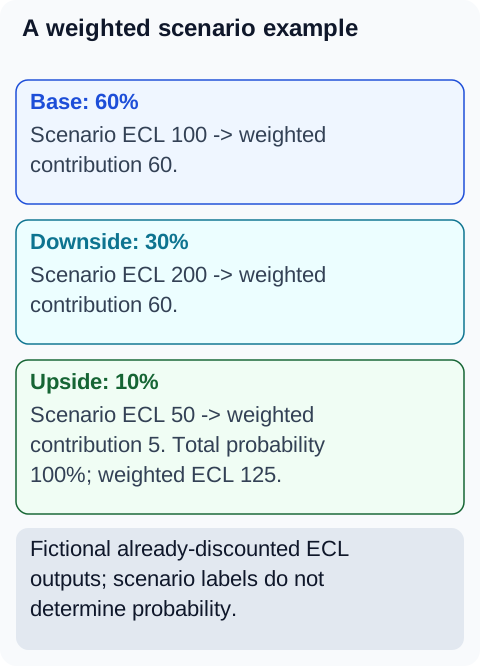 Figure 3. Overlay governance and exit.
12. Tables
| Overlay register field | Required purpose |
|---|---|
| Gap and population | Identify exactly what is missing |
| Cash-shortfall calculation | Reperform amount and direction |
| Scenario/stage overlap | Avoid duplicate risk recognition |
| Evidence and challenge | Support unbiased estimate |
| Review/expiry and remediation | Reassess and resolve model gap |
| Accounting/disclosure mapping | Tie approved total to statements |
13. Illustrative bank case study
Fictional case: a permanent temporary reserve. Management renews an adjustment for three years without updating the affected borrowers or testing overlap. Review separates captured macro risk from a remaining sector data gap, recalculates the allowance and funds the model/data repair. The issue is unsupported estimation and governance, not simply that an adjustment lasted longer than 12 months.
14. BA, developer, tester and operations guidance
- BA: Specify forecasts, transmission, probability rationale and overlay approval/overlap rules.
- Developer: Version the full calculation and expose model-only versus adjusted results.
- Tester: Recalculate weights, nonlinear outcomes, overlap, expiry reviews and population mapping.
- Operations: Maintain the register and reconcile allowances to approved period estimates.
15. Common mistakes
- Using a most-likely forecast while omitting material alternative outcomes.
- Importing severe stress parameters as default ECL probabilities.
- Layering multiple adjustments for the same risk.
- Changing weights to achieve target earnings.
- Releasing a valid adjustment because its expiry date arrived.
- Treating a cash-liquidity buffer as a credit-loss allowance.
16. Key takeaways
- Measure a range of credit outcomes, with probability weighting and discounting.
- Keep scenario transmission and weights coherent and evidenced.
- Overlays address specific model gaps and can have either direction.
- Reassess expiry and remove risk only when justified.
- Reconcile model, adjustments, journals and disclosures.
17. References and verification notes
- IFRS 9 forward-looking measurement
- IFRS 7 credit-risk disclosure
- BCBS ECL governance
- IAS 10 subsequent events
- Rules are applied under the reporting entity's adopted accounting framework and jurisdiction. Basel standards require local implementation; they are not themselves national law. All unnamed cases, amounts and operational thresholds are fictional training examples.