Chapter 048: Cash Flow Hedges and Net Investment Hedges
Section 10: Hedge Accounting and Balance Sheet Management · Chapter 048 of 100
1. Chapter opening
A bank can hedge variable-rate funding with a pay-fixed/receive-floating swap. The derivative's effective result is deferred in a cash-flow hedge reserve until the hedged interest affects P&L. A net-investment hedge may offset the translation exposure of a foreign operation, using an eligible instrument such as foreign-currency borrowing.
Apply the bank's selected IFRS 9 or retained IAS 39 policy. Customer payments, derivative settlements, effective OCI and ineffective P&L each need separate records. OCI changes equity but is neither realised cash nor automatically excluded from regulatory capital.
2. Learning objectives
- Distinguish cash-flow variability from fair-value and net-investment risk.
- Apply highly-probable forecast eligibility and the lower-of reserve mechanics.
- Post derivative, reserve, ineffectiveness and recycling journals.
- Distinguish basis adjustment from reclassification to P&L.
- Decide reserve treatment when forecasts change or foreign interests are disposed.
3. Business context
Treasury forecasts interest on floating-rate debt, future issuance and currency cash flows. A forecast funding transaction needs identifiable timing, quantity and highly-probable occurrence supported by evidence. A broad intention to raise funding sometime next year is not a complete designation.
The forecast log should separate approved baseline, downside assumptions, actual events and changes. A hedged transaction can remain expected after losing highly-probable status; that distinction matters for the reserve even after hedge accounting stops.
4. Finance and accounting view
4.1 Lower-of and ineffectiveness
Fictional qualifying cash-flow hedge: cumulative derivative gain 6 and cumulative present-value change in the hedged expected cash flows attributable to the risk of-5. Ignore tax. Under the lower-of mechanics, the reserve receives 5 and excess instrument gain 1 is ineffectiveness in P&L. Dr Derivative asset 6 / Cr Cash-flow hedge reserve 5 / Cr Hedge ineffectiveness income 1.
If derivative gain is 4 and the relevant hedged cash-flow change is-5, the reserve is 4; the unrecognised item-side 1 difference is not automatically a separate P&L loss. Calculate cumulatively, then derive the period movement from prior recorded balances. Assess credit effects and the qualification criteria independently.
4.2 Settlement and reclassification
When the derivative is cash-settled for 6: Dr Settlement cash 6 / Cr Derivative asset 6. This clears the derivative and does not release OCI by itself. Suppose the associated hedged interest expense of 5 affects P&L. Dr Hedge reserve 5 / Cr Interest expense 5 reclassifies the deferred gain to the same period's earnings. The original interest payment/accrual is a separate journal.
For a highly-probable transaction that results in recognition of a non-financial asset or liability, remove the relevant reserve and include it directly in initial cost or carrying amount as a basis adjustment. That removal is not an OCI-to-P&L reclassification adjustment. For a financial asset or liability, recycle in the periods the hedged cash flows affect P&L. Loss amounts not expected to be recovered require the applicable immediate P&L treatment.
4.3 Forecast ceases to qualify
If a forecast transaction is no longer highly probable, discontinue prospectively when qualification ceases. If the future cash flows are still expected to occur, retain the accumulated reserve until they occur or are no longer expected. If they are no longer expected, immediately reclassify the relevant reserve to P&L. Test the relevant quantity: a reduction from 100 to 70 may affect only 30, not the entire designation.
4.4 Net investment
A foreign operation's translation differences accumulate in OCI under IAS 21. A qualifying net-investment hedge puts the effective hedging instrument result in OCI and ineffectiveness in P&L. For fictional effective FX gain 4 on designated foreign-currency debt: Dr Debt liability 4 / Cr Net-investment hedge OCI 4. An opposite translation loss 4 reduces the foreign-currency translation reserve. The ordinary borrowing interest remains accounted for separately.
On disposal, apply IAS 21's recycling rules. Losing control of a foreign subsidiary differs from selling a partial interest while retaining control: the latter generally reattributes the relevant translation reserve to non-controlling interests rather than recycling it to P&L. Associate/joint-arrangement partial disposals have different rules. Identify the operation, ownership event and attributable reserve before releasing hedge amounts.
5. Product and customer impact
A hedge can stabilise reported funding expense without fixing the customer's variable-rate contract. Basis risk remains if reset dates or benchmarks differ. Liquidity still matters: a derivative can require collateral cash before the hedged funding benefit is realised.
Customer fee disclosure and pricing decisions should follow the contract and applicable conduct rules. A favourable reserve is not distributable cash by definition; finance must assess the applicable legal and capital constraints.
6. Regulatory and supervisory view
IFRS 9 qualification, retained IAS 39 and US ASC 815 cannot be blended into one testing rule. IFRS 7 requires explanations of strategy, reserve changes and ineffectiveness; IAS 21 governs foreign-operation translation/disposal. Maintain separate accounting and prudential reserve bridges with the jurisdiction's actual filters and tax treatment.
An effective hedge does not automatically neutralise IRRBB, liquidity stress or regulatory capital effects. Regulatory reports can recognise cash flows and risks differently from the financial statements.
7. Systems and data view
Maintain designation-linked forecast quantities, probability evidence, actual settlement dates, derivative marks, cumulative lower-of results, reserve movements and expected P&L periods. Keep effective and ineffective balances separate. Net-investment records additionally identify the foreign operation, currency, ownership share, designated amount and disposal status.
Automated reserve release requires an accounting event, not just a derivative maturity date. Audit logs must show why a forecast was retained, reduced or abandoned and which part of the reserve each decision affected.
8. End to end process
- Confirm eligible risk, instrument and forecast/net-investment amount.
- Document inception and probability/ownership evidence.
- Value the instrument and assess the relationship.
- Compute effective OCI and ineffectiveness cumulatively.
- Post and reconcile derivative, cash and reserve separately.
- Link occurrence to P&L, financial recognition or non-financial basis adjustment.
- Review forecast changes/disposals and disclose reserve movement.
9. Controls and risks
| Risk | Control | Evidence |
|---|---|---|
| Unsupported forecast | Probability assessment linked to approved plan | Forecast support |
| All gains parked in OCI | Lower-of calculation and qualification check | Cumulative bridge |
| OCI released on derivative maturity | Release driven by hedged event | Event-to-journal record |
| Cancelled quantity retained | Quantity-level forecast monitoring | Partial discontinuation |
| Every ownership sale recycled | IAS 21 disposal decision tree | Ownership/control analysis |
10. Practical examples
Fictional forecast reduction: planned funding 100 is revised to 70. The 30 portion is no longer expected. Its attributable 2 reserve gain is reclassified Dr Reserve 2 / Cr P&L 2. The remaining 70 stays documented and assessed; there is no justification for releasing its reserve merely because the original forecast changed.
Fictional delayed issuance: issuance moves fromJune toSeptember and is still expected, but the original relationship no longer meets its highly-probable timing criteria. Discontinue prospectively and retain the attributable reserve while the transaction remains expected; determine timing and eligibility from evidence rather than a universal 90-day rule.
Fictional capital purchase: a forecast equipment purchase is hedged; a 3 effective hedge gain is removed from the reserve and deducted from the equipment's initial cost. Subsequent depreciation uses the adjusted cost. Do not call the initial basis adjustment a P&L recycling entry.
11. Diagrams
Figure 1. IFRS cash flow hedge.
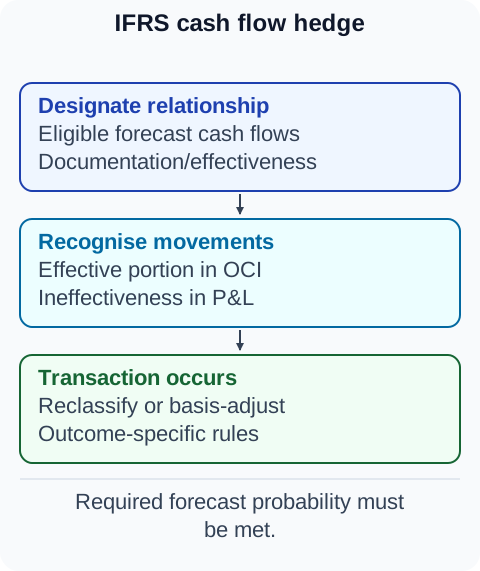 Figure 2. OCI hedge reserves.
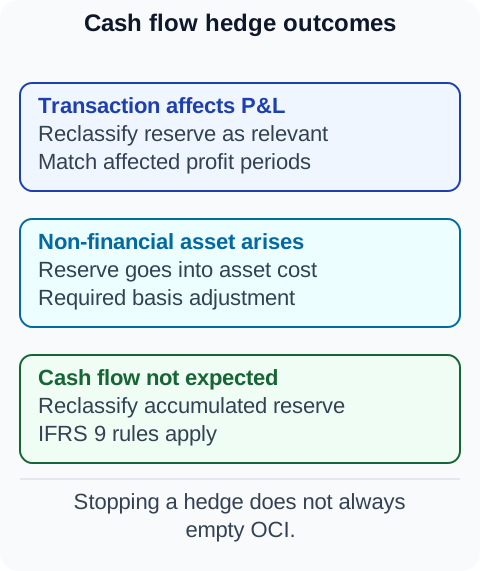
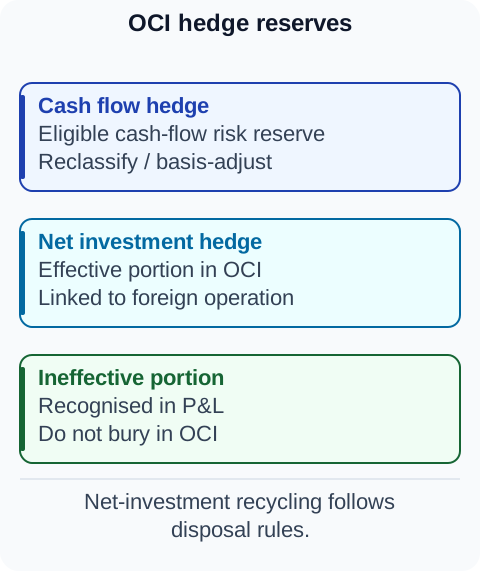 Figure 3. Cash flow hedge outcomes.
12. Tables
| Event | Reserve treatment |
|---|---|
| Hedged interest affects earnings | Reclassify in that earnings period |
| Forecast produces non-financial item | Direct basis adjustment |
| Forecast no longer highly probable, still expected | Stop qualification prospectively; retain reserve |
| Forecast no longer expected | Reclassify relevant reserve immediately |
| Foreign subsidiary partial sale, control retained | IAS 21 reattribution rather than automatic P&L recycling |
13. Illustrative bank case study
Fictional bank case: a bank delays planned issuance and continues to hold an OCI gain. Review finds that management abandoned half the funding plan but only delayed the rest. Finance releases the abandoned portion, retains the still-expected portion and records a prospective designation decision. Splitting the population prevents both premature recycling and an unsupported stranded reserve.
14. BA, developer, tester and operations guidance
- BA: Specify forecast probability, event timing and reserve-release rules.
- Developer: Store cumulative balances and derive period journals; separate settlement from release.
- Tester: Test overhedge, underhedge, delay, cancellation, non-financial recognition and partial disposal.
- Operations: Reconcile OCI to its population and obtain documented forecast decisions.
15. Common mistakes
- Equating cash settlement with reserve recycling.
- Putting all derivative gains into OCI.
- Treating highly probable and still expected as the same test.
- Recycling a non-financial basis adjustment through P&L.
- Applying one disposal rule to every foreign-operation ownership change.
- Mixing cash-flow and translation reserves without traceability.
16. Key takeaways
- Cash-flow hedge reserves follow eligible cash flows and cumulative measurement.
- Ineffectiveness and effective OCI are separate.
- Forecast occurrence, abandonment and derivative settlement have different effects.
- Net-investment hedges require IAS 21 ownership/disposal analysis.
- Preserve an amount-level reserve bridge and source evidence.
17. References and verification notes
- IFRS 9 cash-flow and net-investment hedges
- IAS 21 disposal and partial disposal
- IFRS 7 reserve disclosures
- IAS 39 retained hedge policy
- Rules are applied under the reporting entity's adopted accounting framework and jurisdiction. Basel standards require local implementation; they are not themselves national law. All unnamed cases, amounts and operational thresholds are fictional training examples.