Chapter 050: Portfolio Hedging
Section 10: Hedge Accounting and Balance Sheet Management · Chapter 050 of 100
1. Chapter opening
A bank's mortgages prepay, deposits withdraw and new business replaces old business. Treasury therefore manages time-bucketed sensitivities dynamically. Finance must translate that strategy into qualifying designations with identifiable items, quantities and measurement. The purpose of this chapter is portfolio hedge accounting, not IRB capital modelling or securitisation relief.
IFRS 9 permits an accounting-policy choice to continue IAS 39 hedge accounting and provides a specific option for the IAS 39 fair-value hedge of portfolio interest-rate risk. IASB risk-mitigation proposals are future standard-setting work, not a current licence to book a dynamic net position.
2. Learning objectives
- Separate risk-management net exposure from accounting eligible items.
- Identify IFRS 9 group requirements and the IAS 39 portfolio interest-rate option.
- Allocate exposures to repricing buckets using governed behaviour assumptions.
- Post portfolio basis and derivative movements without changing customer principal.
- Reconcile designation churn, prepayments, basis amortisation and ineffectiveness.
3. Business context
Treasury may view fixed-rate mortgages, current accounts and debt through one behavioural repricing model. Contractual accounting still matters. A demand deposit cannot be treated as a long-dated fixed-rate liability merely because customers usually leave balances in place. Under the IAS 39 portfolio approach, the designated period of demand liabilities is constrained by the earliest date the holder can demand repayment.
Some local endorsed rules contain a carve-out affecting portfolio deposit treatment. Identify its legal scope explicitly. Do not present an EU-specific provision as global IFRS or assume every local bank can apply it.
4. Finance and accounting view
4.1 Framework and population
IFRS 9 groups must consist of individually eligible items, be managed together for risk purposes and meet the applicable group/net-position requirements. Cash-flow hedges of net positions have additional restrictions, including foreign-currency-risk conditions. A broad net interest-margin model is not sufficient documentation.
Under IAS 39's portfolio fair-value hedge of interest-rate risk, allocate the eligible portfolio into repricing periods and designate a monetary amount of assets or liabilities in each period, rather than a net amount of assets and liabilities. Document how quantities, prepayments and the designated rate risk are measured. Expected repricing is not permission to disregard contractual constraints.
4.2 Fictional bucket example
For one eligible repricing bucket, asset exposure 120 and liabilities 80 give economic net asset exposure 40. A bank using the IAS 39 portfolio approach may designate a specified 40 amount of eligible assets with an offsetting pay-fixed/receive-floating swap, subject to the standard's requirements. It does not designate the abstract net 40 as a liability/asset contract.
At the reporting date, designated item risk value falls 2.9 and the derivative gains 3. Dr Hedge P&L loss 2.9 / Cr Portfolio asset hedge adjustment 2.9; Dr Derivative asset 3 / Cr Hedge P&L gain 3. Net P&L is+0.1. Debits and credits both total 5.9. A separate balance-sheet line for the eligible portfolio adjustment does not alter the customer's mortgage principal.
4.3 Dynamic changes and basis
If eligible assets fall from 120 to 95 after prepayments, revisit designated quantities and assumptions. A 40 designation is not automatically overhedged simply because the total portfolio shrank: compare the remaining eligible amount in the relevant bucket and the actual designation. Unanticipated prepayments can nevertheless create ineffectiveness through timing and valuation changes.
Account for the affected adjustment as items leave the designation or portfolio. Amortise surviving AC adjustments under the applicable requirements; remove related basis when items are derecognised. New lending needs an eligible designation from its actual valid inception. A monthly model rerun cannot silently replace the audited population while retaining its original hedge status.
4.4 Model risk and accounting distinction
Prepayment, deposit decay and customer optionality assumptions affect economic sensitivities and accounting measurements differently. Keep a contractual view and a behavioural view with an explained bridge. Backtesting should identify errors by product, rate regime and vintage, and quantify how they changed eligibility, hedge basis and ineffectiveness.
Accounting fair value uses the applicable valuation framework; a conservative IRRBB stress or capital model is not automatically the appropriate fair-value mark. IRB PD/LGD, regulatory capital equity and ECL are separate subjects, even when they share some data.
5. Product and customer impact
Portfolio hedging can stabilise funding economics while customers retain contractual options. Do not suppress prepayment rights or invent early-repayment fees to preserve an accounting hedge. Product teams should understand which options create cost and how the actual contract permits the bank to price it.
Management reporting should distinguish economic net exposure, accounting-designated exposure, residual risk, derivative liquidity needs and hedge-accounting results. A large undesignated portion can be intentional; disclose and govern it rather than forcing it into an ineligible relationship.
6. Regulatory and supervisory view
The adopted IFRS 9/IAS 39 policy and jurisdiction-specific endorsement control accounting. Basel IRRBB is a supervisory interest-rate-risk framework with local implementation; its behavioural assumptions and outlier measures do not supply hedge-accounting eligibility. US portfolio hedging under ASC 815 follows its own requirements.
Future IASB risk-mitigation accounting work must be labelled proposed until a final standard and applicable effective date establish current requirements. IFRS 7 disclosures should explain portfolio strategy, designation, adjustments and ineffectiveness under the policy actually used.
7. Systems and data view
Use versioned snapshots containing contract ID, product, currency, principal, contractual repricing, expected repricing, maturity, prepayment assumptions, bucket, eligibility and designated amount. Reconcile the total portfolio to the product ledger and distinguish excluded items explicitly.
The hedge subledger records each designation cohort, derivative mapping, cumulative basis, amortisation and exit events. Model output is reconciled to these cohorts before journals post. Store the exact curve/model/snapshot version so an independent reviewer can reproduce a historical bucket and its hedge adjustment.
8. End to end process
- Reconcile contractual population and confirm framework.
- Estimate repricing under governed assumptions and identify eligible buckets.
- Select eligible monetary amounts and document valid designations.
- Map derivatives and calculate designated-risk changes independently.
- Measure ineffectiveness and process portfolio adjustments.
- Track prepayments, new business, derecognition and basis amortisation.
- Reconcile accounting exposure to economic/IRRBB views and disclose differences.
9. Controls and risks
| Risk | Control | Evidence |
|---|---|---|
| Ineligible long-dated demand deposits | Contractual/legal eligibility check | Framework and endorsement analysis |
| Lost designation cohorts | Snapshot and cohort reconciliation | Population bridge |
| New loans silently inherit old designation | Valid inception check | New-business register |
| Prepayments ignored | Event mapping and backtesting | Quantity/basis movement |
| Economic stress mark booked as fair value | Valuation-purpose separation | Model and curve approval |
| Proposed rule treated as current | Standard/effective-date register | Applicable accounting policy |
10. Practical examples
Fictional bucket migration: eligible designated assets 40 move to a shorter repricing bucket after an assumption update. Finance identifies the reason and the affected relationship, measures ineffectiveness and applies its policy's change/discontinuation rules. It does not move the basis blindly with a spreadsheet bucket label.
Fictional reconciliation: opening designated amount 40, qualifying additions 10 and exits 8 give closing 42, subject to actual designation approval. Opening basis-2.9, current hedged-risk movement-0.6, basis removed on exits+0.4 and amortisation+0.2 give closing-2.9. The quantity bridge and basis bridge answer different questions and both need supporting cohort data.
Fictional policy conflict: a behavioural model treats deposits as five-year funding, but the adopted accounting requirements permit only the contractual demand period for the proposed item. Retain the economic sensitivity for ALM; redesign accounting designation using eligible assets or instruments rather than stretching contractual eligibility.
11. Diagrams
Figure 1. Portfolio hedging: scope and eligibility.
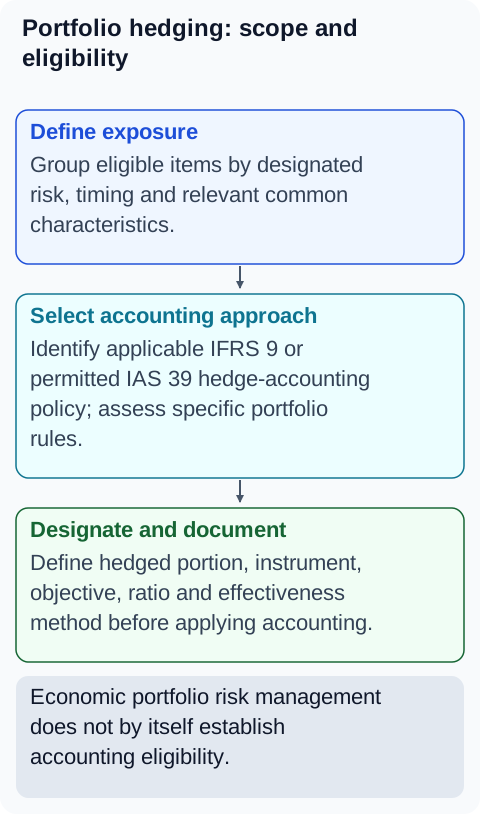 Figure 2. Behavioural exposure versus hedge notional.
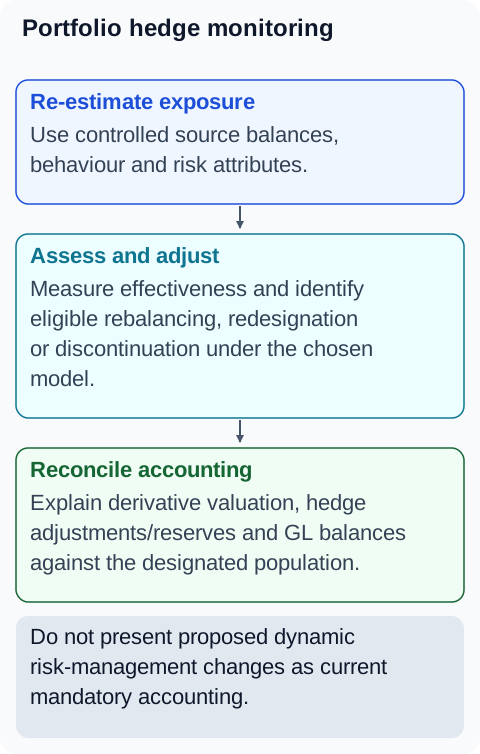
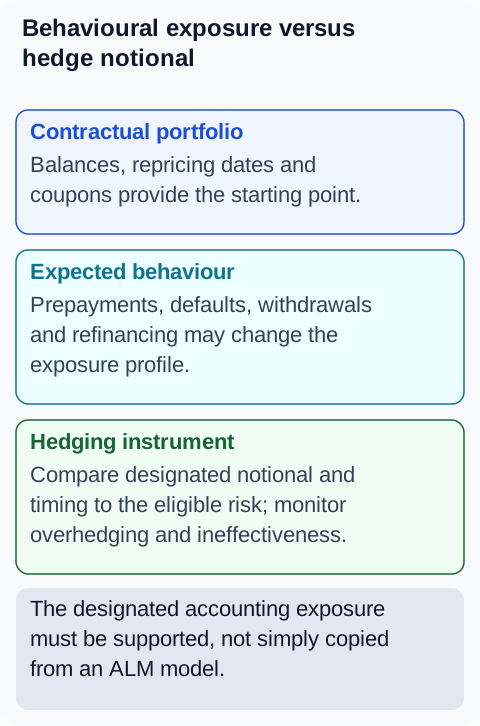 Figure 3. Portfolio hedge monitoring.
12. Tables
| View | Purpose | Main constraint |
|---|---|---|
| Economic ALM | Manage whole-bank repricing exposure | Governed behavioural assumptions |
| IFRS 9 group hedge | Account for qualifying managed items | Group/item/net-position eligibility |
| IAS 39 portfolio FV hedge | Hedge interest-rate risk in eligible portfolio amounts | Repricing periods and designated asset/liability amounts |
| Local IAS 39 carve-out | Apply specific endorsed difference | Entity, jurisdiction and legal scope |
| IRRBB | Supervisory rate-risk assessment | Applicable national implementation |
| Future risk-mitigation proposals | Assess possible future policy | No current accounting authority |
13. Illustrative bank case study
Fictional bank case: a bank rolls a mortgage hedge monthly but retains only the latest spreadsheet. Review cannot explain which prior adjustments belong to prepaid loans. The bank reconstructs designation cohorts from approved snapshots, removes basis linked to exits, measures any correction under IAS 8 and introduces an immutable population bridge. The lesson is traceability across change, not simply using a more complex model.
14. BA, developer, tester and operations guidance
- BA: Specify eligible amounts, framework, snapshots, bucket events and cohort ownership.
- Developer: Retain historical populations and basis mappings; prevent silent designation replacement.
- Tester: Test demand terms, prepayments, new business, bucket changes and both reconciliation bridges.
- Operations: Reconcile to product ledgers and obtain model/finance approval for changes.
15. Common mistakes
- Treating an ALM net exposure as an automatically eligible accounting item.
- Applying a local carve-out globally.
- Confusing future IASB proposals with effective standards.
- Losing basis ownership when the portfolio changes.
- Assuming a stress-model output is a fair-value measurement.
- Replacing portfolio hedging content with IRB capital modelling.
16. Key takeaways
- Portfolio hedging must follow the selected accounting framework and eligible population.
- Behavioural risk management and contractual accounting eligibility need a bridge.
- Designation cohorts survive model reruns and portfolio churn.
- Basis, quantities, derivatives and cash each require reconciliation.
- Future proposals and local carve-outs need explicit status and jurisdiction.
17. References and verification notes
- IFRS 9 hedge accounting policy and groups
- IAS 39 portfolio interest-rate hedging
- IFRS 7 portfolio disclosures
- BCBS IRRBB supervisory framework
- Rules are applied under the reporting entity's adopted accounting framework and jurisdiction. Basel standards require local implementation; they are not themselves national law. All unnamed cases, amounts and operational thresholds are fictional training examples.