Chapter 039: Financial Liabilities and Equity
Section 8: Financial Instrument Classification and Valuation · Chapter 039 of 100
1. Chapter opening
IAS 32 asks whether an issuer has a contractual obligation to deliver cash/another financial asset, exchange assets/liabilities on potentially unfavourable terms, or settle in own shares in a way that fails equity criteria. Substance and full terms govern, not the name 'capital note', legal form or intention to refinance.
An instrument can qualify as regulatory AT 1 while being an accounting liability. Some qualifying AT 1 is equity, but perpetuity or loss absorption alone does not prove that result. Assess accounting, regulatory eligibility and tax treatment separately.
2. Learning objectives
- Classify ordinary bank liabilities and equity from the issuer's perspective.
- Measure liabilities at amortised cost or an applicable fair-value basis.
- Split a qualifying compound convertible with balanced journals.
- Distinguish interest expense from equity distributions.
- Explain accounting equity versus CET 1, AT 1 and Tier 2.
- Control redemption, conversion, write-down and contract amendments.
3. Business context
Treasury designs terms to fund the bank and meet investor, accounting and prudential constraints. A deposit is normally a liability; subordinated debt can be eligible Tier 2 while remaining a liability. AT 1 instruments require full review of redemption, coupons, triggers, conversion and national resolution rules.
Funding choices affect leverage, earnings and distribution capacity. The accounting label does not ensure regulatory eligibility, and a regulatory capital label does not remove contractual cash obligations.
4. Finance and accounting view
4.1 Plain liability and effective interest
Fictional bank issues a 3-year 100 senior bond at par and pays direct transaction costs 2. Dr Cash 100 / Cr Bond liability 100; then Dr Bond liability 2 / Cr Cash 2, initial carrying amount 98. The EIR discounts contractual coupons and redemption to 98. Dr Interest expense / Cr Liability for EIR accrual; coupon payment Dr Liability/payable / Cr Cash. Principal redemption clears the liability. Issue costs are not equity deductions for this amortised-cost debt.
4.2 Compound convertible
Bank issues 100 convertible with a fixed-for-fixed conversion feature satisfying IAS 32 equity criteria. Comparable debt without conversion has fair value 92: Dr Cash 100 / Cr Liability 92 / Cr Equity 8. Debt subsequently accrues effective interest; the 8 equity residual is not remeasured. Allocate directly attributable issue costs proportionally to components. A variable number of shares delivering fixed monetary value generally indicates a liability; complex contingent terms require detailed analysis and relevant exceptions.
4.3 FVTPL and distributions
Derivatives and trading liabilities normally use FVTPL. Eligible hybrid liability contracts may require embedded-derivative separation or permitted whole-contract designation. Own-credit OCI treatment applies to liabilities designated FVTPL, with the accounting-mismatch exception, not automatically every derivative liability.
Interest on liability-classified instruments is normally an expense under the applicable measurement model. Distributions on equity are recorded in equity once the obligation is established; they are not operating expenses. Withholding tax and issue costs require their own treatment. Contractual coupon cancellation discretion must be real, not overridden by another obligation.
4.4 Regulatory capital bridge
CET 1 is eligible common equity/reserves plus applicable adjustments; accounting equity may contain items not eligible in CET 1. AT 1 requires permanence, subordination, coupon discretion and loss absorption under applicable rules. Basel requires contractual loss absorption at a CET 1 trigger of at least 5.125% for AT 1 classified as a liability, and applicable point-of-non-viability requirements also matter. Higher ratio triggers act earlier on a falling ratio, not later. Tier 2 has different maturity/subordination/loss-absorption criteria.
Do not treat ratio triggers and supervisory non-viability powers as substitutes. A call generally requires supervisory permission and must satisfy applicable conditions; an issuer's call right is different from a holder-consent process to amend terms.
5. Product and customer impact
Investors need clear contractual coupon, maturity, conversion and loss risks. Customers holding deposits should not be led to assume deposit protections apply to subordinated notes or AT 1. Classifying an instrument as equity does not promise its market value will remain stable.
6. Regulatory and supervisory view
The Basel capital framework is an international minimum implemented locally. National capital and resolution laws determine eligibility, deductions, trigger and non-viability mechanisms, grandfathering and distribution restrictions. Treat proposed or future rule changes separately from the rule in force.
Accounting classification remains IAS 32/IFRS 9 where adopted, and US GAAP classification is a separate assessment. A specific resolution episode cannot establish a universal shareholder/AT 1 recovery ordering without its legal facts.
7. Systems and data view
Maintain an instrument register with complete legal terms, entity, currency, issue costs, EIR, liability/equity components, redemption rights, trigger basis, accounting framework and prudential rule version. Reconcile the capital-eligibility register to the GL and disclosure population. Changes to terms need documented accounting and regulatory reassessment.
8. End to end process
- Read the full terms from issuer perspective. 2. Determine IAS 32 classification and any components. 3. Apply IFRS 9 measurement and issue-cost policy. 4. Assess prudential eligibility separately. 5. Post and reconcile issuance. 6. Accrue interest or record equity distributions appropriately. 7. Monitor calls/triggers/amendments. 8. Derecognise or convert with approved accounting and disclose the result.
9. Controls and risks
| Risk | Control | Evidence |
|---|---|---|
| Debt labelled equity | Term-by-term IAS 32 analysis | Contract and policy conclusion |
| Capital assumed from accounting label | Separate eligibility opinion | Applicable-rule checklist |
| Wrong EIR | Cash-flow/issue-cost recalculation | Yield proof and amortisation schedule |
| Missed trigger or call condition | Register and event alerts | Ratio basis, permission and action records |
| Issuer/holder mixed | Perspective field in product policy | Separate analyses |
10. Practical examples
**Fictional convertible:**100 issue,92 liability fair value and 8 equity gives a balanced split. If later similar debt yield changes, do not remeasure the equity residual; follow the liability's model.
Fictional AT 1 review: cumulative coupons, holder put and step-up incentive are proposed. They may defeat regulatory eligibility and can create accounting liabilities. Rewrite terms only after legal/accounting/prudential analysis; 'fixed conversion ratio' alone does not cure every defect.
11. Diagrams
Figure 1. Issuer classification under IAS 32.
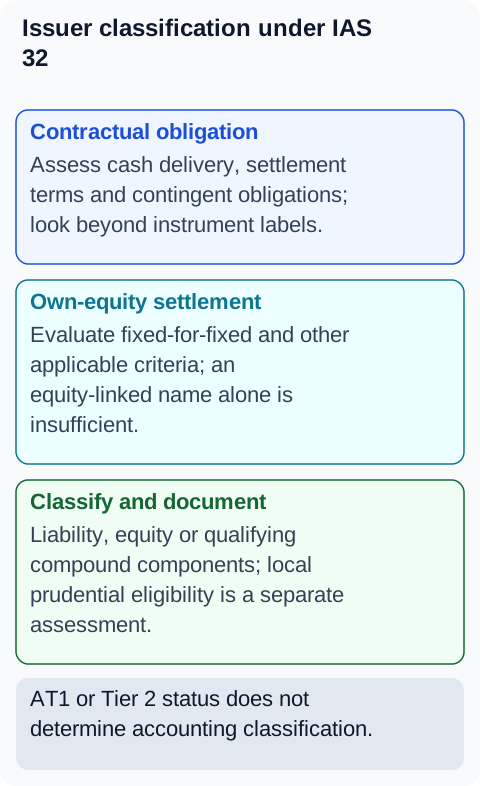 Figure 2. A qualifying compound instrument.
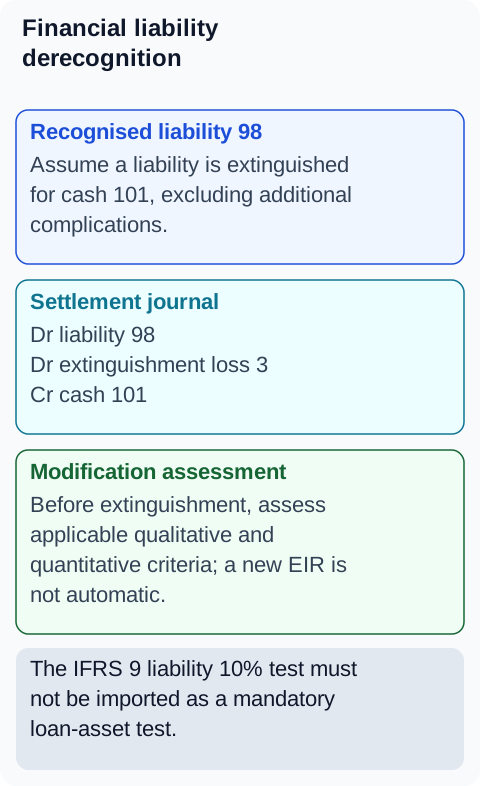
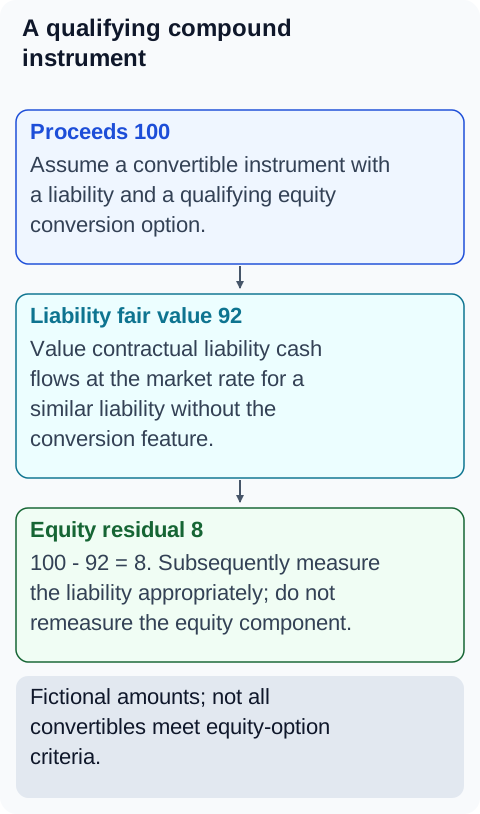 Figure 3. Financial liability derecognition.
12. Tables
| Instrument/term | Accounting question | Prudential question |
|---|---|---|
| Demand deposit | Cash repayment liability | Funding treatment, normally not capital |
| Ordinary share | Residual interest and no prohibited obligation | CET 1 eligibility and adjustments |
| Subordinated term bond | Liability, normally EIR carry | Tier 2 criteria, maturity amortisation |
| Perpetual note | Coupon/redemption and contingent terms | AT 1 criteria and loss absorption |
| Convertible | Equity or derivative conversion component? | Eligibility independently assessed |
13. Illustrative bank case study
Fictional case: the capital label bypassed accounting. A bank books an eligible AT 1 issue directly to accounting equity without assessing a contractual cash-settlement feature. Review determines liability classification, recalculates interest presentation and reconciles regulatory eligibility separately. The correction changes financial statements without automatically removing all prudential eligibility.
14. BA, developer, tester and operations guidance
- BA: Capture full terms and issuer perspective, with separate classification/eligibility conclusions.
- Developer: Track components, EIR and capital flags independently; version amendments.
- Tester: Reperform compound splits, coupons, conversion, redemption and trigger-boundary cases.
- Operations: Reconcile instrument balances and permission records; monitor contractual events.
15. Common mistakes
- Equating AT 1 or Tier 2 with accounting equity.
- Remeasuring a qualifying equity conversion residual.
- Treating liability interest as an equity distribution.
- Omitting issue costs from EIR or component allocation.
- Assuming a 5-year call date is a promised maturity.
- Reversing high-versus-low trigger timing.
16. Key takeaways
- Contractual substance determines issuer classification.
- Liabilities and equity have different subsequent measurement and distribution treatment.
- Compound instruments require supported initial allocation.
- Accounting equity and eligible regulatory capital reconcile through adjustments.
- Triggers, calls and amendments require their own legal and prudential controls.
17. References and verification notes
- IAS 32 liability/equity and compound instruments
- IFRS 9 liabilities
- Basel capital eligibility
- Rules are applied under the reporting entity's adopted accounting framework and jurisdiction. Basel standards require local implementation; they are not themselves national law. All unnamed cases, amounts and operational thresholds are fictional training examples.