Chapter 040: Fair Value Measurement and Valuation Control
Section 8: Financial Instrument Classification and Valuation · Chapter 040 of 100
1. Chapter opening
IFRS 13 defines fair value as the price received to sell an asset or paid to transfer a liability in an orderly transaction between market participants at the measurement date. It uses the principal market, or most advantageous market if no principal market exists, and market-participant assumptions. It does not decide which instruments must use fair value; IFRS 9 and other applicable standards do that.
Finance must distinguish a desk mark, an independently supported accounting value, and prudential adjustments for valuation uncertainty. Correcting a valuation error affects the financial statements; an additional regulatory valuation adjustment can affect CET 1 even when the IFRS mark is correct.
2. Learning objectives
- Define an orderly market-participant exit price.
- Apply the Level 1/2/3 input hierarchy.
- Explain valuation techniques and credit/non-performance risk.
- Reperform an independent price-verification adjustment.
- Separate accounting valuation adjustment from prudential AVA/PVA.
- Reconcile valuation, journals and disclosures.
3. Business context
Valuation drives reported earnings, customer unwind prices, risk and capital. Dealers can propose marks, but independent control must challenge source quality, stale prices, model assumptions and material differences. No single numeric tolerance fits every asset class: an apparently tiny basis-point error can become material across a large portfolio.
| Lens | Purpose | Output |
|---|---|---|
| Front-office mark | Trading and risk view | Proposed value and sensitivities |
| Accounting fair value | IFRS 13 measurement | Supported carrying amount and hierarchy |
| Prudential valuation | Applicable regulatory conservatism | Capital adjustment, separately reconciled |
| Customer unwind | Contract/execution terms | Quote, fees and settlement terms |
4. Finance and accounting view
4.1 Hierarchy is about inputs
Level 1 uses unadjusted quoted prices in active markets for identical items accessible at measurement date. Level 2 uses observable inputs other than Level 1 quoted prices, including suitable curves or comparable prices. Level 3 uses significant unobservable inputs. The entire measurement is classified at the lowest level of a significant input; a price vendor or model label does not decide hierarchy.
4.2 Technique, unit of account and adjustments
Use appropriate market, income or cost approaches with sufficient data, maximising relevant observable inputs and minimising unobservable inputs. A discounted cash-flow technique needs consistent cash flows, curves and risk assumptions; an option model needs suitable volatility and exercise terms. Do not apply an arbitrary liquidity multiplier from market-risk capital horizons to compute IFRS 13 fair value.
The unit of account follows the standard requiring measurement, with limited IFRS 13 portfolio exceptions. For a quoted Level 1 holding, a blockage discount due solely to the size of the holding is not permitted. Bid/ask selection must represent fair value; mid-market pricing can be a practical convention in appropriate circumstances, with supported adjustments.
Liability fair value reflects non-performance risk including own credit, on a transfer rather than settlement premise. Counterparty CVA, own DVA and other adjustments require supported assumptions and must avoid double counting. Transaction costs are not part of fair value; accounting for those costs follows the applicable standard. A forced liquidation price is not automatically an orderly exit price.
4.3 Independent price verification worked
Fictional FVTPL bond position: face 100m, desk price 102.00, independent supported clean price 101.20, accrued interest ignored only for this example. Supported asset value 101.2m versus desk 102m, difference 0.8m. Correct Dr Valuation loss 0.8m / Cr Bond 0.8m. If the bond is debt FVOCI, the relevant pure fair-value correction generally goes to OCI; interest, FX and ECL components are separate. A two-basis-point price error on 100m is 20,000, not automatically millions.
Retain exact market source, price timestamp, quote currency, clean/dirty basis, model version and reviewer. Differences trigger investigation; an independently observed price is not averaged with the desk mark just to reach agreement.
4.4 Prudential valuation
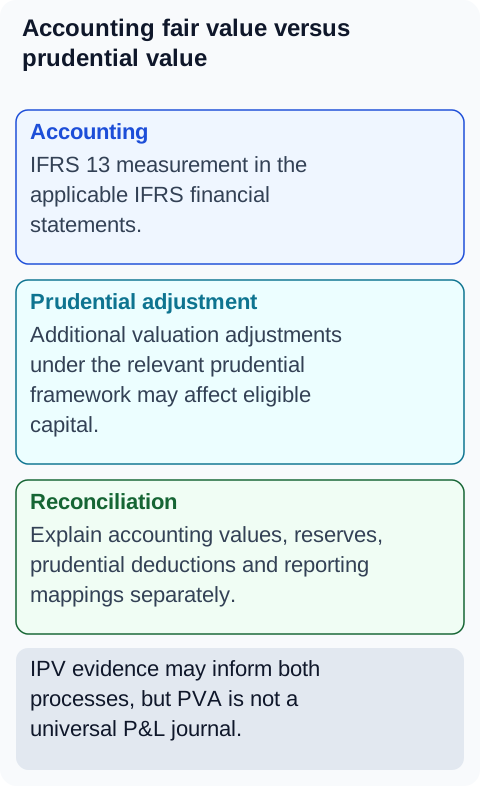
Where local rules require additional valuation adjustments, calculate them using that rulebook, population and aggregation method. Distinguish market-price uncertainty, close-out/model and other defined categories as applicable. Book an IFRS correction when accounting value is wrong; keep any additional prudential CET 1 deduction separate and avoid double counting an adjustment already recognised. Accounting category and regulatory trading/banking-book boundary must also remain separate.
5. Product and customer impact
Clients expect explainable and contract-consistent unwind quotes. Accounting fair value, customer price, transaction costs and early-termination amounts can differ. Explain the basis rather than treating the accounting mark as a guaranteed executable customer quote.
6. Regulatory and supervisory view
IFRS 13 hierarchy and valuation disclosures depend on measurement type and materiality, including additional Level 3 information. IFRS 7 supplies related financial-risk disclosures. Local prudential valuation, market-risk capital and model-risk expectations are separate frameworks; future FRTB adoption dates must not be imported into accounting fair-value rules.
Where IFRS financial statements are adopted locally, endorsement dates and additional requirements must be checked. US ASC 820 is broadly converged with IFRS 13 but still requires a separate policy assessment.
7. Systems and data view
Use reconciled trade and position populations, timestamped market-data feeds, approved valuation models, valuation-adjustment components, hierarchy tags and an independent challenge workflow. Reconcile valuations to subledgers, GL and disclosures. The controls must identify missing positions as well as wrong prices; perfect prices on an incomplete population still misstate accounts.
8. End to end process
- Reconcile the valuation population. 2. Select appropriate inputs and techniques. 3. Compute values and adjustments. 4. Independently verify and investigate discrepancies. 5. Approve supported corrections. 6. Post by accounting category. 7. Compute separate prudential adjustments. 8. Reconcile hierarchy and risk disclosures with carrying amounts.
9. Controls and risks
| Risk | Control | Evidence |
|---|---|---|
| Missing trade | Position completeness reconciliation | Trade/subledger/GL tie-out |
| Stale or wrong quote | Source/timestamp/clean-dirty checks | Price archive and flags |
| Unsupported model | Independent validation and limitations | Validation/model record |
| Trader self-approval | Independent IPV and valuation committee | Challenge and approval log |
| Capital/accounting double count | Adjustment bridge | IFRS mark to prudential deduction proof |
10. Practical examples
Fictional stale quote: bond price remains 102 after the observable market moves to 101.20. Independent verification corrects the 0.8m difference on 100m face and investigates whether other instruments share the stale source.
Fictional Level 3 change: a material volatility input becomes unobservable. Reassess hierarchy based on significance, document input uncertainty and disclosures, and challenge model calibration. The instrument does not automatically change IFRS 9 category.
11. Diagrams
Figure 1. IFRS 13 fair value hierarchy.
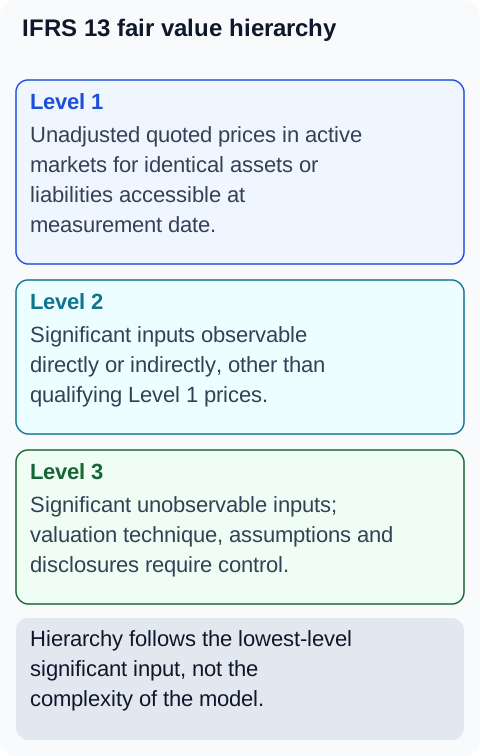 Figure 2. Independent price verification.
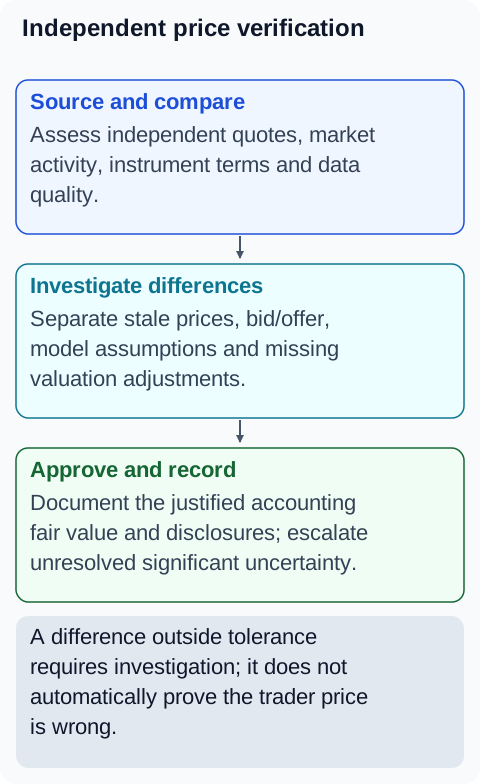 Figure 3. Accounting fair value versus prudential value.
12. Tables
| Item | Accounting fair value | Prudential valuation |
|---|---|---|
| Objective | Orderly market-participant exit price | Applicable regulatory valuation prudence |
| Rules | IFRS 13 and requiring standard | Adopted local capital rules |
| Error correction | Asset/liability and P&L/OCI as appropriate | Recalculate bridge after corrected mark |
| Additional uncertainty adjustment | Include where accounting measurement requires | Separate deduction where rule requires |
| Hierarchy | Significant inputs determine level | Does not itself determine deduction amount |
13. Illustrative bank case study
Fictional case: a small price gap across a large book. A price feed omits accrued interest and reverses quote direction for selected foreign bonds. The desk's total agrees to a locally generated spreadsheet, but independent clean/dirty and currency checks find the defect. Repair source conventions, reconcile affected positions and assess period-error treatment. Agreement between two copies of the same wrong data is not independent verification.
14. BA, developer, tester and operations guidance
- BA: Define source conventions, techniques, adjustments, hierarchy and approval thresholds.
- Developer: Preserve input/version lineage and separate accounting from capital outputs.
- Tester: Seed stale quotes, missing positions, currency reversals, clean/dirty mismatches and Level 3 changes.
- Operations: Reconcile populations and escalate unsupported marks before close.
15. Common mistakes
- Using hierarchy level to choose IFRS 9 category.
- Averaging disputed marks without evidence.
- Treating a prudential adjustment as a universal accounting expense.
- Applying trading-book capital liquidity horizons as valuation formulas.
- Missing accrued interest or FX quote conventions.
- Assuming a vendor quote is automatically Level 1.
16. Key takeaways
- Fair value is an orderly market-participant exit price.
- Hierarchy describes significant inputs, not instrument complexity alone.
- Independent control challenges populations, sources, models and adjustments.
- Journals follow the instrument's accounting category.
- Accounting valuation and regulatory prudent valuation need a clear bridge.
17. References and verification notes
- IFRS 13 fair-value measurement
- IFRS 9 category and measurement
- IFRS 7 disclosures
- Rules are applied under the reporting entity's adopted accounting framework and jurisdiction. Basel standards require local implementation; they are not themselves national law. All unnamed cases, amounts and operational thresholds are fictional training examples.