Chapter 038: Amortised Cost, FVOCI and FVTPL
Section 8: Financial Instrument Classification and Valuation · Chapter 038 of 100
1. Chapter opening
Measurement answers: at what value is the asset carried, where do changes go (P&L vs OCI), is impairment recognised, and what happens on disposal? Amortised cost accrues steadily and impairs; FVOCI carries at fair value with accruals in P&L, moves in OCI, ECL recognised, and debt recycled on sale; FVTPL takes everything to P&L with no ECL and no recycling. Liabilities mostly sit at amortised cost with fair-value options; compound instruments split under IAS 32. This chapter works each bucket with journals.
2. Learning objectives
By the end of this chapter you will be able to:
- Carry an amortised-cost asset: EIR accrual, ECL allowance, disposal gain/loss.
- Carry a FVOCI debt asset: fair value, OCI moves, ECL without double-counting, recycling.
- Carry a FVTPL asset: full fair-value moves, no ECL, no recycling.
- Apply the equity FVOCI election and explain the no-recycling consequence.
- Measure financial liabilities (amortised cost default, FVO, own-credit in OCI).
- Split compound instruments under IAS 32 and apply offsetting conditions.
3. Business context
Measurement category determines where recognised changes appear; it does not dictate a universal dividend or capital result. Distribution law, realised reserves, tax and prudential rules depend on jurisdiction. Under Basel's general CET 1 composition, accumulated OCI is included subject to relevant adjustments and national implementation; do not assume FVOCI reserve changes are always neutralised.
| Category | Carrying amount | P&L | OCI | Impairment/disposal |
|---|---|---|---|---|
| AC debt asset | EIR basis less allowance | Interest, ECL, disposal | None for ordinary measurement | ECL applies; disposal result in P&L |
| FVOCI debt | Fair value | EIR interest, ECL, relevant FX | Other value changes with ECL offset | ECL applies; cumulative OCI recycled |
| Elected FVOCI equity | Fair value | Eligible dividend income | Value changes | No separate ECL; no P&L recycling |
| FVTPL asset | Fair value | Value changes and applicable income | None ordinarily | No separate IFRS 9 ECL |
FVOCI equity dividends enter P&L unless clearly a recovery of part of investment cost. Liability fair-value-option own-credit OCI has its own exception and no-recycling rules.
4. Finance and accounting view
4.1 Amortised cost and allowance
Fictional 100 bond bought at par,5 coupon, no costs: Dr Bond 100 / Cr Cash 100; annual Dr Cash 5 / Cr Interest income 5. If allowance 2 is needed, Dr Impairment 2 / Cr Loss allowance 2, giving net 98. A pure interest-rate market-price fall to 95 creates no AC fair-value journal.
Sell for 97: Dr Cash 97 / Dr Loss allowance 2 / Dr Disposal loss 1 / Cr Gross bond 100. The earlier impairment 2 plus disposal loss 1 equals the total principal loss 3. If there were no allowance, the disposal loss would be 3. Do not ignore the allowance when demonstrating the sale.
4.2 FVOCI debt without double counting
Fair value falls from 100 to 95: Dr OCI 5 / Cr Bond 5. ECL 2: Dr Impairment 2 / Cr OCI ECL offset 2. The asset remains 95; cumulative OCI net debit is 3. Before sale at 97, increase fair value 2: Dr Bond 2 / Cr OCI 2. Cumulative OCI net debit becomes 1. Sell Dr Cash 97 / Cr Bond 97; recycle Dr Disposal loss 1 / Cr OCI 1. Earlier impairment 2 plus disposal loss 1 equals total 3. The loss recycling direction is Dr P&L / Cr OCI; a gain uses the reverse direction.
EIR interest for non-credit-impaired debt is on gross amortised cost; credit-impaired subsequent periods use the net basis under IFRS 9. Foreign debt's amortised-cost FX component is normally P&L while the residual fair-value movement is OCI. Track gross amortised cost, fair value, ECL and OCI separately.
4.3 FVTPL and equity FVOCI
FVTPL 100 to 95: Dr Fair-value loss 5 / Cr Bond 5. Remeasure to 97 before sale: Dr Bond 2 / Cr Fair-value gain 2; then Dr Cash 97 / Cr Bond 97. Total net loss 3. Calling the rise 95 to 97 a loss 2 is wrong. Transaction costs are expensed at inception rather than included in an AC yield.
Equity FVOCI is an eligible investment presentation election, not a debt classification. Dividends are normally P&L unless clearly recovery of investment; fair-value changes remain equity, with no P&L recycling on sale and no separate ECL.
4.4 Liabilities and offsetting
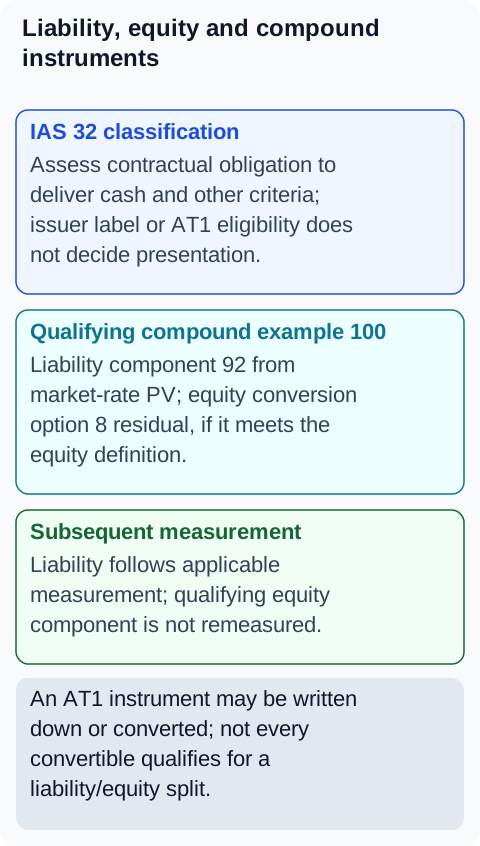
Liabilities normally use amortised cost unless a specific exception or designation applies. For liabilities designated FVTPL, own-credit changes normally go to OCI unless that would create/enlarge an accounting mismatch; remaining fair-value changes go to P&L. This rule is not a universal own-credit OCI rule for every trading derivative. Accounting equity classification and AT 1 eligibility need separate analyses.
IAS 32 offsetting requires a current legally enforceable right plus intent to settle net or realise/settle simultaneously. A default-only master agreement is insufficient. The exact settlement system is not a standalone third criterion, though its mechanics matter to demonstrating simultaneous settlement.
5. Product and customer impact
Category influences reported volatility, valuation needs and pricing analysis, but does not change a customer's contractual entitlement. AC is a business-model result, not a promise to hold every item to maturity. FVOCI permits an actual collect-and-sell model; FVTPL need not imply the prudential trading book.
Monitor sales for business-model evidence and explain realised gains without assuming every profitable sale is manipulation. Separate issuer structured-liability component treatment from the holder's asset analysis.
6. Regulatory and supervisory view
Accounting category does not itself determine a universal prudential filter. Apply the current local capital rules, scope, effective date and tax effects to OCI, prudent valuation, ECL and any still-applicable transition. Do not assume a partial FVOCI filter or continuing day-one ECL transition without that evidence.
IFRS 7 financial disclosures and applicable prudential reports need an explained accounting-to-risk bridge. USGAAP AFS, HTM and trading differ from IFRS 9 categories and impairment requirements; dual reporters maintain separate policy and measurement rather than use approximate labels as calculation rules.
7. Systems and data view
Measurement engines per bucket: EIR/accrual engine (AC + FVOCI interest), fair-value engine with IPV feeds (FVOCI + FVTPL), ECL engine scoped to in-scope AC and FVOCI debt, loan commitments and financial guarantees (Section 9: Credit Impairment), recycling calculator on disposal events, OCI ledger with per-instrument cumulative tracking, and embedded-derivative assessment for liability or other host contracts where separation is required. A hybrid financial asset is classified as a whole under IFRS 9 rather than bifurcated. Controls: bucket-tag integrity (re-tagging blocked without reclassification governance), OCI-to-instrument tie-out, recycling completeness on every disposal, and dual-framework bucket mapping for US reporters.
8. End to end process
One FVOCI bond's life: (1) classify under Chapter 037: Financial Asset Classification with tags; (2) recognise at fair value + costs; (3) accrue interest via EIR to P&L; (4) remeasure to fair value with OCI moves; (5) stage and provide ECL with OCI offset; (6) monitor sales vs business model; (7) dispose: recycle OCI, recognise final gain/loss, release ECL; (8) disclose bucket, hierarchy, staging, recycling. For AC, omit fair-value remeasurement and OCI recycling. For FVTPL, expense transaction costs at recognition and recognise fair-value changes in profit or loss; do not apply a separate IFRS 9 ECL allowance or debt-FVOCI recycling. The bucket changes recognition, measurement and impairment steps as well as presentation.
9. Controls and risks
| Risk | Control | Evidence |
|---|---|---|
| Hidden AC losses (rate-driven) | Unrealised-loss monitoring vs market value | AC-vs-fair packs (even where unrecognised) |
| Recycling omission/delay | Disposal-event-triggered recycling workflow | Recycling tie-outs per disposal |
| Gains trading | Disposal-pattern monitoring vs model | Disposal analytics, model affirmations |
| Wrong netting | Legal-opinion-backed netting register | Opinions, intent evidence |
| Bucket-tag drift | Tag-change governance, reclassification only | Tag audit trails |
10. Practical examples
Fictional late recycling: a debt FVOCI asset is sold with an accumulated 4 OCI gain, but the gain is recycled in the following quarter. The first quarter's profit is understated 4 and the next overstated 4. Assess error correction and materiality under IAS 8, including any required interim comparative correction. Bind reserve release to the actual disposal event rather than a manual close reminder.
Fictional equity sale: elected FVOCI equity is sold with a cumulative 7 gain. Remove the asset against actual cash; do not recycle the gain to P&L. Any permitted transfer within equity does not make it current profit. Distinguish this election from FVOCI debt and liability own-credit OCI.
11. Diagrams
Figure 1. Debt asset: three measurement categories.
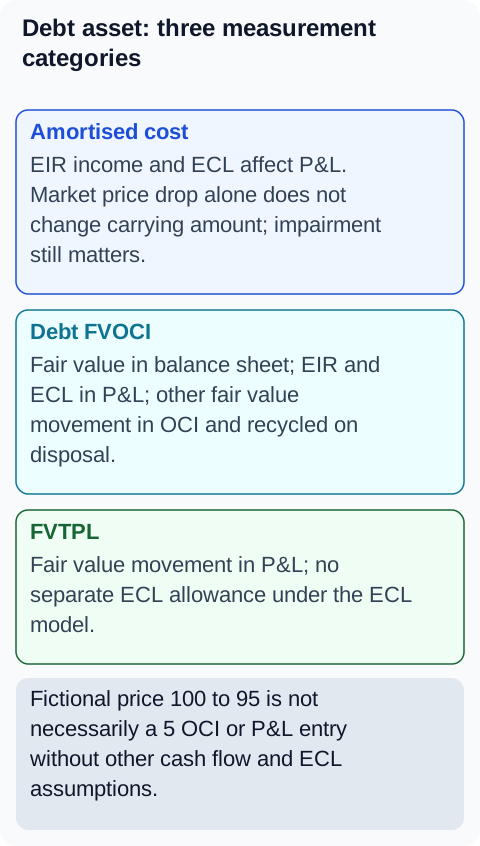
Figure 2. Debt and equity FVOCI disposal.
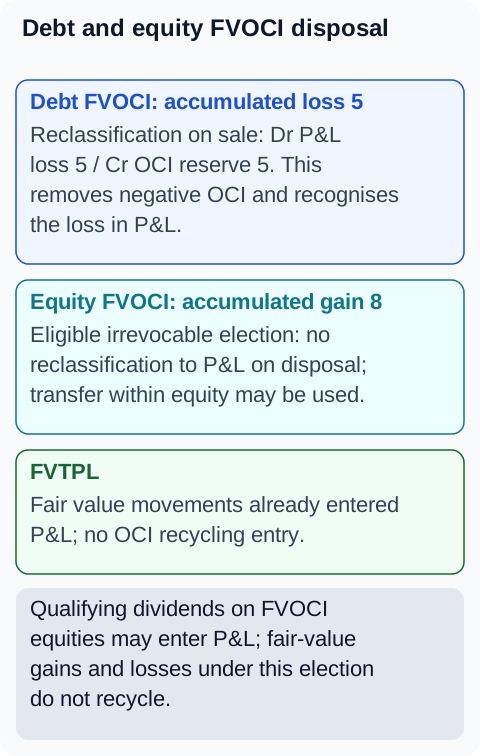
Figure 3. Liability, equity and compound instruments.
12. Tables
| Sale at 97 from original 100 | Earlier recognised loss | Current-period disposal result |
|---|---|---|
| AC with allowance 2 | Impairment 2 | Loss 1; clear gross 100 and allowance 2 |
| FVOCI debt with ECL 2 | P&L impairment 2, net OCI after remeasure debit 1 | Recycle loss 1; asset derecognised at 97 |
| FVTPL last marked 95 | Fair loss 5 | Gain 2 to 97; no OCI recycling |
All three have total principal loss 3 on the same simplified facts, with different timing/presentation. Coupon and financing cash flows are separate. Under IAS 32, loss absorption or regulatory AT 1 status alone does not determine equity; evaluate actual contractual cash/share settlement obligations.
13. Illustrative bank case study
Fictional bank scenario. A bank sees an AC asset fair-value decline while its IFRS 9 allowance remains based on expected credit shortfalls. Finance explains interest-rate versus credit effects, measures the actual ECL and assesses liquidity/capital separately. It neither writes AC directly to a market price nor treats AC as evidence that economic value risk disappeared. This training case does not assert an event at an unnamed real institution.
14. BA, developer, tester and operations guidance
- BA: Specify bucket rules per portfolio (interest, ECL scope, OCI treatment, recycling triggers) with journal patterns per event — plus IAS 32 split logic for compounds.
- Developer: Tag instruments immutably; track cumulative OCI per instrument; trigger recycling on disposal events; enforce netting conditions in presentation logic.
- Tester: Same-bond-three-buckets cases; recycling timing; equity no-recycling; split math on convertibles; netting allow/block matrices.
- Operations: Monitor AC-vs-fair gaps, disposal patterns vs models, and OCI tie-outs as standing packs — not quarter-end surprises.
15. Common mistakes
- Forgetting ECL applies to FVOCI debt (with OCI offset, not carrying-amount reduction).
- Recycling equity FVOCI gains to P&L on sale.
- Expensing AC transaction costs immediately instead of EIR inclusion (FVTPL expenses them — don't confuse).
- Netting derivatives without both IAS 32 conditions evidenced.
- Treating "held" intent as immunity from fair-value monitoring.
16. Key takeaways
- Different valid portfolio business models can produce different measurement categories for otherwise similar debt assets.
- AC accrues and impairs; FVOCI splits P&L/OCI with debt recycling; FVTPL takes all volatility.
- Equity FVOCI never recycles — elections are incentive decisions too.
- Liabilities default to amortised cost; compounds split; netting needs both conditions.
- Monitor what accounting hides: AC-vs-fair gaps and disposal patterns.
17. References and verification notes
- IFRS 9 measurement and own-credit
- IAS 32 presentation/offsetting
- IFRS 7 disclosures
- Rules are applied under the reporting entity's adopted accounting framework and jurisdiction. Basel standards require local implementation; they are not themselves national law. All unnamed cases, amounts and operational thresholds are fictional training examples.