Chapter 095: Digital Assets and Tokenised Instruments
Section 19: Disclosure, Resolution and Emerging Reporting Requirements · Chapter 095 of 100
Tokenised instruments preserve or change legal rights—not just record format. This chapter follows those rights through owned assets, client custody, distribution journals, reconciliation and separate capital treatment.
1. Chapter opening
A token’s technology does not determine the bank’s accounting. Identify the legal issuer, contractual rights, economic asset, beneficial owner and safeguarding obligations. Then apply the relevant accounting standard and a separate prudential classification. Tokenised bonds, deposit tokens, stablecoins and cryptocurrencies without contractual rights are not interchangeable.
2. Learning objectives
- Classify tokens from legal rights and economic substance.
- Distinguish owned holdings from client custody and loss obligations.
- Apply the IFRIC cryptocurrency decision within its stated scope.
- Separate IFRS, US GAAP, SEC staff and Basel treatment.
- Reconcile token quantities, client entitlements and financial journals.
3. Business context
The business model might involve issuance, investment, client custody, exchange, staking, collateral or settlement. Each has distinct credit, market, legal, operational and liquidity risks. A tokenised record can improve processing while adding network and key risks. Neither “backed” nor “on chain” establishes cash equivalence, deposit protection, bankruptcy remoteness or legal settlement finality. Use authorised activities and actual local law rather than assuming a worldwide permission or prohibition.
4. Finance and accounting view
4.1 Owned assets: rights first
A tokenised bond with enforceable contractual principal/interest rights is assessed under IFRS 9, including business model and SPPI where relevant. Tokenisation alone does not establish amortised cost; embedded crypto-linked returns or altered rights may change the result. A bank-issued deposit token may represent the bank’s deposit liability if its legal terms create that obligation. A stablecoin requires analysis of the holder’s contractual redemption claim, issuer, reserve rights, conditions and risks; reserve backing alone does not turn it into cash or a money-market-fund investment.
The IFRIC June 2019 decision covers a specified cryptocurrency subset recorded on a distributed ledger, not issued by an authority/other party and giving no holder-counterparty contract. IAS 2 applies when held for sale in the ordinary course; otherwise IAS 38 applies. Commodity broker-trader inventory can use IAS 2’s fair-value-less-costs-to-sell treatment. IAS 38 does not provide an unrestricted fair-value-through-profit-or-loss option: its revaluation requirements, including an active market, and its OCI/P&L rules matter. Do not apply this decision to every token with contractual financial rights, or copy it into US GAAP. US GAAP crypto rules have their own scope and period requirements; use the current authoritative FASB text for an actual US GAAP holding.
4.2 Client custody and safeguarding loss
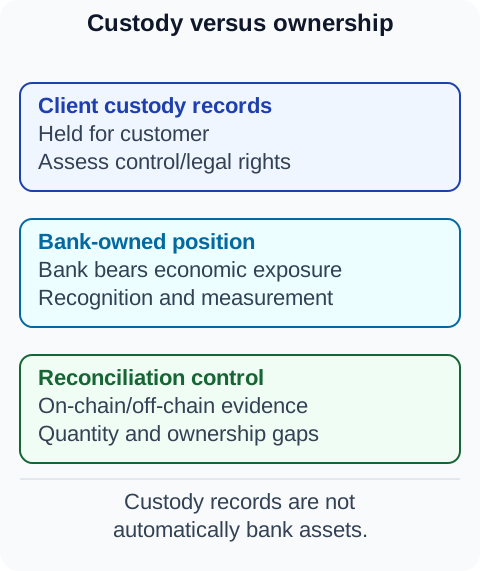
Private-key access is a safeguarding capability; it does not by itself prove beneficial ownership or accounting recognition of the client’s asset. Analyse the custody agreement, control and principal/agent rights, use/re-hypothecation, insolvency treatment and any obligation to make clients whole. Maintain client quantities and entitlements in a custody register. Recognise the bank’s service fees as services are delivered under the applicable revenue rules, and separately assess recognised safeguarding obligations and disclosures.
SEC SAB 122 rescinded SAB 121’s Topic 5.FF guidance, effective 30 January 2025. For affected SEC filings, safeguarding loss obligations are assessed under ASC450-20 or IAS 37 for the applicable accounting framework, with continuing risk/disclosure requirements. SAB 122 is SEC staff interpretive guidance, not a universal IFRS rule or a blanket “custody is always off balance sheet” instruction. A contingent client-loss obligation can still require a liability even where the client tokens are not the bank’s assets.
4.3 A complete custody example
Assume 50,000 tokenised bond units of 1,000 par held solely for a client, with no bank beneficial ownership, no rehypothecation and no present loss obligation. Nominal holding is 50m in the client custody register, not a 50m bank investment journal. Assume a 2.5% annual coupon distributed in 12 equal monthly amounts under this fictional contract: gross client distribution=50m×2.5%/12=104,166.67 monthly. Receipt by the bank as agent: Dr Settlement cash 104,166.67 / Cr Client cash payable 104,166.67; payment clears that payable. Do not record the coupon as bank interest income.
Assume a separate custody service fee 0.1% annually on constant 50m, billed monthly: fee=4,166.67. Dr Client fee receivable 4,166.67 / Cr Custody revenue 4,166.67 as the monthly service is provided; collection clears the receivable. Netting the fee from client cash requires contractual authority and proper records. A2:1 token split changes 50,000 units at 1,000 par to 100,000 units at 500 par; total 50m nominal is unchanged. A split does not create a 50m gain. The actual coupon/payment dates and local tax treatment may differ from this simplified case.
4.4 Reconciliation and finality
Reconcile controlled chain/address balances, custody-register quantities, client entitlements and relevant cash journals. Separate bank-owned wallets from client wallets and assets locked or held through third parties. “Observed on a block explorer” is not always final/legal settlement. Specify confirmation/finality rules, forks, chain reorganisations, token freeze/burn rights, issuer events and off-chain legal registers. Investigate quantity/value differences before assuming a reorganisation self-resolves or insurance covers a loss. Key management needs governed generation, authorisation, storage, backup/recovery and revocation; a universal periodic rotation rule is not appropriate for every chain/key design.
5. Product and customer impact
Explain contractual ownership/redemption, fees, custody location, use of third parties, key and network risks, corporate-action policy and compensation/insurance limits. Safeguarding insurance is a mitigant with exclusions, not a substitute for client-asset controls. Suitability, authorisation and conduct duties depend on product, customer and jurisdiction.
6. Regulatory and supervisory view
Basel’s amended cryptoasset standard has an implementation target of 1 January 2026, with actual national implementation assessed separately. Group 1 eligibility is conditional; tokenised traditional assets and qualifying stablecoins have different classification tests. Group 2a can qualify for specified hedging recognition and market-risk treatment; 1250% is not a blanket rule for every Group 2 exposure. Group 2b has the conservative treatment specified by the standard. The aggregate Group 2 exposure thresholds relate to Tier 1 capital, including 1% and 2% thresholds with different consequences; they are not ordinary target/limit terminology interchangeable with accounting equity. Assess all detailed criteria and current domestic rules before calculating capital.
Accounting, securities/market authorisation, custody safeguards and Basel capital rules are separate registers. MiCA applicability in the EU does not mean every tokenised security is a MiCA cryptoasset, and SEC staff custody guidance does not decide EU prudential treatment. No climate-transition-plan disclosure is inserted as a digital-asset accounting rule.
7. Systems and data view
Use an instrument-rights register, owned/custody split, chain/network/token identities, address and key-control records, client entitlement records, transaction/finality states, valuation sources and accounting/prudential version histories. Restrict permissions and preserve an auditable reconciliation population. Vendor/node feeds and contract records need independent checks; a configurable rule engine is not permission to change legal client terms unilaterally.
8. End to end process
- Verify legal rights, activity permission and beneficial owner.
- Determine accounting scope and separate prudential classification.
- Approve custody/key and settlement controls.
- Record owned-asset journals or client quantities as appropriate.
- Recognise service fees and any separate obligations.
- Reconcile quantities, entitlements and cash independently.
- Process corporate actions/incidents with authorised evidence.
- Reassess changed facts and reporting requirements.
9. Controls and risks
| Risk | Control | Evidence |
|---|---|---|
| Crypto label overrides legal rights | Contractual classification memo | Signed terms/legal analysis |
| Client asset booked as bank investment | Beneficial-owner and scope check | Custody agreement |
| Client coupon booked as bank income | Agency cash/payable bridge | Distribution journals |
| Quantity shortfall hidden | Chain/register/client reconciliation | Open-item record |
| Key/third-party failure | Governed authorisation and tested recovery | Access/recovery evidence |
| Basel classification stale | Separate criteria/status register | Period rule version |
10. Practical examples
Test the 50m custody example without recording a bank asset or client coupon income under its stated facts. Test a 2:1 split, an issuer default, a token with conditional redemption, client-asset reuse, a third-party withdrawal freeze and a chain reorganisation. A changed contractual or beneficial ownership fact can change recognition; do not force every fact pattern into the example’s memorandum treatment.
11. Diagrams
Figure 1. Classify a digital instrument.
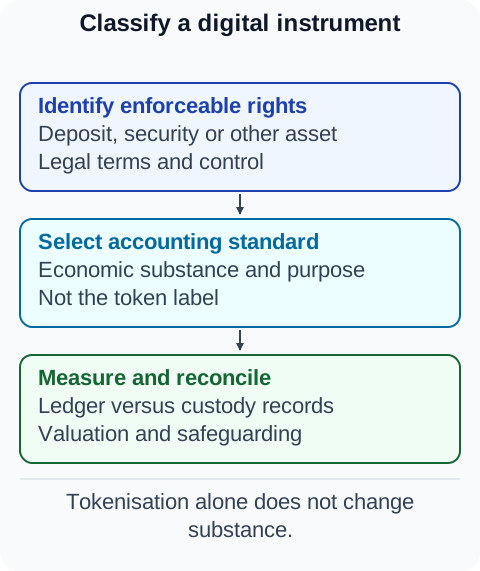 Figure 2. Digital instrument types.
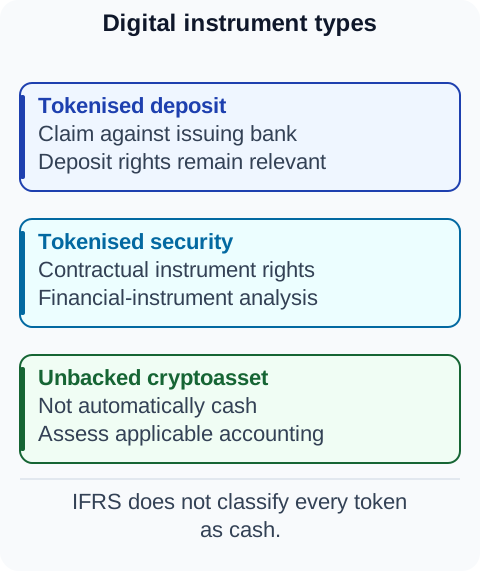 Figure 3. Custody versus ownership.
12. Tables
| Instrument/fact | Accounting assessment | Separate prudential assessment |
|---|---|---|
| Owned tokenised debt | Contract rights; IFRS 9 classification/measurement | Group 1 criteria or other applicable category |
| Specified no-contract cryptocurrency | IAS 2/IAS 38 scope | Group 2a/2 bconditions |
| Stablecoin | Actual redemption/reserve rights | All qualifying-stablecoin criteria |
| Client custody | Asset control and separate loss obligation | Safeguarding/operational and applicable exposure rules |
| Bank-issued deposit token | Actual contractual bank liability | Liability/funding and activity requirements |
13. Illustrative bank case study
The client coupon was posted as bank income. In this fictional bank, the distribution interface treated a client-held bond coupon as owned-investment income. Reconciliation to the custody contract and client payable corrected the journal, preserved the client entitlement and assessed affected-period reporting. A token quantity match alone had not tested the economic ownership.
14. BA, developer, tester and operations guidance
- BA: document rights, owner, role and every distribution/fee event.
- Developer: preserve separate wallet, entitlement and financial records.
- Tester: verify coupon agency journals, split invariance and scope changes.
- Operations: reconcile holdings and cash, and escalate loss/finality uncertainty.
15. Common mistakes
- Treating all tokens as IAS 38 assets.
- Treating key control as beneficial ownership.
- Recognising client coupons as bank income.
- Applying 1250% to allGroup 2 without criteria.
- Treating SAB 121 as current unrescinded guidance.
- Assuming insurance, a block explorer or segregation eliminates legal risk.
16. Key takeaways
Classify rights and ownership first. Reconcile quantities and cash separately, assess safeguarding obligations and apply accounting, conduct and capital rules under their actual scopes and dates.
17. References and verification notes
- IFRS 9: accounting classification/impairment and prudential risk measures are separate; use endorsed period version.
- IFRIC cryptocurrency agenda decision, June 2019: For the specified cryptocurrency without contractual rights: IAS 2 applies when held for sale in the ordinary course, otherwise IAS 38; IAS 2 broker-trader fair-value-less-costs-to-sell treatment has its own conditions. Not all tokens are financial assets.
- SEC SAB 122: Rescinds SAB 121 Topic 5FF effective 30 January 2025. ASC 450-20 or IAS 37 applies to safeguarding loss obligations, with relevant disclosures. Staff interpretation is distinct from a Commission rule.
- Basel cryptoasset amendments: July 2024 amendments to classification, with an international implementation target of 1 January 2026; national implementation is separate. Group 1 conditions and Group 2a/2b treatment differ.
Fictional quantities, payment frequency and fees. IFRIC2019 decision is scoped to its specified cryptocurrency facts. SEC staff guidance and Basel standards are distinct from national law. No unsupported exact US GAAP crypto rule, universal insurance coverage ratio or automatic incident recovery is asserted.