Chapter 021: Loan Origination and Disbursement
Section 5: Lending and Credit Product Accounting · Chapter 021 of 100
A 200,000 mortgage is approved at 6.15% with a 990 arrangement fee, a 250 valuation cost, and a drawdown schedule that releases funds in three tranches — and finance must get the day-one balances right, the fee attribution correct, and the amortisation schedule built before the first interest accrual. Loan origination is where banking meets the first page of the financial statements: fees, costs, loan asset, customer liability. This chapter maps the full origination lifecycle: application, approval, fee capture, direct-cost allocation, drawdown mechanics, day-one accounting, and the controls that keep the loan book accurate from the first second.
1. Chapter opening
Origination starts when a borrower applies and ends when funds are disbursed and the loan book is live. Between these points: credit approval, fee negotiation, direct-cost capture, staged fees and rebates, drawdown schedule, and the first posting. The loan asset opens at net investment (principal less unearned fees, plus direct origination costs) with a corresponding EIR solved to spread fee economics over the expected life. This chapter covers the business mechanics of origination, the accounting for fees and costs, the day-one GL postings, and the controls that prevent origination errors from infecting the loan book for years.
The origination lifecycle is a controlled process that transforms a credit application into a performing loan asset. The process begins with the borrower's application (submitted through a branch, online platform, or broker) and ends with the funds being disbursed to the borrower's account. Between these points, the bank performs credit analysis (assessing the borrower's ability to repay), pricing (determining the interest rate, fees, and other terms), legal documentation (executing the loan agreement), and operational processing (opening the loan account, setting up the repayment schedule, and disbursing the funds). Each stage produces outputs that feed the accounting — credit approval provides inputs to classification; accounting and prudential assessments remain separate, the pricing determines the EIR, the legal documentation determines the contractual terms, and the disbursement triggers the first GL posting.
The day-one accounting is the critical moment. When the loan is disbursed, the bank debits the loan asset and credits the borrower's account (or the disbursement account). For an amortised-cost loan initially measured at fair value equal to principal, eligible integral fees reduce and qualifying incremental transaction costs increase initial carrying amount. A valuation/legal label alone does not prove eligibility, and initial fair value need not always equal contractual principal. The EIR is solved at this point — the single rate that spreads all contractual cash flows (principal, interest, fees, costs) over the expected life. The EIR determines the pattern of income recognition for the life of the loan — a mistake at origination propagates through every subsequent period.
2. Learning objectives
By the end of this chapter you will be able to:
- Explain the origination lifecycle from application to disbursement and map it to accounting events.
- Classify fees: arrangement fees, drawdown fees, rebate on early repayment, and brokerage — and determine whether they are integral (EIR) or separate (IFRS 15).
- Allocate direct origination costs (valuation, legal, credit assessment) and explain the carrying-amount impact.
- Post day-one GL entries for disbursement, fee capture, and cost allocation.
- Build the initial amortisation schedule and solve EIR for a simple loan.
- Describe controls: fee-approval workflows, cost-capture completeness, drawdown-to-approval matching.
3. Business context
Origination sets contractual principal, interest, fees, drawdown conditions and servicing responsibilities. Those customer terms differ from the bank's IFRS carrying amount. A 500,000 interest-only loan at 6.15% for 25 years, with unchanged principal and no prepayment, has 768,750 contractual interest (500,000 × 6.15% × 25); an amortising mortgage produces a different amount.
An integral fee received lowers initial loan carrying amount and raises yield for the same future receipts. Qualifying transaction costs paid increase carrying amount and lower yield. If a fee is 990 and qualifying costs are 1,250, net costs of 260 lower rather than raise the yield, all else equal. Use actual cash flows and evidenced expected life; the sign of the adjustment matters.
A borrower's early-repayment refund or charge is contractual, subject to applicable conduct law; it is not computed automatically from the bank's unamortised accounting fee. Capture the legal settlement separately from the accounting derecognition calculation.
4. Finance and accounting view
4.1 Origination fee economics (worked 200,000 mortgage · 6.15% · 25 years · fictional simplified)
Assume a 200,000 mortgage passes the IFRS 9 amortised-cost tests, is originated at fair value equal to principal, and has a 990 integral fee received plus 250 qualifying incremental transaction cost paid.
| Event | Debit | Credit |
|---|---|---|
| Loan credited to account at same bank | Loan principal 200,000 | Customer deposit 200,000 |
| Integral fee debited to deposit | Customer deposit 990 | Integral fee adjustment to loan 990 |
| Qualifying transaction cost paid | Loan cost adjustment 250 | Cash 250 |
Gross initial carrying amount is 200,000 − 990 + 250 = 199,260. The legal borrower principal remains 200,000 unless the contract separately finances charges. The fee adjustment is a contra-asset, not an unearned-service liability. Solve EIR from the specified repayment schedule and eligible fees/costs; 6.15% alone plus a term does not define the exact yield without payment timing and expected cash flows. Book day-one ECL separately Dr Impairment expense / Cr Loss allowance where applicable.
A direct external loan payout credits settlement payable or cash instead of creating a customer deposit. Undrawn tranches remain commitments with relevant ECL; do not recognise the full approved principal as a funded loan.
4.2 Drawdown and fee capture
A same-bank draw credits the borrower’s deposit; an external draw credits settlement cash/payable under the processing design. For staged lending, each legally effective draw requires a unique event, approved remaining availability and the correct recognition date. The undrawn commitment and its ECL are tracked separately from funded principal.
Capture each contractual fee or authorised waiver and classify its substance. A fee at each tranche is not automatically a distinct service or integral interest merely because it is called a drawdown fee. Recognise a separate service when its performance obligation is satisfied; apply eligible integral fees to loan measurement/EIR. Any early-repayment refund or charge follows signed terms and applicable law. Reconcile charges, waivers, cash and fee adjustments before declaring the origination complete.
4.3 Direct origination costs
Include only incremental costs directly attributable to acquiring/originating the financial asset where IFRS 9 permits them. A label such as valuation, legal or credit assessment is not conclusive: document whether the cost would have been incurred without a successful transaction. Unsuccessful origination costs and general overhead do not automatically enter a recognised loan asset. Staff compensation may qualify only where it meets the incremental test; not all staff cost is categorically excluded.
FVTPL financial assets expense transaction costs immediately. Systems or model-development spend follows its own applicable standard, including IAS 38 where relevant, rather than being spread into individual loan EIR simply because it supports origination.
5. Product and customer impact
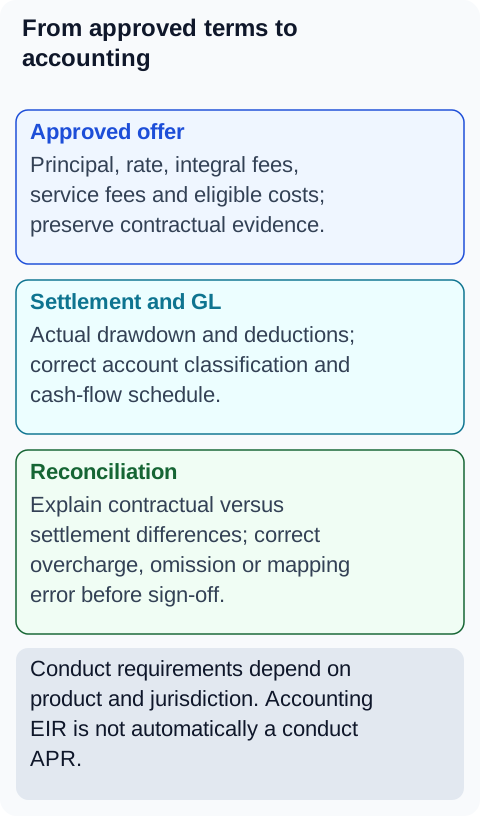
Customer statements and repayment quotes follow contractual principal, coupon interest, charges and payments. The bank's EIR schedule supports financial reporting and can differ from that contractual schedule. A capitalised accounting cost paid by the bank does not automatically increase the borrower's debt. Reconcile quoted and executed legal charges, customer cash/settlement and the separate accounting carrying-amount bridge.
6. Regulatory and supervisory view
Mortgage fee disclosure, affordability, credit assessment and early-repayment rights are product- and jurisdiction-specific. Do not treat UK mortgage rules, EU consumer-credit law and prudential capital rules as equivalent. IFRS EIR is a financial-reporting yield; a disclosed annual percentage rate/APRC may use a different legal definition. Check both without replacing one with the other.
A quoted 990 contractual fee must reconcile to the executed customer charge or an authorised explained change. Whether the bank capitalises its own 250 transaction cost is an accounting-policy question, not proof that the customer was quoted a 250 addition to legal principal.
7. Systems and data view
Origination chain: application (borrower data, credit data, fee negotiation) → approval (credit limit, pricing, conditions) → fee capture (arrangement, application, drawdown) → cost capture (valuation, legal, credit assessment) → drawdown (schedule, tranches) → GL posting (loan principal, integral-fee contra adjustment, qualifying transaction-cost adjustment) → EIR engine (solve, build schedule) → reconciliation (origination data vs GL vs EIR schedule). Controls: fee-capture completeness check, drawdown-to-approval match, EIR-schedule validation (zero-close, hand-schedule re-performance).
The drawdown-to-approval match is a preventive control. The drawdown (the disbursement of funds) must match the approval (the terms that were approved by the credit committee). The match checks: amount (drawdown ≤ approved amount), currency (drawdown currency = approved currency), rate (drawdown rate = approved rate), and conditions (all conditions precedent have been satisfied). If the drawdown does not match the approval, the loan is not disbursed — the discrepancy is flagged and resolved before funds are released. The match prevents unauthorised disbursements (funds disbursed for an amount or rate that was not approved) and ensures that the loan book reflects the approved terms.
8. End to end process
Origination lifecycle: (1) application received; (2) credit assessment and approval; (3) fee negotiation and agreement; (4) legal documentation executed; (5) valuation and legal costs incurred; (6) fee and cost captured; (7) drawdown schedule agreed; (8) funds disbursed; (9) GL posted; (10) EIR solved and schedule built; (11) reconciliation confirmed; (12) first statement generated. Each step produces evidence for audit.
9. Controls and risks
| Risk | Control | Evidence |
|---|---|---|
| Fee not captured | Fee-capture completeness check | Fee reconciliation |
| Wrong amount disbursed | Drawdown-to-approval match | Match report |
| Direct costs misclassified | Policy with examples, classification review | Classification register |
| EIR wrong at origination | Hand-schedule re-performance | Re-performance pack |
| Quote-vs-settlement mismatch | Equality check at origination | Match report |
10. Practical examples
A: missed integral fee. In a fictional population of 500 mortgages, a 990 contractual fee per loan totals 495,000. Investigate whether fees were uncollected, collected but unmapped, waived or omitted only from EIR. The lifetime fee amount is not an immediate 495,000 income misstatement; quantify the period carrying-amount and interest effects from the actual schedules.
B: ineligible overhead. Capitalising 500,000 of shared branch overhead overstates loan carrying amount and understates current expenses. It generally lowers EIR for unchanged receipts. Correct the improper asset and related income/expense timing under the applicable error policy.
11. Diagrams
Figure 1. Loan origination and disbursement.
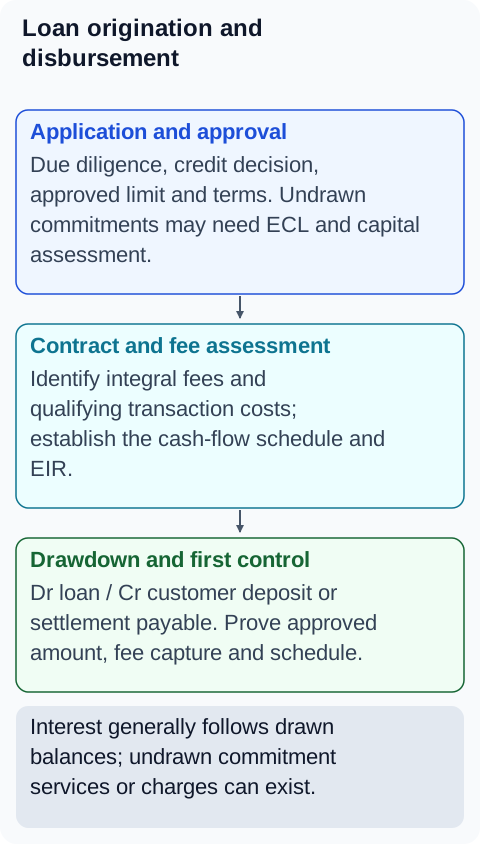
Figure 2. Integral fees and qualifying costs.
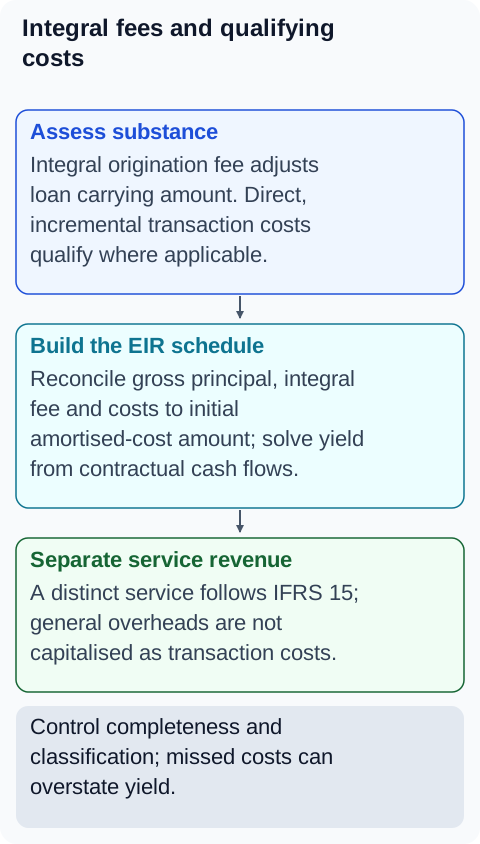
Figure 3. From approved terms to accounting.
12. Tables
Table 1 — Fee classification
| Fee/cost | Decision | Treatment |
|---|---|---|
| Integral origination/arrangement fee | Assess substance, not label | Adjust loan carrying amount and EIR |
| Application/drawdown fee | Integral or distinct service? | IFRS 9 or IFRS 15 as applicable |
| Early-repayment refund/charge | Actual contractual terms and accounting event | Settlement and derecognition/modification policy |
| Broker commission paid by bank | Incremental and directly attributable? | Eligible loan transaction cost or expense |
| Brokerage/advice provided by bank | Distinct service and recognition conditions? | IFRS 15 where in scope |
Table 2 — Direct vs indirect origination costs
| Cost | Direct? | Treatment | Example |
|---|---|---|---|
| Third-party valuation | Assess incremental/direct attribution | Capitalise only if qualifying | Contract-specific successful origination |
| Legal documentation | Assess incremental/direct attribution | Capitalise only if qualifying | Incremental successful-transaction cost |
| Credit assessment | Specific does not itself prove incremental | Qualifying transaction cost or expense | Cost that would not arise without the transaction |
| System upgrades | Not loan transaction cost | Apply IAS 38/other applicable policy, rather than loan EIR | Core banking system upgrade |
| General credit-model dev | Not loan transaction cost | Apply the relevant development-cost policy | Portfolio-level model improvement |
| Branch overhead | No | Expense | Rent, utilities, staff salaries |
13. Illustrative bank case study
A fee-control population is repaired. In this fictional case, 500 loans lack their integral-fee accounting adjustment. Finance reconciles signed contracts, customer charges, cash and journal records to determine the actual failure. It corrects the carrying amount and EIR for affected loans, assesses period errors and verifies future accruals. A single missed fee does not justify changing unaffected loans or claiming the whole fee amount as day-one lost income.
14. BA, developer, tester and operations guidance
- BA: Define fee classification (integral vs separate) per product, direct-cost criteria, drawdown-to-approval match rules, and EIR-solve inputs (contractual vs expected life).
- Developer: Origination workflow with fee-capture gate; cost-classification flags; EIR-solve engine; schedule generation with controlled rounding and residual investigation.
- Tester: Fee-capture completeness, drawdown-amount accuracy, EIR-schedule validation, quote-vs-settlement equality.
- Operations: Fee-capture reconciliation at origination; EIR-schedule review for new products.
15. Common mistakes
- Recognising an integral arrangement fee as immediate service revenue; classify its substance and apply EIR where appropriate.
- Capitalising indirect costs as direct origination costs.
- Using contractual life instead of expected life for EIR.
- Not reconciling fee captures to the GL at origination.
- Not checking quote-vs-settlement equality.
- Failing to build the EIR schedule before the first interest accrual.
16. Key takeaways
- Origination determines lifetime economics — get it right at day one.
- Fees integral to the loan are deferred through EIR; separate services are IFRS 15.
- Only qualifying incremental, directly attributable costs enter amortised-cost loan measurement; FVTPL and other expenditure follow their applicable rules.
- Reconcile executed customer charges to the quote or an authorised explained change; apply the actual local disclosure and conduct rules.
- Fee-capture completeness and EIR-schedule validation are mandatory controls.
17. References and verification notes
-
IFRS Foundation: IFRS 15: service revenue follows performance obligations; integral instrument economics remain within IFRS 9 and taxes collected for authorities are not service revenue.
-
IFRS Foundation: IFRS 9: classification depends on business model and contractual cash flows; initial recognition and directly attributable costs follow IFRS 9. This is the IFRS track, not US GAAP CECL.
-
IFRS 9 initial measurement (transaction costs), EIR method (Effective Interest Rate and Amortised Cost), IFRS 15 (separate performance obligations), UK MCOB/CCR fee-disclosure requirements, and local mortgage-conduct rules — verify current regulations.
-
All fees, costs, rates and amounts are simplified fictional illustrations; real engines use exact day-count, compounding and prepayment assumptions.