Chapter 067: Banking Tax Operations
Section 14: Tax and Other Corporate Accounting · Chapter 067 of 100
This chapter explains banking tax operations from the reporting bank's perspective. Examples are fictional; accounting follows IFRS unless another framework is expressly identified.
1. Chapter opening
Banking tax operations administer the bank's own taxes and its duties as withholding or reporting agent. The workflow links customer documentation, payment classification, deductions, remittance, returns and reconciliations. Tax information exchange, income-tax expense and customer withholding are distinct processes.
2. Learning objectives
- Distinguish own-company tax from customer agency obligations.
- Post gross interest, net customer credits and withheld-tax liabilities correctly.
- Control residency, beneficial ownership, treaty and exemption evidence.
- Reconcile withholding returns and remittances to transaction-level records.
3. Business context
Interest, dividends, custody proceeds and cross-border services can have different tax treatment. Tax residence alone may not determine the rate: payment type, source, beneficial ownership, treaty eligibility, exemptions and domestic anti-abuse rules can matter. A universal customer withholding rate or documentation expiry is unsafe.
4. Finance and accounting view
4.1 Own taxes versus agency balances
Current/deferred corporate income taxes follow IAS 12. VAT/GST, bank levies, payroll taxes and stamp/transaction taxes depend on domestic law and may fall under different accounting requirements. Input-tax recovery can be restricted for exempt banking services; assess allocation and non-recoverable amounts rather than assume all VAT is recoverable.
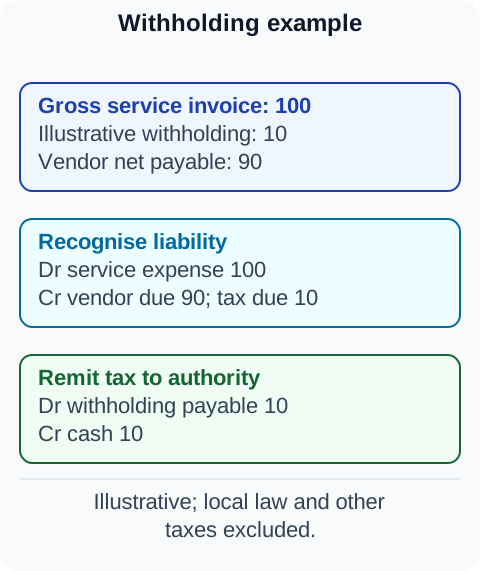
When withholding customer interest, the bank generally owes part of the gross payment to the tax authority as agent. The withheld portion is not extra interest expense. Assuming gross interest 1,000 and an illustrative 10% withholding rate, record Dr interest expense 1,000 / Cr customer deposit 900 / Cr withholding tax payable 100. When remitted: Dr withholding tax payable 100 / Cr cash 100. If the gross interest was accrued earlier, debit the accrued-interest liability instead of recording the expense again.
4.2 Documentation and reporting
Capture payment nature, tax residence, tax identifier, beneficial owner and evidence for reduced rates or exemptions. Use the legally required default where valid documents are missing, then follow the applicable correction/refund process. A customer's self-certification does not establish every treaty condition; document the checks required by the relevant regime.
FATCA and CRS are tax-transparency regimes with different legal bases, classifications and reporting requirements. They do not themselves determine ordinary income-tax expense. US qualified-intermediary arrangements and Forms 1042/1042-S have separate withholding/reporting mechanics. Apply the specific regime and reporting year; do not interchange these labels.
4.3 Reconciliation and corrections
Prove gross eligible payments, exempt/reduced-rate amounts, tax withheld, customer net credits, tax-payable movement and cash remittance. Separate unsettled tax liabilities from reporting mismatches. Corrections require linked original and amended records, appropriate customer communication and local filing/remittance steps. Never clear a payable merely because the return was submitted.
5. Product and customer impact
Tax deductions affect customer net receipts and certificates. Errors can overcharge a customer or leave the bank liable for underwithholding. Explain gross amount, deduction and applicable correction process clearly; protect sensitive residency and tax-identification data.
6. Regulatory and supervisory view
IRS Form 1042-S instructions for 2026 are a primary US source for that reporting year and scope. OECD CRS resources describe international transparency standards; local implementation and current schemas govern an actual filing. IAS 12 concerns income-tax accounting, not every operational tax payable. The sample 10% withholding rate is fictional, not treaty advice.
For US Form 1042-S electronic filing, distinguish the return tax year from the filing season: the IRS 2026 instructions require IRIS for 2026 returns, ordinarily due 15 March 2027. FIRE is retiring for tax year 2026 and is unavailable for filing season 2027. A bank should validate IRIS access, schema, identifiers, correction handling and acknowledgements before that filing cycle; other jurisdictions and return types retain their own channels and deadlines.
7. Systems and data view
Configure effective-dated jurisdiction, product and payment rules. Validate tax identifiers, document status and rate selection without exposing unnecessary personal data to users. Maintain immutable payment-level evidence, remittance references and reconciliation records. Restrict manual overrides and record independent approval.
8. End to end process
- Classify customer/account and payment under the applicable regime.
- Validate documents and applicable rate/exemption.
- Calculate gross, withheld and net amounts.
- Post the agency liability and customer credit.
- Reconcile and remit by the local deadline.
- Submit, validate and if necessary amend required returns/certificates.
9. Controls and risks
| Failure | Control |
|---|---|
| Expired/ineligible reduced rate | Effective-dated documentation review |
| Withholding counted as extra expense | Gross/net/payable journal proof |
| Return sent but tax not paid | Separate remittance reconciliation |
| CRS/FATCA classifications confused | Regime-specific rules and training |
| Manual rate override | Authorised review and audit trail |
10. Practical examples
Opening withholding payable is 20. During the period the bank withholds 100 and remits 90. Closing payable is 20 + 100 - 90 = 30, assuming no corrections or FX. A sample of 300 transactions identifies three errors: the observed sample error rate is 3/300 = 1%. It does not establish the population's exact error rate or a 99.8% accuracy certification; investigate the affected rule and population.
11. Diagrams
Figure 1. Banking tax operations.
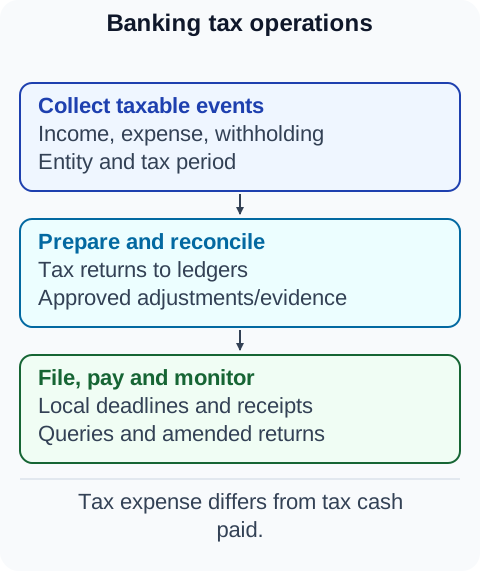 Figure 2. Tax operations responsibilities.
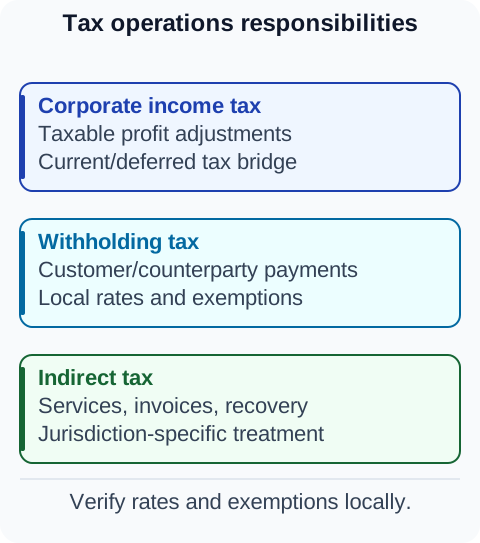 Figure 3. Withholding example.
12. Tables
| Gross interest allocation | Amount |
|---|---|
| Interest expense or release of prior accrual | 1,000 |
| Customer deposit credit | 900 |
| Withholding payable credit | 100 |
| Total credits | 1,000 |
13. Fictional banking case study
A fictional bank retained reduced-rate treatment after customer evidence ceased to be valid. Review identified the affected payments, determined the applicable local correction process and reconciled additional deductions/remittances. The bank changed its document-expiry control and preserved the original records for amended reporting.
14. BA, developer, tester and operations guidance
Current/deferred tax covers the bank's own income taxes. Customer account and custody operations supply withholding data. The close process reconciles agency liabilities and late remittances, while governance controls rule changes and overrides.
15. Common mistakes
- Applying one treaty rate to every customer.
- Treating withheld customer tax as an additional bank expense.
- Expensing gross interest again when releasing its accrual.
- Treating information exchange as a payment or tax remittance.
- Claiming a sample percentage proves whole-population accuracy.
16. Key takeaways
Reliable tax operations connect valid documentation to correct payment treatment, balanced postings, remittance and reporting. Keep customer agency obligations separate from the bank's income-tax accounts.
17. References and verification notes
- IRS 2026 Form 1042-S instructions: US reporting requirements in scope.
- OECD CRS resource centre: international transparency resources; domestic rules apply.
- IAS 12: income taxes.
- Rates, sample sizes and case study are fictional illustrations.