Chapter 008: Accruals, Deferrals and Accounting Periods
Section 2: Accounting Foundations for Banking · Chapter 008 of 100
A branch manager protests: "We collected 300 in interest this quarter — why does Finance report only 200?" Because 100 of it was earned last quarter and accrued then; cash collection merely cleared the receivable. This timing gap between earning and receiving — and between paying and consuming — is the whole of accrual accounting. This chapter teaches accruals, deferrals, prepayments, provisions vs payables, period cut-off, and why banks live on accrual while managing cash separately.
1. Chapter opening
Cash accounting records income when cash arrives and expenses when cash leaves. Accrual accounting records them when the economic event occurs — interest earned daily whether or not paid, salaries owed at month-end whether or not payday passed. Banks (and IFRS/US GAAP financial statements generally) use accrual, because cash timing would make lending margins unreadable. This chapter builds the mechanics: receivables and payables, accrued vs deferred, cut-off discipline, and the reconciliations that prove timing is right.
2. Learning objectives
By the end of this chapter you will be able to:
- Contrast accrual and cash accounting on the same transaction with correct journals.
- Post accruals (earned-not-received, incurred-not-paid) and their reversals/settlements.
- Post deferrals (received-not-earned, paid-not-consumed) and their releases.
- Distinguish payables, provisions and contingent liabilities with the right standard.
- Explain period cut-off: freeze, late events, materiality treatment.
- Design cut-off test cases a tester or auditor would run.
3. Business context
Accrual quality decides whether monthly product P&L is decision-grade or fiction: without daily interest accruals, a mid-month dashboard understates income; without required bonus accruals and recognition of levy obligations at their legal triggers, costs look artificially light until year-end shocks. Supervisors and auditors target cut-off because shifting income across period-ends flatters results with zero cash evidence. For operations, accrual engines running overnight determine what customers see as "available balance" vs "booked balance" each morning.
| Timing pattern | Example | Month-end risk |
|---|---|---|
| Earned, not received | Loan interest accrued daily, paid monthly | Understated income if engine misses a day |
| Received, not earned | Distinct-service prepayment, annual custody fee | Day-one profit spike if not deferred |
| Incurred, not paid | Staff bonuses, deposit-guarantee levies, legal bills | Hidden cost build-up; year-end surprise |
| Paid, not consumed | Annual software licence, prepaid rent, insurance | Overstated expense if not prepaid and released |
4. Finance and accounting view
4.1 The core journals
Accrued income (earned, cash later): each period Dr Accrued interest receivable / Cr Interest income; on receipt Dr Cash / Cr Accrued receivable (no new income — Figure 1). Accrued expense: Dr Expense / Cr Accrued payable; on payment Dr Accrued payable / Cr Cash. Deferred income (cash first): Dr Cash / Cr Deferred income liability; release Dr Deferred income / Cr Income for a service fee (Figure 2). An integral loan origination fee instead adjusts the loan carrying amount and EIR; it is not this service-fee liability. Prepaid expense: Dr Prepayment asset / Cr Cash; release Dr Expense / Cr Prepayment.
4.2 Payables vs provisions vs contingencies (IAS 37 boundary)
| Item | Obligation | Measurement certainty | Treatment |
|---|---|---|---|
| Trade payable | Certain, invoiced | Exact | Liability at invoice amount |
| Accrued payable | Certain, not yet invoiced | Estimable (timesheets, metered services) | Liability at best estimate |
| Provision | Present legal/constructive obligation; probable outflow and reliable estimate | Uncertain timing/amount; reviewed each period | Liability under IAS 37; financial guarantee/ECL obligations follow IFRS 9 |
| Contingent liability | Possible obligation, or present obligation failing recognition criteria | May be measurable but outflow not probable | Not recognised; disclose unless possibility of outflow is remote |
For redress and litigation, assess present obligation, probable outflow and reliable estimation under IAS37 at each reporting date, as developed in Provisions and Employee Obligations. Recognition depends on those facts; an approved future budget alone is insufficient.
4.3 Cut-off mechanics
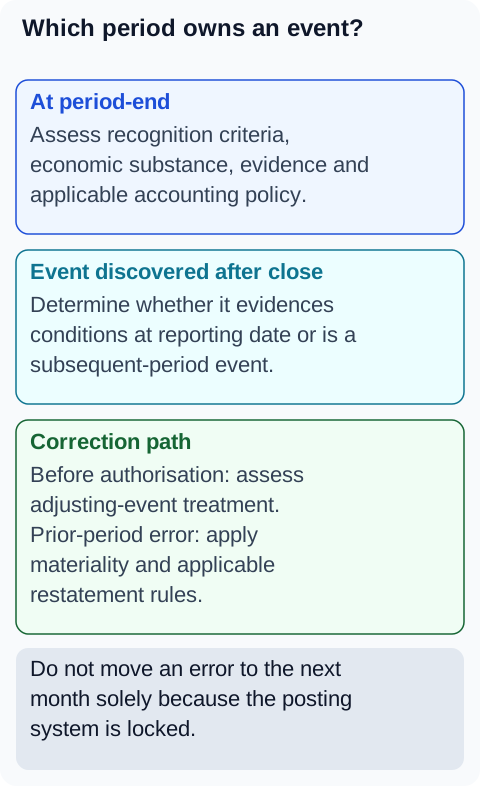
Accounting cut-off follows recognition facts at the reporting date, not an arbitrary processing freeze or a value-date field. A last-business-day operational cutoff does not exclude recognised events on a weekend calendar reporting date. Reconcile captured, pending, rejected and late-arriving events so each population has an accounting disposition.
Before statements are authorised, apply IAS 10: evidence of conditions existing at period-end can require an adjusting entry; material events arising later require disclosure instead. After authorisation, assess errors under IAS 8, including retrospective correction of material prior-period errors. A period lock is an access control, not permission to put a known material error into the next period. Record the original event and capture times, correction rationale, approval and affected reports.
4.4 Worked quarter (fictional)
A 12,000 loan at 12% nominal using a simplified 30/360 convention, interest paid quarterly in arrears: monthly accrual Dr Receivable 120 / Cr Income 120 (Jan, Feb, Mar); quarter receipt Dr Cash 360 / Cr Receivable 360. A cash-basis comparison shows 0, 0, 360; accrual P&L shows 120, 120, 120. Annual custody fee 1,200 received January: Dr Cash 1,200 / Cr Deferred 1,200; monthly Dr Deferred 100 / Cr Fee income 100. Bonus pool estimate 900 for the year: monthly Dr Staff cost 75 / Cr Bonus accrual 75; true-up at year-end when actuals known, with variance explained — persistent one-directional true-ups indicate biased estimation and draw audit attention.
5. Product and customer impact
Accrual engines decide customer-visible interest: savings interest credited monthly but earned daily (on mid-month closure, test the interest entitlement and payout under the actual contract and local law); loan statements splitting interest/principal (amortisation depends on accrual correctness); overdraft charging cycles; fee anniversary logic. Cut-off affects customers at period-ends: settlement timing depends on scheme and product; an operational submission cutoff does not by itself determine accounting recognition, and complaints spike when the two disagree.
6. Regulatory and supervisory view
Cut-off manipulation (holding the books open, parking income, delaying loss recognition) is a classic enforcement theme — supervisors expect locked periods, timestamped freezes, approved adjustment windows, and cut-off testing in internal audit plans. FINREP validations include period-on-period plausibility that exposes timing shifts; ECL staging cut-off (which exposures moved stage before period-end) is separately scrutinised (Section 9). Tax follows its own timing rules per jurisdiction — accounting accrual does not equal tax deductibility timing (deferred tax, Current and Deferred Tax).
7. Systems and data view
Engines and calendars: interest accrual engines (daily, per-contract, EIR-aware), fee sweep jobs, payroll/procurement feeds for cost accruals, provision workflow tools with approval chains, and the period calendar master (open/closed/frozen states per ledger, entity and period). Critical controls: engine completeness (every eligible contract accrued — reconciled counts), rate/table versioning (accruals rerun identically from the same inputs), freeze enforcement (no postings to locked periods without privileged, logged adjustment rights), and timestamp integrity (event time vs capture time vs posting time all stored — Booking Date, Value Date and Reporting Date).
8. End to end process
Month-end accrual cycle: (1) confirm subledger freeze and capture completeness; (2) run accrual engines with period-end parameters; (3) sweep fee and cost feeds; (4) review provision balances with owners (legal, HR, redress) and update estimates with evidence; (5) reconcile accrual accounts (roll-forward: opening + new accruals − releases/settlements = closing; investigate residuals); (6) post manual top-ups only with maker-checker and rationale; (7) attest accrual listings; (8) lock the period. Step 5's roll-forward is the single most powerful accrual control — unexplained growth in an accrual balance is a finding in waiting.
9. Controls and risks
| Risk | Control | Evidence |
|---|---|---|
| Missing accruals (income/cost in wrong period) | Engine completeness checks, roll-forwards, flash-to-actual review | Accrual listings, roll-forward packs |
| Stale provisions never trued up | Periodic estimate review with owners, variance analysis | Review minutes, true-up journals |
| Backdated postings into closed periods | Period locks, privileged adjustment rights, approval workflow | Lock reports, adjustment logs |
| Biased estimates (always favourable) | Independent challenge, historical accuracy tracking | Challenge records, bias statistics |
| Cash basis creeping into management packs | Reconciliation of management vs statutory timing | Timing-bridge reports |
10. Practical examples
Example A — The levy shock. A bank forgets to accrue its annual deposit-guarantee levy (IFRIC 21: recognise when the obligating event occurs, often a fixed date). Assume the fictional levy obligating event occurred on 1 January but was missed: eleven months show understated costs before the error is discovered and corrected in December — management bonuses already signalled on false numbers. Lesson: calendar all obligating events; accrue or recognise per the standard's trigger, not cash habit.
Example B — Accrual account balloon. Accrued fee receivable grows 40% while fee income grows 5% — cash isn't following recognition. Investigation: a billing interface failed silently; investigate the receivable's recoverability and whether services were delivered before deciding whether income was overstated. Lesson: ratio-monitor accrual balances to their income lines; divergence is an early warning, not a curiosity.
11. Diagrams
Figure 1. Interest earned before receipt.
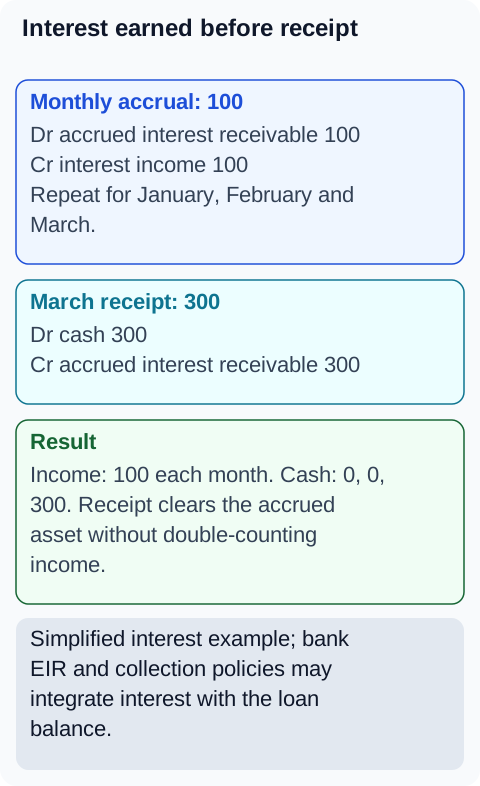
Figure 2. Prepaid service fee recognised over time.
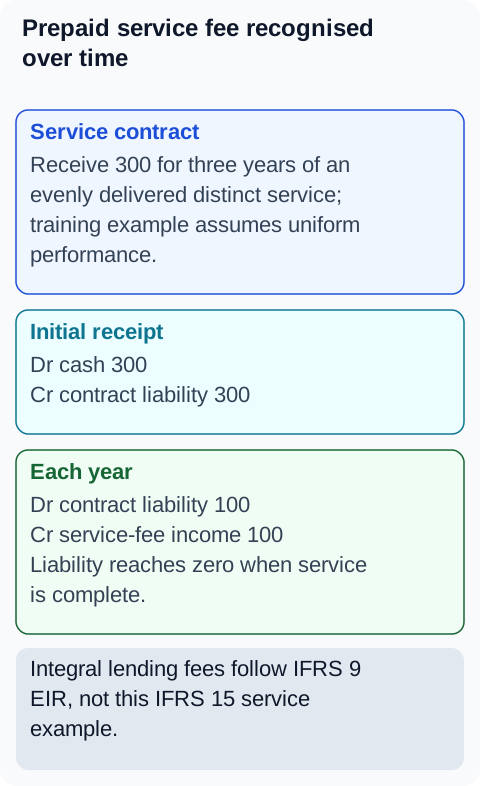
Figure 3. Which period owns an event?
12. Tables
Table 1 — Accrual vs deferral quick reference
| Situation | First journal | Second journal | Balance while waiting |
|---|---|---|---|
| Interest earned, paid later | Dr Receivable / Cr Income | Dr Cash / Cr Receivable | Asset (receivable) |
| Cost incurred, paid later | Dr Expense / Cr Payable | Dr Payable / Cr Cash | Liability (payable) |
| Fee received, earned later | Dr Cash / Cr Deferred income | Dr Deferred / Cr Income | Liability (deferred income) |
| Insurance paid, used later | Dr Prepayment / Cr Cash | Dr Expense / Cr Prepayment | Asset (prepayment) |
Table 2 — Cut-off test cases for testers and auditors
| Test | Expected result |
|---|---|
| Payment authorised 23:58 on last day | Determine whether authorisation creates a recognised accounting event; a memo hold alone may not |
| Recognised event occurs 00:02 next day | Normally new period, subject to actual entity timezone and recognition facts |
| Earlier value date, captured 3 days late | Investigate recognition facts; apply approved correction/adjusting-event process, not automatic value-date allocation |
| Late item outside operational window | Escalate; correct recognition and IAS 8/IAS 10 assessment still apply |
| Accrual engine skips one product feed | Completeness check fails; close blocked |
| Manual journal dated in locked period | Rejected; requires privileged adjustment workflow |
13. Illustrative bank case study
Year-end pulled forward. A trading desk, short of its annual target, held December's books open into January to capture New Year gains while pushing January losses back — small amounts, clear intent. Internal audit's cut-off testing caught timestamp anomalies; the restatement was minor but the enforcement outcome wasn't: personal accountability findings against the desk head and finance manager, and a skilled-person review of the whole close process. Lesson: cut-off is where culture meets accounting — tiny timing abuses signal governance failure far beyond their amounts. (Fictional training case; no specific bank or event is asserted.)
14. BA, developer, tester and operations guidance
- BA: Specify accrual triggers, rates, day-count conventions, release schedules and cut-off timestamps per product; define materiality handling for late events in requirements, not in production debates.
- Developer: Store event time, capture time, value date and posting date as separate fields; enforce period locks in the posting service, not the UI; make accrual runs deterministic and re-runnable.
- Tester: Test across period boundaries with frozen clocks: last-second events, back-valued captures, late feeds, locked-period attempts, leap days and holiday calendars.
- Operations: Run roll-forwards on every material accrual account at each close; chase residuals before attestation, not after audit queries.
15. Common mistakes
- Recognising cash receipts as income without clearing the accrued receivable (double-counting).
- Booking an upfront service fee before performance, or failing to include an integral instrument fee in EIR.
- Forgetting recurring obligating events (levies, bonuses) until they detonate.
- Posting into locked periods through back doors to "fix" variances.
- Treating provisions as cookie jars — over-providing in good years, releasing in bad ones (earnings management, and auditors test for it).
16. Key takeaways
- Accrual records economics when earned/incurred; cash records movement — banks report the former and manage the latter.
- Every accrual needs a settlement path; every deferral needs a release schedule.
- Payables record obligations with greater measurement certainty; provisions require a present obligation and recognition tests; contingent liabilities are disclosed unless remote.
- Cut-off is a timestamped, locked, tested boundary — not an aspiration.
- Roll-forwards and accrual-to-income ratios are the early warnings requiring investigation and measurement evidence.
17. References and verification notes
-
IFRS Foundation: IFRS 9: classification depends on business model and contractual cash flows; initial recognition and directly attributable costs follow IFRS 9. This is the IFRS track, not US GAAP CECL.
-
IFRS Foundation: IAS 10: adjusting events evidence conditions at the reporting date; non-adjusting events concern later conditions and material ones require disclosure.
-
IFRS Foundation: IAS 37: a provision requires a present obligation, probable resource outflow and reliable estimate; contingent liabilities are disclosed unless the outflow possibility is remote.
-
Accrual basis and IAS 37 provision/contingency boundary per IFRS; IFRIC 21 for levy timing; US GAAP equivalents (ASC 450 contingencies, ASC 606/310 timing) differ in detail — verify the applicable framework.
-
Day-count conventions (Actual/365, 30/360, Actual/360) are product- and currency-specific; confirm the contract and market convention before building engines.
-
All figures are fictional training simplifications.