Visual overview
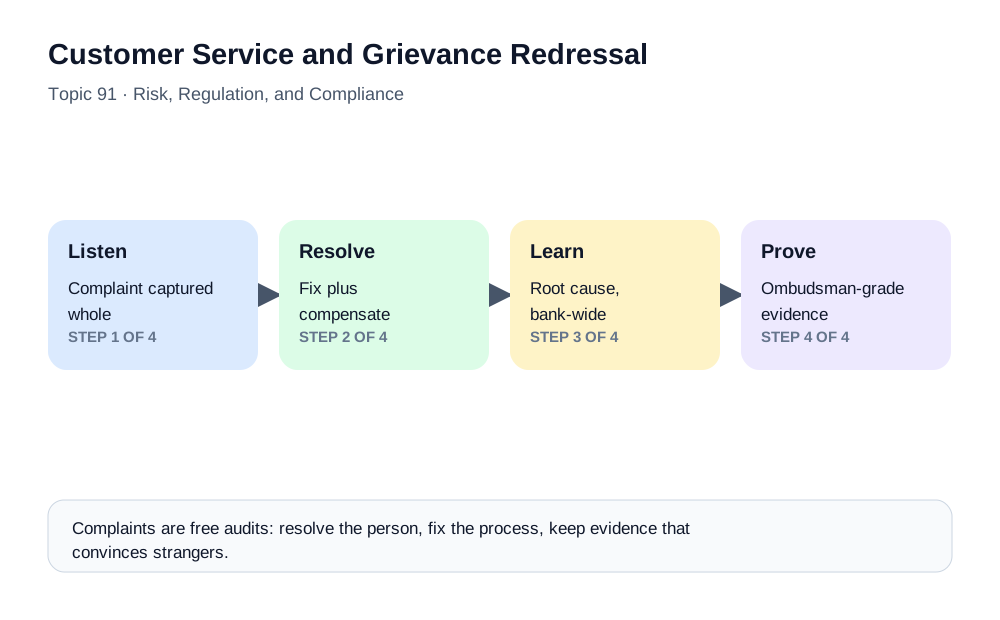
Customer Service and Grievance Redressal at a glance — Ombudsman, consumer protection, complaint handling.
Banking Ombudsman, Consumer Protection, and Complaint Handling
Banking is fundamentally a service business, and the quality of that service, particularly when problems arise, defines the relationship between banks and their customers. India has constructed one of the most comprehensive consumer protection frameworks in banking, providing multiple levels of recourse for customers who believe they have been treated unfairly. Understanding this escalation pyramid, from initial complaint through ultimate legal remedy, empowers customers to pursue resolution while informing banks of the standards they must meet.
Customer service has become more visible as banking has shifted toward digital, always-on channels and customers can compare experiences across providers quickly. Social media can amplify poor outcomes, while regulators use complaints and service data as signals of potential conduct and operational weaknesses. The economic value of retention varies by product and customer segment, so generic claims that acquiring a customer always costs a fixed multiple of retention should not be treated as banking fact. The durable point is that complaint quality affects trust, remediation cost, regulatory risk and the long-term customer relationship.
A useful way to understand grievance redress is to separate the bank's internal process from external remedies. Customers should first use the regulated entity's complaint mechanism and escalation channels. Under the Reserve Bank - Integrated Ombudsman Scheme, 2026, effective 1 July 2026, an eligible complaint about deficiency in service can be taken to RBI when the regulated entity has not resolved it satisfactorily or has not replied within 30 days, subject to the Scheme's maintainability conditions. The Scheme also provides an appeal mechanism for specified decisions. Consumer commissions, courts and other statutory remedies can exist separately where their legal conditions are met; they should not be taught as a rigid five-step ladder that every complaint must follow in the same sequence.
The bank's own grievance mechanism should make it easy to lodge, track and escalate complaints across branch, call-centre and digital channels. Exact acknowledgement and resolution service levels depend on the applicable RBI instruction, product rules and the bank's board-approved policy; a universal three-day, 48-hour or 30-day timetable should not be invented for every complaint type. What should be consistent is ownership, case identification, status tracking, evidence, communication, escalation, root-cause analysis and regulatory reporting where required. The 30-day period is especially important for access to RB-IOS because a customer can approach the Scheme if the regulated entity has not replied within that period or the customer is dissatisfied with its response, subject to the Scheme's other conditions.
The Reserve Bank - Integrated Ombudsman Scheme, 2026, effective 1 July 2026, is the current scheme for this course review and supersedes the earlier integrated framework. It provides cost-free redress for eligible complaints involving deficiency in service by covered regulated entities. Complaints can be lodged through RBI's Complaint Management System and through the other modes specified by RBI; the current Scheme and RBI process pages should be used for the responsible receipt and processing arrangements. The durable lesson is the separation between the bank's own grievance process and an external ombudsman remedy; customers must check current coverage, maintainability and appeal provisions rather than rely on an older timetable.
The Integrated Ombudsman can consider complaints across a comprehensive range of banking activities. Deposit-related complaints include non-payment, delays in refund, and incorrect charges. Loan-related complaints address non-compliance with fair practices codes and excessive interest charges. Card complaints cover unauthorized transactions and billing errors. Digital payment complaints address failed UPI, NEFT, or card transactions and refund delays. Remittance complaints involve delays, non-credit, and incorrect beneficiary issues. Insurance and mutual fund mis-selling by bank staff falls within jurisdiction. Pension-related complaints address delays in credit of pension payments. This broad coverage ensures that most banking customer grievances can be addressed through the Ombudsman process.
RB-IOS contains procedural timelines, but the process should not be simplified into a promise that every complaint is decided within 30 days. The Scheme first supports settlement or facilitation and allows an Award where appropriate. Compensation limits, appeal rights and time limits depend on the current Scheme and decision type, so operational guidance should use the current RBI text rather than a generic timetable or the superseded 2021 figures.
The Consumer Protection Act, 2019 can provide an additional statutory remedy for qualifying consumers alleging deficiency in banking services or other covered conduct. Pecuniary jurisdiction was revised by the Consumer Protection (Jurisdiction of the District Commission, the State Commission and the National Commission) Rules, 2021: District Commissions cover complaints where the value of goods or services paid as consideration does not exceed ₹50 lakh; State Commissions cover more than ₹50 lakh and up to ₹2 crore; and the National Commission covers more than ₹2 crore, subject to the Act and current rules. Electronic filing facilities are available through the government's consumer-dispute digital systems.
Complaint mix changes from year to year and differs by bank, product and reporting taxonomy. Digital payments, cards, loans, deposits, remittances, service charges and customer-service issues can all generate material complaint volumes, but fixed percentages should not be presented without a dated source and defined population. Banks should analyse their own complaint data and the latest official RBI publications to identify current trends, recurring root causes, vulnerable-customer impacts and products with unusually high complaint or escalation rates.
Effective complaint handling requires banks to view complaints not merely as operational nuisances but as valuable feedback enabling improvement. Each complaint represents a customer experiencing friction in their banking relationship, and the resolution process provides an opportunity to rebuild trust or further damage it. Banks that excel at complaint handling recognize that the customer whose problem is resolved effectively often becomes more loyal than one who never experienced a problem at all. The escalation pyramid exists to ensure that customers have recourse when banks fail, but the goal of every bank should be to resolve issues at the first level before they require regulatory intervention.
<!-- MBA-DEEP-DIVE-START -->Deep Dive: Customer Service and Complaint Management as a Banking Control
Customer service is not separate from banking operations. A complaint about a delayed transfer, wrong fee, blocked account or failed card transaction is often the customer's view of an underlying process, technology or control failure. A mature bank therefore treats complaints as both service cases and operational intelligence. The immediate objective is to resolve the individual customer's issue fairly; the broader objective is to identify whether the same problem can affect many others.
Complaint handling also sits inside a legal and regulatory framework. Exact timelines, escalation rights and remedies depend on the institution, product and jurisdiction. In India, covered complaints can move from the regulated entity's own grievance mechanism to the Reserve Bank - Integrated Ombudsman Scheme, 2021 when the Scheme's conditions are met. Consumer-protection remedies can exist separately. Front-line teams should therefore use current approved procedures rather than rely on remembered numbers from older schemes.
1. A complaint should be easy to recognise
Customers do not always use the word “complaint.” They may say a fee is unfair, a transfer is missing, staff behaviour was inappropriate or a service repeatedly fails. The bank needs a definition that helps staff distinguish a complaint from a routine request, enquiry, fraud report or technical service ticket while ensuring genuine dissatisfaction is not hidden by classification.
Misclassification creates conduct risk. If a branch records an unauthorised charge as a “query,” complaint reporting will understate the problem and the case may miss escalation rights.
Training should use realistic examples and allow uncertain cases to be reclassified through quality review.
2. Every complaint needs a durable case identity
A complaint should receive a reference that remains stable across channels and escalations. Customers should not have to begin again because they called after first visiting a branch.
The case record should identify the customer, relevant account or transaction, issue category, date received, current owner, status, communications, evidence and final outcome. Where a complaint moves between teams, ownership should transfer explicitly rather than disappear into an email chain.
A durable case identity also supports audit trails and root-cause analysis.
3. Channel integration matters
Banks receive complaints through branches, contact centres, mobile apps, email, web forms, social media and sometimes external authorities. A fragmented model can create duplicate cases or inconsistent responses.
A customer who reports the same failed payment in the app and later calls the bank should ideally be linked to one underlying issue. Channel information should help identify urgency and accessibility needs without changing the substantive fairness of the investigation.
Integrated complaint data also gives management a more accurate view of volume and recurrence.
4. Acknowledgement is not resolution
Acknowledging receipt reassures the customer that the case exists and provides a reference, but it does not solve the problem. Some banks focus heavily on acknowledgement service levels while substantive investigation ages unnoticed.
The customer should receive a realistic explanation of what happens next, especially when the issue requires information from another bank, merchant, card network or internal operations team.
Communication should distinguish estimated timelines from legal deadlines and avoid promising an outcome before investigation.
5. Service levels should reflect issue type
A lost debit card and a disputed complex loan calculation do not require the same process. Banks should set internal service levels by risk, complexity and applicable external requirements.
High-risk situations can need immediate action even if the final complaint response takes longer. Suspected fraud may require card blocking. A sanctions-related restriction may need specialist review. A vulnerable customer without access to essential funds may require urgent escalation.
The complaint framework should therefore combine time targets with impact-based prioritisation.
6. Ownership should remain with the complaint function even when others investigate
Operations, Technology, Fraud, Payments, Credit or Legal may need to investigate pieces of a complaint. The customer should still have one accountable case owner.
Without this role, internal teams can exchange technical findings while no one decides the customer outcome. The case owner coordinates evidence, challenges incomplete responses and ensures communication.
Specialist teams own their technical conclusions; the complaint process owns the end-to-end case.
7. Facts should be reconstructed from authoritative sources
Complaint investigation should use system records, transaction logs, contracts, call recordings, case notes and other relevant evidence. Staff should not assume that the first internal explanation is correct.
For a payment complaint, the bank may need initiation time, authentication evidence, status messages, posting entries, settlement outcome, return reason and customer notification. For a fee complaint, it may need the tariff effective on the transaction date and evidence that terms were communicated.
The investigation should recreate what happened, not merely state what normally happens.
8. The customer's story is evidence too
System logs can show that a payment was authorised, but the customer may explain that they were manipulated by a fraudster or that the interface behaved unexpectedly. The bank should assess both system evidence and customer circumstances under the applicable framework.
Customer statements should not automatically override reliable records, but neither should records be treated as the complete story. Complaints often reveal process weaknesses that systems do not capture.
A good investigator asks what fact would confirm or challenge each explanation.
9. Failed payments need end-to-end analysis
A transfer can fail at initiation, validation, fraud control, screening, routing, clearing, settlement, posting or beneficiary credit. Saying “transaction failed” is not enough.
The complaint process should identify where the payment stopped and whether money was debited, reserved, settled, returned or held. Duplicate attempts and reversals need special attention because customers may see several entries for one intended payment.
Payment operations should provide reason codes that complaint teams can translate into plain customer language.
10. Card disputes are not one category
A card complaint can involve unauthorised use, duplicate billing, cash not dispensed, goods not received, recurring subscriptions, merchant disputes, refund delays or exchange-rate questions.
Different dispute mechanisms and evidence can apply. Staff should avoid telling every customer to “raise a chargeback” as though it is a universal right with one outcome.
The bank should identify the transaction type, network rules, legal protections and applicable deadlines before advising the customer.
11. Fraud complaints need fast separation of service and liability questions
When a customer reports fraud, immediate protective steps may include blocking credentials or restricting further transactions. The eventual question of reimbursement can require separate legal and factual analysis.
Customer communication should not prejudge liability. Telling a victim “you authorised it, so nothing can be done” before investigation can create serious conduct harm. Equally, staff should not promise reimbursement when the framework requires further assessment.
The complaint record should connect to the fraud case without duplicating or contradicting it.
12. Account restrictions require clear explanations where legally possible
Customers can become highly distressed when an account is blocked or a payment is held. The bank should explain what it lawfully can without disclosing restricted information or undermining investigations.
Sanctions, AML, fraud, court orders and technical controls can create different restrictions. Front-line staff need reason categories and escalation guidance so they do not invent explanations.
Where disclosure is limited, communication should still be respectful and should explain available next steps where permitted.
13. Fees and interest complaints need calculation transparency
Customers should be able to understand how a disputed charge arose. Investigation may require the product terms, rate history, balance calculation, value dates, waiver rules and prior communication.
A system-generated fee is not automatically correct. Configuration errors, product migrations or incorrect customer classifications can create systematic overcharging.
If one case identifies a defective rule, the bank should assess the wider affected population rather than refund only the complainant.
14. Lending complaints often combine service and credit judgement
A borrower may complain about rejection, pricing, collateral, disbursement delay, credit reporting, collection or restructuring. Some issues involve discretionary credit decisions while others involve legal or process obligations.
Complaint teams should distinguish “the customer disagrees with the credit decision” from “the bank failed to follow its own process or communicated inaccurately.”
Where the bank is not required to approve credit, it should still provide the explanation or notice required by the applicable framework.
15. Collections complaints deserve independent review
Complaints about harassment, misleading statements or unauthorised contact should not be sent back only to the collector accused of the behaviour.
Banks should review call recordings, contact logs, agency conduct and vulnerability information. Outsourced collection activity remains part of the customer's experience with the bank and should feed vendor oversight.
Serious allegations may require Compliance, Legal, Human Resources or investigation teams as well as complaint handling.
16. Vulnerable customers need flexible service
A customer facing bereavement, disability, illness, financial distress or low digital confidence may require additional assistance. The bank should avoid assuming vulnerability but should recognise disclosed or observable support needs.
Practical adjustments can include accessible formats, more time, authorised representatives, specialist teams or prioritised access to essential funds where policy permits.
The case record should capture relevant support without collecting unnecessary sensitive information.
17. Complaint language should be human
A technically accurate response can still fail if the customer cannot understand it. Banks often repeat internal codes or legal wording without explaining the actual outcome.
A good response states what the customer complained about, what the bank investigated, what evidence mattered, what was decided, what remedy applies and what escalation rights remain.
It should avoid defensive language and unnecessary jargon. Plain language is a control because it reduces misunderstanding and repeat complaints.
18. Partial uphold is a real outcome
Complaints are not always simply upheld or rejected. The bank may find that the transaction was processed correctly but communication was poor, or that one fee was valid while another was not.
The outcome taxonomy should support partial uphold and distinguish financial from non-financial remedies.
This gives management better data. A bank with many partially upheld complaints about communication may need different remediation from one with calculation errors.
19. Compensation should follow a controlled method
Where compensation or goodwill is appropriate, staff need clear authority and principles. Payments should reflect the applicable legal framework, policy and customer harm rather than the negotiator's persistence.
Systemic remediation should be separated from discretionary goodwill. Both should be recorded so finance, conduct and audit teams can understand the total cost.
High-value or unusual compensation should receive appropriate approval.
20. The Internal Ombudsman strengthens internal challenge
For entities subject to RBI's Internal Ombudsman framework, certain complaints that are wholly or partly rejected by the regulated entity are reviewed internally by an independent senior mechanism before the final response is issued, according to the applicable directions.
The objective is to improve the quality and independence of internal grievance redress before the customer needs to approach RBI.
Complaint systems should identify which cases require this review and prevent a final rejection from bypassing it where the rule applies.
21. RB-IOS is an external redress mechanism, not the bank's second-line team
The Reserve Bank - Integrated Ombudsman Scheme operates outside the bank. It addresses eligible deficiency-in-service complaints against covered regulated entities when the Scheme's conditions are met.
A bank should therefore maintain evidence capable of supporting its position before the Ombudsman: case chronology, customer communication, transaction data, policy, applicable terms and the rationale for the decision.
Poor internal case records make external defence difficult even when the original operational action was correct.
22. The 30-day RB-IOS gateway should be understood correctly
Under the Scheme, a customer can approach RBI if the regulated entity has not replied within 30 days or if the customer is dissatisfied with the response, subject to maintainability and other Scheme conditions.
That does not mean banks should aim to take 30 days for every complaint. Many cases should be resolved much faster.
Nor does it mean every complaint outstanding for 30 days will automatically receive an Ombudsman Award. Eligibility, limitation, subject matter and other conditions still apply.
23. Ombudsman compensation has defined limits
The Scheme distinguishes the amount involved in the dispute from compensation for consequential loss. The Ombudsman's power to direct compensation for consequential loss is limited by the Scheme, including the ₹20 lakh ceiling, and an additional amount up to ₹1 lakh can be awarded for loss of time, expenses, harassment and mental anguish.
Complaint staff should not quote these figures as guaranteed customer entitlement. They define the Ombudsman's power in eligible cases.
Current Scheme text should always be checked because external redress rules can change.
24. Consumer commissions are a separate legal route
The Consumer Protection Act, 2019 provides a three-tier commission structure for qualifying consumer disputes. Under the 2021 jurisdiction rules, pecuniary jurisdiction is based on the value of goods or services paid as consideration: up to ₹50 lakh for District Commissions, above ₹50 lakh and up to ₹2 crore for State Commissions, and above ₹2 crore for the National Commission, subject to the Act and current rules.
This route is not simply “the next level after RBI.” Different legal conditions and remedies apply.
Bank complaint letters should accurately describe escalation options where the bank is required to provide them.
25. Root-cause analysis separates individual error from systemic defect
A complaint may arise because one employee made a mistake or because the process is defective for every customer. The latter requires broader action.
Root-cause analysis can use complaint themes, transaction populations, system versions, branch patterns and time periods. If five customers complain about the same charge after a product migration, the bank should test the full migrated population.
A mature complaints function can therefore trigger operational-risk or remediation programmes.
26. Repeat complaints are a powerful signal
A customer who complains repeatedly about the same unresolved issue may be experiencing case fragmentation. A product with repeat complaints across many customers may have a design flaw.
Management reporting should distinguish repeat contacts, reopened cases and recurring root causes. A falling number of open complaints can be misleading if customers are forced to open new cases each time.
First-contact resolution is useful only when the resolution is correct and durable.
27. Complaint taxonomy needs governance
Categories should be detailed enough to reveal patterns but stable enough for trend analysis. If one team codes “payment failure” and another “digital channel,” the same problem can be split across reports.
Taxonomy changes should be documented, and old data should be mapped where possible. Free-text notes can support analysis but should not replace structured categories.
Artificial intelligence can assist classification, but human quality control is needed because misclassification affects regulatory reporting and root-cause analysis.
28. Management information should show outcome, risk and age
Useful dashboards can include complaint volume, uphold rate, ageing, response times, escalation, compensation, repeat complaints, vulnerable-customer cases, products, channels and root causes.
Raw volume needs context. A rapidly growing product may have more complaints but a lower rate per thousand customers. A low-volume complaint category may still be high risk if it concerns discrimination or unauthorised transactions.
Senior management should see both scale and severity.
29. Board oversight should focus on themes
The board or relevant committee should not investigate individual routine complaints. It should understand trends, material cases, systemic remediation, external Ombudsman outcomes and areas where customer service signals broader control weakness.
Repeated external reversals of bank decisions can indicate poor internal interpretation. A sudden increase in one complaint type can indicate a system release problem.
Board attention helps ensure customer issues are not dismissed as call-centre noise.
30. Quality assurance tests the fairness of decisions
Complaint QA should review evidence, reasoning, communication and outcome. A case can meet its deadline and still be poor quality.
Sampling should include rejected, partially upheld, high-value, vulnerable-customer and externally escalated cases. Findings should feed coaching and process redesign.
Where a legal interpretation is recurring, complaint teams should use approved guidance rather than allow each investigator to invent a different standard.
31. Complaint data should connect to operational incidents
When an ATM network, payment gateway or mobile app fails, complaints will increase. Incident management and complaint management should exchange information.
The incident team needs customer impact to assess severity. The complaint team needs a consistent explanation and remedy. Once the incident is fixed, the bank may need proactive remediation for customers who never complained.
This connection is essential in digital banking, where one technical defect can affect thousands of customers simultaneously.
32. Complaint handling should survive outages
If the bank's customer-service platform is unavailable during a major incident, customers still need a way to report urgent issues. Business-continuity plans should cover complaint intake, priority cases and later reconciliation into the main system.
Temporary spreadsheets or email boxes create data and privacy risk, so contingency methods should be pre-designed and access-controlled.
Service resilience includes the ability to hear customers during the disruption, not only restore the transaction platform.
33. A failed-payment scenario
A corporate customer sends payroll through a digital channel. The account is debited, but several beneficiaries do not receive funds. The first response says “payment successful” because the channel shows accepted status.
A proper complaint investigation follows the flow beyond channel acceptance. Operations discovers that one settlement batch was rejected after a downstream validation error. Some items were returned, while others remain in suspense.
The bank should reconcile the full batch, correct balances, explain the distinction between acceptance and settlement, address any customer loss under the applicable terms and investigate why the front end displayed a misleading final status.
34. A fee scenario
Customers begin complaining about a new maintenance fee. The tariff shows the fee is valid, so front-line staff reject the cases.
Root-cause review finds that a migration placed a group of exempt salary accounts into the standard current-account category. The individual complaint is therefore evidence of a population defect.
The correct response includes customer refund, full-population identification, ledger reconciliation, product-master repair and a control preventing the misclassification from recurring.
35. A mature grievance-redress standard
A high-quality banking complaint process gives the customer a clear route to be heard, creates one accountable case, reconstructs facts from evidence, reaches a reasoned decision, provides appropriate remedy and explains external rights accurately. It also converts complaint patterns into action across Product, Operations, Technology, Risk and Compliance.
The strongest measure of customer service is not whether complaints are made to disappear quickly. It is whether the bank resolves the underlying problem fairly and learns enough from the case to prevent avoidable harm to the next customer.
Complaint Management Continuation: Turning Customer Problems into Bank-Wide Learning
Complaint severity should reflect customer impact, not customer status
A small monetary error can be severe when it blocks access to essential funds, affects a vulnerable customer or creates repeated distress. Conversely, a high-value corporate complaint may be commercially important but technically straightforward.
Prioritisation should therefore consider harm, urgency, legal risk and operational impact rather than only account value or customer segment. Relationship importance can influence service coordination, but it should not determine whether facts are investigated fairly.
Complaint ownership needs resilience during staff absence
A case should not stop because the assigned investigator is on leave. Workflow design should provide queue ownership, deputy arrangements and visible ageing so overdue complaints are reassigned promptly.
This sounds administrative, but long-running complaints often reveal weak operational ownership more than complex substance. A bank with strong case technology can still fail if responsibility is attached to an individual inbox rather than a managed queue.
Evidence requests should be proportionate
Banks sometimes ask customers for documents the bank already holds or information irrelevant to the issue. Repeated evidence requests create frustration and can look like an attempt to discourage the complaint.
Investigators should first identify what facts are genuinely disputed and what internal evidence is available. If customer documentation is necessary, the request should explain exactly what is needed and why.
Call recordings are valuable but need context
A recorded call can confirm what an employee said, whether disclosures were read and whether the customer gave instructions. But a single call may be one part of a longer journey involving branch conversations, app messages or previous calls.
Complaint analysis should therefore place recordings in chronology. Quality reviewers should avoid treating one script-compliant call as proof that the overall customer experience was fair.
Digital logs should be translated into customer meaning
Technical logs might show HTTP status codes, authentication tokens or payment-state transitions. Customers should not be expected to understand those details.
The complaint team should use technical evidence to reach the right conclusion, then explain the outcome in plain language. If an app said “successful” when the bank only meant “received for processing,” the wording itself may need remediation.
Transaction timestamps require a common time basis
Cross-border and digital investigations can involve systems in different time zones. An apparent sequence can be wrong if logs are compared without normalising timestamps.
Banks should preserve time-zone metadata and, where relevant, clock synchronisation evidence. This is especially important in disputes about cut-off times, authentication or the order in which restrictions and transactions occurred.
Complaint case chronology is a powerful control
A simple chronological timeline can clarify complex cases: customer instruction, bank action, system response, external event, communication and remediation.
Chronology prevents teams from arguing from isolated screenshots. It also helps external reviewers understand whether the bank acted promptly and what information was available at each stage.
External dependencies should not become excuses
A bank may need information from another bank, card network, merchant, courier or vendor. The customer should not be abandoned while internal teams wait.
The case owner should track the external request, chase appropriately and provide status updates. Where the bank is legally responsible for the customer outcome, contractual dependency on a third party should not be presented as a final answer.
Complaint resolution can require financial reconciliation
When money is missing, duplicated or refunded, the complaint should not close until entries reconcile. A service note saying “refund processed” is insufficient if the customer ledger still shows the wrong balance.
Operations may need to trace suspense accounts, settlement files and reversals. Final closure should confirm where the funds are now and whether interest or fees created by the error also need correction.
Interest on delayed funds can be part of harm analysis
A delayed transaction can create more than the principal amount. Customers may incur interest, late fees, exchange-rate differences or other consequential effects.
The bank should apply the compensation framework relevant to the product and jurisdiction and avoid inventing a universal formula. The investigator should identify claimed loss, evidence and causal connection before deciding remedy.
Complaint staff need authority boundaries
Front-line teams should know which refunds or adjustments they can approve and when escalation is required. Too little authority delays simple resolution; too much uncontrolled discretion creates inconsistency and fraud risk.
Delegated limits, maker-checker controls and audit trails can balance speed with control.
Goodwill should not replace admission where a fault occurred
A bank may offer goodwill in situations where liability is unclear. But if investigation confirms a genuine bank error, the record should identify it accurately.
Calling every reimbursement “goodwill” can hide operational defects and distort complaint analytics. Root-cause reporting depends on truthful classification.
Complaint rejection requires stronger explanation, not shorter explanation
Customers often accept an unfavourable outcome more readily when the reasoning is clear. A rejection should explain which facts were established, what terms or rule applied and why the requested remedy is not available.
Template language such as “we have investigated and found no error” is weak when it does not address the customer's specific point.
Ombudsman referrals should trigger internal quality review
When a case moves to RBI under RB-IOS, the bank should examine whether internal handling was complete and whether its evidence is organised. The objective is not merely to defend the original decision.
If the external review identifies a weakness, the bank should capture the learning and assess similar cases. Repeated reversals on one issue can indicate a policy or training defect.
External awards and settlements should inform root cause
An Ombudsman Award, court decision or consumer-commission outcome can reveal how an external authority interprets customer rights. Legal and complaint teams should assess whether the decision affects only one case or requires broader policy change.
The analysis should consider current law and appeal status rather than automatically generalise every individual outcome.
Complaint data should be normalised for business volume
Raw complaint numbers can rise when a product grows. Rates per customer, account or transaction can provide a better comparison, although the denominator should suit the issue.
A payment product might use complaints per million transactions, while a lending product might use complaints per thousand active accounts. Absolute numbers remain important for operational capacity.
Uphold rates need careful interpretation
A high uphold rate can signal process failure, but a very low rate can signal overly defensive complaint handling. Comparisons across products are difficult because customer expectations and issue types differ.
Management should combine uphold rates with QA findings, external reversals, repeat complaints and root-cause themes.
Complaint ageing should show where time is spent
A case may be open for twenty days, but management needs to know whether nineteen days were spent waiting for one internal team. Workflow timestamps can identify bottlenecks.
Ageing by stage helps target process improvement. It can reveal, for example, that disputes wait too long for merchant evidence or that Legal review becomes a queue for every complex case.
Root-cause categories should be actionable
Labels such as “system issue” or “human error” are too broad to drive improvement. Better analysis asks which system rule failed, which interface broke, why the employee made the error or which policy was unclear.
A useful root cause points toward an owner and remedy.
Systemic issue governance should separate containment and correction
When a widespread defect is discovered, the bank may first need to stop further harm, then identify affected customers, fix technology and finally complete remediation.
Complaint teams should track these stages separately. Closing the original complaints after temporary refunds does not mean the systemic issue is fixed.
Product owners should see complaint themes regularly
Complaint data should flow back to those who design products and journeys. Otherwise customer service becomes a repair department for defects created elsewhere.
Product governance can use complaint themes when prioritising backlog, simplifying terms, changing UI or revising fees.
Technology teams should receive customer-impact context
A technical defect ticket may look low severity if the system recovers automatically. Complaint data can show that customers experienced duplicate debits or missed payroll.
Incident severity should consider real customer outcome, not only infrastructure duration.
Complaint operations need fraud controls of their own
Refund authority can be abused by staff or external fraudsters impersonating customers. Complaint processes therefore need authentication, payment-control, approval and monitoring.
A customer-service function should be empathetic without bypassing security. Emergency situations can use controlled alternative verification rather than informal exceptions.
Privacy applies to complaint evidence
Cases can contain health information, financial distress, family disputes, call recordings and identification documents. Access should be limited to those who need it.
When complaints are used for training or analytics, sensitive data should be minimised or anonymised where appropriate.
Deceased-customer cases need specialist handling
Bereavement complaints often combine emotional sensitivity with legal authority questions. Staff should not demand inconsistent documentation or discuss account details with someone not entitled to receive them.
Specialist processes can improve both empathy and control by guiding required evidence, representative authority and account restrictions.
Power-of-attorney disputes require clear authority checks
A customer may complain that an attorney or authorised person could not transact, or that the bank allowed too much authority. Investigation should examine the mandate, effective dates, product scope and system entitlements.
These cases show why customer service depends on accurate legal and account data.
Accessibility complaints can expose digital design defects
Customers using screen readers, alternative input devices or other accessibility tools may encounter barriers that ordinary testing misses.
Complaint patterns should feed digital accessibility testing and product improvement. Resolving the individual case through a manual workaround is useful but not enough if the channel remains inaccessible.
Cross-border complaints need entity clarity
A global banking group may serve the customer through one entity while another group entity processes the transaction. The complaint process should identify the legal service provider and coordinate internally without forcing the customer to navigate the group structure.
Regulatory escalation rights may depend on that entity and jurisdiction, so response letters should be accurate.
Corporate customer complaints can be operationally critical
A corporate complaint about payroll, liquidity or file processing can affect hundreds of downstream employees or suppliers. The monetary value of the bank's error may not reflect the operational impact.
Priority frameworks should consider cascading customer effects and business continuity.
Complaint testing belongs in major migrations
When products or customer data move to a new platform, testing should cover how complaints will be investigated after migration. Historical statements, old terms and prior case notes may still be needed.
A technically successful migration can create service failure if complaint teams lose access to the evidence required for older transactions.
AI can assist complaint handling but should not replace accountability
AI can summarise calls, classify cases or draft responses. Controls should verify accuracy, privacy, bias and the risk of invented facts.
A generated response should never introduce a right, deadline or financial outcome that the approved decision does not support. Human oversight should match the risk of the use case.
Complaint teams should learn from near misses
A case resolved before the customer suffered loss can still reveal a serious control weakness. If an employee noticed an incorrect transfer just before release, the event may deserve root-cause action even though no formal complaint follows.
Combining complaints with incidents and near misses gives a fuller customer-risk picture.
Closure should include the customer's practical position
A case is not truly resolved if the bank's internal record is corrected but the customer still cannot use the account or does not understand what changed.
Final checks should confirm financial correction, system access where relevant, communication and any promised follow-up.
Closing perspective: complaint handling is evidence of institutional maturity
Every bank makes mistakes and every customer will not receive the outcome requested. Maturity is visible in how the institution responds: whether it listens, reconstructs facts, applies the right standard, explains the decision, corrects harm and learns from patterns.
When complaint data changes products, controls and technology, customer service becomes part of the bank's risk-management system rather than a function that simply answers unhappy calls.
Customer Service Continuation II: Designing Resolution Around the Customer's Real Problem
A service case can hide a financial or control event
A customer who says “my transfer is missing” is describing an outcome, not the root cause. The payment may have been rejected before booking, debited and waiting for external settlement, returned by another institution, blocked for review, posted to a wrong internal state, or completed while the receiving party has not reconciled it. Customer service should therefore avoid guessing from the front-end status.
A mature service platform links the complaint to authoritative transaction identifiers and presents enough controlled information for the case owner to understand the lifecycle. Where specialist investigation is required, the handoff should preserve those identifiers and the customer's evidence. The customer should not be asked to resubmit the same screenshot to several departments simply because internal systems are fragmented.
This approach also improves root-cause analysis. Ten complaints that look like “late payment” can be grouped accurately only when the bank knows whether they share the same payment rail, product, system release or operational queue.
Temporary resolution and permanent resolution are different
Sometimes the bank can reduce customer harm before the underlying defect is fixed. A fee may be refunded while Technology investigates the calculation problem. Access to essential funds may be restored through an approved workaround while a profile defect is corrected. A replacement card may be issued while a dispute continues.
The case record should distinguish the immediate remedy from the root-cause action. Closing a complaint because compensation was paid can hide a systemic defect that will affect other customers tomorrow. Conversely, leaving the customer unresolved until a multi-month technology fix is delivered is unfair when a safe individual remedy is available now.
Good governance therefore tracks both: has this customer received a fair outcome, and has the bank removed or accepted the underlying cause?
Complaint compensation needs consistent decision principles
Banks may compensate customers for direct financial loss, fees, interest, inconvenience or other harm depending on policy and applicable requirements. Without guidance, similar cases can receive very different outcomes based on which employee handles them.
A compensation framework should define authority levels, evidence, categories of loss and escalation for unusual cases. It should not become so rigid that staff cannot address exceptional harm, but departures should be documented and reviewable.
Compensation data are also diagnostic. A rising pattern of small refunds for the same issue can reveal a process defect that is more expensive than management realises because the amounts are dispersed across thousands of cases.
Vulnerability should change the handling approach without changing the facts
A vulnerable customer deserves accessible and appropriate service, but the investigation still needs evidence and a correct banking outcome. The bank may need to communicate more slowly, use an authorised representative, prioritise access to essential funds, or offer a channel suited to the customer's needs.
Case notes should record only relevant information and protect privacy. Staff should avoid unnecessary medical or personal detail merely to justify an adjustment. Where the customer needs support, the bank should make the process easier rather than requiring repeated disclosure of sensitive circumstances to each new agent.
The aim is equitable access to resolution, not lower evidentiary standards or paternalistic treatment.
Service recovery after a major incident needs coordinated communication
During a widespread outage, thousands of customers can contact the bank at once. If every case is investigated separately, the contact centre becomes overwhelmed and customers receive inconsistent answers. Incident and complaint processes should therefore connect.
When a confirmed incident exists, service teams need an approved description, affected services, current status, safe workarounds, expected next update and rules for individual exceptions. Customers who suffered specific financial harm may still need separate cases, but ordinary status enquiries can be answered consistently.
After restoration, the bank should reconcile queued or failed transactions before telling customers simply to retry. Otherwise a customer may create a duplicate payment because the original instruction actually completed during the outage.
Closed-loop learning is the final customer-service control
Complaint reporting is useful only when it changes behaviour. Management should identify recurring causes, assign accountable owners, agree corrective actions and verify that those actions reduced the problem. A dashboard showing complaint volume without action ownership is descriptive rather than preventive.
The learning loop can influence product design, staff training, system controls, customer communications and third-party management. For example, repeated complaints about a beneficiary screen may reveal confusing wording rather than a payment-engine defect. Repeated complaints about unexplained account holds may show that the operational rule is correct but the notification is inadequate.
Customer service is therefore one of the bank's richest operational sensors. Each case should solve an individual problem, while aggregated evidence should make the underlying service safer, clearer and more reliable for everyone else.
Final Customer-Service Depth: Evidence Quality
A fair resolution needs evidence that another reviewer can follow
Customer-service quality is weakened when the final answer is correct but the case file does not show how the bank reached it. A durable complaint record should identify the relevant transaction or product evidence, the customer's allegation, the bank's findings, any conflicting information, the decision, remedy and communication sent.
Case notes should distinguish facts from assumptions. Writing “customer error” is not evidence; the record should show what instruction was received, how it was authenticated, which validation occurred and why the bank concluded the transaction was authorised or the charge was correct. Likewise, a system screenshot without a timestamp or transaction identifier may be insufficient when the case is reviewed months later.
Good evidence improves consistency, makes escalation faster and protects both customer and bank. It also allows quality-assurance teams to test whether similar cases are being decided on the same principles rather than on the confidence or seniority of the individual investigator.
<!-- MBA-DEEP-DIVE-END -->