Visual overview
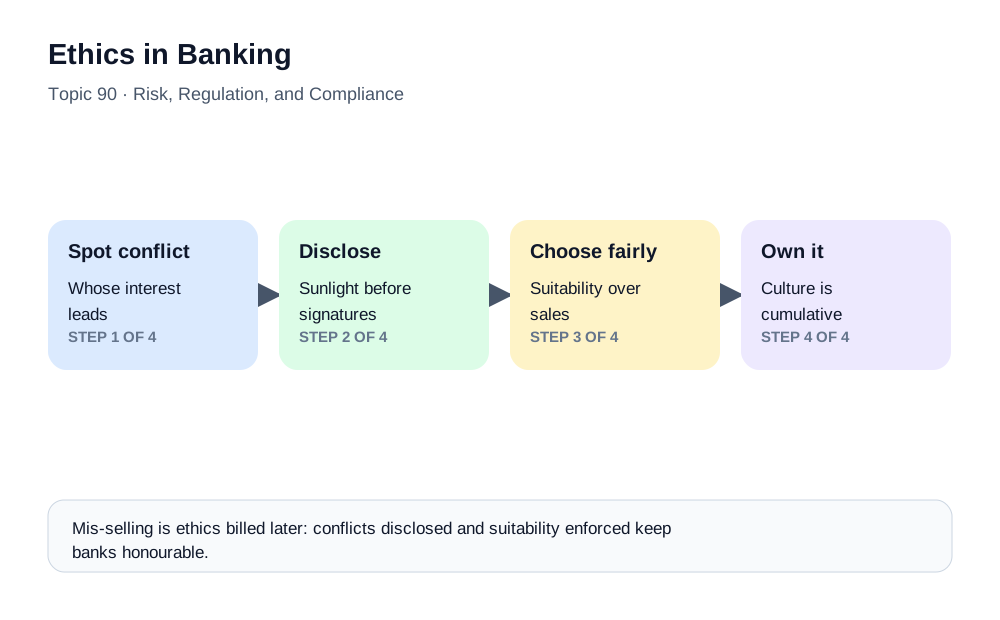
Ethics in Banking at a glance — Mis-selling, conflicts of interest, responsible lending.
Mis-Selling, Conflicts of Interest, and Responsible Lending
Major banking misconduct episodes have shown how incentives, culture, conflicts and weak challenge can damage customers, markets and trust. Benchmark manipulation, unauthorised account opening, unsuitable product sales and abusive lending or collection practices are different forms of misconduct with different legal consequences, but they share an important governance lesson: revenue objectives cannot override law, customer protection, market integrity or the bank's own standards. Ethics therefore complements compliance by guiding decisions even where a rule does not prescribe every detail.
Ethics matters especially in banking because customers and counterparties often rely on the institution's expertise, information and control over important financial services. The precise legal duty differs by product, jurisdiction and relationship: a bank is not automatically a fiduciary to every customer in every transaction. Even where no fiduciary duty exists, conduct rules, contractual duties, suitability or appropriateness requirements, fair-treatment standards, market-abuse laws and the bank's own code can constrain behaviour. Persistent misconduct can lead to customer harm, remediation, enforcement, restrictions and severe reputational damage.
Mis-selling is a broad conduct concept covering situations in which a product is sold through misleading information, inappropriate recommendation, inadequate disclosure, pressure or other practices that breach the applicable legal or regulatory standard. Suitability duties are especially relevant where the bank provides advice or distributes regulated investment or insurance products, but the exact test differs by jurisdiction and product. Sales incentives can create risk when employees are rewarded for volume without equal attention to customer need, eligibility, comprehension and post-sale outcomes.
Conflicts of interest present another major ethical challenge. Proprietary trading against advisory clients creates conflicts when banks trade for their own accounts while advising customers on the same securities. Fee incentives distort advice when bankers recommend products based on commission levels rather than customer benefit. Relationship lending to directors' companies raises questions about preferential terms extended to insiders at shareholder expense. Insider trading using non-public information obtained through banking relationships violates both legal prohibitions and fundamental fiduciary duties. Managing these conflicts requires not merely disclosure but genuine structural separation or elimination of the conflicting activities.
Banking history provides many conduct case studies, including unauthorised-account practices at Wells Fargo, manipulation of benchmark rates such as LIBOR and foreign-exchange fixes, large-scale payment-protection-insurance remediation in the United Kingdom, misconduct connected with 1MDB, and failures in mortgage origination and securitisation before the global financial crisis. The exact facts, legal findings and financial penalties differ across firms and proceedings. The educational value lies in examining how incentives, weak challenge, conflicts, poor controls and delayed escalation allowed misconduct to persist rather than reducing complex cases to one headline number.
Responsible lending means applying the consumer-protection, affordability, disclosure, fair-treatment and creditworthiness requirements that govern the relevant product and jurisdiction, while also avoiding practices the bank would regard as exploitative even where a narrow rule is silent. Not every lending regime uses the word 'suitability', and affordability tests differ across mortgages, cards, unsecured credit and business lending. The practical standard is that credit decisions, pricing, disclosures, collections and support for customers in difficulty should be evidence-based, lawful and consistent with approved conduct-risk appetite.
In India, fair-practice and customer-service expectations arise from multiple RBI directions, circulars and product-specific frameworks rather than one single code that can be summarised safely as a universal rule for every loan. Requirements can address disclosure of terms and charges, interest-rate practices, recovery conduct, grievance handling and other customer protections, with scope varying by regulated entity and product. Practitioners should check the current instruction applicable to the institution and facility instead of relying on a memorised generic checklist.
Building an ethical culture requires systematic attention to multiple organizational elements. Tone from the top means that boards and senior management must visibly prioritize ethics in their communications, decisions, and personal conduct, setting the standard for the entire organization. Codes of conduct must articulate clear ethical standards applicable to all employees, providing guidance for common situations and boundaries that cannot be crossed. Training must regularly reinforce ethical expectations and provide practical guidance for recognizing and addressing ethical dilemmas, going beyond mere compliance checkboxes to genuine skill development. Incentive alignment requires removing perverse incentives such as sales targets that reward mis-selling, replacing them with metrics that measure customer outcomes and satisfaction. Whistleblower protection ensures that employees who report wrongdoing face no retaliation, creating safe channels for raising concerns. Consequence management means that ethical violations result in real consequences, demonstrating that standards are genuine rather than aspirational. Measuring customer outcomes rather than merely sales volumes provides feedback on whether the bank is genuinely serving customer interests.
Whistleblowing and speak-up arrangements are important because employees and contractors can observe risks that formal reporting does not capture. Legal protection, listing requirements and regulatory expectations vary by jurisdiction and institution, so the bank should define confidential reporting channels, investigation ownership, escalation to the board where appropriate and safeguards against retaliation. Case studies show why concerns about sales practices, fraud or control circumvention must be assessed on their substance rather than dismissed because they challenge successful business lines or senior employees.
Ethics in banking ultimately requires recognizing that banks serve a social function beyond mere profit generation. As custodians of public deposits and providers of credit essential for economic activity, banks bear responsibilities that transcend shareholder returns. The institutions that have thrived over decades and centuries are those that have earned and maintained public trust through consistent ethical conduct. Those that have failed or been dismantled are disproportionately those that sacrificed ethics for short-term gain.
<!-- MBA-DEEP-DIVE-START -->Deep Dive: Ethics, Conduct and Decision-Making in Banking
Ethics in banking becomes practical when an employee must decide what to do with an attractive sale, a profitable exception, a vulnerable customer, confidential information or a target that can be achieved only by stretching normal standards. Rules provide boundaries, but no rulebook can anticipate every commercial situation. Ethical banking therefore combines law, conduct standards, professional judgement, culture, incentives and accountability.
The strongest ethical framework does not ask employees to choose between “doing business” and “doing the right thing.” It designs business processes so sustainable commercial performance depends on fair customer outcomes, market integrity and controlled risk-taking. When those objectives conflict, governance should make the conflict visible and provide a route for challenge.
1. Ethics and compliance are related but not identical
Compliance asks whether conduct follows applicable law, regulation and internal policy. Ethics asks whether the decision is responsible, fair and consistent with the institution's stated values even when a rule does not prescribe the exact answer.
A transaction can be technically permitted yet ethically questionable. For example, a customer might legally qualify for a complex product while clearly not understanding the risk. The bank should consider the applicable sales standard, the nature of the relationship, customer sophistication and whether the process creates foreseeable harm.
Ethics should not be used to replace legal analysis. It supplements formal obligations by guiding judgement at the boundaries.
2. The customer's interests are not identical to the bank's
Banks are commercial institutions and are entitled to earn returns. Customers also have their own objectives. Ethical banking does not require the bank to act as a fiduciary in every relationship; the legal duty depends on the product and jurisdiction.
What it does require is honesty about the bank's role. If the bank is providing advice, the customer should understand the basis of that advice. If it is selling a product, disclosures and representations should be accurate. If there is a conflict, it should be managed under the relevant legal and policy framework.
Problems arise when commercial incentives are disguised as independent advice or when customers are encouraged to believe the bank is acting in a capacity it is not actually assuming.
3. Mis-selling begins before the signature
A signed application form does not prove a sale was fair. The sales process includes targeting, marketing, explanation, recommendation, disclosure, consent and post-sale support.
Mis-selling risk can arise when staff omit material information, exaggerate returns, minimise downside, pressure customers, manipulate eligibility or select a product because it pays a higher commission. It can also arise from system design, such as default options that steer customers toward more expensive products without clear explanation.
A strong control framework therefore tests the entire customer journey rather than relying only on the final contract.
4. Suitability and appropriateness depend on the product
Investment advice, insurance distribution, derivatives and lending can be subject to different standards. Some regimes require suitability; others require appropriateness, affordability, creditworthiness, fair disclosure or best-interest duties for particular activities.
Training should therefore avoid saying “all bank products must be suitable” as if one legal test governs everything. Staff should know which standard applies to the product they sell.
Systems can support this by capturing customer objectives, risk tolerance, experience, income or other relevant attributes where required, but a questionnaire should not become a mechanical way to manufacture eligibility.
5. Vulnerability changes how service should be delivered
Customers can be vulnerable because of age, disability, illness, bereavement, financial distress, language barriers, low digital confidence or temporary life events. Vulnerability does not mean incapacity, and banks should avoid stereotyping.
The ethical and conduct challenge is to identify when a standard process creates disadvantage. A vulnerable customer may need more time, accessible communication, an authorised representative or a different channel.
Controls should protect against exploitation while respecting autonomy and privacy. Front-line staff need clear escalation paths for situations involving coercion, suspected financial abuse or doubts about authority.
6. Sales targets influence behaviour
Targets are not inherently unethical. They become dangerous when employees believe missing the target is more serious than breaching customer or control standards.
A bank should examine how incentives interact with product design and management pressure. If staff receive high variable pay for one product, cancellation or complaint rates should also be monitored. If branch managers rank employees only by sales volume, staff may learn that quality metrics are secondary.
Balanced scorecards can include customer outcomes, control adherence, risk, complaints and long-term performance, but those measures must genuinely affect reward rather than appear as decorative criteria.
7. Conduct risk can be created by product economics
Some products generate revenue structures that create inherent conflicts. High upfront commission can favour one investment over another. Penalty fees can make customer difficulty profitable. Foreign-exchange spreads may be opaque to unsophisticated customers.
Product governance should ask how the bank makes money and whether that revenue model creates incentives to act against expected customer outcomes.
The answer is not always to remove the fee. It may be to disclose it clearly, separate advice from sales, cap incentives, create approval controls or monitor customer outcomes.
8. Conflicts should be identified before they are managed
A conflict cannot be controlled if the bank does not recognise it. Common conflicts arise between the bank and customer, between two customers, between employees and the bank, and between business units.
Examples include advising competing bidders, lending to a company while holding confidential information about another, personal account dealing by employees, gifts from vendors, and recommendations influenced by commission.
Conflict registers, pre-clearance, information barriers, recusals and independent review can help, but the control should match the conflict. Some conflicts are too severe to manage and the activity should not proceed.
9. Confidential information is a trust boundary
Bank employees may see customer balances, credit problems, acquisition plans, trading intentions and personal data. Access to information does not create a right to use it.
Ethical handling requires need-to-know access, confidentiality, secure communication and restrictions on personal or commercial use. Market-sensitive information can create insider-dealing and market-abuse risks.
A relationship manager should not share a client's confidential acquisition plan with another client simply because it could create a profitable financing opportunity.
10. Market integrity is an ethical obligation
Banks participate in markets as dealers, brokers, advisers, benchmark submitters and liquidity providers. Their conduct can influence prices and confidence.
Manipulation, collusion, misuse of confidential information and misleading trading practices harm counterparties and the market itself. Controls therefore include surveillance, communications monitoring, conflicts management, benchmark governance and conduct training.
Market misconduct often develops through rationalisation: “everyone does it” or “the client expected it.” Ethical culture challenges those normalisations before they become systemic.
11. Benchmark scandals show the danger of weak challenge
Benchmark manipulation cases are useful because the misconduct often involved routine communications, informal coordination and incentive structures rather than one dramatic act.
The lesson is that seemingly small behaviours can aggregate into market harm. Supervisors and banks responded with stronger benchmark governance, surveillance and accountability.
Training should focus on why employees crossed the boundary, how warning signals were missed and what controls now prevent recurrence rather than merely memorising fine amounts.
12. Responsible lending begins with truthful economics
A loan should be presented in a way that allows the customer to understand the cost and obligations under the applicable rules. Interest, fees, repayment structure and consequences of default should not be obscured.
Creditworthiness or affordability assessment should use reliable information and appropriate assumptions. A model can support consistency, but staff should not manipulate inputs to approve a loan that clearly falls outside policy.
Ethical lending also means avoiding discrimination and applying exceptions consistently under approved authority.
13. Collections reveal the bank's conduct culture
A bank's ethical standards are tested when a customer cannot pay. Collections teams must protect the bank's legitimate right to recover while respecting law, dignity and approved conduct standards.
Harassment, threats, public humiliation or misleading statements can create serious harm and regulatory risk. Outsourced collection agencies should be governed to the same applicable standard because the customer experiences them as acting for the bank.
Good practice includes clear contact rules, vulnerability handling, dispute resolution, evidence of communication and escalation of hardship cases.
14. Forbearance should be controlled, not improvised
Supporting a borrower in temporary difficulty can be both commercially sensible and responsible. But restructuring or payment relief should follow policy so similar customers are treated consistently and credit risk is recognised accurately.
An ethical decision does not mean hiding deterioration to help the customer. The bank should provide appropriate support while maintaining truthful accounting, classification and reporting.
This is a recurring theme in banking ethics: compassion and control are not opposites.
15. Fairness does not always mean identical treatment
Treating every customer exactly the same can produce unfair outcomes when circumstances differ. A vulnerable customer may need additional support. A sophisticated institutional client can require different disclosure from a first-time retail investor.
At the same time, differential treatment can become discriminatory if decisions are based on prohibited or irrelevant characteristics.
Banks should therefore define legitimate decision factors, monitor outcomes and provide override governance where judgement is allowed.
16. Algorithmic decisions introduce new ethical questions
Credit scoring, fraud detection and personalised offers increasingly use advanced analytics or machine learning. Models can improve consistency, but they can also reproduce historical bias or use variables customers do not understand.
Responsible use requires data governance, validation, monitoring, appropriate explainability and human oversight where relevant. The bank should know what outcome the model optimises and whether that objective aligns with legal and conduct requirements.
An accurate model can still be ethically problematic if it systematically creates unfair outcomes or uses data for a purpose customers would not reasonably expect.
17. AI-generated customer communication needs controls
Generative AI can draft emails, chatbot responses and advice-like content. The ethical risk is not simply hallucination. The system can also create overconfident explanations, inconsistent treatment or disclosure gaps.
Banks should define approved use cases, human review requirements and prohibited activities. Customer-facing outputs should be tested for accuracy, tone, accessibility and escalation.
A chatbot should not invent a fee waiver, legal right or investment recommendation because it is trying to be helpful.
18. Data ethics goes beyond privacy consent
Privacy law sets legal boundaries, but ethical data use also considers proportionality and customer expectations. A customer may technically consent through lengthy terms without understanding that unrelated behavioural data will be used to influence credit or pricing.
Banks should ask whether data use is necessary, explainable and consistent with the purpose for which information was obtained. Sensitive data deserves heightened governance.
The principle is especially important as banks combine transaction, device, location and external data sources.
19. Gifts and hospitality create subtle conflicts
A vendor invitation or client gift can appear harmless but influence judgement or create the appearance of influence. Banks typically set thresholds, pre-approval requirements and prohibited categories.
Ethical decision-making considers context as well as value. A modest gift during a competitive procurement can be more problematic than a larger industry event with transparent attendance.
Employees should have a simple way to disclose and seek advice rather than rely on personal interpretation.
20. Procurement ethics protects the bank
Vendor selection can involve confidential bids, personal relationships and significant commercial value. Procurement should use clear criteria, segregation of duties, conflict declarations and documented decisions.
Steering work toward a favoured supplier can create fraud, corruption and third-party risk even if the chosen vendor is competent.
Ethical procurement also considers whether supplier practices create unacceptable labour, environmental or corruption concerns under the bank's policy and applicable law.
21. Related-party lending requires heightened discipline
Loans or services involving directors, senior executives or connected parties can create conflicts and reputational risk. Legal restrictions vary, but governance should identify connected parties and ensure appropriate independent approval.
The ethical question is whether the transaction is being offered on terms that would be justified for an unrelated customer.
Systems and ownership data must support the control; a policy cannot identify relationships the bank's data does not capture.
22. Expense and accounting choices can become ethical issues
Ethics is not limited to customer-facing conduct. Manipulating accruals, delaying loss recognition, misclassifying expenses or overriding valuation can mislead shareholders and regulators.
Finance controls, independent valuation, audit and whistleblowing help protect reporting integrity. Senior pressure is a particular risk because junior staff may believe they must follow an instruction even when it conflicts with policy.
A strong culture gives employees a route to challenge such requests safely.
23. “Tone from the top” must be visible in decisions
Leadership statements matter only if behaviour matches them. Employees watch what happens when a profitable executive breaches policy, when a major customer demands an exception or when control remediation delays a launch.
If leadership repeatedly chooses revenue and excuses the method, the real culture becomes clear.
Boards and executives should therefore examine consequence management, promotions, remuneration and exception approvals as evidence of culture.
24. Middle management shapes daily culture
Employees interact more often with team leaders than with the chief executive. A strong board message can be undermined if middle managers pressure staff to bypass controls.
Training and incentives should therefore reach managers who translate strategy into daily targets. Speak-up surveys and exit interviews can reveal local cultural pockets that enterprise averages hide.
Conduct risk often develops in one desk, branch or product before it becomes visible across the bank.
25. Whistleblowing needs trust and process
A speak-up channel should be confidential, accessible and supported by non-retaliation controls. Reports need professional triage and investigation.
Not every allegation is substantiated, and fairness applies to the person accused as well as the reporter. Evidence, independence and appropriate confidentiality matter.
Serious concerns involving senior management should have a path to board or audit-committee oversight so management cannot suppress investigation into itself.
26. Ethical investigations should avoid predetermined conclusions
Investigators should examine evidence impartially. A high-performing employee should not receive preferential treatment, and an unpopular employee should not be assumed guilty.
Case records should show allegation, evidence, interviews, findings, policy interpretation and decision. Where misconduct is confirmed, consequence management should be consistent with severity and precedent while allowing relevant circumstances to be considered.
The credibility of the ethics programme depends heavily on perceived fairness.
27. Customer complaints are conduct data
Complaints can reveal misleading sales, confusing fees, inaccessible services, discriminatory treatment or weak collections practice. A bank should analyse themes rather than close each case independently.
Repeated complaints about one product may justify script changes, employee retraining, compensation review or product redesign.
Conduct teams should also consider near misses and call-monitoring results because some harmed customers never complain.
28. Remediation should correct the customer outcome
When misconduct occurs, disciplinary action alone is insufficient. The bank should identify affected customers, quantify harm and provide remediation where required.
Population identification can be difficult. If a flawed sales script was used for three years, the bank needs data and assumptions to determine who may have been affected.
Remediation should be governed, tested and reconciled so the bank does not create a second error while fixing the first.
29. Ethics metrics need context
Boards may receive statistics on complaints, whistleblowing, disciplinary cases, product cancellations and conduct breaches. A lower number is not always better.
Few whistleblowing reports may indicate either strong culture or fear. More complaints may reflect easier reporting rather than worse service. Metrics should therefore be interpreted with trends, root causes and qualitative evidence.
The purpose is to understand behaviour, not to manufacture a green dashboard.
30. A practical sales scenario
A retired customer visits a branch asking to renew a fixed deposit. The employee has a target for an investment-linked product that pays a higher commission. The product may be legally available to the customer, but it carries market risk and a longer horizon.
Ethical handling begins by understanding the customer's objective. If the customer wants capital certainty and liquidity, the employee should not present the investment as “almost the same as a deposit.” Relevant disclosures, needs assessment and product rules must be followed.
The key control is not the signed form; it is whether the customer was given a fair and accurate basis for the decision.
31. A practical credit scenario
A relationship manager wants to approve a commercial loan before quarter-end. The borrower is strategically important, but recent financial statements show deterioration. The manager asks Credit to use an optimistic forecast so the transaction remains within policy.
The ethical issue is not whether the customer deserves support. It is whether the bank is representing risk truthfully. Credit assumptions should be evidence-based, and any exception should be approved transparently under delegated authority.
Hiding risk to achieve a target weakens both ethics and financial control.
32. A practical technology scenario
A digital bank discovers that an eligibility algorithm rejects a materially higher proportion of one customer group. The model meets aggregate accuracy targets and generates profitable growth.
A responsible response is to investigate the cause, legal relevance, data features and customer impact before expanding use. The bank may need model changes, stronger explanation, human review or revised data.
Ethics here is not separate from model risk; it shapes the question the model-risk process must answer.
33. The durable standard for ethical banking
Ethical banking is visible when employees can explain not only whether they were allowed to act, but why the action was appropriate. Customers receive accurate information. Conflicts are managed. Vulnerability is respected. Credit and collections remain fair. Markets are not manipulated. Confidential information is protected. Incentives do not reward misconduct. Employees can challenge senior people safely.
No bank will eliminate every judgement error. The objective is a system that makes responsible decisions more likely, detects harmful behaviour quickly and corrects outcomes when standards fail.
Trust is not created by an ethics statement. It is accumulated through thousands of decisions in which the bank chooses transparency, control and fair dealing even when a less responsible option would be easier or more profitable in the short term.
Ethics Continuation: Applying Conduct Principles to Difficult Banking Choices
Ethical risk appears when targets and controls collide
The easiest ethical decisions are rarely the ones that create major scandals. The difficult cases arise when a legitimate commercial target conflicts with a customer, market or control concern. A branch may be behind its sales plan, a trader may be close to a revenue target, or a product launch may be critical to strategy. In those moments employees learn which objective the institution truly values.
A mature bank designs escalation so an employee can say, “this target can be achieved only by taking a risk outside our standards,” without being treated as obstructive. Management can then change the target, change the process or formally decide within authority how to proceed.
Ethical leadership includes refusing profitable business
Some relationships or transactions are commercially attractive but create unacceptable conduct, legal, reputational or financial-crime risk. Leadership must be prepared to decline them.
This is especially difficult when revenue is concentrated in a few clients. A governance process should make the conflict explicit and prevent the relationship owner from becoming the sole judge of whether the risk is acceptable.
Turning away business can be evidence that risk appetite is real rather than a statement used only in policy documents.
Cross-selling should start with customer need
Banks can legitimately offer several products to the same customer. Cross-selling becomes problematic when product count is treated as success regardless of use or benefit.
Controls can examine whether products remain active, whether customers cancel soon after sale, whether complaints cluster around certain staff, and whether optional services were presented as mandatory.
Managers should distinguish a customer choosing a useful bundle from an employee manufacturing product penetration to meet an internal scorecard.
“Free” products still require honest explanation
A product advertised as free may have conditions, transaction fees, foreign-exchange costs or charges after a promotional period. Marketing should not create an impression that conflicts with the actual economics.
Ethical advertising considers the overall message, not only whether each statement can be defended technically. Important conditions should not be hidden in a place customers are unlikely to notice.
Pricing discretion needs boundaries
Relationship managers may have authority to negotiate interest margins or fees. Discretion can improve customer service, but it can also create unfair inconsistency or favour connected customers.
Banks should define pricing authority, required rationale and monitoring. Analytics can identify whether similar customers receive materially different outcomes without business explanation.
Where law prohibits discriminatory pricing factors, model and manual decisions should be tested for those risks.
Product complexity creates a communication obligation
Complex derivatives, structured investments or long-term insurance products can be appropriate for some customers. Complexity itself is not misconduct.
The ethical issue is whether the customer understands the material risks relevant to the applicable sales standard. Staff should not use complexity to discourage questions or make downside sound remote.
For sophisticated corporate clients, communication can be technical; for less experienced customers, explanation may need to be simpler. Clarity should match the relationship without becoming misleading.
Customer consent should be meaningful
Digital journeys can collect consent through checkboxes that users click quickly. Legal validity is important, but ethical design also asks whether the choice was understandable and voluntary.
Preselected options, confusing button design or repeated prompts can push customers toward outcomes they did not actively choose. Conduct review should therefore examine interface design as well as contract wording.
Dark patterns can create banking conduct risk
A digital interface can make cancellation difficult, hide cheaper options or create urgency that is not real. Such patterns may conflict with consumer-protection law and can undermine trust even before formal enforcement occurs.
Product, UX, Legal and Compliance teams should review key journeys for symmetry: is it reasonably as easy to decline or leave an optional service as it is to join?
Complaints should not be discouraged
An employee may believe preventing a complaint protects performance metrics. That creates the wrong incentive.
Customers should be able to complain without being pressured to withdraw or accept a quick goodwill payment in exchange for silence. Complaint data is valuable control information and should not be manipulated to keep dashboards green.
Managers should monitor unusual branches or teams with implausibly low complaint volumes alongside other evidence.
Refund decisions should be principled
Goodwill payments can resolve service failures, but inconsistent discretionary refunds can create fairness issues. Two customers with the same harm should not receive radically different outcomes simply because one is more persistent or valuable.
Policies should define authority and relevant factors while allowing judgement for exceptional circumstances. Material remediation should be governed at population level rather than negotiated case by case.
Recovery agents represent the bank's values
A bank can outsource collection activity but customers still associate the conduct with the lender. Contracts, training, monitoring and complaint analysis should therefore reinforce applicable standards.
A provider that recovers more money through intimidation may look commercially successful in narrow metrics while creating legal and reputational damage. Vendor scorecards should include conduct quality, not only recovery rate.
Employee personal trading creates conflict risk
Employees in markets, advisory or corporate roles can possess information unavailable to the public. Personal trading policies may require pre-clearance, restricted lists, holding periods or prohibitions depending on role and jurisdiction.
The ethical principle is that professional access should not be converted into private advantage. Monitoring should be proportionate and respect privacy while protecting market integrity.
Gifts from customers can create hidden pressure
A gift received after a loan approval may appear to be simple gratitude. It can nevertheless create an expectation of future favourable treatment or the appearance of corruption.
Policies should define thresholds and prohibited circumstances, but employees should also consider timing and context. When uncertain, disclosure and independent review are safer than private judgement.
Confidentiality applies inside the bank too
Employees should not browse celebrity accounts, colleague balances or sensitive corporate files out of curiosity. Technical access may exist for operational reasons, but business need determines legitimate use.
Monitoring privileged and unusual access helps enforce this boundary. Ethical culture reinforces that customer information is not internal entertainment.
Referral arrangements should be transparent
Banks may refer customers to insurance companies, investment firms, lawyers or other providers. If the bank receives commission or another benefit, the relationship should be handled under applicable disclosure and conflict rules.
Employees should not describe a paid referral as independent merely because the third party is legally separate.
Corporate clients can also be vulnerable to unfair conduct
Conduct discussions often focus on retail customers, but small businesses and even sophisticated corporates can face information asymmetry, conflicts or pressure.
A treasury client may rely on the bank's explanation of a hedge. A small company may not understand a complex fee structure. The applicable legal standard can differ, but professional integrity still requires accurate representation.
Market making requires clarity about role
A bank acting as principal may earn a spread and take the opposite side of a client trade. That is not inherently unethical if the role and applicable market rules are clear.
Problems arise when an employee presents the interaction as independent advice while using confidential client intentions to benefit the bank improperly.
Role clarity is a core conduct control in wholesale markets.
Information barriers need operational support
Policies separating advisory and trading teams are useful only if systems, physical access and employee behaviour reinforce them.
Shared drives, chat channels, temporary project teams and remote work can create leakage routes. Access rights should follow need, and exceptions should be documented.
Regular training should use realistic scenarios rather than abstract statements about “Chinese walls.”
Ethical decision frameworks help under uncertainty
When no rule gives a simple answer, employees can ask: What is the customer's reasonable expectation? Is the representation accurate? Who could be harmed? Is there a conflict? Would I be comfortable if the decision were reviewed by the board or regulator? Is the action consistent with our stated values?
These questions do not replace expert advice, but they help identify when escalation is needed.
Escalation should not punish the messenger
If raising a concern repeatedly results in lost opportunities or poor performance ratings, employees will learn to remain silent. Non-retaliation therefore needs practical monitoring.
Human Resources, Compliance and whistleblowing teams can look for adverse treatment following protected reports where the framework requires it. Legitimate performance management should remain possible, but it should be evidenced independently.
Investigations need proportional confidentiality
Ethics investigations should protect evidence and individuals, but unnecessary secrecy can fuel rumours and fear. Information should be shared on a need-to-know basis, and the subject should receive fair process under applicable policy and law.
Once a case closes, the bank may communicate general lessons without exposing confidential personal details.
Consequence management should be consistent
Similar misconduct should attract broadly consistent treatment, while allowing for intent, impact, seniority, cooperation, repetition and local employment law.
Senior revenue producers should not receive lighter consequences because they are commercially valuable. Unequal treatment is one of the fastest ways to destroy speak-up culture.
Board conduct oversight should connect multiple signals
A board may see complaints, compliance breaches, whistleblowing, employee surveys and remuneration separately. Conduct insight improves when those signals are connected.
For example, a product with rapid sales growth, high employee incentives, rising cancellations and repeated complaints deserves attention even if each metric remains within its individual threshold.
Ethical risk should enter new-product approval
Product approval should ask not only whether the product is legal and profitable but how customers could misunderstand it, what conflicts it creates, how staff are paid and what poor outcomes could arise.
Those questions are cheaper before launch than after a remediation programme.
Training should rehearse real dilemmas
Annual e-learning can communicate rules, but practical judgement improves through scenarios. A relationship manager should practise what to do when a senior client requests an inappropriate exception; a trader should examine information-sharing boundaries; a call-centre employee should practise handling a vulnerable customer.
Scenario discussion also reveals where policies are too vague to support staff.
Ethical culture should survive pressure periods
Quarter-end, market stress and major incidents increase pressure to make fast decisions. Controls sometimes weaken because teams describe them as temporary obstacles.
The bank should predefine which controls can be adjusted under contingency authority and which remain mandatory. Emergency governance helps prevent “temporary” ethical shortcuts from becoming normal practice.
Remediation should include lessons for incentives
When misconduct occurs, banks often focus on the employee who acted improperly. Root-cause analysis should also ask what target, system, management message or product design encouraged the behaviour.
If the incentive remains unchanged, replacing one employee may not prevent recurrence.
Ethical strength can be measured by challenge quality
A bank cannot score ethics with one number. It can, however, observe whether concerns are escalated, whether leaders respond constructively, whether repeated misconduct is addressed and whether customer outcomes improve after action.
The pattern of decisions is more informative than slogans.
Closing perspective: ethics is a control over how profit is earned
Banks need profit to remain sustainable. Ethics does not reject commercial success; it governs the methods used to achieve it. Revenue should come from products customers can understand under the applicable standard, credit that is assessed honestly, markets that are treated with integrity and services delivered without exploitation.
When the institution can explain not only the financial result but also the fairness and control behind that result, ethics becomes part of professional banking rather than a separate annual training topic.
Ethics Continuation II: Where Banking Culture Is Actually Tested
Ethical judgement becomes hardest when incentives and ambiguity meet
The most revealing ethical situations in a bank are rarely obvious frauds. They are cases where an employee can construct a plausible commercial reason for a decision that also creates an unfair outcome. A relationship manager may believe an expensive product is acceptable because the customer signed the form. A credit officer may justify an optimistic assumption because rejecting the facility could damage an important relationship. A trader may describe a questionable communication as ordinary market colour. In each case, the risk is not ignorance of rules but motivated reasoning: the conclusion is influenced by the outcome the decision-maker wants.
A practical defence is structured challenge. Before approving a material exception, the decision record can ask what customer or market harm could arise, which conflict exists, which assumptions favour the bank, what independent evidence supports the decision, and whether the same action would still appear acceptable if reviewed later by a regulator, customer or board committee. This does not turn ethics into a checklist; it creates a point where commercial pressure must confront objective evidence.
Speak-up mechanisms need protection, investigation and closure
A bank can publish a whistleblowing policy yet still discourage challenge if employees believe speaking up will damage their career. Effective arrangements therefore need confidentiality where possible, protection against retaliation, independent investigation routes, escalation for allegations involving senior management, and governance over case closure.
The response matters as much as the reporting channel. If employees repeatedly raise concerns and receive no indication that issues were examined, trust deteriorates. The bank may not be able to disclose confidential investigation details, but it can communicate that concerns are assessed under defined procedures and that retaliation itself is unacceptable conduct.
Management information should look for patterns without exposing reporters unnecessarily. Repeated concerns about the same sales practice, desk, branch or manager can reveal cultural risk earlier than formal customer complaints. Conversely, a business unit with no speak-up cases is not automatically healthy; silence can indicate fear, lack of awareness or a belief that escalation is pointless.
Ethical use of customer data requires purpose discipline
Banks hold unusually rich information about customers. Transaction histories can reveal health spending, travel, relationships, income, financial distress and other sensitive aspects of life. Having technical access to those data does not mean every proposed use is appropriate.
An ethical data decision asks whether the use is lawful, necessary for the stated purpose, proportionate, explainable and consistent with reasonable customer expectations. A model built to detect fraud may legitimately use behavioural signals that would be inappropriate for unrelated marketing. A relationship manager should not browse a well-known customer's account out of curiosity even if a poorly designed role technically permits access.
Access monitoring, purpose-based permissions, data minimisation and meaningful consequences support the boundary. Product and analytics teams should also consider whether combining individually ordinary datasets creates a sensitive inference that was not obvious when the separate data were collected.
Fair collections test the bank when it has the stronger position
Collections teams deal with customers who may be under severe financial pressure. The bank has legitimate rights to recover money, protect collateral and enforce contracts, but the manner of collection can create conduct harm. Threatening language, misleading statements about legal consequences, inappropriate contact frequency or pressure on vulnerable customers can turn a valid debt into an unethical service outcome.
A strong collection strategy differentiates inability to pay from unwillingness to pay where evidence permits, provides appropriate hardship or restructuring routes under policy, records customer circumstances accurately and escalates suspected vulnerability. Staff incentives should not reward cash recovery in a way that encourages harassment or discourages sustainable arrangements.
The same standard applies when collection activity is outsourced. A third-party agency acts within a service chain for which the bank still needs governance, monitoring, complaint analysis and contractual controls appropriate to the applicable framework.
AI-assisted decisions do not transfer accountability to a model
Banks increasingly use models to prioritise fraud alerts, support credit decisions, personalise offers, detect suspicious behaviour or assist customer service. Ethical accountability remains with the institution and the people governing the decision. “The model said so” is not a sufficient explanation when a customer is harmed or a control fails.
Teams should understand whether a model makes a decision, recommends one, ranks cases or merely extracts information. Material uses need validation, monitoring, data-quality controls, appropriate human oversight and routes for challenge where relevant. Bias can enter through historical data, target definitions, proxy variables, labels and deployment choices even when protected characteristics are not explicitly used.
Employees also need boundaries around generative tools. Confidential customer or bank information should not be entered into unapproved services. AI-generated explanations, code or customer communications require review proportionate to the risk because fluent output can still be inaccurate or inappropriate.
Gifts and relationships can influence judgement quietly
Conflicts are not limited to obvious bribery. Repeated meals, travel, event tickets, discounts, personal relationships or promises of future employment can create subtle obligations. The risk is especially important in procurement, credit approval, investment allocation and vendor selection where individual discretion can move substantial value.
Policies often set thresholds and approval rules, but ethical judgement should look beyond the monetary limit. A gift below a threshold may still be inappropriate during a tender or immediately before a credit decision. Ordinary low-value hospitality may be acceptable in a transparent business context. The timing, purpose, frequency and decision-maker's role matter.
Registers and pre-clearance create evidence, but culture determines whether employees disclose borderline situations. Managers should model disclosure rather than treating it as an accusation of wrongdoing.
Culture is measured through decisions, not slogans
Banks often publish values such as integrity, customer focus and accountability. Culture becomes real when those values affect promotions, remuneration, product approval, incident response and the treatment of people who challenge decisions. If a high-revenue employee repeatedly breaches controls without consequence, staff learn more from that exception than from any annual ethics training.
Boards and senior management can examine leading indicators such as override rates, complaint themes, conduct incidents, policy exceptions, employee survey results, speak-up cases, disciplinary consistency and incentive outcomes. None proves culture on its own. Together they show whether commercial success and responsible behaviour are genuinely aligned.
The durable principle is operational: make the responsible decision easier to identify, easier to challenge, properly recorded and genuinely consequential. Ethics in banking is not an abstract statement about being good. It is the design of incentives, authority, information and accountability so that trust survives ordinary commercial pressure as well as obvious misconduct.
Final Ethics Depth: Exception Governance
Exceptions reveal whether ethical standards are real
Every bank needs exceptions because no policy can anticipate every legitimate customer or market situation. The ethical risk begins when exceptions become a quiet route around the normal standard. A waiver granted repeatedly to a profitable client can gradually turn into an unofficial policy that has never received proper governance.
Material exceptions should therefore identify the rule being departed from, the business reason, the customer or market impact, the approving authority, duration and any compensating controls. Temporary exceptions should expire automatically unless renewed through a fresh decision. Management information should show where exceptions cluster by product, manager, customer segment or business unit.
This turns ethical challenge into evidence. If one team consistently needs exceptions to meet its targets, the problem may be the target, product design or local culture rather than a series of unrelated special cases. Ethical governance is strongest when repeated exceptions trigger review of the underlying system instead of normalising the workaround.
<!-- MBA-DEEP-DIVE-END -->