Trusts, Foundations and Other Legal Arrangements
Trusts, foundations and similar arrangements are normal parts of private wealth, succession planning, philanthropy, employee benefits, investment structures, securitisation and commercial asset administration. Their presence is not, by itself, evidence of financial crime. The challenge for a bank is that legal ownership, economic benefit and decision-making power may sit with different people. A customer record that captures only the person signing the account mandate can therefore be legally neat but operationally incomplete.
The useful mental model is simple: understand the arrangement, map the people and powers, verify the evidence, then apply the rule that actually governs the bank and customer relationship. Do not begin by assuming that every settlor is an owner, every protector controls the trust, every beneficiary must be treated identically, or every foundation has the same legal personality. Those conclusions depend on the governing law, the bank's jurisdiction, the applicable AML/CFT rules, the structure itself and the powers actually held or exercised.
At global-standard level, FATF Recommendation 25 and its 2024 guidance focus on transparency and beneficial ownership of legal arrangements. The guidance is addressed primarily to countries and supports public authorities and the private sector in understanding risks and obtaining adequate, accurate and up-to-date information. It does not turn one national implementation into a universal bank procedure. A bank still has to translate the relevant local law, regulation and supervisory expectation into its own CDD, screening, monitoring and escalation controls.
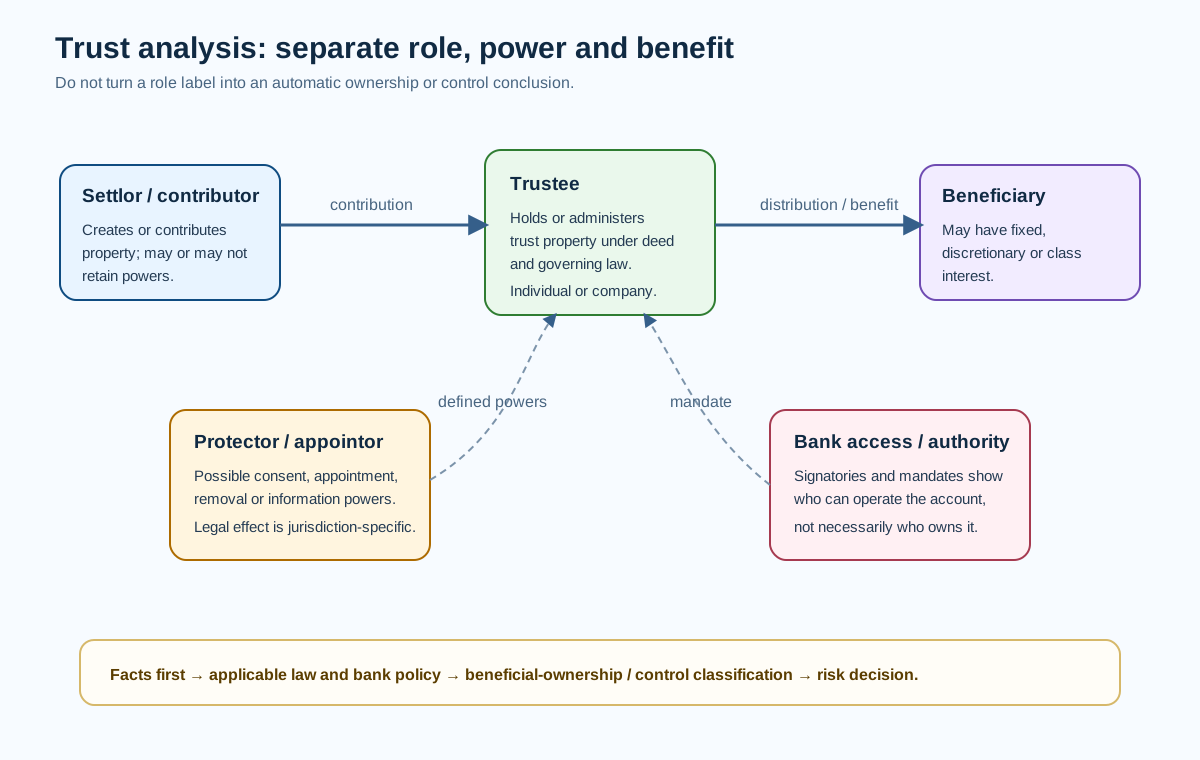
Start with the arrangement, not a checklist
The first question is what the bank is actually dealing with. An express trust is generally a legal arrangement under which a trustee holds or administers assets for beneficiaries or a purpose, subject to the governing law and trust terms. It may not be a separate legal person. A foundation, by contrast, may be a legal person under its local law and may have a founder, council or board, beneficiaries or purposes, and different supervision or registration requirements. Other vehicles can perform economically similar functions while using different terminology.
That distinction matters because the bank's customer may be the trustee, the foundation itself, a company owned by a trust, an investment vehicle whose shares are held by a trustee, or an individual receiving distributions. Each creates a different CDD perimeter. The role of a trust in the ownership chain is not the same as the identity of the bank's direct customer, and the beneficial-ownership rule for a legal entity owned by a trust may differ from the rule for identifying relevant parties to the trust itself.
A strong file therefore records at least five things separately. It identifies the legal form and governing jurisdiction. It identifies the bank's direct customer and account mandate. It maps the parties to the arrangement. It records the powers attached to those roles. Finally, it captures why the arrangement exists and how the bank expects the relationship to operate. Keeping these as separate data concepts prevents a later system from treating a role label such as protector or beneficiary as an automatic legal conclusion.
The role map: settlor, trustee, protector, beneficiary and others
The settlor is the person who establishes or contributes property to a trust, although terminology and legal consequences vary. The trustee holds or administers the trust property and normally owes duties under the governing law and trust instrument. A protector may have consent, appointment, removal, information or other powers. Beneficiaries may have fixed interests, discretionary interests or be members of a class. Some arrangements use enforcers, appointors, guardians, investment advisers or other power-holders. Foundations may use founders, councils, supervisory bodies or beneficiaries rather than trust terminology.
For financial-crime analysis, the role name is only the starting point. The next question is what the role allows the person to do. Can the person appoint or remove a trustee? Direct investments? Approve or veto distributions? Amend the purpose? Add or remove beneficiaries? Change governing law? Terminate the arrangement? Control a corporate trustee? Receive information only? These powers can be relevant to beneficial-ownership, customer-risk and sanctions analysis, but their legal effect must be classified under the applicable framework rather than inferred from common sense alone.
A bank should also distinguish a power that exists in a deed from a power that is exercised in practice. A protector may have a broad consent power but rarely use it. A settlor may have no formal reserved power yet still provide non-binding wishes that a trustee considers. A professional trustee may have extensive legal discretion while delegating portfolio management to a regulated investment manager. Those facts can alter the risk picture, but they do not automatically rewrite the legal classification. The file should preserve both the documentary position and relevant behavioural evidence.
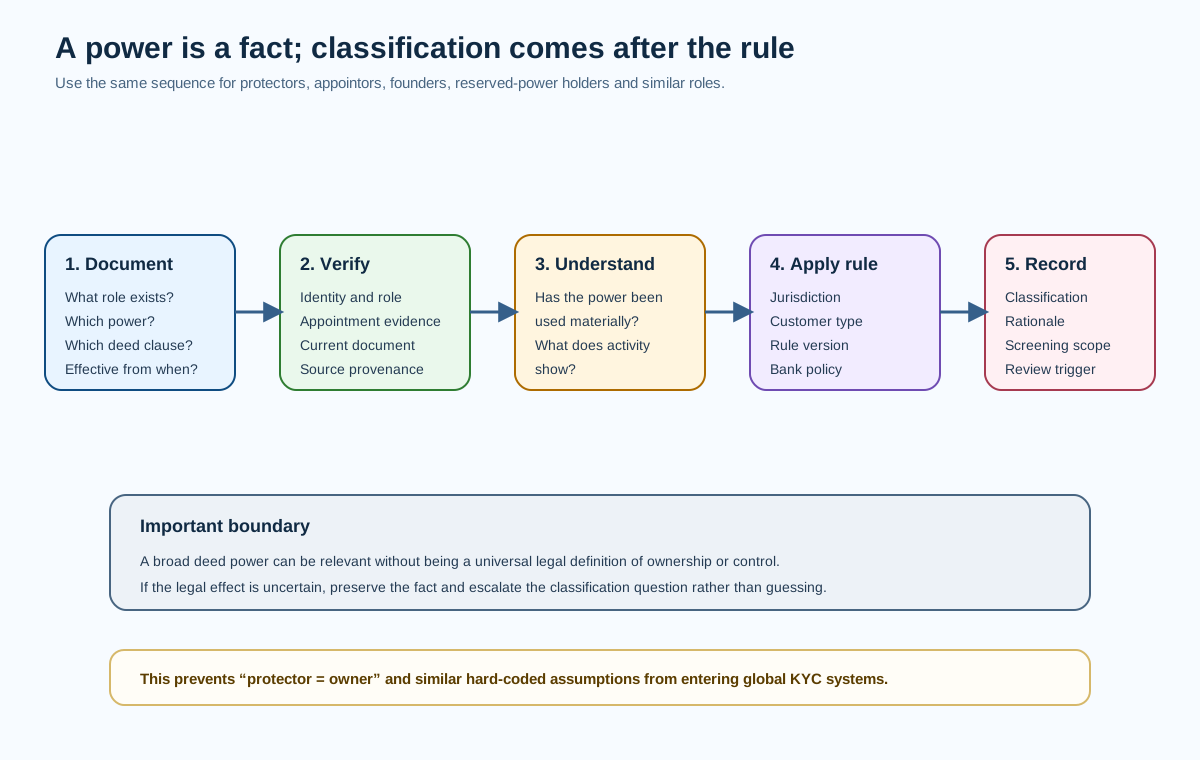
FATF Recommendation 25: what the global standard is trying to achieve
FATF strengthened Recommendation 25 in February 2023 and issued detailed guidance in March 2024. The direction of travel is clear: countries should assess the misuse risk of trusts and similar arrangements, ensure that trustees or equivalent persons obtain and hold relevant beneficial-ownership information, and enable competent authorities to access adequate, accurate and up-to-date information in a timely way. The guidance also addresses professional trustees and service providers, information sources and international cooperation.
For a bank, the practical value of the FATF framework is the transparency model. It encourages the institution to avoid a single-field view of beneficial ownership and to understand the people connected to the arrangement, the nature of their powers and the information sources supporting the conclusion. The bank can then map those facts to its own national rules. That is more reliable than importing a percentage threshold or role definition from a corporate-customer procedure that may not fit trusts at all.
FATF is also useful for understanding why the information should remain current. A trust can change trustee, protector, beneficiary class, governing law, purpose, distribution pattern or asset profile. A foundation can change council members, beneficiaries, purpose or controlling powers. Ongoing CDD therefore needs event triggers relevant to the arrangement rather than only the passage of time.
Jurisdiction matters: the same structure can create different obligations
The danger in global banking is turning a valid local rule into a universal rule. Trusts are a good example because current regimes differ materially.
In Australia, AUSTRAC's reformed AML/CTF framework took effect for existing reporting entities from 31 March 2026. Its current trust CDD guidance is explicit that the reporting entity should understand the trust and trustee or representative, identify relevant beneficial owners according to the Australian framework, and understand the control structure, rights, duties and decision-making processes. The guidance recognises roles such as individual trustees, beneficial owners of corporate trustees, settlors, appointors, guardians, protectors and, in some circumstances, beneficiaries. That is an Australian implementation and should be labelled as such.
In the European Union, Regulation (EU) 2024/1624 provides a detailed future framework for beneficial ownership of express trusts, similar legal arrangements and foundation-like legal entities. It generally applies from 10 July 2027. In September 2026 a bank should therefore treat those provisions as an important forthcoming harmonised framework, not as a rule already generally applicable throughout the EU. Implementation planning may use it, but live customer decisions still require the law currently in force for the relevant entity and booking jurisdiction.
The United States illustrates an entirely different design. FinCEN's current CDD Rule applies to legal entity customers of covered financial institutions and uses ownership and control prongs. Ordinary unincorporated trusts are not simply treated as legal entity customers under that rule. Where a trust owns 25 percent or more of a legal entity customer, FinCEN's May 2026 FAQs explain how a trustee can be relevant to the ownership prong, including cases with multiple trustees or a legal-entity trustee. This is not the same conceptual model as FATF Recommendation 25's transparency of the trust arrangement itself. A global platform therefore needs jurisdiction-specific rule sets rather than a single hard-coded trustBeneficialOwner algorithm.
The United Kingdom adds another layer through the Trust Registration Service and AML obligations for relevant firms. Registration or proof from a national register can be valuable corroborating evidence, but it does not replace understanding the deed, the customer's purpose or the bank's own CDD obligations. National registration regimes also change over time, so the source and date of registry evidence matter.
The bank's evidence stack
A sound trust or foundation file is built from multiple evidence layers. The constitutional layer includes the trust deed, foundation charter, bylaws, amendments and appointment documents. The identity layer verifies relevant individuals and legal entities under the applicable CDD standard. The authority layer proves who may act for the customer, such as trustee resolutions, mandates, powers of attorney or council decisions. The ownership-and-control layer maps the roles and powers required by law and policy. The economic layer explains source of wealth, source of funds and the nature of the assets where risk requires it. The activity layer describes expected products, geographies, counterparties, distributions and transaction patterns.
No single document answers every question. A deed can show a formal power but not whether it has been amended. A registry extract may be current on the date of issue but not show every operational detail the bank needs. A trustee certificate may help, but the bank should understand when it can rely on representations and when independent corroboration is appropriate. The standard should be risk-based and proportionate; it should not become document collection for its own sake.
Source reliability also matters. A certified deed from a regulated professional trustee carries different evidentiary weight from an unsigned structure chart sent by an introducer. A regulated registry is useful for facts within its scope, but a bank should not infer that an absence from a registry means absence of a role if the registry was never designed to capture that role. Data lineage should record where each fact came from, when it was obtained, who verified it and which version of the arrangement it describes.
Purpose and plausibility
Understanding purpose is central because the same structure can be low risk in one context and much harder to understand in another. A family trust holding long-term investments for succession planning has a different operating profile from a charitable foundation making grants, an employee-benefit trust, or a special-purpose trust used in structured finance. The bank should be able to explain why the chosen structure makes sense for the stated purpose and why the proposed banking products fit that purpose.
The purpose test is not a search for a single legitimate reason. Many customers have tax, succession, privacy, governance and commercial reasons at the same time. Tax planning is not automatically tax evasion, asset protection is not automatically creditor fraud, and a cross-border structure is not automatically suspicious. The bank's task is to identify material inconsistencies, missing explanations or information that changes the risk assessment.
For example, a trust established for long-term family succession may reasonably hold investment assets and make periodic distributions. A sudden change into high-volume third-party payment activity, payments to unrelated commercial counterparties or frequent cash-equivalent transfers could be inconsistent with that profile and justify review. The trigger is the mismatch between expected and observed activity, not the trust label itself.
Source of wealth and source of funds
Where the customer's risk profile requires enhanced due diligence, the bank may need to understand how the wealth contributed to the arrangement was created and where a particular inflow came from. Those are different questions. Source of wealth explains the broader origin of economic capacity, while source of funds explains the origin of the money or asset involved in a particular transaction or funding event.
For a trust, the settlor or other contributor may be central to the wealth story, but the analysis should follow the actual funding history. A trust created many years ago may have received property from several contributors, generated investment returns, sold businesses or inherited assets. For a foundation, funding may come from a founder, donors, investment returns or operating income. The evidence should fit the story rather than force every structure into a one-person wealth model.
A good analyst also distinguishes inability to explain from evidence of crime. Missing records for a decades-old inheritance can create uncertainty without proving illicit origin. The bank should apply its evidence standards, consider reasonable alternatives and document residual risk. Escalation should be linked to the facts and local reporting threshold, not to complexity alone.
Screening and sanctions
Trust and foundation relationships create several screening touchpoints because the direct customer, authorised persons and relevant connected parties may all fall within the bank's sanctions, PEP or other screening policy. Which roles must be screened, when, and against what lists depends on law and policy. The technical design should therefore store role and relationship data in a way that lets the screening service know why a person is connected and the effective dates of that connection.
A sanctions match is not resolved by a KYC risk rating. If applicable sanctions law requires an asset freeze, blocking action, rejection, prohibition or report, that legal decision follows the sanctions framework. Conversely, a high-risk trust structure is not automatically sanctioned. The system should keep sanctions decisioning, AML customer-risk scoring and suspicious-activity investigation related but distinct.
Ownership and control under sanctions regimes can also differ from AML beneficial-ownership concepts. A person who is relevant for KYC may not meet a particular sanctions ownership or control test, and a person not captured by a basic CDD threshold may still be relevant to sanctions analysis. Where a designated or otherwise restricted person is connected to a trust, foundation, corporate trustee or underlying company, sanctions specialists and legal counsel may need to determine the effect under the specific regime.
Monitoring distributions and other activity
A trust does not require a special transaction-monitoring universe simply because it is a trust. Monitoring should use the customer's expected activity, products and risk profile. The distinctive value of fiduciary information is that it gives context: a distribution to a known beneficiary may be expected; a large payment to an unrelated entity may need explanation; a change in trustee followed by a new payment corridor may be more significant than either event alone.
Distribution monitoring is therefore about context, not surveillance of every beneficiary's life. Where the bank has lawful visibility and the risk warrants it, it can test whether payments are consistent with known beneficiaries, purposes and governance. If funds move onward through accounts held at the same institution, that may provide additional context. But the bank should not claim a universal obligation to trace every onward transfer outside its visibility or authority.
Other useful events include trustee or council changes, changes to the beneficiary class, new protectors or appointors, change of governing law, change of registered office, material amendments to reserved powers, significant new assets, new high-risk geographies, adverse information or changes to the direct customer's mandate. Those events can trigger a scoped review without assuming that every change requires a full re-onboarding.
Foundations require their own map
A foundation can resemble a trust economically while being legally different. Depending on jurisdiction, it may be a separate legal person owning its assets. The bank should identify the founder or founders where relevant, council or board members, supervisory body members, beneficiaries or beneficiary classes, persons holding amendment or appointment powers and any other individuals who exercise ultimate control under the applicable framework.
The practical assessment asks who can appoint and remove decision-makers, who can change the purpose, who can direct investments or distributions, who can receive economic benefit and who actually manages the relationship with the bank. If a regulated foundation has external supervision, audited accounts and reliable registry information, those sources can strengthen the evidence stack. If supervision or public information is limited, the bank may need more primary documentation. That is a question of evidence sufficiency, not a presumption that the jurisdiction or vehicle is illicit.
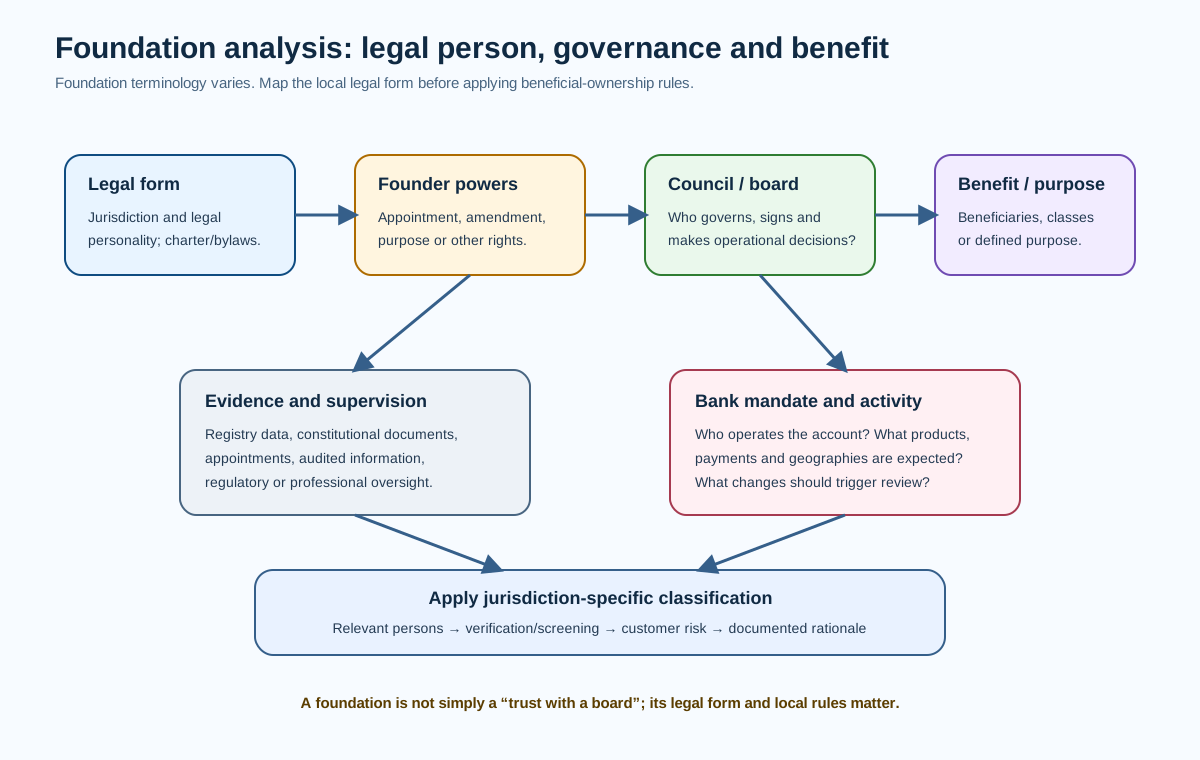
Reserved powers, protectors and changes of governing law
Some trust laws permit settlors or other persons to reserve significant powers. Some trusts use protectors with consent or appointment rights. Some documents permit a change in governing law or trustee jurisdiction. These features can be legitimate. They become important to the bank when they alter who must be identified, how control is assessed, how the arrangement's purpose is understood, or whether an event changes the customer risk profile.
The right approach is not to label a reserved-power trust or a relocation provision as an evasion device. The analyst should obtain the relevant documents, understand the legal effect with appropriate legal input, map the powers, examine any material exercise of those powers and apply the relevant policy. If the arrangement changes jurisdiction, the bank should consider whether its prior legal, regulatory and evidence assumptions still hold and whether a targeted review is needed.
This is also where system design matters. A static customer record with one current trustee and one country cannot reconstruct the relationship as it existed when a historical transaction occurred. Effective-dated party relationships, document versions and governance events allow an investigator to answer who held which role on the transaction date? rather than using today's structure as a proxy for the past.
Alert, case and investigation boundaries
A CDD concern about a trust can become an investigation, but the handoff should be evidence-based. Examples include unexplained third-party activity inconsistent with purpose, material undisclosed parties, apparently false information, unusual distributions, unexplained source of funds, links to known criminal conduct, or sanctions concerns. The investigator should receive the structure map, role/power data, relevant documents, transaction history and the reason the issue matters.
The investigation then tests hypotheses. Is the activity consistent with a legitimate amendment, succession event or asset sale? Is the apparent inconsistency caused by stale KYC data? Is an intermediary acting within an expected professional role? Is there evidence of concealment, laundering, fraud, corruption, sanctions evasion or another predicate concern? The answer should come from evidence, not from the complexity of the structure.
A suspicious transaction or activity report follows the local legal threshold and reporting process. The customer-risk decision, account restriction decision and suspicious-reporting decision may influence one another but should not be collapsed into one status. Confidentiality and tipping-off restrictions also vary, so customer communication must follow local rules.
Roles and governance inside the bank
The relationship team usually knows the customer's stated purpose and commercial context. KYC or onboarding operations collect and verify required data. Financial-crime compliance sets standards, interprets policy and handles complex escalation. Sanctions specialists resolve sanctions-specific questions. Tax, legal, wealth, trust, investment or product specialists may be needed for structures that fall outside normal frontline expertise. Investigators assess suspicious activity, while quality assurance and audit test whether the process works in practice.
The most important governance control is a clear decision-rights model. Who can approve a high-risk fiduciary relationship? Who decides that evidence is insufficient? Who can request specialist legal interpretation? Who owns remediation when the structure changes? Who is responsible for recording a new trustee, protector or council member in the source system? Ambiguity creates operational gaps even when policies are technically correct.
Management information should focus on control health rather than fashionable metrics. Useful measures include aged incomplete reviews, unresolved ownership or control questions, screening rescan failures, missing effective dates, overdue high-risk reviews, repeated data-quality defects, material event backlogs and quality-assurance findings. A low alert count is not evidence that fiduciary risk is well managed.
Data architecture and BA considerations
For a business analyst, the core data model is a graph, even if the implementation uses relational tables. Entities include the customer, trust or foundation, trustee, corporate trustee, settlor or founder, protector or appointor, beneficiary, council member, authorised signatory, underlying legal entities and bank accounts. Relationships need role type, effective-from and effective-to dates, evidence source, verification status, jurisdiction and, where appropriate, quantitative ownership information.
Do not overload one beneficialOwner Boolean. A person can be a settlor, beneficiary and authorised signatory at the same time. A corporate trustee can be the direct customer while its own beneficial owners are separate records. A future EU rule may require one classification while a US legal-entity-customer rule requires another. The architecture should store the underlying facts and let jurisdiction-aware rules derive the regulatory classification.
Requirements should also specify versioning. If a deed is amended, the old version should remain available for historical reconstruction. If a trustee changes, prior transactions should retain the old relationship context. If a screening alert was cleared based on a role that later ended, the audit trail should show which data was used at the time. Event messages between KYC, screening, monitoring and case systems should include effective dates and source identifiers to avoid false current-state assumptions.
Testing should cover ordinary and difficult cases. Test a simple family trust with one trustee and fixed beneficiaries. Test a corporate trustee. Test multiple trustees. Test a discretionary beneficiary class. Test a foundation with a council and founder appointment rights. Test a trust that owns a legal entity customer under a US scenario. Test an Australian trust onboarding under AUSTRAC's current framework. Test future-effective EU rules separately from current production rules. Test missing documents, conflicting registry data, role changes, duplicate identities, sanctions hits and historical reconstruction.
Customer impact and proportionality
Complex CDD can become harmful when every unusual structure is treated as suspicious or when customers are asked repeatedly for documents that the bank already holds. A proportionate process explains what is needed, why it is needed and which person is expected to provide it. It reuses verified information where lawful and reliable, avoids duplicate requests across products, and escalates genuine uncertainty rather than complexity itself.
Vulnerable customers and family arrangements need particular care. Capacity, bereavement, succession and family disputes can create urgent operational issues without being financial crime. The bank should follow legal mandates, safeguarding procedures and court orders where applicable rather than trying to adjudicate private-law disputes through AML controls. Financial-crime teams can identify risk indicators, but they should not substitute their judgement for a court, trustee's fiduciary duty or specialist legal advice.
De-risking also needs discipline. High risk does not mean prohibited. A bank may decide that it cannot obtain sufficient information or operate within appetite, but the decision should be governed, documented and consistent with applicable law and fair-treatment expectations. Where a restriction, exit or refusal is required, the customer communication should not reveal confidential investigative information.
Mini case: a family trust buys a company
Consider a fictional trust used for family succession. A professional corporate trustee is the bank's customer. The deed identifies a settlor, a protector with power to appoint and remove the trustee, and a discretionary class of family beneficiaries. The trust has historically held investments. It now proposes to acquire a trading company and requests a new payment facility for purchase consideration and later operating distributions.
The bank first separates facts from conclusions. It verifies the corporate trustee and its authorised representatives. It records the settlor, protector and beneficiary class required by the applicable policy. It obtains the deed and the latest amendment, confirms the protector's appointment power, and records that power without automatically declaring the protector the legal beneficial owner for every purpose. It verifies the acquisition purpose, purchase agreement, expected funding flow and source of funds. It screens relevant parties under its sanctions and PEP policy.
During review, the bank learns that the protector will also become a director of the acquired company. That is material because it links a governance role in the trust with operating control in an underlying business. The file is updated, and the customer-risk assessment considers whether the dual role creates additional corruption, conflict, sanctions or ownership/control questions. Legal and compliance specialists confirm how the applicable rules classify the person. The relationship is not rejected simply because the structure is complex.
After onboarding, monitoring sees the expected purchase payment and normal company-related distributions. Six months later a new beneficiary-owned company begins receiving repeated payments described as consulting fees, although this was not part of the expected profile. The bank opens a review. It checks whether the payments were properly authorised, whether services were provided, whether the beneficiary company was disclosed, and whether the activity changes source-of-funds, conflict or suspicious-activity considerations. The investigation outcome depends on evidence. If the payments are supported by genuine contracts and governance, the profile can be updated. If documents appear false or the money is rapidly returned to a directing party, the case may move into suspicious-activity assessment under local law.
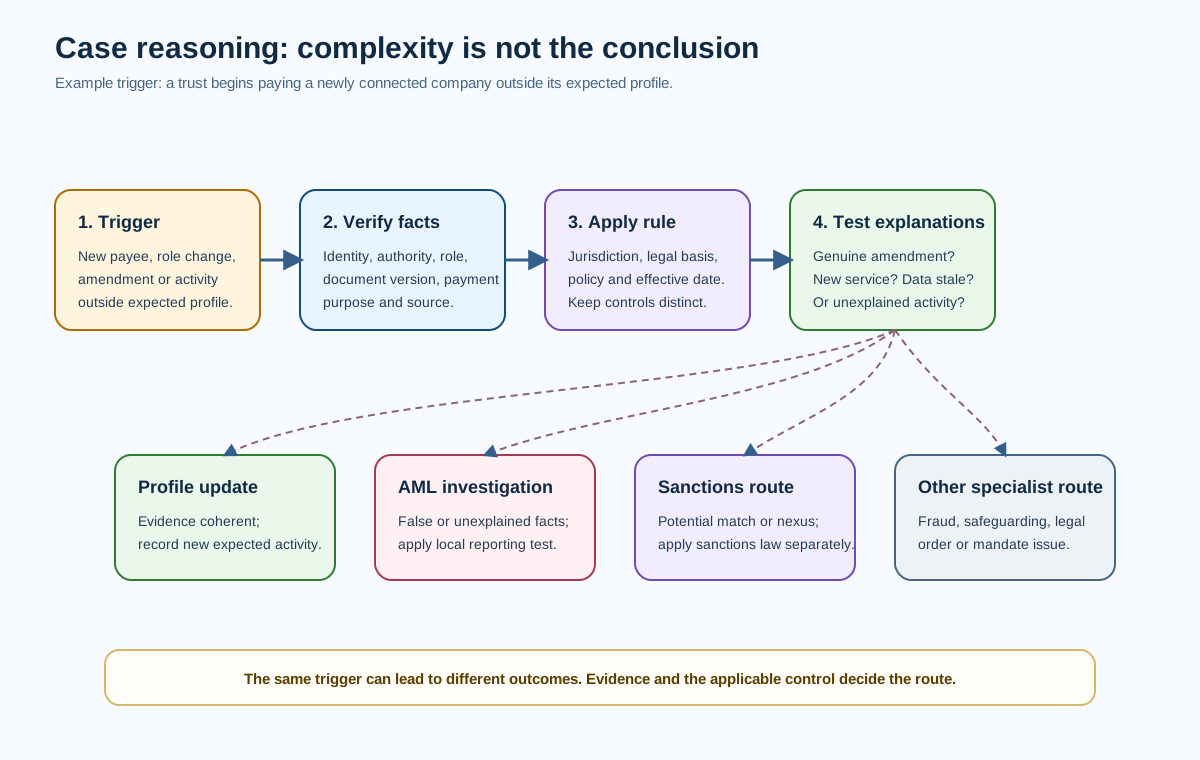
What good looks like
A strong bank does not try to become a trust-law firm. It knows enough to recognise which facts matter, captures those facts in reusable data, applies jurisdiction-specific rules, and calls specialists when the legal effect is uncertain. It distinguishes the direct customer from the arrangement, legal title from economic benefit, documented powers from exercised powers, AML beneficial ownership from sanctions ownership/control, and customer-risk decisions from suspicious-reporting decisions.
The practical test is whether another analyst can reconstruct the conclusion. They should be able to see the structure, the parties, the powers, the evidence, the applicable rule, the unresolved questions, the reason for the risk rating and the downstream controls. If the file merely says complex trust, EDD completed, the bank has collected paperwork without producing understanding.
The chapter's central message is therefore not that trusts and foundations are dangerous. It is that split ownership, benefit and control demand disciplined mapping. When that mapping is accurate, banks can support legitimate fiduciary structures while identifying the minority of cases where opacity, false information, unusual activity or prohibited connections require stronger action.
Operational deep dive: turning fiduciary documents into usable bank data
The base chapter established the governing discipline: understand the arrangement, map roles and powers, verify evidence, and then apply the legal and policy framework relevant to the bank. This deep dive focuses on the operational machinery that makes that discipline repeatable. The hardest problem is rarely obtaining a deed. It is translating a changing legal structure into reliable data that screening, monitoring, case management and customer-risk processes can use without flattening important distinctions.
Deed and constitutional-document analysis
A deed, charter or foundation instrument should be read as a source of facts, not as a shortcut to a risk conclusion. The reviewer identifies the parties, appointment and removal rights, amendment powers, consent rights, investment powers, distribution mechanics, beneficiary definitions, purpose provisions, governing law and change mechanisms. The output should be a structured role-and-power map with links back to the relevant document clauses.
This distinction matters because two trusts using the same role names can work very differently. One protector may only approve a change of trustee; another may have consent rights over distributions and investments. One settlor may have no retained powers; another may hold a defined power permitted by governing law. The bank should capture those differences rather than assign risk solely from the presence of a title.
Document versioning is essential. An amendment can change a beneficiary class, trustee, protector or reserved power without changing the trust name. A system that overwrites the old value loses the ability to reconstruct who held a role when a historic payment occurred. Requirements should therefore preserve the original document, amendment sequence, effective date, reviewer and extracted facts. Where documents conflict, the case should remain unresolved until the authoritative position is established rather than allowing the newest upload to win automatically.
From powers to classifications
The data model should separate four layers. The first is the role, such as trustee, settlor, founder, protector, beneficiary or council member. The second is the documented power, such as appointment, removal, consent, direction or amendment. The third is evidence about exercise of that power. The fourth is the classification produced by the applicable rule or policy.
That separation prevents a common architecture error: storing controller = true because a person has an appointment right. In one jurisdiction or policy the power may be sufficient for a particular classification; in another it may be one factor among several. The underlying fact should survive even if the regulatory rule changes. Rules engines can then derive current classifications without destroying the evidentiary record.
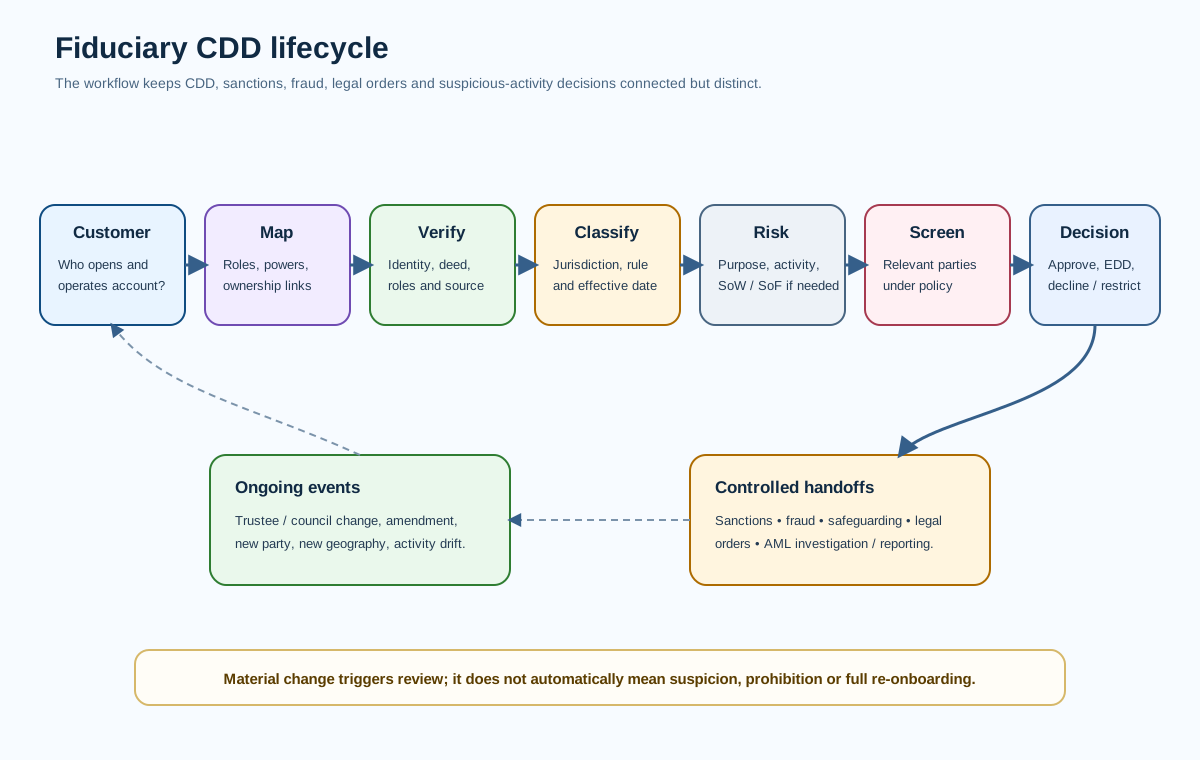
Corporate trustees and layered structures
Corporate trustees create two different questions. First, what role does the company perform in the trust? Second, who owns or controls the corporate trustee under the rules applicable to that legal entity? Those layers should not be merged. The trustee company may be a regulated professional firm with multiple clients, or it may be a private company established for one family. The risk and data requirements can differ significantly.
A layered structure may also include a trust owning shares in a holding company, which owns an operating company, while the bank's customer is the operating company. The analyst should trace the relationship sufficiently to satisfy the applicable beneficial-ownership and customer-risk requirements, but should not assume that every individual connected to the trust becomes the operating company's beneficial owner under every regime. The US CDD Rule's current treatment of a trust owning 25 percent or more of a legal entity customer illustrates why jurisdiction-specific mapping matters.
For architecture, the relationship graph should support legal-entity-to-legal-arrangement links as well as person-to-entity links. Each edge needs a type, effective dates, source and verification status. That lets downstream systems distinguish trustee of, settlor of, beneficiary of, owns shares in, director of and authorised signatory for rather than reducing all of them to a generic related party relationship.
Verification and discrepancy handling
Verification should be proportionate to risk and the reliability of the source. A bank may use deeds, government or supervisory registers, regulated professional confirmations, corporate records, identity evidence and customer representations. The correct evidence mix depends on the jurisdiction and customer type. A national register can be an important source without being a complete truth source for every role or power.
When two sources disagree, the discrepancy itself should be managed. It may be a simple timing problem, such as a newly appointed trustee not yet reflected in a register. It may be a data-entry error. It may reveal that the customer supplied incomplete information. The workflow needs a status such as unresolved discrepancy, an owner, an expected resolution date and a record of which source was considered authoritative and why. Automatically treating every discrepancy as suspicion is as weak as ignoring it.
In the United Kingdom, the Trust Registration Service is one example of a jurisdiction-specific register that can support customer due diligence for relevant trusts. The bank still needs to understand which trusts must register, which information the service contains, and the limits on access and disclosure. The lesson is architectural: registry evidence should carry source, jurisdiction, retrieval date and scope so it can be interpreted correctly later.
Behavioural evidence without overreaching
Behaviour can help the bank understand whether the stated governance matches account activity. For example, a trustee may be the authorised account operator while distributions consistently require a protector's documented consent. That fact can be relevant to the risk assessment and to the legal classification under some frameworks. But behavioural evidence is not a licence to invent legal ownership categories.
Useful evidence can include signed resolutions, account mandates, distribution approvals, investment instructions, appointment records and communication held legitimately by the bank. The purpose is to understand how the relationship operates and whether the information supplied remains reliable. The bank should avoid speculative conclusions based on family dynamics, fee levels or professional relationships unless those facts are materially relevant and supported by evidence.
The same discipline applies to letters of wishes. Such documents may be relevant to understanding a trust's purpose or intended distributions, but their legal effect varies and they are often non-binding. A bank should not state that alignment with a letter automatically proves direction. If a legal-control conclusion depends on the effect of the document, legal expertise may be required.
Event-driven review architecture
Fiduciary structures need useful change events. A trustee appointment, protector change, material deed amendment, new beneficiary class, foundation council change, change of governing law, material new contributor or significant shift in expected activity may warrant a review. The event should include the entity identifier, relationship affected, effective date, source and reason for change.
The review does not always need to be full. A trustee replacement may require identity verification, authority changes, screening and an assessment of whether the customer's risk changes. A minor administrative amendment may require only document versioning. A new high-risk jurisdiction or a newly identified controlling person may require broader reassessment. The workflow should support scoped reviews based on materiality rather than routing every event into the same expensive process.
Failure modes deserve explicit testing. What happens if the registry feed is unavailable? If a deed arrives without an effective date? If the same person is created twice with different transliterations? If a trustee change reaches KYC but not sanctions screening? If the case system closes before the source customer record is updated? These are financial-crime control failures even when the underlying policy wording is sound.
Distribution and transaction context
Transactions should be read against the purpose and known structure. A family trust may make distributions to beneficiaries, pay tax, professional fees and investment costs. A charitable foundation may pay grantees and operating expenses. A commercial purpose trust may have flows defined by transaction documents. Monitoring should detect material departures from those expected patterns and use the structure map to explain them.
When a payment is unusual, the analyst asks whether it is authorised, consistent with the arrangement's purpose, supported by evidence and compatible with the customer profile. A beneficiary receiving a large distribution is not suspicious merely because the amount is large. A payment to an unknown third party is not necessarily suspicious if it is a legitimate asset purchase. Context, evidence and comparison with the stated purpose matter more than a trust-specific threshold.
Where the bank also holds the recipient's account, it may lawfully observe onward movement that informs an investigation. Where it does not, the investigation should not pretend to know the ultimate use. Requests for information, customer contact and interbank cooperation must follow applicable law, confidentiality rules and internal procedures.
Handoffs to sanctions, fraud and investigations
A fiduciary CDD case can expose issues owned by other controls. A connected party may match a sanctions list. An elderly settlor may appear to be the victim of fraud or exploitation. A distribution may raise suspicion of laundering or corruption. A court order may affect the account. The KYC workflow should identify the issue and hand it to the correct process rather than trying to resolve all legal questions inside one case type.
This requires explicit statuses. CDD information incomplete, sanctions match under review, fraud safeguarding referral, legal order received, and AML investigation open are different conditions. Combining them into one high risk flag makes operational action unsafe because each has different confidentiality, timing and decision rights.
BA acceptance criteria
For delivery teams, useful acceptance criteria are observable. A reviewer can add multiple fiduciary roles to one person without losing role-specific powers. A corporate trustee can be linked to its own beneficial owners while remaining a separate trustee entity. All relationships are effective-dated. Amended documents preserve prior versions. Screening is triggered for the roles defined by jurisdiction and policy. A material role change produces the right downstream event. A historical transaction can reconstruct the parties and powers that existed on its date. A jurisdiction rule can change without rewriting the underlying role data.
Testing should include positive, negative and boundary cases. Positive tests prove required parties are identified and screened. Negative tests prove an irrelevant role does not become a beneficial owner merely because it appears in a document. Boundary tests cover multiple trustees, corporate trustees, discretionary beneficiary classes, foundations, changes of governing law and mixed current/future regulatory rules. The expected result should cite the rule or policy version being tested, especially where the EU framework has a future application date or where national reforms recently changed.
The operational goal is not a perfect diagram of private law. It is a defensible bank record that preserves facts, legal/policy classification and evidence separately enough that every downstream control can use them correctly.
Advanced practice: worked fiduciary cases
These cases are fictional composites designed to test reasoning, not to provide legal conclusions for real trusts or foundations. No amount, percentage or behaviour in a case should be turned into a generic red flag threshold. The correct method is to establish the facts, identify the applicable rule and policy, consider reasonable explanations, and document why the evidence supports the outcome.
Case 1: the protector with broad consent rights
A professional trustee opens an investment account for a family trust. The deed gives a protector consent rights over certain distributions and the appointment of replacement trustees. During onboarding the relationship manager describes the protector as the owner of the trust, while the KYC analyst describes the protector as only an adviser.
Both shortcuts are unsafe. The reviewer first records the actual powers and checks the governing law and the bank's policy. The protector's identity is verified because policy requires it, and screening is completed. The analyst then establishes how the consent right works in practice: it applies only to distributions above a defined category and has not been used to direct investments or operate the account. Legal advice confirms how the relevant jurisdiction treats those powers for the classification the bank must make.
The result is a documented role-and-power profile rather than a generic ownership label. The trust can proceed subject to the normal approval required by its overall risk profile. If the protector's powers later expand, or the person begins to exercise additional rights, the change becomes a review trigger. The lesson is that a protector is neither automatically irrelevant nor automatically the beneficial owner for every purpose.
Case 2: a foundation with genuine charitable activity and related-party payments
A foundation has a recognised charitable purpose and a governing council. Its account activity includes grants to established charities, staff costs and payments to a company owned by a founder's relative for property maintenance. The maintenance payments are material enough to be noticed in monitoring, but they are not automatically suspicious.
The review separates two questions. First, is the foundation operating consistently with its stated purpose? Grant records, audited accounts and programme evidence support that conclusion. Second, is the related-party supplier relationship properly explained and authorised? The bank obtains the contract, understands the service, checks governance approval and confirms that the relationship was disclosed to the foundation's auditor. The bank does not attempt to determine whether every commercial term is optimal; it assesses whether the payment creates a material financial-crime concern or changes the customer risk profile.
If the evidence had shown false invoices, undisclosed beneficial ownership or circular payments, the case could move into investigation. In this version the evidence is coherent, so the relationship remains open and the expected-activity profile is updated to reflect the supplier. The lesson is that related-party activity is a reason to understand the transaction, not proof of private benefit or laundering.
Case 3: a corporate trustee in a layered ownership chain
A corporate customer is owned by a holding company, and a trust owns a significant share of that holding company. The trustee is a regulated corporate trust company. The onboarding system tries to look through every trust role and create all discretionary beneficiaries as beneficial owners of the operating company.
The business analyst stops the rule from going live until the legal requirement is clear. In the relevant US CDD scenario, the institution applies FinCEN's legal-entity-customer rule and current FAQs, including the specific treatment of a trust that owns 25 percent or more of a legal entity customer. The trustee relationship is handled according to that rule, while the bank's broader risk-based CDD may collect additional trust information where appropriate.
A different jurisdiction might require a different outcome. The architecture therefore stores the trust relationship, trustee identity and other relevant parties as facts and lets a jurisdiction-specific rules layer derive the legal classification. The lesson is architectural as much as regulatory: facts should be portable; legal classifications should be versioned.
Case 4: a trust changes trustee and governing law
A long-standing trust customer replaces its professional trustee and changes governing law following a family relocation. The transaction profile and beneficiaries remain unchanged. A poorly designed perpetual-KYC engine treats the country change as an automatic high-risk event and blocks all outgoing payments.
The better process creates a targeted review. The bank verifies the new trustee and account authority, screens relevant parties, obtains the deed of appointment and amendment, checks whether the governing-law change alters the bank's legal or policy classification, and assesses whether the move changes geography or service risk. The event is important because prior assumptions may no longer hold, but it is not suspicious merely because the jurisdiction changed.
If the new jurisdiction or trustee prevents the bank from obtaining information required by law or policy, continuation may become impossible. If the evidence remains adequate, the relationship can continue with updated records. The lesson is to separate material change requiring review from suspicion and prohibition.
Case 5: beneficiary payments outside the expected profile
A discretionary trust normally holds investments and makes periodic family distributions. Monitoring detects recurring payments to a newly formed consultancy that is owned by one of the beneficiaries. The payments are described as advisory fees and are larger than the beneficiary's prior distributions.
The investigator does not assume that using a beneficiary company is a concealment technique. The bank checks whether the consultancy is a disclosed connected party, whether the trustee authorised the arrangement, what services are said to be provided, and whether the payments fit the trust's purpose. The beneficiary's company is screened and linked to the trust record. The bank also reviews transaction behaviour for signs that the payments are immediately returned to another connected party where that information is lawfully visible.
Two different outcomes are possible. Genuine services supported by governance records may justify updating the expected profile. False documentation or unexplained circular movement could support escalation and suspicious-activity assessment. The same transaction pattern therefore does not have one predetermined answer; the evidence determines the path.
Case 6: a settlor becomes a PEP after onboarding
A settlor was not politically exposed when the trust relationship began but later takes a prominent public function. The screening system identifies the change during rescreening. This is not proof of corruption, and it does not make every trust transaction suspicious.
The bank follows the PEP requirements applicable to its jurisdiction and policy. It confirms the identity match, updates the role record, assesses whether enhanced due diligence, senior approval, source-of-wealth refresh or increased monitoring is required, and documents the rationale. Other relevant roles and the trust's purpose remain part of the analysis.
This case tests system integration. PEP screening must retain the fact that the person is connected as settlor and perhaps another role; the customer-risk engine must receive the event; the review workflow must not automatically create a suspicious report; and transaction monitoring should receive the updated risk context only if policy requires it. The lesson is that a role change or risk attribute can propagate through controls without collapsing them into one decision.
Case 7: a vulnerable settlor and disputed instructions
An elderly settlor contacts the bank directly and says that recent trust-related instructions do not reflect their wishes. A family member separately tells the relationship manager that the settlor has lost capacity and asks the bank to ignore the complaint. The account is operated by a professional trustee.
The financial-crime team should not decide the settlor's capacity or the validity of the trust instructions itself. The bank follows its safeguarding, legal and mandate procedures, verifies who has authority to instruct the account, considers whether fraud or exploitation indicators require referral, and preserves relevant evidence. If a court order or legally effective instruction is received, operations follows that authority.
The AML question is separate: is there evidence suggesting misappropriation, fraud, laundering or another reportable concern? That decision follows the local reporting threshold. The lesson is that vulnerable-customer protection, private-law authority, fraud response and AML investigation can intersect while remaining distinct control processes.
Case 8: future EU rule versus current production rule
A global bank is preparing for Regulation (EU) 2024/1624 and configures its target data model to capture the settlor, trustee, protector, beneficiaries and other persons exercising ultimate control for express trusts. A project team accidentally enables the future rule in production in 2026 and starts rejecting records that do not meet the future data standard.
The error is not that the future data model is wrong; it is that the effective date is wrong. The EU AML Regulation generally applies from 10 July 2027. The bank may choose to collect additional information earlier where lawful and proportionate, but it should not represent a future legal requirement as already applicable. Requirements therefore need rule version, legal basis, effective date, impacted entities and transition behaviour.
This case is especially useful for testers. They should prove that the 2026 production rule remains valid until the configured change date, that advance data collection is labelled correctly, and that migration does not overwrite historical classifications. The lesson is that regulatory accuracy includes time, not only content.
Case 9: a foundation register disagrees with customer records
A foundation's registry extract lists a council member who the customer says resigned recently. The bank has a signed resignation and board resolution, but the public register has not yet updated. A naive discrepancy rule marks the customer as having supplied false information.
The reviewer records the discrepancy, validates the documents, checks the expected registry update process and decides whether the bank can rely on the current evidence. The old council member remains effective-dated in history, the new council is captured, and the discrepancy is tracked until the authoritative register catches up where required.
If the customer could not produce credible evidence or repeatedly supplied contradictory information, risk would increase. In this case the difference is temporal and explainable. The lesson is that discrepancy management needs provenance and dates, not binary match/no match logic.
Case 10: trust-owned commercial company with sanctions exposure
A trust owns shares in a commercial company that becomes connected to a newly designated person through a change in ownership elsewhere in the group. The financial-crime platform raises both a KYC event and a sanctions alert.
The bank does not wait for the next periodic KYC review to determine the sanctions action. Sanctions specialists assess the relevant ownership/control rules, legal nexus and required action under the applicable regime. In parallel, the customer-risk team updates the trust and company relationship data and considers whether the event changes the AML risk profile.
The outcomes can be different: sanctions law may require a specific immediate action, while the AML customer relationship may need a separate review or investigation. The lesson is that good fiduciary data helps sanctions analysis, but KYC governance does not replace sanctions decisioning.
Practice takeaway
Across all ten cases, the reusable sequence is the same. Capture the structure as facts. Verify the facts from appropriate sources. Apply the rule that is legally and temporally relevant. Test reasonable explanations. Route sanctions, fraud, safeguarding, legal and AML issues to their proper owners. Record the evidence and effective dates so the next reviewer can reconstruct the decision.
That approach protects both sides of the risk equation. It prevents genuine opacity or false information from hiding behind complex legal structures, and it prevents legitimate trusts and foundations from being treated as suspicious merely because their ownership and governance do not look like a conventional company.
Practice close: the fiduciary analyst's playbook
A usable trust or foundation review should finish with a decision that another person can reconstruct. The reviewer should be able to show what the arrangement is, who the relevant parties are, what powers matter, which evidence supports the facts, which legal or policy rule was applied, what remains uncertain and what downstream controls need the information.
The practical sequence
Begin by confirming the direct customer. Is the account held by an individual trustee, a corporate trustee, the foundation itself, an underlying company or another entity connected to the arrangement? This sounds basic, but many control errors begin when the trust, trustee and trust-owned company are treated as interchangeable customers.
Next, map the arrangement. Record the governing jurisdiction, legal form, settlor or founder, trustee, protector or appointor, beneficiaries or beneficiary classes, council or supervisory body, authorised signatories and any other person with material powers. Capture powers separately from roles. A person can have an appointment right without operating the account, while another person may operate the account without owning or controlling the arrangement for AML purposes.
Then verify the information using sources appropriate to the risk and jurisdiction. Constitutional documents, appointment instruments, national registers, regulated professional confirmations, identity evidence, corporate records and customer representations can all contribute. Record the source and date. If sources disagree, create a discrepancy case rather than forcing a premature conclusion.
Only after the facts are stable should the reviewer apply the relevant beneficial-ownership, CDD, sanctions and risk rules. This is where jurisdiction and effective date matter. FATF provides the global standard for transparency of legal arrangements; national implementation determines the bank's binding requirements. The US CDD legal-entity-customer rule, Australia's current trust CDD framework and the EU's future AML Regulation should not be blended into one universal rule.
What should trigger specialist help
Specialist input is appropriate when the legal effect of a power is unclear, the arrangement uses unfamiliar local-law concepts, a trust or foundation sits inside a complex ownership chain, sanctions ownership/control questions arise, governing law changes, or customer evidence conflicts with an authoritative source. Legal input is also important where the bank's action could affect private-law rights, such as a disputed trustee appointment, court order or capacity issue.
The purpose of escalation is not to make complex customers wait unnecessarily. A good operating model has a defined referral path, expected service level and clear decision owner. Specialists should answer the specific unresolved question, while the KYC team retains responsibility for the complete customer record.
Customer communication
Document requests should be precise. Instead of asking for all trust documents, explain whether the bank needs the current deed and amendments, proof of trustee appointment, beneficiary information required by policy, evidence of a contributor's source of funds, or a foundation's council records. Reusing verified information across products where lawful reduces unnecessary friction.
Where the bank cannot explain every reason for a request because of confidentiality or tipping-off restrictions, communication should still be respectful and clear about what is required and by when. Complexity is not misconduct. Customers should not be told that a trust is inherently high risk simply because it is a trust.
BA and testing checklist
A delivery team should be able to prove that the system supports multiple roles per person, multiple trustees, corporate trustees, discretionary beneficiary classes, foundations, effective-dated relationships, document versioning and jurisdiction-specific classifications. A role change should trigger only the controls required by policy. A sanctions alert should not be closed merely because a KYC review is complete. A future-dated regulation should not become an active production rule early.
Historical reconstruction is a key test. Pick a transaction from a prior date and ask the system to show the trustee, protector, relevant beneficiaries or council members, governing jurisdiction and screening state that existed then. If it can show only today's structure, investigation evidence is already degraded.
Negative testing matters just as much. A person who is mentioned in a document but holds no relevant role should not be created as a beneficial owner by keyword extraction. A registry delay supported by credible appointment evidence should not automatically create a fraud conclusion. A beneficiary distribution within the expected profile should not be escalated merely because the recipient is related to the settlor.
Common failure modes
The first failure is role-label automation: protector = controller, settlor = owner, or beneficiary = beneficial owner without considering the applicable rule. The remedy is facts-first data and a jurisdiction-aware classification layer.
The second failure is document collection without understanding. A file may contain a deed, passport and structure chart yet still fail to explain who can make decisions or why the relationship exists. The remedy is a short, evidence-linked structure narrative that connects documents to conclusions.
The third failure is stale relationship data. Trustee and council changes may reach the relationship team but not screening or monitoring. The remedy is effective-dated events with downstream acknowledgement and exception management.
The fourth failure is control collapse. AML, sanctions, fraud, safeguarding and legal-order issues become one high risk status. The remedy is separate decisions with controlled handoffs and a consolidated case view.
The fifth failure is overreach. The bank tries to decide family-law disputes, capacity questions or trust validity when those matters require legal authority or a court. The remedy is to preserve evidence, follow mandate and safeguarding procedures, and obtain the right specialist decision while financial-crime teams focus on the risks they are authorised to assess.
Final practitioner test
Before closing a review, ask six questions. Can the direct customer be distinguished from the arrangement? Can every relevant role and material power be explained? Is each important fact tied to a source and effective date? Is the regulatory classification explicitly linked to jurisdiction and rule version? Are downstream screening and monitoring controls using the updated data? Could an investigator reconstruct the structure as it existed on the date of a future alert?
If the answer to those questions is yes, the bank has moved beyond document collection into genuine customer understanding. That is the standard this chapter is designed to build.
Masterclass: governing fiduciary risk across a bank
Trust and foundation risk becomes difficult when knowledge is fragmented. Private banking may understand the family and advisers, onboarding may hold the deed, sanctions may maintain connected-party matches, payments may see unusual counterparties, and investigations may reconstruct the structure only after an alert. A mature operating model joins those views without pretending that every team needs to become expert in trust law.
A clear ownership model
The bank should have a policy owner for fiduciary CDD standards and clear business ownership for individual relationships. The policy owner defines what information is required by jurisdiction and risk, how complex structures are escalated, when specialist legal or sanctions advice is needed, and what evidence is sufficient. The relationship owner explains the commercial purpose and keeps customer contact coordinated. KYC operations maintain the verified record. Compliance challenges higher-risk or uncertain cases and owns policy interpretation within its mandate.
The model should not depend on one specialist who remembers every difficult structure. A centre of expertise can provide reusable guidance on common trust and foundation patterns, maintain jurisdictional notes, review novel arrangements and support training. Its role is to improve consistency, not to centralise every ordinary case and create an onboarding bottleneck.
Risk appetite without blanket exclusions
Risk appetite should describe the conditions the bank can and cannot support rather than banning broad legal forms. Examples of meaningful boundaries include inability to identify parties required by law, inability to verify the authority of the person operating the account, inability to understand source of wealth where enhanced due diligence requires it, prohibited sanctions exposure, or structures whose information cannot be kept sufficiently current for the bank to meet its obligations.
A trusts are high risk rule is too crude. A regulated professional trustee administering a transparent family structure may be easier to understand than a simple private company with hidden nominees. Risk factors should therefore be tied to customer, geography, product, channel, purpose, transparency, connected parties and observed behaviour.
Jurisdiction library and rule versioning
Global banks benefit from a controlled jurisdiction library that records the legal and policy treatment of common fiduciary roles. The library should state the source, legal basis, effective date, affected business lines and owner. It should clearly distinguish current law from future requirements and internal policy choices from legal obligations.
That discipline is particularly important in 2026. Australia's AML/CTF reforms are now in force. FinCEN updated its CDD FAQs in May 2026 and US beneficial-ownership reporting under the Corporate Transparency Act also changed substantially in August 2026. The EU AML Regulation creates an important future framework generally applying from July 2027. Without effective dating, a technically accurate rule can still be operationally wrong.
Data architecture as a control
The ideal data model stores the arrangement and its connected parties as a relationship graph. It preserves roles, powers, evidence sources, verification state and effective dates. Regulatory classifications are derived attributes rather than the only stored truth. This allows a rule to change without forcing the bank to recollect facts it already has.
The graph also supports downstream controls. Screening can identify which roles require rescreening. Monitoring can understand that a payee is a known beneficiary rather than an unknown third party. Investigations can reconstruct ownership and governance on the transaction date. Customer-risk models can consume changes without replacing sanctions or suspicious-activity decisioning.
Data quality needs governance. Duplicate identities, missing effective dates, unresolved source conflicts, orphaned relationships and downstream feed failures should be visible in management information. A pristine policy cannot compensate for a trust relationship that disappears between KYC and sanctions because a mapping table failed.
Quality assurance
Quality assurance should test reasoning as well as field completion. A reviewer can have every mandatory field populated and still misunderstand the structure. QA samples should ask whether the direct customer is clear, whether relevant roles and powers are supported by evidence, whether the jurisdictional rule was applied correctly, whether the purpose makes sense, whether source-of-wealth or source-of-funds work is proportionate, and whether downstream controls received the right data.
Thematic reviews are useful where the same issue appears across files. If multiple teams classify protectors differently, that may reveal a policy or training problem. If registry discrepancies remain unresolved for long periods, the issue may be workflow design rather than analyst performance. If corporate trustee relationships lose their own ownership data, the root cause may be a data-model limitation.
Regulatory engagement and evidence
When supervisors review fiduciary CDD, the bank should be able to show more than a policy. It should demonstrate how the rule is translated into data fields, workflows, approvals, event triggers and quality assurance. It should also be able to show how national implementations differ and how those differences are controlled in a global platform.
Evidence should be reproducible. For a sampled customer, the bank should reconstruct the structure, identify the sources used, show the rule version active at the time, explain the risk decision and demonstrate that relevant screening or monitoring events were sent. This is stronger than presenting a static screenshot of today's customer profile.
Change governance
Regulatory change affecting trusts or foundations should follow a controlled path: identify the source, assess business and data impact, determine effective date, update policy and rules, migrate or remediate affected records where required, test positive and negative scenarios, deploy, and monitor exceptions. The change assessment should state whether it alters who must be identified, what information is collected, when it is refreshed, which registers are used, or which downstream systems need the data.
A good example is a future beneficial-ownership rule. Delivery should not simply add new mandatory fields. It should identify which customer populations are affected, how existing structures will be remediated, whether the data already exists elsewhere, how historical records are preserved and how the rule will be activated on the correct date.
The masterclass conclusion
Fiduciary risk is not controlled by collecting more documents. It is controlled by preserving the relationship between legal form, people, powers, evidence, jurisdiction and observed activity. Governance then ensures that those facts reach the right control at the right time.
The mature bank can therefore say three things with confidence. It understands the structure well enough to meet its obligations. It knows which parts of the conclusion are legal requirements, which are policy choices and which are risk judgements. And it can reconstruct that reasoning later for an investigator, auditor or supervisor. That is a much stronger objective than simply marking a trust or foundation file complete.
Knowledge checks with explained answers
1. A trust has a settlor, two trustees, a protector and a discretionary beneficiary class. Who is the beneficial owner?
There is no safe global answer from the role list alone. The bank must apply the beneficial-ownership and CDD rules relevant to its jurisdiction and customer type. FATF Recommendation 25 provides a global transparency framework for legal arrangements, while national implementations determine the bank's binding obligations. The reviewer should capture all relevant roles and powers as facts, then derive the required classification under the applicable rule.
2. Does a protector with the power to appoint a trustee automatically control the trust?
Not automatically for every legal or regulatory purpose. The appointment power is a material fact and may be relevant under the applicable framework. The bank should record the power, understand any evidence of its exercise, and obtain legal or policy interpretation where necessary. A role or power should not be converted into a universal ownership conclusion by system logic alone.
3. Why is a corporate trustee different from the trust itself?
The corporate trustee is a legal entity performing the trustee role. It can have its own owners, controllers, directors and regulatory status. The trust is the legal arrangement governed by its deed and applicable trust law. A bank may need to understand both layers: the role of the corporate trustee in the trust and the ownership or control of the corporate trustee under the rules applicable to that company.
4. Is a trust registry extract sufficient CDD evidence?
It can be valuable evidence, but usually it is one source within a wider evidence stack. The bank still needs to understand what the registry covers, how current it is, whether the trust falls within its scope and what additional information is required by the bank's own legal and policy obligations. Deeds, amendments, appointment records and identity evidence may remain necessary.
5. What should happen if the deed and registry disagree about the trustee?
The discrepancy should be investigated rather than treated automatically as fraud or ignored. The difference may result from a recent appointment, filing delay, error or incomplete customer information. Record the sources and effective dates, obtain supporting appointment or resignation evidence, decide which source is authoritative for the required conclusion, and track any unresolved discrepancy to closure.
6. Why should powers and classifications be separate data fields?
Because the legal meaning of a power can differ by jurisdiction and framework. Can appoint trustee is a factual attribute. Beneficial owner, controller, sanctions owner/control nexus and high-risk customer are classifications or decisions. Preserving the underlying facts lets the bank update rules later without losing the evidence from which the decision was derived.
7. A beneficiary receives a large distribution. Is that a red flag?
Not by itself. A distribution may be entirely consistent with the trust purpose and beneficiary rights. The useful questions are whether the payment is authorised, expected, supported by evidence and consistent with the customer profile. If the amount, recipient or purpose is materially inconsistent with what the bank understands, the transaction may warrant review.
8. How should a change of governing law be treated?
As a potentially material event requiring a scoped assessment. The bank should understand why the change occurred, verify any new trustee or authority, and determine whether its prior legal, regulatory and evidence assumptions still apply. A jurisdiction change is not automatically suspicious and should not be coded as such.
9. Why can the US CDD treatment of a trust-owned company not simply be copied into a global trust procedure?
FinCEN's CDD Rule is a US rule for covered financial institutions and legal entity customers. Its ownership and control prongs, including the current FAQ treatment of a trust that owns 25 percent or more of a legal entity customer, answer a specific US regulatory question. Other jurisdictions may identify trust parties differently. A global system should store the facts and apply jurisdiction-specific rules.
10. What is the importance of 10 July 2027 for EU trust data?
Regulation (EU) 2024/1624 generally applies from 10 July 2027. Its detailed provisions on beneficial ownership of express trusts, similar arrangements and foundation-like entities are therefore highly relevant to implementation planning in 2026, but they should not be represented as already generally applicable law in September 2026. Rule effective dates must be part of requirements and testing.
11. How should sanctions and AML risk decisions interact?
They should share reliable party and relationship data but remain distinct decisions. A sanctions match may require immediate action under the applicable sanctions regime regardless of the customer's AML risk rating. A complex or high-risk trust is not automatically sanctioned. AML investigation, sanctions decisioning and customer-risk review should have controlled handoffs rather than a single combined status.
12. What makes a fiduciary review auditable?
The file should show the direct customer, arrangement, parties, material powers, evidence sources, effective dates, applicable rule or policy version, unresolved issues, decision rationale and downstream actions. Another reviewer should be able to reconstruct the conclusion without relying on undocumented knowledge held by the original analyst.
Glossary of working terms
Legal arrangement: a relationship or structure recognised under law that may not itself be a separate legal person. An express trust is a common example. Exact legal characterisation depends on governing law.
Settlor: a person who establishes or contributes property to a trust. The consequences of that role and any retained powers depend on the trust terms, governing law and applicable AML/CFT framework.
Trustee: the person or entity that holds or administers trust property subject to the governing law and trust instrument. A trustee can be an individual or a corporate entity.
Protector: a role used in some trusts with powers defined by the deed, such as consent, appointment, removal or information rights. The role has no single universal AML classification.
Beneficiary: a person or class that may benefit from the trust or foundation. Interests may be fixed, discretionary or otherwise defined by the governing instrument and law.
Founder: a person associated with establishing a foundation. Founder rights and ongoing powers vary significantly by jurisdiction and foundation type.
Council or board: the governing body of many foundations. Its legal powers, appointment mechanics and supervision depend on the local framework and constitutional documents.
Beneficial ownership: a regulatory concept used to identify natural persons who ultimately own, control or benefit from a customer or arrangement according to the relevant framework. Definitions and tests differ across jurisdictions and entity types.
Role-and-power map: a bank record separating a person's formal role from the specific powers attached to that role and the evidence supporting them.
Effective dating: recording when a relationship, role, power or document version became valid and, where applicable, when it ended. It is essential for historical reconstruction.
Discrepancy: a material difference between customer information and another source such as a register or document. A discrepancy needs resolution; it is not automatically evidence of deception.
Source of wealth: evidence and explanation of how a person or structure accumulated broader economic wealth.
Source of funds: evidence and explanation of the origin of money or assets used in a particular transaction or funding event.
Event-driven review: a review triggered by a material change, such as a trustee replacement, significant deed amendment, new connected party or change in expected activity. Its scope should reflect the event and risk.
Rule version: the legal or policy logic active for a specific jurisdiction and effective period. Storing rule version prevents future requirements from being applied early or historical decisions from being judged against today's rule accidentally.
References and further reading
The chapter uses FATF as the global standard-setting baseline and uses Australia, the United States, the United Kingdom and the European Union as jurisdiction-specific examples. These sources should not be blended into one universal rule. Trust and foundation law also depends on the governing jurisdiction, so live legal conclusions may require specialist legal advice.
Global standards
- Financial Action Task Force (FATF) — Guidance on Beneficial Ownership and Transparency of Legal Arrangements, published 11 March 2024. This is the primary global guidance for the Recommendation 25 transparency framework for trusts and similar legal arrangements: https://www.fatf-gafi.org/en/publications/Fatfrecommendations/Guidance-Beneficial-Ownership-Transparency-Legal-Arrangements.html
- Financial Action Task Force (FATF) — The FATF Recommendations, current consolidated recommendations updated through June 2026. Recommendation 10 provides the CDD baseline and Recommendation 25 addresses transparency and beneficial ownership of legal arrangements: https://www.fatf-gafi.org/en/publications/Fatfrecommendations/Fatf-recommendations.html
Australia
- AUSTRAC — Initial customer due diligence for a trust. Current guidance under Australia's reformed AML/CTF framework explains trust, trustee and beneficial-owner information, control structure and relevant role-holder analysis: https://www.austrac.gov.au/industry-and-business/obligations-and-guidance/your-amlctf-program/customer-due-diligence/initial-customer-due-diligence/initial-customer-due-diligence-guides-customer-type/initial-cdd-trust
- AUSTRAC — Beneficial owner fact sheet, updated 26 March 2026, for the current Australian beneficial-ownership framework: https://www.austrac.gov.au/business/core-guidance/customer-identification-and-verification/beneficial-owners
United States
- Financial Crimes Enforcement Network (FinCEN) — Customer Due Diligence Rule FAQs, consolidated and updated 6 May 2026. The FAQs explain the US legal-entity-customer rule, the 2026 account-opening exceptive relief and specific treatment where a trust owns 25 percent or more of a legal entity customer: https://www.fincen.gov/resources/statutes-and-regulations/cdd-rule-faqs
- FinCEN — Customer Due Diligence Final Rule resources. These materials describe the US CDD Rule and its risk-based ongoing-customer-due-diligence framework: https://www.fincen.gov/resources/statutes-and-regulations/cdd-final-rule
United Kingdom
- HM Revenue & Customs — Check if you need to register a trust, published 30 June 2026 and updated 13 July 2026. This is a UK-specific Trust Registration Service source and should not be treated as a global trust-registration rule: https://www.gov.uk/guidance/check-if-you-need-to-register-a-trust
- HM Revenue & Customs — Manage your trust's details. This explains how trustees maintain Trust Registration Service information and obtain proof of registration for UK purposes: https://www.gov.uk/guidance/manage-your-trusts-registration-service
- HM Revenue & Customs — Send a data request to HMRC to get information about a trust, updated 9 April 2026. This describes the limited circumstances and process for access to certain UK trust information: https://www.gov.uk/guidance/ask-hmrc-for-information-about-a-trust
European Union
- EUR-Lex — Regulation (EU) 2024/1624 on the prevention of the use of the financial system for the purposes of money laundering or terrorist financing. The Regulation contains the future EU framework for beneficial ownership of express trusts, similar legal arrangements and foundation-like entities. It generally applies from 10 July 2027, so the chapter treats it as forthcoming rather than already generally applicable in September 2026: https://eur-lex.europa.eu/legal-content/EN/TXT/?uri=CELEX:32024R1624
Private international law background
- Hague Conference on Private International Law — Convention of 1 July 1985 on the Law Applicable to Trusts and on their Recognition. This provides useful background on recognition and applicable law but is not an AML/CFT customer-due-diligence standard: https://www.hcch.net/en/instruments/conventions/full-text/?cid=59
Review note — 18 September 2026: regulatory requirements, trust registration, beneficial-ownership tests and the legal effect of fiduciary powers differ by jurisdiction and can change. Current official sources and the law applicable to the relevant customer, bank entity and arrangement should be checked before applying the educational examples to a live case.